
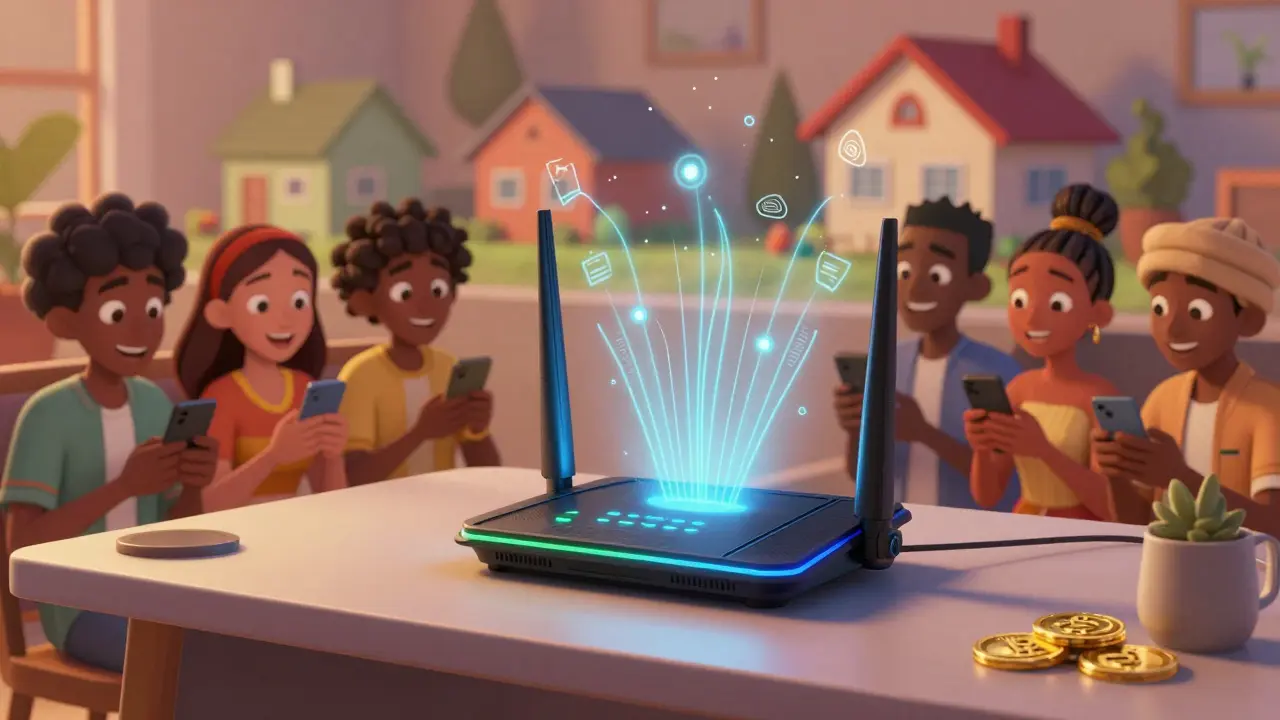
You might have seen headlines about the Wicrypt (WNT) NFT & Device Drop and wondered if you missed out on free tokens or cheap hardware. The short answer is complicated because the project’s history doesn’t match the hype. Wicrypt promised a decentralized internet where you earn crypto for sharing Wi-Fi, but the reality of their distribution events was far less straightforward than typical airdrops.
If you are looking to claim WNT tokens today, you need to know that the window for easy participation closed years ago. This guide breaks down what the Wicrypt device drop actually was, why it wasn't a standard airdrop, and where the project stands in 2026.
What Is Wicrypt (WNT)?
To understand the airdrop confusion, you first need to understand the project itself. Wicrypt Network is a decentralized wireless infrastructure project that allows users to share internet bandwidth through physical devices while earning cryptocurrency rewards. Think of it as a peer-to-peer internet service provider powered by blockchain technology.
The native token, WNT, serves three main purposes:
- Payments: Users pay for internet access using WNT.
- Rewards: Node operators earn WNT for providing bandwidth.
- Governance: Token holders can vote on network upgrades.
Founded by Olayinka Okereke (CEO) and Adeyinka Adebayo (CTO), both former Microsoft and Google engineers, Wicrypt aimed to solve expensive internet costs in emerging markets like Nigeria. Unlike pure software projects, Wicrypt required physical hardware-specialized routers-to function.
The "Device Drop" Was Not a Free Airdrop
Here is the biggest misconception: The "Device Drop" was not a free giveaway. Many new crypto users assume "drop" means "free." In Wicrypt’s case, it meant a limited-time opportunity to purchase hardware at a discounted rate before public sale.
| Event Type | Cost to User | Requirement | Outcome |
|---|---|---|---|
| TGE (Token Generation Event) | $0 - $1,500+ | Early investment or IDO participation | Received WNT tokens based on contribution |
| Device Drop | $99 USD | Purchase of physical router hardware | Received a Wi-Fi hotspot device + small token bonus |
| NFT Campaigns | Variable | Minting specific community NFTs | Access to exclusive channels or future discounts |
The core model relied on buying a Wicrypt Router for around $99. You would plug this device into your existing internet connection. The router then shared unused bandwidth with neighbors. In return, the protocol rewarded you with WNT tokens. It was a buy-to-earn model, not a play-to-earn or click-to-earn scheme.
How Tokens Were Actually Distributed
Wicrypt’s token distribution followed a structured vesting schedule rather than a single massive airdrop. Understanding this timeline explains why many people feel they were "missed out":
- Private Funding (August 2021): The team raised $1.5 million from strategic investors. These tokens were locked for 36 months to prevent immediate dumping.
- IDO on OccamRazer (October 2021): Wicrypt launched on Cardano’s OccamRazer launchpad. Participants bought tokens directly. Some portions unlocked linearly over two months.
- TGE Conclusion (December 5, 2021): The official Token Generation Event ended. This was the last chance for early retail investors to get in at pre-market prices.
If you did not participate in the private round or the IDO, you had to wait for exchange listings. By the time WNT hit major exchanges, the price had already moved significantly from the initial distribution price.

The Hardware Reality Check
Decentralized wireless networks live or die by hardware adoption. Here is how Wicrypt compared to its competitors during its active phase:
| Project | Technology | Hardware Cost | Peak Hotspots/Devices |
|---|---|---|---|
| Helium (HNT) | LoRaWAN / 5G | $350 - $400 | 500,000+ (Q4 2021) |
| Wicrypt (WNT) | Wi-Fi Sharing | $99 | ~1,200 (Dec 2021 estimate) |
| RightMesh (RMESH) | Mesh Networking | Free/Low Cost | Undisclosed |
While Helium focused on IoT sensors and later 5G, Wicrypt targeted everyday Wi-Fi usage. The lower entry price ($99 vs $350+) was attractive, but the total number of deployed devices remained low. Reports suggest only about 1,200 devices were active by late 2021. Without enough nodes, the network effect stalls. If there aren’t enough people sharing bandwidth, there isn’t enough demand to make earnings worthwhile for those who do share.
User feedback from that period highlighted real-world issues:
- Earnings Variability: One user in Lagos reported earning ~$3.50/day, while others saw drops of 40% due to device reboots.
- Shipping Delays: Hardware orders took 6-8 weeks to arrive, frustrating early adopters.
- Geographic Limits: The network primarily worked in Nigeria and select African regions. Users in Europe or North America often found no usable bandwidth nearby.
Current Status: Is Wicrypt Still Active?
This is the most critical section for anyone searching for WNT today. As of 2026, Wicrypt is effectively inactive.
Several red flags appeared starting in 2022:
- Development Stagnation: The project’s GitHub repository shows minimal activity after March 2022. The last significant commit was dated March 14, 2022.
- Exchange Delistings: WNT is no longer traded on major centralized exchanges. CoinGecko lists it among delisted tokens, with last recorded DEX activity in Q2 2022.
- Community Decline: The primary Telegram group shrank from 8,500 members in 2021 to roughly 1,200 active members by late 2025.
Industry analysts, including Messari, noted in 2023 that over 70% of hardware-dependent blockchain projects fail to survive beyond 18 months. Wicrypt fits this pattern. While the idea of decentralized Wi-Fi remains valid-especially in areas with poor infrastructure-the execution faced insurmountable scaling challenges.
If you hold old WNT tokens, they likely have little to no liquidity. If you are considering buying Wicrypt hardware now, do not. There is no guarantee the network will ever resume operations, and used hardware has no resale value outside of niche collector circles.

Lessons for Future Airdrop Hunters
Wicrypt’s story offers valuable lessons for navigating the crypto space:
- Check Vesting Schedules: Long vesting periods (like Wicrypt’s 36-month lock) mean early investors can’t sell immediately, but they also signal long-term commitment-or potential abandonment if development stops.
- Verify Hardware Costs: Any project requiring upfront hardware investment carries higher risk. Calculate the break-even point carefully. For Wicrypt, earning back a $99 device took months of consistent uptime.
- Monitor GitHub Activity: Code commits are a leading indicator of project health. If development stops, the token usually follows.
- Beware of Geographic Bias: Decentralized networks are local. A project thriving in Nigeria may be useless in Canada. Always check network coverage maps before investing.
Frequently Asked Questions
Can I still claim Wicrypt (WNT) airdrop tokens?
No. The primary distribution events (TGE and IDO) concluded in late 2021. There have been no verified airdrops since then. Any website claiming to offer free WNT tokens now is likely a scam.
Is the Wicrypt device drop still available?
No. The device drop program ended years ago. The official store is no longer operational, and the network is inactive. Purchasing second-hand Wicrypt routers is not recommended as they cannot connect to a functioning network.
Where can I buy or sell WNT tokens?
WNT is delisted from major exchanges. Liquidity is extremely low or non-existent. Attempting to trade on obscure decentralized exchanges carries high risk of slippage or fraud.
Why did Wicrypt fail?
Wicrypt struggled with hardware adoption rates, geographic limitations, and development stagnation. The combination of high operational costs for physical devices and low network density made it unsustainable compared to competitors like Helium.
Are there similar active projects to Wicrypt?
Yes. Helium (now part of T-Mobile partnerships) remains the largest decentralized wireless network. Other projects like Boba Network or various DePIN (Decentralized Physical Infrastructure Networks) initiatives continue to explore similar models with improved sustainability.
Next Steps for Crypto Investors
If you are interested in decentralized infrastructure, focus on projects with transparent development records and active communities. Look for:
- Regular GitHub updates.
- Clear revenue models beyond token speculation.
- Real-world partnerships with telecom providers.
Avoid any project promising "free money" through hardware drops without clear utility. The Wicrypt experience shows that physical assets in crypto require significant maintenance, capital, and network effects to succeed.
mark valmart
June 4, 2026 AT 04:00man this hits close to home honestly i remember back in 2021 when everyone was talking about these decentralized wifi things and how they were gonna change the world for people in developing countries it felt so promising at the time but looking back now it is pretty clear that the execution just wasn't there and it sucks because a lot of regular folks lost money thinking they were onto something big
Crystal Davis
June 5, 2026 AT 04:51the entire premise of hardware-dependent crypto projects is fundamentally flawed from a game theory perspective because the incentive structure collapses once the token price drops below the operational cost of electricity and depreciation which Wicrypt failed to account for in their whitepaper making their failure inevitable rather than accidental
Barclay Chantel
June 5, 2026 AT 19:08it is truly pathetic how many people fall for these schemes every single cycle without doing any due diligence whatsoever one would think after Helium's massive crash that people would learn but no we are right back here watching another project die because the founders had no idea what they were building beyond a shiny slide deck
Diana Morris
June 7, 2026 AT 13:54stop buying shitcoins with hardware attached its always a rug pull waiting to happen wake up people
Joshua Alcover
June 8, 2026 AT 22:45the ontological framework of decentralized physical infrastructure networks requires a rigorous examination of the underlying thermodynamic constraints imposed by the second law of thermodynamics upon the energy expenditure required for data transmission via radio frequency waves which inherently limits the scalability of such models in high-density urban environments where spectral congestion becomes a prohibitive factor for viable economic returns on investment for node operators
Dianne Wright
June 10, 2026 AT 08:09i feel like you guys are missing the bigger picture here its not just about the tech its about the community spirit that was built around it even if the project died the memories of those early days in lagos and nairobi were real and meaningful to the people who believed in it and i hate seeing people tear down the dreamers just because the market turned sour
Hadleigh Edwards
June 11, 2026 AT 10:59while it is certainly disheartening to see a project with such noble intentions fail to meet its potential targets and deliver on its promises to the community that supported it during its nascent stages we must remember that innovation often requires sacrifice and learning from past mistakes is crucial for future success in the rapidly evolving landscape of blockchain technology and decentralized networks which will undoubtedly continue to grow and improve despite these setbacks
Debbie Lewis
June 12, 2026 AT 18:58just observing from the sidelines mostly but yeah the shipping delays alone should have been a huge red flag for anyone paying attention logistics are hard especially when you are trying to ship specialized hardware to multiple continents simultaneously and then adding crypto volatility into the mix makes it a recipe for disaster
Sam Dashti
June 14, 2026 AT 16:18i wonder if anyone actually tried to resell the routers on ebay or local markets i bet there are some sitting in closets gathering dust right now which is kind of tragic considering they were supposed to be the keys to financial freedom for so many people who bought into the hype
Eric Grosso
June 16, 2026 AT 03:24thats crazy i heard abt this stuff last year but never looked into it much guess i dodged a bullet tbh the whole device drop thing sounded too good to be true even back then
Bill Gunn
June 16, 2026 AT 15:27hey folks just wanted to add that if you are still holding onto any old WNT tokens dont throw them away yet sometimes dead projects get revived or merged into larger ecosystems though its unlikely in this case its always worth checking the github repos occasionally just in case 🤷♂️📉
trisya hazriyana
June 16, 2026 AT 19:56synergistic failures occur when the technological infrastructure does not align with the economic incentives driving user adoption leading to a cascade of negative feedback loops that ultimately result in systemic collapse of the network value proposition
Miss Masquer
June 17, 2026 AT 03:28as someone who has lived in both north america and parts of africa i can tell you that the internet accessibility issue is very real and while wicrypt may have failed the need for affordable connectivity remains urgent and i hope that future projects take more time to understand the cultural and logistical nuances of deploying hardware in emerging markets rather than just throwing money at a problem without a sustainable plan
Edith Mair
June 17, 2026 AT 04:36can someone clarify if the team behind wicrypt started a new project or if they just disappeared completely because i have seen similar names popping up recently and it feels like a rebranding attempt to scam people again
Christina Pearce
June 17, 2026 AT 12:45i appreciate the detailed breakdown here it is really helpful to see the timeline laid out clearly so people do not fall for the same traps again i think the key takeaway for me is to always check the github activity before investing in any hardware related crypto project because code commits are the only truth that matters
Craig Swanson
June 18, 2026 AT 15:22listen up everyone stop letting these grifters fool you with their fancy words and fake promises if a project requires you to buy expensive hardware to earn tokens it is probably a pyramid scheme in disguise protect your wallet and stay skeptical of anything that sounds too good to be true because it almost always is
Dana Rapoport
June 20, 2026 AT 00:21it is interesting to reflect on how the narrative around decentralized wireless has shifted since 2021 we went from believing that peer-to-peer sharing could disrupt telecom giants to realizing that regulatory hurdles and technical limitations make it nearly impossible to scale without centralization creeping back in