
You’ve probably seen the ticker SAFEMARS on a price chart or heard it mentioned in old crypto forums. But what exactly is it? Is it still worth holding, or is it just another relic from the 2021 meme coin boom?
Safemars is a community-driven cryptocurrency token built on the Binance Smart Chain (now known as BNB Chain) that rewards holders automatically through a transaction tax system. It belongs to a specific category of assets known as "reflection tokens." Instead of requiring you to stake your coins in a complex smart contract to earn interest, Safemars distributes rewards directly into your wallet every time anyone else buys or sells the token.
If you are looking at this token in 2026, you need to understand both how its mechanics work and the significant risks associated with its current market position. This guide breaks down the tokenomics, the reality of its liquidity, and what it means for your portfolio.
How Safemars Actually Works: The Reflection Mechanism
To understand Safemars, you have to look past the hype and look at the code. The core innovation-or rather, the core feature-of SafeMars Protocol is its autonomous yield generation. Here is the simple breakdown:
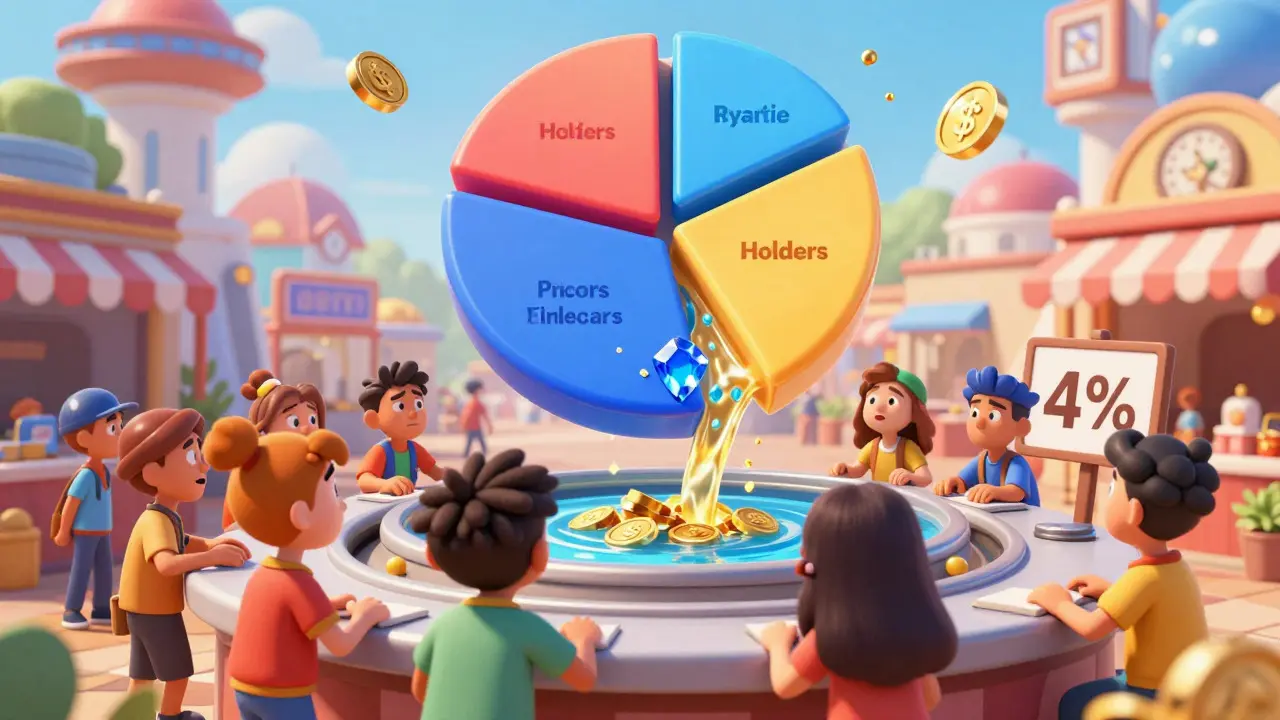
- The Tax: Every time a transaction occurs involving SAFEMARS, a 4% fee is applied.
- Rewards (2%): Half of that fee is instantly redistributed to all existing holders. If you hold 1% of the supply, you get 1% of those rewards. You don’t need to click anything. The tokens just appear in your balance.
- Liquidity (2%): The other half is converted into BNB (the native coin of the BNB Chain) and added to the liquidity pool. This is designed to support the price floor by increasing the depth of the market.
This model was popularized during the 2021 altcoin season by projects like SafeMoon. The idea is appealing because it feels passive. You buy, you hold, and your stack grows. However, there is a catch: that 4% tax applies to every trade. If you want to sell, you pay 4%. If you want to buy, you pay 4%. This creates friction that discourages frequent trading but encourages long-term holding-if the project remains viable.
Tokenomics and Supply: What’s Left?
When Safemars launched on March 13, 2021, the total supply was set at an astronomical number: 1,000,000,000,000,000 (one quadrillion) tokens. Why so many? To make the unit price look small and accessible, a common tactic in meme coin marketing.
However, not all of those tokens are circulating today. Data from trackers like CoinStats and CoinGecko suggests that roughly 60% of the original supply has been removed from circulation, likely through burns or locked liquidity mechanisms. Current estimates place the circulating supply between 380 trillion and 404 trillion tokens.
| Metric | Value / Estimate | Note |
|---|---|---|
| Initial Max Supply | 1 Quadrillion (1,000 Trillion) | Set at launch in 2021 |
| Circulating Supply | ~380-404 Trillion | Varies by data provider; implies ~60% reduction |
| Transaction Tax | 4% | 2% to holders, 2% to liquidity |
| Network | BNB Smart Chain (BEP-20) | Low gas fees compared to Ethereum |
This discrepancy in supply numbers across different platforms highlights a key issue with micro-cap tokens: data transparency is often poor. When you see conflicting numbers on CoinMarketCap versus CoinGecko, it usually means the token lacks active team communication or formal audits to clarify the exact state of the contract.
Price Performance and Market Reality in 2026
Let’s talk about the elephant in the room: the price. Safemars reached its All-Time High (ATH) of approximately $0.0000156 in May 2021. As of 2026, the price hovers around $0.000000008 to $0.000000010.
That is a decline of over 99.9% from its peak. While percentage drops sound scary, the absolute value is already tiny. A 99% drop from a penny is still a fraction of a cent. But the real story isn't just the price-it's the volume.
Daily trading volumes for SAFEMARS are extremely thin, often reported in the hundreds of dollars range ($5 to $800 depending on the day). For context, major cryptocurrencies like Bitcoin or Ethereum move billions daily. Even mid-tier DeFi tokens move millions. With such low volume, liquidity is scarce. This means if you try to sell a large amount of SAFEMARS, you could crash the price significantly due to slippage. There simply aren't enough buyers waiting in the order book to absorb large sales without impacting the price.
Where Can You Trade Safemars?
You won’t find SAFEMARS listed on top-tier centralized exchanges like Coinbase Pro or Binance Spot markets for direct trading. While these platforms may display price tracking pages, they often show zero circulating supply or minimal volume, indicating they are informational listings rather than active markets.
To actually buy or sell SAFEMARS, you typically need to use decentralized exchanges (DEXs) on the BNB Chain. The primary venues include:
- PancakeSwap v1/v2: The most common DEX for BSC tokens.
- Uniswap v2 (BSC version): Another option for swapping BEP-20 tokens.
- Gate.io: One of the few centralized exchanges that has historically supported the pair, though liquidity here is also limited.
Because you are using DEXs, you will need a compatible wallet like MetaMask or Trust Wallet, configured to interact with the BNB Smart Chain. You’ll also need some BNB in your wallet to pay for gas fees (transaction costs on the network).

Risks and Red Flags: What Investors Should Know
If you are considering adding SAFEMARS to your portfolio, you must approach it with extreme caution. Here are the critical risk factors based on current data:
- No Named Team: Major aggregators do not list specific founders or a registered company behind the project. The team appears to be pseudonymous or inactive. Without accountability, there is no one to answer to if something goes wrong.
- Lack of Audits: There are no publicly cited security audits from reputable firms. Smart contracts can have bugs, or worse, hidden functions that allow developers to manipulate the supply or halt transactions.
- Extreme Volatility: With a market cap under $4 million and low volume, the price can swing wildly on very small trades. A single large buyer or seller can move the price by double digits in minutes.
- Regulatory Uncertainty: As a speculative token with no clear utility beyond holding, it falls into a gray area for regulators worldwide. Changes in crypto laws could impact its tradability.
- Opportunity Cost: Money tied up in a stagnant micro-cap token could potentially earn higher yields in more established DeFi protocols with better security and liquidity.
Is Safemars Still Relevant?
In 2026, Safemars sits in the "long tail" of the cryptocurrency market. It is not dead, as it still has listings and occasional trading activity, but it is certainly dormant in terms of development. There are no recent roadmap updates, new features, or major partnerships announced.
Its primary use case remains speculative holding. If you believe in the community-driven ethos of early BSC tokens and are willing to accept the high risk of total loss, it might fit a tiny portion of a diversified portfolio. However, for most investors seeking growth or stability, SAFEMARS offers little advantage over more liquid, audited, and actively developed projects.
The "autonomous" nature of the protocol means it doesn't require constant management, which is a plus. But autonomy also means no rescue mission if the liquidity dries up completely. Always do your own research (DYOR) and never invest more than you can afford to lose when dealing with micro-cap altcoins.
Is Safemars a scam?
There is no definitive proof that Safemars is a "scam" in the traditional sense of a rug pull where developers stole funds and vanished immediately. However, it carries high risk due to the lack of a public team, absence of security audits, and extreme price depreciation. It behaves like a speculative asset with uncertain long-term viability.
How do I claim my Safemars rewards?
You don’t need to do anything. The 2% reward from each transaction is automatically distributed to all holders proportionally. The tokens accumulate in your wallet balance over time without any manual claiming process.
Can I buy Safemars on Coinbase or Binance?
Not directly. While Coinbase and Binance may show price charts for SAFEMARS, they do not offer active trading pairs with deep liquidity. You typically need to use decentralized exchanges like PancakeSwap on the BNB Chain to buy or sell the token.
What happens to the 4% transaction fee?
The 4% fee is split evenly. 2% is redistributed to existing token holders as rewards, and the other 2% is converted to BNB and added to the liquidity pool to help stabilize the price.
Is Safemars mineable?
No, Safemars is not mineable. It is a BEP-20 token on the BNB Chain, meaning its supply is managed by the smart contract logic (fees and burns) rather than through proof-of-work mining.