
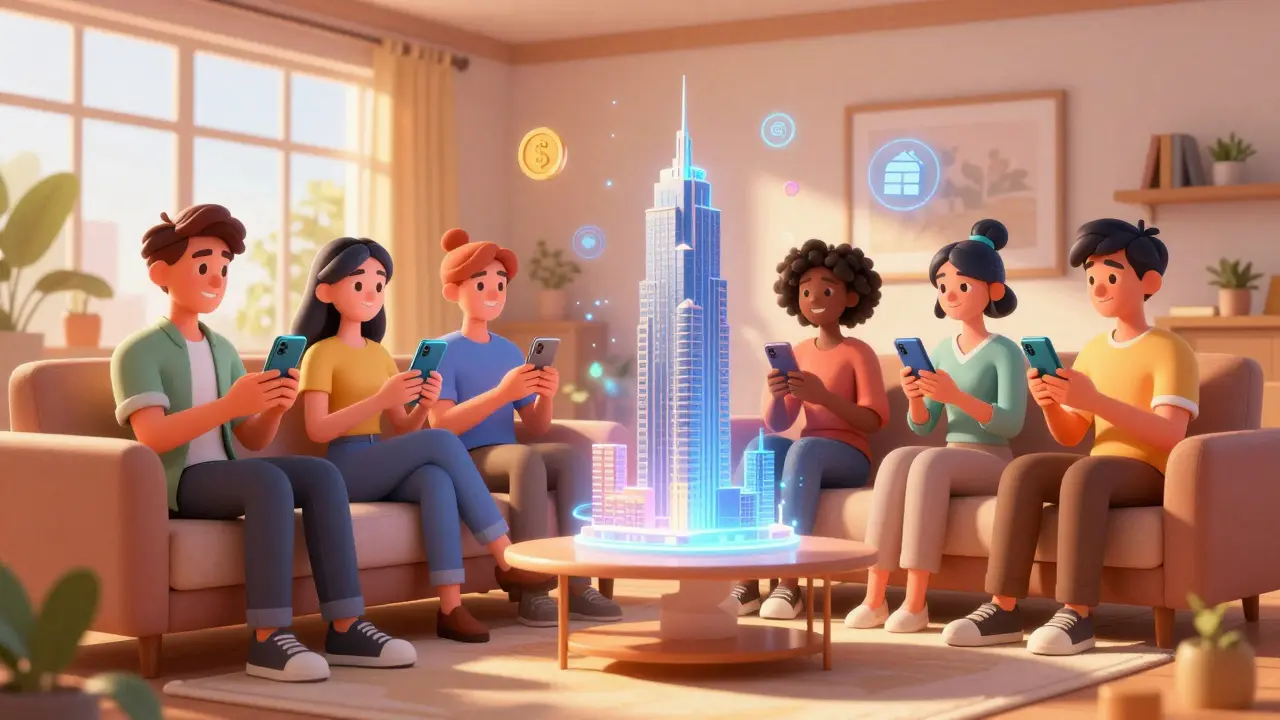
Imagine buying a slice of a luxury apartment in Auckland or a commercial building in London without needing a mortgage, a lawyer, or even leaving your house. You pay with crypto, get a digital receipt that proves you own that piece of the building, and can sell it later on a global marketplace in minutes. This isn't science fiction anymore. It’s Real Estate Tokenization, which is the process of converting physical property rights into digital tokens on a blockchain network.
For decades, real estate has been the ultimate "illiquid" asset. Selling a house takes months. Buying one requires massive upfront capital. But now, thanks to blockchain technology and Non-Fungible Tokens (NFTs), we are seeing a shift that could reshape how the world invests in property. If you’ve heard buzzwords like "tokenized assets" or "fractional ownership" and wondered what they actually mean for your wallet, you’re in the right place. Let’s break down exactly how this works, why it matters, and whether it’s ready for prime time in 2026.
How Does Real Estate Tokenization Actually Work?
To understand tokenization, you first need to separate the physical brick-and-mortar from the legal concept of ownership. In the traditional model, when you buy a house, you sign a deed. That deed is a paper record stored in a government office. It’s slow to update and hard to verify instantly across borders.
In the tokenized model, that deed becomes a digital token on a blockchain. Think of the blockchain as a public, unchangeable ledger that everyone can see but no one can hack. Here is the step-by-step process:
- Asset Selection & Legal Wrapping: A property owner puts their building into a special legal entity, often a Limited Liability Company (LLC) or a trust. This separates the liability from the individual investor.
- Token Creation: Developers create digital tokens that represent shares in that LLC. These tokens live on a blockchain like Ethereum, Polygon, or Solana.
- Distribution: Investors buy these tokens using cryptocurrency or sometimes fiat money via a platform. When you buy a token, you aren’t just buying a random coin; you are buying a verified legal claim to a portion of the property’s value and income.
- Management & Payouts: Smart contracts-automated code on the blockchain-handle rent collection. When tenants pay rent, the smart contract automatically distributes the profits to all token holders based on how many tokens they own.
The magic here is speed and transparency. Instead of waiting weeks for bank transfers and title searches, transactions settle in minutes. The history of every transaction is recorded permanently on the blockchain, reducing fraud risk significantly.
NFTs vs. Fungible Tokens: Which One Do You Need?
This is where most people get confused. You might hear "NFT" and think of expensive digital monkey pictures. While NFTs *can* be used for art, they are also incredibly powerful for unique assets like real estate. However, not all real estate tokens are NFTs. There are two main types you need to know about.
| Feature | Fungible Tokens (ERC-20) | Non-Fungible Tokens (NFTs / ERC-721) |
|---|---|---|
| Ownership Structure | Fractional (many small slices) | Whole Asset (one unique token) |
| Interchangeability | Yes, all tokens are identical | No, each token is unique |
| Best For | Retail investors, high liquidity | High-net-worth individuals, unique properties |
| Example | Buying $100 worth of a $1M building | Buying an entire historic mansion via one token |
Fungible tokens are interchangeable digital assets where each unit holds the same value and rights as any other unit. If a $1 million apartment building is tokenized into 1,000 shares, each share is identical. You can trade them freely on secondary markets. This is ideal for everyday investors who want exposure to real estate without buying a whole house.
Non-Fungible Tokens (NFTs) are unique digital certificates of ownership that cannot be exchanged equally because each represents a distinct asset. If you tokenize a rare vineyard or a specific commercial skyscraper as a single NFT, that one token represents 100% ownership. Transferring that NFT transfers the entire property. This method is often used by developers selling entire projects or high-value unique assets where fractional ownership doesn't make sense.
Why Bother? The Benefits Over Traditional Investing
You might be asking, "I can already buy REITs (Real Estate Investment Trusts) on the stock market. Why do I need blockchain?" Great question. REITs have been around for decades, but they come with baggage. Tokenization solves several specific pain points:
- Lower Entry Barriers: Traditionally, investing in premium real estate required hundreds of thousands of dollars. With tokenization, you can start with $50 or $100. This democratizes access to wealth-building assets that were previously reserved for the ultra-rich.
- Liquidity: Selling a house takes months. Selling a REIT share is easy, but you’re selling shares in a company, not direct property. Tokenized real estate aims to offer the best of both worlds: direct ownership with near-instant tradability on specialized exchanges.
- Reduced Fees: Traditional real estate involves agents, lawyers, notaries, and banks, each taking a cut. Blockchain uses smart contracts to automate these roles, potentially cutting transaction costs by up to 80%.
- Global Access: An investor in New Zealand can easily buy a fraction of a rental property in Berlin or Miami without dealing with complex cross-border banking restrictions, provided the platform handles local compliance.
According to analysis by firms like KPMG, tokenization is particularly effective for owners of single assets or small portfolios because it drastically reduces the time and cost associated with offering fractional ownership opportunities.

The Risks: It’s Not All Smooth Sailing
Let’s keep it real. This technology is still maturing. While the potential is huge, there are significant hurdles you need to understand before putting your money in.
Regulatory Uncertainty is the biggest elephant in the room. Laws regarding securities, property rights, and digital assets vary wildly between countries. In the US, the SEC views many tokenized real estate offerings as securities, meaning they must follow strict registration rules. In other jurisdictions, the laws are vague or non-existent. If regulations change overnight, it could impact the value or legality of your tokens.
Smart Contract Vulnerabilities are another concern. While blockchains themselves are secure, the code written on top of them (smart contracts) can have bugs. If a hacker finds a flaw in the contract managing the rent distributions, funds could be stolen. Always choose platforms that have undergone rigorous third-party security audits.
Illiquidity Traps exist too. Just because a token *can* be traded doesn’t mean someone will buy it immediately. If there isn’t enough demand for a specific property token, you might find yourself holding an asset you can’t sell quickly, similar to owning a physical house in a bad market.
Who Is This For? Identifying Your Investor Persona
Not everyone needs to jump into tokenized real estate. Here is who benefits most:
- The Small-Capital Investor: You want to diversify your portfolio beyond stocks and bonds but don’t have $50,000 for a down payment. Tokenization lets you build a diversified real estate portfolio with small amounts.
- The Tech-Savvy Millennial/Gen Z: You are comfortable with crypto wallets, understand private keys, and prefer digital-first experiences over visiting realtors.
- Property Owners Seeking Liquidity: If you own a vacation home that sits empty half the year, tokenizing it allows you to raise capital from multiple investors while retaining some ownership or management control.
If you are a conservative investor who prefers the simplicity of a standard index fund or a regulated REIT, tokenized real estate might add unnecessary complexity to your life right now.
Getting Started: A Practical Checklist for 2026
If you decide to take the plunge, follow these steps to stay safe and informed:
- Choose a Reputable Platform: Look for platforms that are transparent about their legal structure, have clear KYC (Know Your Customer) processes, and publish regular audit reports. Avoid anonymous projects.
- Understand the Underlying Asset: Don’t just look at the token price. Research the physical property. Where is it located? What is the rental yield? Who is managing the maintenance? The token is only as good as the building backing it.
- Secure Your Wallet: Ensure you use a hardware wallet (like Ledger or Trezor) for storing valuable tokens. Never leave large amounts on exchange hot wallets.
- Check Local Tax Implications: In many countries, profits from token sales may be taxed as capital gains or ordinary income. Consult a tax professional familiar with digital assets in your jurisdiction.
- Start Small: Treat your first investment as a learning experience. Allocate only money you can afford to lose while you learn how the secondary markets work.
The Future Outlook
We are currently in the early adoption phase. Major financial institutions and real estate giants are experimenting with tokenization, signaling that this is not just a crypto trend but a structural shift in finance. As regulatory frameworks become clearer and user interfaces become simpler (making it easier to buy tokens with credit cards rather than crypto), we expect mainstream adoption to accelerate.
By the end of this decade, it won’t be unusual to see your primary residence or rental properties represented partly or wholly by digital tokens. The key is to watch the space, understand the mechanics, and enter cautiously. The revolution is happening, but it’s being built one block-and one brick-at a time.
Is real estate tokenization legal?
Legality varies by country. In many jurisdictions, tokenized real estate is treated as a security, meaning it must comply with local securities laws. Platforms typically handle this by restricting access to accredited investors or implementing strict KYC/AML checks. Always verify the legal status in your specific region before investing.
Can I really own a physical house with an NFT?
Yes, but indirectly. The NFT represents ownership of a legal entity (like an LLC) that owns the physical property. You hold the digital token, which grants you the rights and responsibilities defined in the smart contract and legal documents, such as receiving rent and voting on major decisions.
What happens if the blockchain network goes down?
Major blockchains like Ethereum are highly decentralized and have never gone "down" in a way that erased data. Transactions might be delayed during high congestion, but your ownership records remain secure. The risk is more related to the platform interface failing, not the underlying blockchain disappearing.
How do I get paid rent from tokenized property?
Rent is usually collected by the property manager and deposited into a multi-signature wallet controlled by the smart contract. The contract then automatically distributes the funds to all token holders' wallets proportional to their holdings. Some platforms convert crypto rent into stablecoins or fiat to reduce volatility for investors.
Are there fees involved in buying tokenized real estate?
Yes. You may encounter platform fees for purchasing tokens, gas fees (network transaction fees) on the blockchain, and annual management fees for property upkeep. However, these are often lower than the combined costs of agent commissions, legal fees, and closing costs in traditional real estate.
KEITH WONG
July 3, 2026 AT 14:53lol another hype piece on blockchain savior complex 🙄 its gonna be a blood bath for retail investors who dont read the fine print on those LLC structures. most of these platforms are just ponzi schemes with better marketing teams.
Curtis Johnson
July 4, 2026 AT 17:28i think we should all try to stay open minded about this new tech because it really could help people who have been shut out of the housing market for decades, and maybe if we work together we can figure out how to make it safe for everyone involved without losing our heads over fear
Hamza k
July 4, 2026 AT 19:53the whole idea of fractional ownership is like trying to own a single brick in a cathedral while the rest of the building burns down around you! it sounds poetic but practically it is a nightmare of legal liability that no one has actually solved yet!
Kim Kay
July 5, 2026 AT 19:56i was reading this and thought it might be good for me but then i saw the part about smart contract vulnearbilities and got scared. does anyone know if there is a way to insure against code bugs? i dont want to lose my life savings on a typo in someones java script.
Brad Semp
July 7, 2026 AT 06:28The notion that one can simply "buy a slice" of real estate via digital tokens is fundamentally flawed from a legal standpoint. The separation of title and beneficial ownership creates a labyrinthine structure that only benefits the platform operators, not the retail investor. It is a sophisticated mechanism for wealth extraction disguised as democratization.
Korn Arrieta
July 8, 2026 AT 01:20You are ignoring the regulatory hammer that is about to drop. The SEC is already circling like sharks. When they classify these tokens as unregistered securities, the platforms will freeze assets overnight. Your liquidity argument is completely void because there is no secondary market depth to support exit strategies during a panic sell-off.
Russ Fincham
July 8, 2026 AT 16:22Look at the data. Real estate tokenization has failed to gain traction because the underlying asset class is inherently illiquid. Trying to force liquidity onto an illiquid asset through technology is like putting a spoiler on a minivan. It looks cool but serves no aerodynamic purpose and adds unnecessary drag to your portfolio performance metrics.
Linda Hilliard
July 10, 2026 AT 01:40Let us be clear: this is not investing; it is speculation wrapped in blockchain jargon to appeal to technologically naive demographics. The concept of fractionalizing high-value assets ignores the economies of scale that make institutional real estate investing profitable. Retail participants are merely providing exit liquidity for early insiders. 📉
Winston Lacewing
July 11, 2026 AT 01:16I feel like I am missing out on something huge here but also terrified that I will get scammed by some guy named Bob in a basement 🏠💸 Is it really worth risking my rent money on a digital receipt that might disappear if the server goes down? My soul feels heavy thinking about the moral implications of gambling with housing stability 😔
Kristine Lawson
July 12, 2026 AT 08:14One must consider the ethical ramifications of commodifying shelter into tradable digital artifacts; furthermore, the environmental impact of the proof-of-work mechanisms associated with many of these blockchains cannot be ignored in light of our current climate crisis. It is a morally bankrupt endeavor.
Tawny Holmes
July 13, 2026 AT 22:24NFTs for real estate are dead on arrival. Legal frameworks do not support it. End of story.
Jessie Smith
July 15, 2026 AT 00:44the essence of property is not just the bricks but the social contract surrounding them, which is inherently untokenizable. you cannot digitize the feeling of home or the community ties that bind a neighborhood together, so trying to reduce it to a string of code is a philosophical error of the highest order.
Drew M
July 15, 2026 AT 05:15I mean, honestly, if you have the capital to buy a whole building, why tokenize it? But for the rest of us, it seems like a fun experiment. I bought some pixel art once, so why not a pixel apartment? 🏙️✨ Just don't expect it to pay your mortgage anytime soon, my friends!
Deep Rahman
July 15, 2026 AT 23:32When we look at the history of human settlement and the way land has always been tied to identity and power, we see that the introduction of digital intermediaries changes nothing about the fundamental struggle for space and resources, and instead just adds a layer of complexity that obscures the true nature of ownership and makes it harder for the common person to understand their rights in a world that is becoming increasingly abstract and disconnected from physical reality.