
Okratech Token (ORT) is a cryptocurrency built to power a freelance marketplace called OrtJob, promising zero commissions for freelancers. But behind the bold claim lies a token with minimal adoption, wild price swings, and little evidence it’s actually being used. If you’re wondering whether ORT is a hidden gem or just another low-cap crypto with no future, here’s what you need to know - no hype, just facts.
What Is Okratech Token (ORT) Actually For?
Okratech Token (ORT) is a BEP-20 token on the BNB Chain, launched in 2021. Its main purpose? To fuel OrtJob, a platform that claims to let freelancers work without paying any commission - unlike Upwork or Fiverr, which take 20% of your earnings. The idea sounds simple: get paid in ORT, use it to access services, and avoid middlemen. But here’s the catch: OrtJob doesn’t have a meaningful user base. As of January 2026, only 437 active wallet addresses interacted with the platform in the last 24 hours. That’s fewer than a small Discord server.
ORT isn’t just a payment token - it’s supposed to be the engine for a whole ecosystem. The team says it plans to integrate DeFi features like staking and liquidity pools. But those features were promised for 2022 and 2023. Nothing’s live. The last GitHub commit was in September 2023. No new code. No updates. No roadmap progress.
How Many ORT Tokens Are There?
There are 900 million ORT tokens in total. That’s a fixed supply - no more will ever be created. But here’s where things get messy: only about 18 million ORT were in circulation when the project launched. Today, between 816 million and 870 million are out there, depending on which exchange you check. That means over 90% of the supply was released after the initial launch.
This isn’t normal. Most tokens release their supply gradually to avoid crashing the price. ORT did the opposite. The team held back 98% of the tokens for years, then flooded the market. That’s why the price dropped from its all-time high of $0.074 to under $0.00025. When you release 850 million tokens all at once, demand has to catch up - and it hasn’t.
Where Can You Buy ORT?
You can trade ORT on five major exchanges: Binance, Bybit, Gate.io, MEXC, and PancakeSwap. But here’s the problem: prices vary wildly across them. On Binance, ORT trades at $0.001495. On MEXC, it’s $0.0002067. That’s a 625% difference. Why? Because liquidity is thin. There’s not enough buying and selling pressure to keep prices stable. This isn’t just volatility - it’s manipulation risk.
Trading volume is also inconsistent. Binance reports around $415,000 in daily volume. MEXC shows under $60,000. That’s not a market - that’s a few traders flipping the same coins. And if you try to buy ORT on a random site that claims to list it, you’re likely hitting a scam. Reddit users in December 2025 reported fake ORT tokens on phishing exchanges designed to steal wallet keys.
Is OrtJob Actually Working?
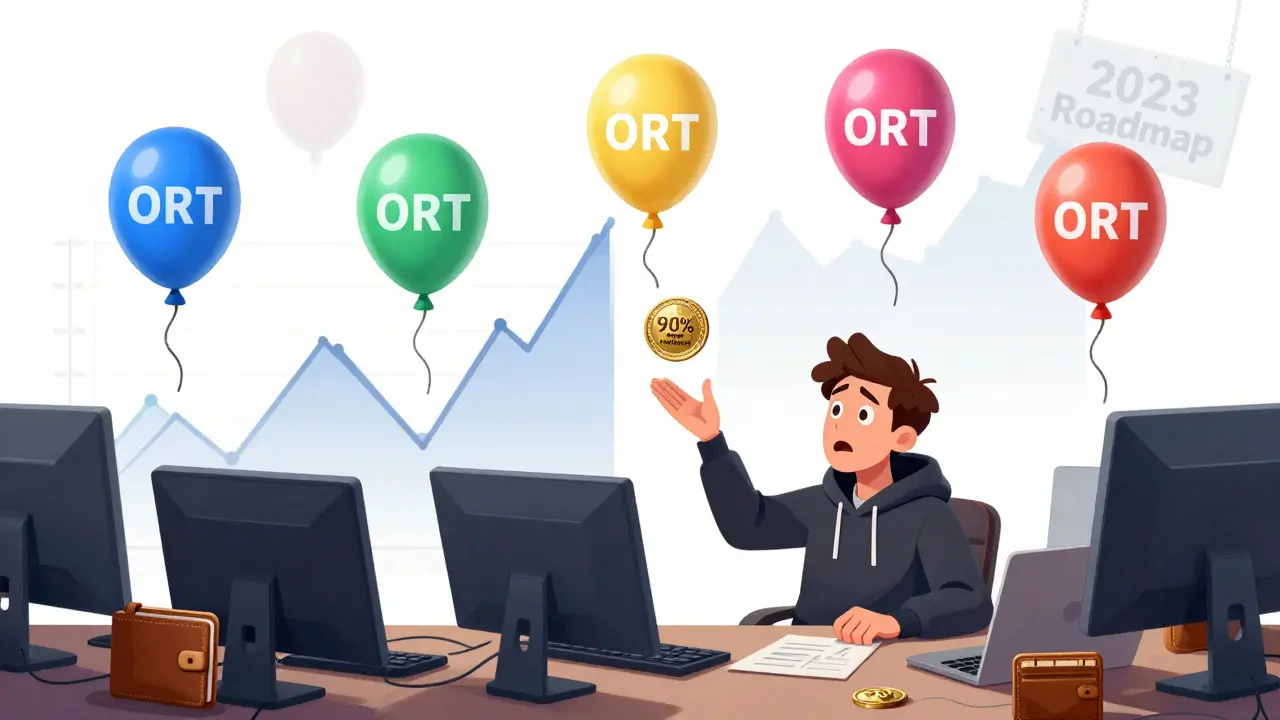
The whole point of ORT is OrtJob - the freelance platform. But if you go to OrtJob’s website today, you’ll find a bare-bones interface. There are no active job postings. No client profiles. No payment history. Trustpilot reviews (14 total) give it 3.2 out of 5 stars. Common complaints? “No jobs available,” “support never replies,” and “looks like a placeholder site.”
Compare that to Upwork: 12 million freelancers, 5 million clients, $1.2 billion in annual payments. OrtJob has 12,450 total wallet holders - and most of them are just holding ORT as a speculative bet, not using it to pay for services. The “no commission” promise is meaningless if no one’s hiring or offering work.
Why Is the Price So Volatile?
ORT’s 24-hour price swings regularly exceed 5%. On January 25, 2026, it jumped 5.54% in one day. That’s not due to news or adoption - it’s because of low liquidity. When only a few hundred people are trading a token, one large buy or sell order can move the price dramatically. It’s like trying to sell a rare baseball card in a town of 20 people. One person decides to buy - price doubles. Next day, they change their mind - price crashes.
Technical analysts on 3Commas predict a 21.75% drop by the end of 2026. Others, like LiteFinance, say ORT could hit $0.0044 - a 2,000% gain. Both can’t be right. One is based on wishful thinking. The other on market reality. The fact that these predictions exist at all shows how little data there is to base them on.
What Do Experts Say About ORT?
Major crypto research firms aren’t impressed. Messari labeled ORT a “high-risk speculative asset with low probability of survival beyond 2027.” CoinDesk didn’t even include it in their January 2026 watchlist. Why? Because the project has no transparency. No public team. No LinkedIn profiles. No interviews. No updates. The Twitter account @OkratechToken posted only three times since January 2025 - all price alerts, zero development news.
YouTube reviewers like Crypto Insider call it a “high-risk speculative asset with unproven utility.” That’s not a review - that’s a warning. The concept of a commission-free freelance platform is solid. But execution? Zero. The token has no real-world use. No users. No revenue. No traction. It’s a speculative bet on a dead idea.
Should You Buy ORT?
If you’re looking for a long-term investment - no. ORT doesn’t have the fundamentals to grow. No team activity. No user growth. No product development. It’s trading because people hope it’ll pump - not because it’s valuable.
If you’re a short-term trader chasing volatility - maybe. But you’re not investing. You’re gambling. The risk is high. The reward? Unclear. You could make 50% in a week. Or lose 80% in a day. And if the project dies, ORT becomes worthless. There’s no backup plan. No team to revive it. No community pushing for change.
And here’s the real problem: setting up to buy ORT isn’t easy. You need a BNB Chain-compatible wallet (like MetaMask or Trust Wallet), you need to buy BNB first, then swap it for ORT on PancakeSwap or MEXC. It takes 45 minutes for a first-time user. For what? A token with 12,450 holders and no real use case.
What Are the Alternatives?
If you want to support freelance work on blockchain, look at projects with actual traction. DWork has a daily trading volume of $12,000 - tiny, but it’s active. Ethereum-based platforms like Gitcoin pay developers for open-source work using real grants and verified contributions. Even if they’re small, they’re building something.
Or stick with traditional platforms. Upwork and Fiverr work. They have millions of users. They have dispute resolution. They pay out reliably. The commission is high, but you get results. ORT offers no such guarantee.
Final Verdict
Okratech Token (ORT) is not a crypto coin you should hold. It’s not a tool. It’s not a platform. It’s a bet on a promise that hasn’t been kept for over three years. The tokenomics are broken. The team is silent. The product doesn’t work. The community is small and skeptical.
The idea behind ORT - cutting out commissions for freelancers - is good. But good ideas don’t become successful crypto projects without execution. ORT has none. It’s a ghost town with a token attached. If you’re curious, trade a few dollars for fun. But don’t invest. Don’t believe the hype. And don’t expect this to turn into anything real.
Gurpreet Singh
January 28, 2026 AT 19:09Been watching ORT for months now. Honestly? It’s a ghost town. I checked OrtJob last week - zero jobs, zero replies. Even the Discord is dead. I’d rather stick with Upwork and pay the fee than gamble on vaporware.
Also, 900M supply? And only 18M circulating at launch? That’s not a token - that’s a pump-and-dump waiting to happen.
Respect to the idea, but execution? Zero.
Just say no.
Christopher Michael
January 28, 2026 AT 22:20Okay, let’s be real: if you’re buying ORT because you think ‘no commission’ means it’s going to replace Upwork, you’re not just wrong-you’re dangerously misinformed.
The tokenomics are a dumpster fire: 850M tokens dumped after years of hoarding? That’s not ‘fair distribution,’ that’s insider manipulation.
And the price discrepancies between exchanges? That’s not volatility-it’s a red flag screaming ‘rug pull.’
Also, no GitHub commits since 2023? No team? No roadmap? You’re not investing-you’re donating to a fantasy.
Don’t be the last one holding the bag.
Parth Makwana
January 29, 2026 AT 14:38ORT is a textbook case of tokenomics gone rogue. The 900M total supply, coupled with the delayed release of 98% of tokens, creates an asymmetric risk-reward profile that is fundamentally unsustainable.
Moreover, the lack of on-chain utility beyond speculative trading renders it a non-functional asset class.
With zero active development, no credible team, and a platform that functions as a digital placeholder, ORT fails every litmus test for viability in the Web3 ecosystem.
Investors must recognize that speculative hype cannot substitute for verifiable traction.
Consider this: if the team had released 5% annually over 5 years, liquidity might have stabilized.
Instead, they chose short-term manipulation over long-term value creation.
Don’t confuse volume for adoption.
And please, stop quoting ‘2000% gains’-those are mathematically impossible without a parallel universe where demand magically appears.
Elle M
January 31, 2026 AT 02:23Wow. Someone actually thought this was a good idea? You people are the reason crypto is a joke.
‘No commission’? Cool. So what? No jobs. No users. No team. Just a token with a fancy name and a website that looks like it was made in 2015.
And you’re seriously considering investing? In THIS? In 2026? I’m embarrassed for you.
Go buy some Bitcoin. Or better yet-go get a job.
Rico Romano
February 2, 2026 AT 01:25Let’s be clear: ORT isn’t a crypto project. It’s a behavioral economics experiment in collective delusion.
People aren’t buying it for utility-they’re buying it because they watched a YouTube video where someone said ‘this could moon.’
The fact that MEXC lists it at $0.0002 and Binance at $0.0015 isn’t market inefficiency-it’s proof that no one agrees on its value, because it has none.
And yet, somehow, the same people who scoff at penny stocks think this is ‘smart investing.’
It’s not. It’s just the same old story with a new blockchain label.
And if you think ‘freelance platform’ is the answer, why not just build one on Ethereum? Or use a stablecoin?
You don’t need a new token to cut commissions. You need a working product.
ORT has neither.
Crystal Underwood
February 2, 2026 AT 18:25Oh my god. You’re still talking about ORT like it’s a real thing?
Let me break it down for you: no team, no code, no jobs, no users, no updates, no transparency, no credibility.
And you’re seriously considering putting money into this? You’re not a crypto investor-you’re a sucker.
The only thing ‘utility’ about ORT is how much utility it has in making people lose their life savings.
And don’t even get me started on the ‘no commission’ lie. You can’t have a marketplace with no buyers and no sellers. That’s not innovation. That’s a hallucination.
Go cry into your Coinbase app.
Raymond Pute
February 3, 2026 AT 13:08Look, I get it. The idea of a commission-free freelance platform sounds great. I mean, who doesn’t hate paying 20% to Upwork? But the problem isn’t the idea-it’s the execution, or rather, the complete absence of it.
ORT isn’t a token; it’s a Rorschach test. People project their hopes onto it because they want to believe in something. But belief doesn’t create liquidity. Community doesn’t build a product. And wishful thinking doesn’t generate job postings.
The fact that the team sat on 98% of the supply for years and then dumped it all at once? That’s not a strategy-it’s a confession.
And the price discrepancies across exchanges? That’s not ‘market dynamics’-that’s a sign that nobody knows what the hell this thing is worth, because it has no intrinsic value.
It’s like buying a car with no engine and calling it a ‘future mobility solution.’
It’s not future tech. It’s a time capsule of bad decisions.
And the worst part? People are still buying it. Not because they understand it. But because they’re afraid of missing out.
That’s not investing. That’s gambling with a fancy name.
Jack Petty
February 3, 2026 AT 22:30ORT is a CIA psyop.
They seeded it on Reddit. Paid influencers. Pumped it on Telegram. Now they’re letting it die slowly so people keep talking about it.
Look at the wallet distribution. 870M in circulation? Half of those are likely bots or wash trades.
The ‘platform’? A static HTML page.
The team? Ghosts.
And you’re still here?
They’re not trying to build a platform.
They’re harvesting your wallet keys.
christal Rodriguez
February 4, 2026 AT 10:13It’s not about the token. It’s about the lack of accountability.
There’s no team. No roadmap. No updates. No accountability.
That’s the real failure here.
Not the price.
Not the supply.
Just… silence.
Tressie Trezza
February 6, 2026 AT 01:47I get why people want ORT to work. The idea of cutting out middlemen is beautiful.
But beauty doesn’t pay bills.
And a token with no users isn’t a currency-it’s a memorial.
Maybe if the team had launched with 10% of the supply and grown it slowly with real users…
But they didn’t.
So now we’re left with a ghost.
And I feel bad for anyone who believed in it.
Calvin Tucker
February 7, 2026 AT 21:38The grammatical structure of the project’s whitepaper is inconsistent with credible blockchain initiatives.
Furthermore, the lexical density of its communication channels is alarmingly low.
And the absence of verifiable team members violates the fundamental principle of trust minimization in decentralized systems.
Therefore, ORT cannot be classified as a legitimate asset.
It is, by all measurable standards, a non-entity.
Gustavo Gonzalez
February 8, 2026 AT 18:02So you’re telling me a project with 437 active wallets is supposed to compete with Upwork?
And you’re not suspicious that the ‘team’ has zero LinkedIn profiles?
And the Twitter account hasn’t posted in a year?
And the GitHub is dead?
And the ‘platform’ looks like a 2012 WordPress theme?
And the price is all over the map?
And you still think this is a good investment?
Bro.
Bro.
Bro.
Go touch grass.
Mark Ganim
February 8, 2026 AT 18:04This isn’t a crypto project.
This is a funeral.
And we’re all standing around it, tossing coins into the grave, hoping it’ll rise again.
It won’t.
It’s been dead for three years.
They just haven’t buried the body yet.
And you? You’re the one still bringing flowers.
mary irons
February 10, 2026 AT 04:43Let’s be honest: ORT is a test to see how many people will still believe in something that’s clearly dead.
It’s like watching someone keep calling a disconnected number, hoping the line will ring.
They’re not waiting for an answer.
They’re waiting for the hope to die.
And we’re all just spectators.
Wayne mutunga
February 12, 2026 AT 01:32I don’t know if ORT will ever work.
But I do know that the idea behind it-no commissions for freelancers-is worth pursuing.
Maybe not with this token.
But maybe with something better.
Let’s not throw the baby out with the bathwater.
Just… don’t put your life savings in ORT.
Gavin Francis
February 13, 2026 AT 06:53ORT? Nah.
Been there. Done that.
Got the empty wallet to prove it.
Stick with Upwork. Pay the 20%.
At least you get paid.
😄
Rob Duber
February 14, 2026 AT 13:52ORT is the crypto equivalent of a haunted house where the ghost is the only tenant.
Everyone says it’s haunted.
No one’s ever seen it.
But people still bring cameras.
And candles.
And hope.
And then they sell their soul for a 5% pump.
It’s tragic.
And hilarious.
And terrifying.
And I can’t look away.
Gary Gately
February 15, 2026 AT 11:23idk man i heard ort could go to 10x but then i checked the website and it was just a blank page with a logo
so i just bought some dogecoin instead
at least doge has memes
ort has nothing
not even a meme
rip
Brandon Vaidyanathan
February 16, 2026 AT 11:50You people are pathetic.
You’re not investors.
You’re emotional vampires feeding off hype.
ORT is a tombstone.
And you’re all dancing on it.
And you wonder why crypto is a joke?
It’s because of you.
Keep buying.
Keep hoping.
Keep losing.
It’s your life.
Enjoy the ride.
Gareth Fitzjohn
February 16, 2026 AT 14:27Interesting analysis.
But I still don’t understand why anyone would expect a token with no active development to have value.
It’s not complicated.
Build something.
Then people will use it.
Not the other way around.
Moray Wallace
February 17, 2026 AT 22:43It’s sad, really.
The idea was good.
But the execution? Nonexistent.
And now, the community is just arguing about price charts instead of asking why the team went silent.
That’s the real tragedy.
Dahlia Nurcahya
February 19, 2026 AT 14:53I used to believe in ORT.
I thought maybe they were just quiet.
Maybe they were building in secret.
But after three years of silence? No GitHub. No updates. No jobs.
I realized: silence isn’t strategy.
It’s surrender.
And I’m letting go.
Not because I’m mad.
But because I care too much to keep pretending.
Dylan Morrison
February 21, 2026 AT 02:09Sometimes the best thing you can do is walk away.
Not because you lost.
But because you refused to let a dead idea steal your time.
ORT isn’t a failure.
It’s a lesson.
And you? You’re the student.
Study it.
Then move on.
❤️
William Hanson
February 22, 2026 AT 15:39Just delete the wallet.
Stop checking the price.
Stop reading the threads.
Stop hoping.
You’re not investing.
You’re grieving.
And it’s not even your project.
Let it die.
josh gander
February 23, 2026 AT 04:47I’ve been in crypto since 2017.
I’ve seen hundreds of projects come and go.
But ORT? This one hits different.
It’s not even a scam.
It’s a tragedy.
A beautiful idea, abandoned.
A team that vanished.
A community that still clings to hope.
I don’t hate ORT.
I feel sorry for it.
And for everyone who believed in it.
Let’s not make the same mistake again.
Look for teams that talk.
That ship.
That build.
Not just promise.
And if they’re silent?
Walk away.
Before you lose more than money.
Christopher Michael
February 23, 2026 AT 20:41And yet, people still buy it. Every time it dips, someone says ‘this is the bottom.’
It’s not a bottom.
It’s a black hole.
And you’re throwing money into it like it’s a wishing well.
Good luck.
josh gander
February 25, 2026 AT 01:32Exactly.
It’s not about price.
It’s about the silence.
That’s the real red flag.
Not the chart.
Not the volume.
The silence.
That’s what kills projects.
Not bad math.
Just… no one left to care.