
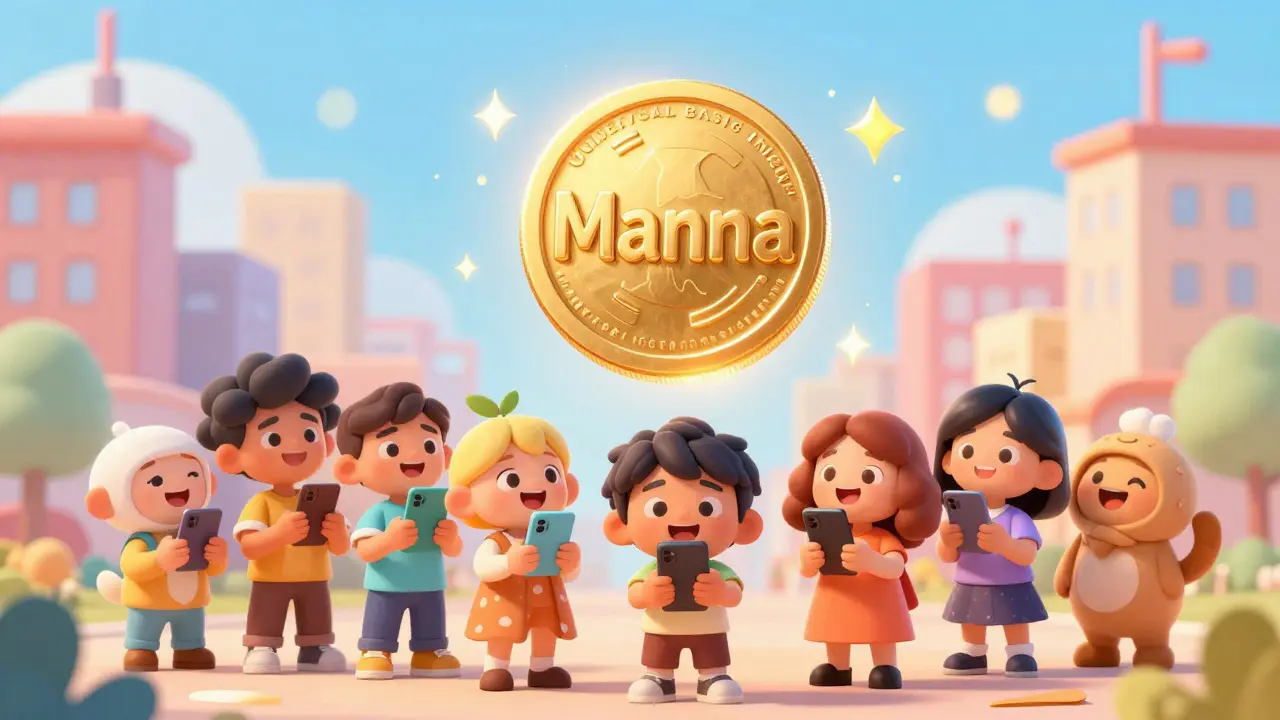
You might have heard about a cryptocurrency that promises to give money away for free. It sounds like a dream come true, right? That is exactly what Manna claims to be. But before you start waiting for your daily drop of digital cash, there is a lot more to this story than just free tokens. In fact, if you are looking to make money or spend these coins easily, you are likely in for a rude awakening.
Manna (MANNA) is not your typical investment coin. It was created by a nonprofit group with a very specific social mission. However, the reality of using Manna today is quite different from its original promise. Let’s break down what it actually is, how it works, and whether it still has any value in 2026.
The Origin Story: From Grantcoin to Manna
To understand Manna, you have to look back at where it started. The project launched on March 23, 2015, under the name Grantcoin. Grantcoin was an early experiment in blockchain technology focused on charitable distribution. Back then, the idea of using blockchain for anything other than speculative trading was pretty new.
In 2017, the team rebranded the project to Manna. This change marked a shift in focus toward Universal Basic Income (UBI). Universal Basic Income is an economic theory where government or organizations provide all citizens with a regular, unconditional sum of money. The goal was bold: use blockchain technology to distribute a basic income to every person on Earth, regardless of their wealth or status.
The driving force behind this was the People's Currency Foundation. The People's Currency Foundation is a tax-exempt nonprofit organization dedicated to distributing Manna as a human right. Founded by Eric Stetson, along with Jon Frechin and Brandon Venetta, the foundation holds a unique place in crypto history. It is the first nonprofit to launch a blockchain currency with UBI as its primary distribution method.
The philosophy is simple: everyone deserves access to financial resources. By removing the need to mine or buy the coin, they aimed to onboard millions of people who had never touched cryptocurrency before. On paper, it was a noble experiment in global equity.
How Does Manna Distribution Work?
If you want Manna, you don’t need a powerful computer or a large bank account. You just need to register. Here is the process:
- Register: You go to the People's Currency Foundation website and sign up for an account.
- Verify: You confirm your email address to prove you are a real person.
- Receive Drops: Once registered, you become eligible for daily distributions.
As of their 2022 protocol update, the foundation distributes approximately 1 million MANNA tokens daily among all registered users. If you are one of the few active holders, your share might seem decent. But as more people join, the amount per person shrinks. It is a classic dilution model.
The total supply of Manna is fixed at roughly 2.36 billion tokens. According to data from late 2025, nearly all of these tokens are already in circulation. There are no new tokens being mined; they are just being moved around or sitting in wallets. This means the "free money" you receive is only valuable if someone else wants to buy it from you.
Technical Reality: An Outdated Blockchain
Here is where things get tricky. Manna does not run on modern infrastructure like Ethereum or Solana. It runs on its own blockchain, which is based on Peercoin. Peercoin is one of the earliest cryptocurrencies, notable for introducing a hybrid Proof-of-Work and Proof-of-Stake consensus mechanism. Peercoin itself is an older fork of Bitcoin.
This legacy architecture creates several problems for users in 2026:
- Wallet Compatibility: The official Manna wallet was last updated in 2019. It often fails to install on modern operating systems like Windows 11 or the latest macOS versions. Many users report having to set up virtual machines just to check their balance.
- Security Risks: Security firms like CertiK have noted that the codebase contains unpatched vulnerabilities from 2017. These include risks related to replay attacks and outdated cryptographic libraries.
- No Mobile App: Despite promises in their 2022 roadmap, there is no functional mobile wallet. You cannot manage your Manna from your phone easily.
Dr. Sarah Chen, a blockchain researcher at MIT, pointed out in a 2024 interview that Manna’s technical stagnation has rendered it largely obsolete compared to newer platforms. While the founders argue that the value lies in the network of recipients, the lack of technical maintenance makes it hard to trust the security of your funds.
Can You Actually Spend Manna?
This is the million-dollar question (or rather, the $0.001 question). Most cryptocurrencies gain value because businesses accept them or traders buy and sell them. Manna struggles with both.
| Feature | Manna (MANNA) | Circles (CirclesUBI) |
|---|---|---|
| Daily Trading Volume | $0 (negligible) | $1.2+ million |
| Exchange Availability | One obscure DEX | Multiple major exchanges |
| Underlying Tech | Legacy Peercoin fork | Gnosis Chain (EVM compatible) |
| Usability | Very Low | High |
According to market data from October 2025, Manna has virtually zero trading volume on major platforms like CoinMarketCap. It is listed on only one decentralized exchange, often referred to as MannaSwap. Even there, liquidity is so thin that selling even a small amount can cost you more in fees than the tokens are worth. One user reported paying $48 in gas fees to sell $50 worth of Manna.
There are no stores accepting Manna. No services integrate it. It exists mostly in a vacuum. If you hold Manna, you are holding a digital collectible with no practical utility. The People's Currency Foundation argues that the value is in the concept, not the commerce. But for most users, a currency that cannot be spent is just a number on a screen.
Current Market Status and Price
Let’s talk numbers. As of late 2025, Manna trades at a fraction of a cent. Prices hover around $0.001, but this is misleading because there are almost no buyers. The market capitalization is roughly $2.9 million, placing it outside the top 5,000 cryptocurrencies globally.
Historically, Manna reached an all-time high of about $0.07 in early 2018. Since then, it has dropped over 98%. It hit an all-time low of $0.000017 in January 2024. The volatility is extreme, but the trend is clearly downward due to lack of interest.
Why is the price so low? Simple supply and demand. Millions of tokens are distributed for free every day, creating constant selling pressure. Meanwhile, there are very few buyers interested in acquiring Manna because it offers no yield, no governance rights, and no spending power.
Risks and Red Flags
If you are considering registering for Manna or buying some, you need to be aware of the significant risks:
- Liquidity Trap: You may find it impossible to convert your Manna into fiat currency (like USD or NZD) without losing most of its value.
- Developer Abandonment: The GitHub repository shows minimal activity. The last major code commit was in late 2021. The team seems to have shifted focus away from technical development.
- Regulatory Uncertainty: The SEC has not clarified the status of nonprofit-distributed tokens. Depending on future rulings, Manna could be classified as an unregistered security, which would complicate its legal standing further.
- Network Decay: With only dozens of active addresses transacting regularly, the network is at risk of becoming completely dormant. A dead chain means lost access to your funds forever.
Eric Stetson, the founder, defends the project by citing the 1.2 million wallets that have received distributions since 2015. He views Manna as a proof-of-concept for global basic income. However, critics argue that a proof-of-concept that doesn't work technically is not much of a proof at all.
Alternatives to Manna
If you are interested in the idea of Universal Basic Income through crypto, Manna is probably not the best choice anymore. The sector has evolved. Newer projects offer better technology, higher liquidity, and actual utility.
Circles (CirclesUBI): Built on the Gnosis Chain, Circles allows users to create local currencies and earn interest. It has partnerships with other UBI projects and actual trading volume. It is far more usable than Manna.
GoodDollar: Another UBI-focused project that distributes tokens weekly. While also niche, it has a more active community and better integration with modern DeFi tools.
These alternatives may not be perfect, but they represent living ecosystems rather than historical artifacts. They show that the dream of digital UBI can work, but it requires modern tech stacks and active developer support.
Conclusion: Is Manna Worth Your Time?
Manna holds a special place in crypto history as the first attempt to combine blockchain with Universal Basic Income. Its mission was altruistic, and its initial execution was innovative for its time. However, in 2026, it serves more as a museum piece than a functional currency.
If you are curious about blockchain history, signing up for Manna costs nothing but a few minutes of your time. You will receive some tokens, and you can see how the distribution works. But do not expect to make money. Do not expect to spend it. And definitely do not invest any of your own capital expecting a return.
The crypto world moves fast. Projects that fail to update their technology and engage their communities quickly fade into obscurity. Manna is a cautionary tale of good intentions meeting poor execution. For anyone serious about UBI or crypto investing, there are better, more vibrant options available today.
Is Manna (MANNA) a scam?
Manna is not a traditional scam because it does not take your money upfront. It is a legitimate nonprofit project founded in 2015. However, it is often criticized for being technically obsolete and lacking utility. While the founders have good intentions, the project suffers from severe neglect, making it difficult to use or sell. It is more of a failed experiment than a malicious scheme.
How do I get Manna tokens?
You can get Manna tokens for free by registering on the People's Currency Foundation website. After verifying your email, you become eligible for daily distributions. There is no need to buy them or mine them. The amount you receive depends on the total number of active registrants.
Can I sell Manna for real money?
Technically, yes, but practically, it is very difficult. Manna is listed on only one obscure decentralized exchange with extremely low liquidity. Selling even small amounts often results in high fees that exceed the value of the tokens. Most users find it nearly impossible to convert Manna into usable fiat currency like USD or EUR.
What is the current price of Manna?
As of late 2025, Manna trades at approximately $0.001 per token. However, this price is volatile and often inaccurate due to lack of trading volume. The all-time high was $0.07 in 2018, meaning the coin has lost over 98% of its peak value.
Is the Manna wallet safe to use?
The official Manna wallet is outdated and incompatible with many modern operating systems. Security experts have identified unpatched vulnerabilities in its underlying codebase. While it may not be actively hacked, using software that hasn't been updated since 2019 carries inherent security risks. It is recommended to use it with caution, ideally on an isolated system.
Who founded Manna?
Manna was founded by Eric Stetson, who serves as the Executive Director of the People's Currency Foundation. Other key co-founders include Jon Frechin (Marketing Director) and Brandon Venetta (Project Manager). The foundation is a tax-exempt nonprofit organization.