
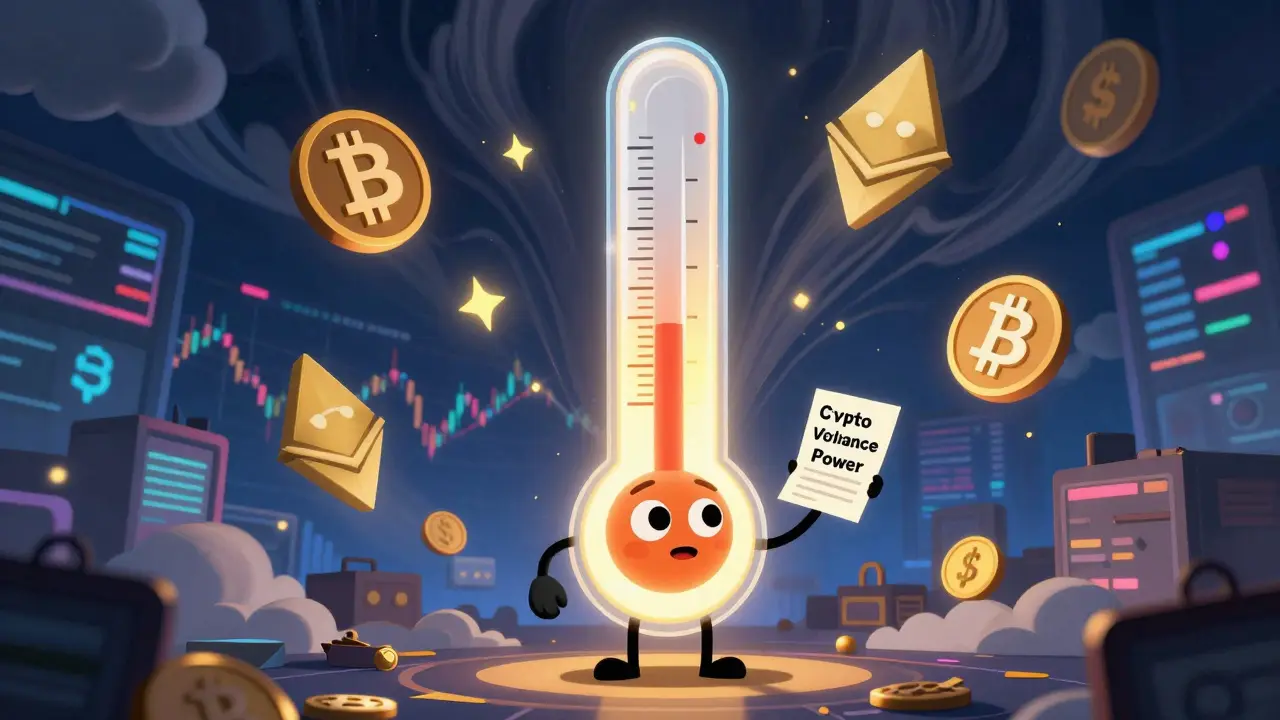
Govi (GOVI) isn't another meme coin or a flashy new blockchain project. It's a governance token built for something far more specific: measuring and trading crypto market volatility. If you've ever heard of the VIX index in traditional finance - the "fear gauge" that tracks stock market swings - GOVI is the crypto version of that, but built on decentralized tech. It’s not meant to be a store of value like Bitcoin or a utility token like Ethereum. It’s a tool for traders who want to hedge against wild price swings in Bitcoin and Ethereum.
What does GOVI actually do?
GOVI is the backbone of the Crypto Volatility Index (CVI) a decentralized platform that measures the expected 30-day volatility of Bitcoin and Ethereum using options market data. Instead of guessing whether the market will crash or rally, CVI gives you a number - from 0 to 200 - that tells you how much fear or calm is priced into the market right now. Think of it like a thermometer for crypto panic.
But GOVI isn’t just a price tag on this index. Holding GOVI gives you real power. Token holders vote on key decisions like:
- Which assets the CVI index tracks (currently just BTC and ETH)
- How much leverage traders can use when betting on volatility
- What fees are charged for trading or staking
- How platform revenue gets distributed
This isn’t a token that sits quietly in your wallet. It’s designed to be active. The more people use CVI to trade volatility, the more fees the protocol collects - and those fees get shared with GOVI stakers.
How staking works: xGOVI and auto-compounding
If you stake your GOVI tokens on the CVI platform, you don’t just earn rewards - you get xGOVI a receipt token that represents your share of the staking pool. Here’s the clever part: xGOVI auto-compounds. That means any rewards you earn - from trading fees or protocol incentives - are automatically reinvested into your staking position. No need to manually claim and re-stake. No gas fees every week. Just leave it, and your stake grows.
This design removes friction for long-term holders. It’s not about short-term speculation. It’s about aligning your financial interest with the platform’s success. If more people start using CVI to hedge their crypto portfolios, the fees go up - and so do your rewards.
Tokenomics: Fixed supply, low circulating supply
There are only 32 million GOVI tokens ever created. That’s it. No more. No inflation. As of early 2026, around 30.2 million are already in circulation - meaning nearly all of them are out in the market. There’s no big unlock coming. No team reserve to dump later. The supply is mostly baked.
With only 3,180 unique wallet holders, GOVI has a very small community compared to major tokens. That makes it more susceptible to price swings from even modest buying or selling pressure. A few large wallets can move the needle.
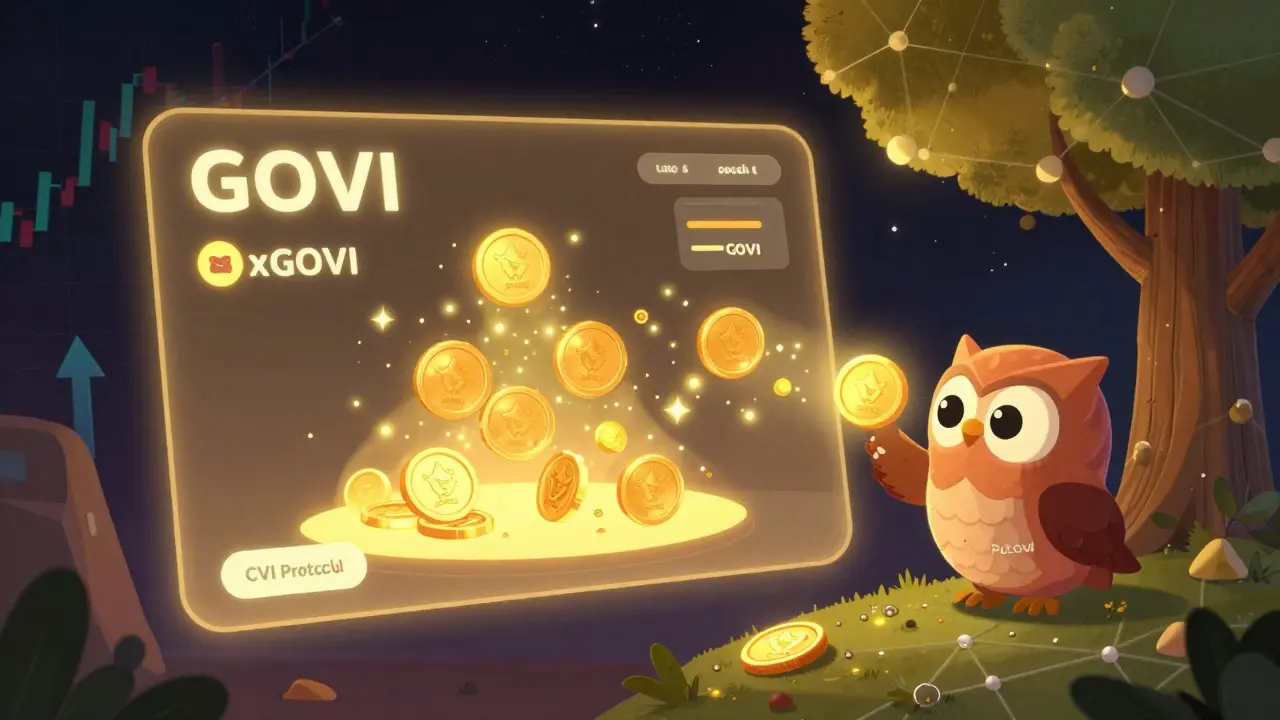
Price history: From .91 to Price history: From $7.91 to $0.02
.02
GOVI had a wild ride. It hit an all-time high of $7.91 on May 12, 2021. That was during the peak of DeFi mania, when everyone was chasing yield and volatility trading looked like the next big thing.
Today, as of February 2026, GOVI trades between $0.0025 and $0.0195, depending on the exchange. That’s a drop of over 99% from its peak. The market has completely repriced the project. Why? Because CVI never exploded into mainstream use. Trading volume on the index itself stayed low. Most crypto traders still use centralized options platforms or just hold BTC/ETH and hope for the best.
But here’s the twist: in the past month, GOVI jumped 103% from $0.0096. That’s not a recovery to its old highs - it’s a bounce from near-dead levels. Technical indicators show strong buy signals across moving averages, RSI, MACD, and others. But that doesn’t mean the long-term trend is fixed. The one-year change is still -84%, and the market cap hovers between $70,000 and $620,000 - tiny compared to even the smallest real cryptocurrencies.
Where you can trade GOVI
GOVI is listed on major exchanges like Gate.io, Coinbase, and Binance. But the real action is on Gate.io, where the GOVI/USDT pair handles over $10,000 in daily volume - more than all other exchanges combined. Coinbase reports a 7-day average volume of $78,720, but that includes all trading pairs.
Don’t expect deep liquidity. A $80,000 daily volume is microscopic. If you try to sell 10,000 GOVI tokens at once, you’ll likely crash the price. This isn’t a liquid asset. It’s a niche token with high risk and low volume.

Who’s behind GOVI?
The team includes Dr. Nir Haloani, Anton Suslonov, Yoni Neeman, and Tomer Armarnik. They’re associated with COTI, the blockchain network that powers CVI. But there’s little public info about their past work, track record, or development roadmap. No whitepaper updates. No major GitHub activity. No community AMAs. That lack of transparency is a red flag for many investors.
Is GOVI a good investment?
Let’s be blunt: GOVI is not for most people.
If you’re looking for a crypto to hold for years - skip it. The price has collapsed, the protocol isn’t widely used, and the team is quiet. There’s no clear path to recovery.
If you’re a trader who understands volatility and wants to earn yield from a niche DeFi product - maybe. Staking GOVI could give you passive income if CVI gains traction. But right now, you’re betting on a dead project coming back to life. The technical indicators are flashing "buy," but that’s often just noise in low-volume markets.
The real value of GOVI isn’t in its price. It’s in its function: a governance token for a real DeFi tool. But tools need users. And right now, CVI has almost none.
What’s next for GOVI?
Without major updates, marketing, or partnerships, GOVI will likely keep trading in a narrow range. If the team releases a new version of CVI with better user interfaces, integration with wallets like MetaMask, or partnerships with DeFi analytics platforms, maybe interest returns. But as of early 2026, there’s no sign of that.
For now, GOVI remains a ghost of its former self - a token with a solid idea, terrible adoption, and a price that reflects both.
Is GOVI a good long-term investment?
No, not as a long-term hold. GOVI’s price has dropped over 99% from its peak, and the CVI protocol has not gained significant user adoption. While staking offers yield, the underlying platform isn’t widely used, making it a high-risk bet with little upside. Only experienced DeFi traders who understand volatility markets should consider it.
How does GOVI differ from Bitcoin or Ethereum?
Bitcoin is digital gold. Ethereum is a programmable blockchain for apps. GOVI is neither. It’s a governance token for a single DeFi tool - the Crypto Volatility Index. It doesn’t have its own blockchain. It runs on COTI’s network. Its value comes only from voting rights and fee-sharing on CVI, not from network adoption or utility.
Can I stake GOVI and earn rewards?
Yes. By staking GOVI on the CVI platform, you receive xGOVI tokens, which automatically compound your rewards. These rewards come from trading fees collected by the CVI protocol. You don’t need to manually claim them - they’re reinvested automatically. But the total yield depends entirely on how much trading happens on CVI - which is currently very low.
Why did GOVI’s price crash so hard?
GOVI’s 2021 price surge was fueled by hype around DeFi volatility trading. But the CVI platform never became popular. Most traders still use centralized options or just hold BTC/ETH. Without user growth, fees stayed low, staking rewards dried up, and holders sold off. The token’s value is tied directly to platform usage - and usage never materialized.
Is GOVI available on Coinbase?
Yes, GOVI is listed on Coinbase, but trading volume is low. The most active trading occurs on Gate.io, where the GOVI/USDT pair handles over $10,000 daily. Coinbase is more of a listing than a major trading hub for this token.
What is xGOVI?
xGOVI is a receipt token you get when you stake GOVI on the CVI platform. It represents your share of the staking pool and automatically compounds rewards - meaning you don’t need to manually claim or re-stake. xGOVI’s value grows as CVI collects more trading fees, but it can’t be traded or transferred outside the platform.
How does CVI measure volatility?
CVI uses Black-Scholes option pricing models to calculate the 30-day implied volatility of Bitcoin and Ethereum. It pulls data from cryptocurrency options markets to estimate how much the market expects prices to swing in the next month. The index ranges from 0 to 200 - higher numbers mean more expected volatility.
Is GOVI a security?
There’s no official regulatory determination. GOVI is structured as a governance token, not a security, but its revenue-sharing model could attract scrutiny in jurisdictions like the U.S. or EU. No public audits or legal opinions have been published, so users assume all regulatory risk.
Can I use GOVI to hedge my crypto portfolio?
Not directly. GOVI itself isn’t a hedging instrument. But you can trade the CVI index - which GOVI governs - to hedge against volatility. For example, if you own BTC and fear a crash, you can buy CVI calls to profit if volatility spikes. GOVI holders benefit indirectly by earning fees from those trades.
What’s the difference between GOVI and CVI?
CVI is the volatility index platform - the tool that measures market fear. GOVI is the token that governs it. Think of CVI as the engine and GOVI as the steering wheel. You need GOVI to change how CVI works, but you use CVI to trade volatility. One is the governance asset; the other is the service.
Holly Perkins
February 14, 2026 AT 10:15Ben Pintilie
February 16, 2026 AT 01:07Sakshi Arora
February 17, 2026 AT 11:59Beth Trittschuh
February 17, 2026 AT 17:21kelvin joseph-kanyin
February 19, 2026 AT 00:00Elizabeth Choe
February 19, 2026 AT 18:33Crystal McCoun
February 19, 2026 AT 20:34Joe Osowski
February 20, 2026 AT 00:35Gaurav Mathur
February 20, 2026 AT 00:57Donna Patters
February 20, 2026 AT 08:48bala murali
February 22, 2026 AT 04:30Elijah Young
February 23, 2026 AT 13:38Jeremy Lim
February 24, 2026 AT 21:10Benjamin Andrew
February 25, 2026 AT 06:35