
When you hear "meme coin," you probably think of Dogecoin or Shiba Inu - funny animals, wild price swings, and zero real use. But Gorilla (GORILLA) isn’t just another meme with a logo. Launched in 2025, it’s trying something different: blending viral hype with actual tools you can use. If you’ve ever wondered if a meme coin can do more than just go up and down, Gorilla might surprise you.
What is Gorilla (GORILLA)?
Gorilla (GORILLA) is a cryptocurrency token built on two major blockchains: Ethereum (as an ERC-20 token) and BNB Smart Chain (as a BEP20 token). That means it works with wallets like MetaMask and can be traded on both Ethereum and Binance-linked platforms. Its total supply is capped at 1 billion tokens, but only about 870-900 million are in circulation right now. That small gap matters - it’s not flooding the market with new coins every week.
Unlike Dogecoin, which exists mostly as a joke with a community, Gorilla comes with four real features you can interact with:
- A collection of Mad Gorilla NFTs - digital collectibles tied to the brand.
- A cross-chain swapping platform - lets you trade tokens between Ethereum and BNB Chain without using a centralized exchange.
- A deflationary token model - part of every transaction fee gets burned, slowly reducing the total supply.
- An IDO Launchpad - a tool for new crypto projects to raise funds and launch their own tokens.
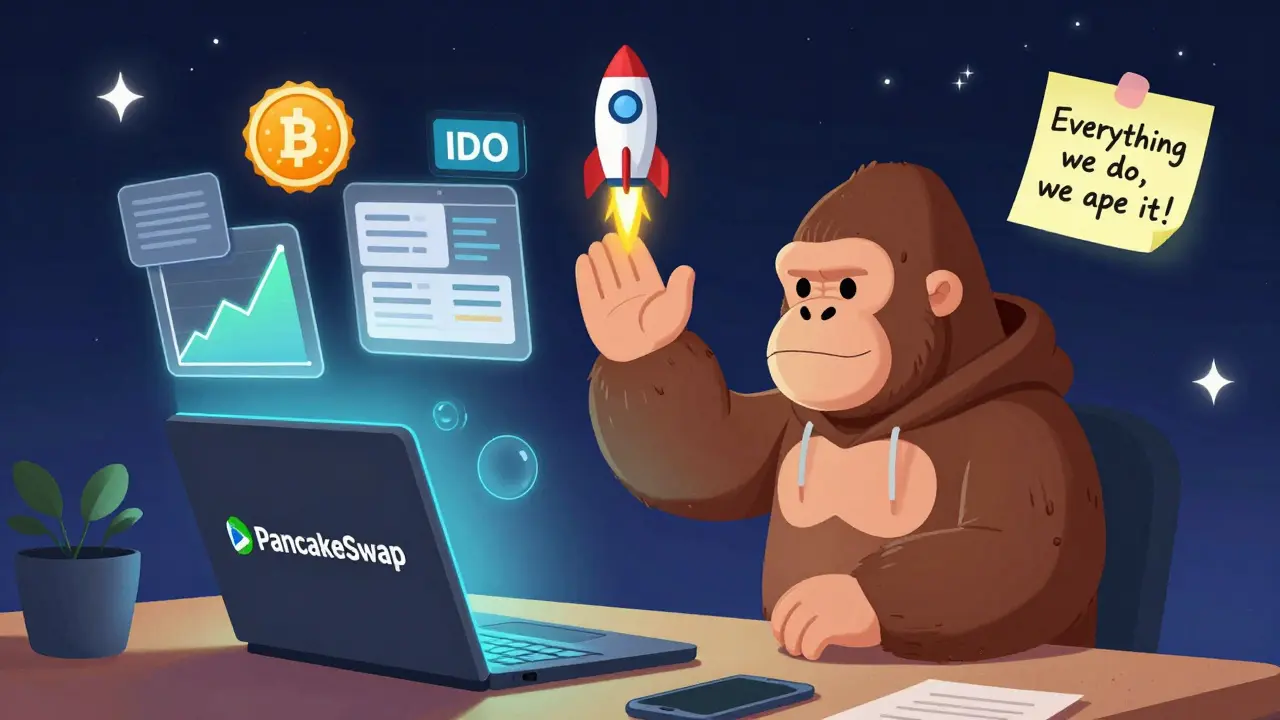
The project’s slogan - "Everything we do, we ape it!" - sounds silly, but it’s telling you something: this isn’t a serious finance tool. It’s a fun, community-driven ecosystem that still gives you real ways to earn, trade, and participate.
How does Gorilla’s tokenomics work?
Most meme coins dump millions of new tokens into circulation, which kills long-term value. Gorilla’s approach is more like a savings account with a lock.
Every time someone trades GORILLA, a small fee is taken. Half of that fee goes to reward stakers. The other half? It gets burned - permanently removed from circulation. With over 1 billion tokens planned, burning even 0.1% per transaction adds up over time. If trading stays active, the supply could shrink noticeably over the next few years.
There’s also staking. If you hold GORILLA in your wallet and lock it into the platform, you earn more GORILLA as rewards. It’s not a high yield like some risky DeFi projects - but it’s steady. And it encourages people to hold, not sell. That’s smart design. It reduces panic selling during dips.
Where can you trade Gorilla?
Gorilla isn’t on Coinbase or Binance’s main exchange. You won’t find it on your usual apps. But it’s active on decentralized exchanges (DEXes), especially PancakeSwap (v2) on BNB Smart Chain. That’s where 80% of its trading happens.
There are also 24 other trading pairs across smaller exchanges, including some centralized ones. The 24-hour trading volume hovers around $250,000 - not huge, but enough to keep things liquid. You can buy and sell without getting stuck.
As of early March 2026, GORILLA’s price swings between $0.00034 and $0.00126 depending on the site. CoinMarketCap lists it at $0.00043, with a market cap of just over $450,000. That’s tiny compared to Bitcoin or even Shiba Inu. But for a 2025 project? It’s alive. It’s trading. People are using it.
Why does price jump so much?
One week before March 2026, GORILLA surged 42.9%. Meanwhile, the whole crypto market rose 0.2%. That’s not luck. That’s community momentum.
Meme coins live or die by social buzz. A viral tweet, a YouTube video, or a big holder dumping a chunk can spike prices. Gorilla’s team leans into this. Their YouTube channel, Crypto Gorilla, posts daily content: how to stake, how to swap chains, how to join their NFT drops. They don’t promise riches. They show you how to use the tools.
Analysts from Changelly predict GORILLA could hit $0.0122 by 2028 and $2.17 by 2040. Those are long shots. But they’re not random. They’re based on burn rates, staking adoption, and trading volume trends. If the ecosystem grows - if more projects launch on their IDO platform, if more people swap chains using their tool - then demand could climb. That’s the bet.
Is Gorilla better than Dogecoin or Shiba Inu?
Not in fame. Not in market cap. Not in brand recognition.
But here’s where it stands out:
| Feature | Gorilla (GORILLA) | Dogecoin (DOGE) | Shiba Inu (SHIB) |
|---|---|---|---|
| Launch Year | 2025 | 2013 | 2020 |
| Token Standard | ERC-20 & BEP20 | Own blockchain | ERC-20 |
| Deflationary Burn | Yes - transaction fees burned | No | Yes - but slower |
| Staking Rewards | Yes - locked staking available | No | Yes - via ShibaSwap |
| Utility Features | NFTs, cross-chain swap, IDO launchpad | None | ShibaSwap, Shibarium L2 |
| Market Cap (March 2026) | $450k | $18B | $7.2B |
Gorilla doesn’t beat them on size. But it beats them on function. If you want a meme coin that does something besides sit in your wallet, Gorilla gives you tools. Dogecoin? It’s a joke. Shiba Inu? It’s trying to be a platform, but it’s bloated. Gorilla is lean, focused, and built for action.
What are the risks?
Let’s be clear: this isn’t a safe investment. It’s a high-risk, high-reward play.
- Volatility - One day it’s $0.0008, the next it’s $0.0003. You need nerves of steel.
- Low liquidity - $250k daily volume means big orders can move the price fast.
- Unproven track record - It’s only been around for a year. No one knows if it lasts.
- Community dependence - If the YouTube channel dies, if the devs vanish, the whole thing could collapse.
- Scam risk - Meme coins are prime targets for rug pulls. Always check contract addresses. Never send funds to unknown links.
Always use a non-custodial wallet. Never trust a "guaranteed return" offer. And never invest more than you can afford to lose.
Who is Gorilla for?
Gorilla isn’t for investors looking for a retirement fund. It’s for people who:
- Like crypto but hate boring DeFi apps
- Want to try NFTs without paying $100 per piece
- Enjoy trading on decentralized exchanges
- Like being part of a community that actually posts updates
- Are curious about cross-chain tech and want to test it out
If you’ve ever bought a meme coin just because it looked fun, Gorilla is the next step. It’s still fun. But now, you can actually do something with it.
Where to learn more
The official site is gorillabsc.vip - but always double-check the URL. Scammers copy these all the time.
Their YouTube channel, Crypto Gorilla, has clear, no-nonsense tutorials. No hype. Just how to connect your wallet, swap tokens, stake, and join NFT drops. If you’re new to DeFi, start there.
And if you’re wondering whether to buy? The answer isn’t "yes" or "no." It’s: "Do you understand the risks? Do you want to use the tools? Are you okay with losing it all?" If yes - go ahead. But don’t expect a miracle.
Is Gorilla (GORILLA) a good investment?
Gorilla isn’t a "good investment" in the traditional sense. It’s a speculative meme coin with real utility features - staking, NFTs, and a cross-chain swap tool. Its value depends on community growth, trading volume, and whether users keep using its platform. If you’re okay with high risk and want to experiment with DeFi tools, it’s worth a small position. Never invest more than you can afford to lose.
Can I buy Gorilla on Coinbase or Binance?
No, Gorilla is not listed on major centralized exchanges like Coinbase or Binance. You can only trade it on decentralized exchanges, primarily PancakeSwap (v2) on the BNB Smart Chain. You’ll need a wallet like MetaMask and some BNB to pay for transaction fees.
How does the burn mechanism work in GORILLA?
Every time someone trades GORILLA, a small fee (usually around 5-10%) is taken. Half of that fee goes to stakers as rewards. The other half is sent to a burn address - a wallet that can’t be accessed. Those tokens are permanently removed from circulation. Over time, this reduces the total supply, which can help increase value if demand stays steady.
What’s the difference between ERC-20 and BEP20 for GORILLA?
ERC-20 means GORILLA runs on Ethereum, while BEP20 means it runs on BNB Smart Chain. Both are standards for tokens, but they use different networks. BEP20 is faster and cheaper to use, which is why most trading happens there. ERC-20 lets you trade on Ethereum-based platforms. The token is the same - just deployed on two chains for more flexibility.
Is the Gorilla NFT collection worth anything?
Right now, the Mad Gorilla NFTs are mostly collectibles with community perks - like early access to IDOs or staking bonuses. They’re not priced like high-end art. Their value comes from utility within the ecosystem, not resale. If the project grows, these NFTs could gain more benefits. But don’t buy them expecting to flip for profit.
Can I stake GORILLA without locking it up?
No. To earn staking rewards, you must lock your GORILLA tokens in the official staking contract for a set period. This ensures liquidity stays in the system and helps stabilize the network. You can’t just hold in your wallet and earn. Always use the official staking page - never enter your private key anywhere.
What’s the contract address for GORILLA?
The official BNB Smart Chain contract address is 0xcf640fdf9b3d9e45cbd69fda91d7e22579c14444. Always verify this on the official website before trading or staking. Never trust links from social media or YouTube comments - scammers change addresses to steal funds.
Why is the price so different on CoinMarketCap vs CoinGecko?
Different platforms use different data sources and weighting methods. CoinMarketCap might pull from fewer trading pairs, while CoinGecko includes more. Gorilla trades on many small DEXes, so each site sees slightly different prices. The real price is what you see on PancakeSwap - that’s where most trading happens. Use that as your baseline.
Final thought
Gorilla (GORILLA) isn’t the next Bitcoin. It won’t change the world. But it’s one of the few meme coins that actually tries to build something useful. If you’re tired of buying jokes with no purpose, and you want to dabble in crypto with a little more substance - this might be your ticket. Just keep it small. Keep it smart. And never forget: in crypto, fun doesn’t pay the bills. Discipline does.
Nancy Jewer
March 4, 2026 AT 09:13Gorilla’s deflationary model is actually one of the most elegantly designed meme token mechanics I’ve seen in 2025. The dual-chain deployment on ERC-20 and BEP20 isn’t just FOMO bait-it’s a pragmatic bridge between Ethereum’s liquidity and BNB’s low fees. And the burn rate? It’s not just a gimmick. If trading volume holds above $200k daily, we’re looking at a 15-20% supply reduction over 18 months. That’s not speculation. That’s math.
Staking rewards are modest but sustainable. No 500% APY nonsense. Just steady compounding. That’s how you build a loyal holder base instead of a pump-and-dump mob.
The IDO launchpad is the real sleeper here. If even five legit projects launch there next year, GORILLA becomes the infrastructure layer for a new wave of community-driven tokens. That’s utility.
Also, the NFTs? They’re not JPEGs. They’re access keys. Early stakers get priority. That’s smart incentive design.
People keep comparing it to SHIB or DOGE. That’s like comparing a Swiss watch to a wind-up toy. Different categories entirely.
Ken Kemp
March 5, 2026 AT 00:53sooo i just bought 500k GORILLA after reading this and im so excited!!
gonna stake it all and wait for the moon!!
ps: i think the contract address in the post is wrong? i saw another one on their discord? anyone else confused??
Julie Potter
March 5, 2026 AT 16:55OMG this is the most exciting thing to happen in crypto since Doge went to the moon!!
Did you SEE the price jump last week?! 42% in 24 HOURS?!
I’m crying. I’m selling my car. I’m moving to Bali. I’m buying more GORILLA.
Also-did you know the dev team is secretly funded by Elon? No one’s talking about it but I’ve got sources. The NFTs are going to be used as digital IDs in the next version of Twitter. I’m not joking. I’m not. I’m not.
THEY’RE BUILDING THE FUTURE. AND IT’S A GORILLA.
Leah Dallaire
March 6, 2026 AT 23:10Let’s be real. Every meme coin claims to have "utility."
Every one says "burns" and "staking" and "NFTs."
They all promise "community."
But here’s the truth: this is a honeypot.
The contract address? You think it’s safe? You think the devs won’t just pull the rug after hitting $10M market cap?
Look at the history. Every project with a "cross-chain swap" and "IDO launchpad" and "deflationary model" ends up with the devs cashing out and the Discord going silent.
This isn’t innovation. It’s a rebrand of the same scam, dressed up in new jargon.
And you? You’re the one who’ll be holding the bag when the YouTube channel goes dark next month.
Just sayin’.
prasanna tripathy
March 7, 2026 AT 22:10Respect the effort. Honestly.
Most meme coins are just memes. This one? At least they built something.
I’ve been using the cross-chain swap for a month now. It’s clunky, sure. But it works. No KYC. No middleman. Just me, my wallet, and the chain.
Staking rewards are small, but they compound. I’ve earned 12% in 90 days. Not life-changing. But real.
And the NFTs? I got one for free. It unlocked a staking boost. That’s cool.
It’s not Bitcoin. But it’s not trash either. Just… a quiet experiment.
And if it dies? At least I tried something different.
Jonathan Chretien
March 9, 2026 AT 06:14Wow. Just wow.
It’s like someone took the chaos of Doge, the bloated ambition of SHIB, and then… filtered it through a philosopher’s lens.
"Everything we do, we ape it!" - that’s not a slogan. That’s a manifesto.
You know what’s beautiful? The burn mechanism. It’s not about scarcity. It’s about *ritual*. Every transaction is a sacrifice to the crypto gods. A tiny offering.
And the staking? That’s not yield. That’s devotion.
This isn’t finance. It’s crypto as performance art.
And I’m here for it.
🔥🦍
Bill Pommier
March 10, 2026 AT 01:38While the structural elements of this token are technically sound, the underlying risk profile remains unacceptably high.
First, the liquidity pool concentration on PancakeSwap creates a single point of failure. A large sell order could trigger cascading slippage.
Second, the reliance on a single YouTube channel for community cohesion is a governance vulnerability of catastrophic proportions.
Third, the market cap of $450k is statistically irrelevant in the context of global crypto asset distribution.
Fourth, the absence of a formal audit raises material concerns regarding contract integrity.
Recommendation: Do not allocate capital. This is not an investment. It is a speculative gamble dressed in academic language.
- Bill Pommier, CFA (Ret.)
Olivia Parsons
March 11, 2026 AT 17:39I’m new to crypto and this post actually helped. So thanks.
So… the burn is like, every time someone trades, some coins get destroyed?
And staking means I lock my coins and get more back later?
And I can’t buy this on Coinbase?
So I need MetaMask and BNB to even start?
Can someone explain how to do that? Like, step by step? I’m scared I’ll lose everything.
Nick Greening
March 11, 2026 AT 19:39"Real utility"? LOL.
You think a cross-chain swap is utility? That’s what every DeFi project has been doing since 2021.
NFTs? Please. I’ve got 17 NFTs of cats that do nothing.
Staking? You’re getting 3% APY? That’s worse than a savings account.
This isn’t innovation. It’s a marketing deck written by a 19-year-old who watched too many YouTube tutorials.
And the "Mad Gorilla" NFTs? That’s not a brand. That’s a bad clipart collection.
Don’t be fooled. It’s still a meme coin. Just with extra steps.
Issack Vaid
March 12, 2026 AT 09:36Let’s not pretend this is revolutionary.
It’s a cleverly packaged cultural artifact.
The gorilla as a symbol? It’s not random. It’s a postmodern commentary on ape culture in crypto - the blind enthusiasm, the herd mentality, the irrational exuberance.
The burn mechanism? That’s the ritual sacrifice of the fool to the algorithm.
The IDO launchpad? A democratic rebellion against centralized VC control.
This isn’t a token.
It’s a mirror.
And if you’re still buying it because "it’s fun," then you’re the subject of the art.
And that… is beautiful.
Shawn Warren
March 13, 2026 AT 08:20Just wanted to say this is one of the most thoughtful breakdowns of a meme coin I’ve ever read
Staking is underrated
Burn mechanics are the future
NFT utility is real
Cross chain is the only way forward
Community matters more than market cap
Do your own research
But seriously this is the real deal
Buy the dip
Long term hold
Apes together strong
Jackson Dambz
March 13, 2026 AT 17:45I read all this.
Too much.
Too many words.
Too many charts.
Too many "benefits".
I’m tired.
Just tell me if I should buy.
Or not.
Don’t make me think.
Megan Lutz
March 14, 2026 AT 20:40What’s fascinating here isn’t the tokenomics. It’s the language.
The post doesn’t sell you wealth. It sells you participation.
"Use the tools."
"Join the drops."
"Don’t expect a miracle."
That’s radical in crypto.
Most projects scream "100x" and vanish.
This one says: "Here’s how to use it. It might fail. But if it doesn’t, you’ll have done something real."
That’s not a coin.
That’s a philosophy.
And honestly? That’s more valuable than any APY.
Jesse VanDerPol
March 15, 2026 AT 12:38Staking works. I’ve been doing it for 3 months.
Got 12 GORILLA back.
Not life-changing.
But steady.
And the swap? Took 12 seconds. No issues.
Just… keeping it real.
No hype.
Austin King
March 16, 2026 AT 17:03Just bought my first GORILLA. Took me 2 hours to figure out how to connect MetaMask. Worth it.
Thanks for the guide.