
When you hear about a new crypto coin, especially one tied to a launchpad like GemPad (GEMS), it’s easy to assume it’s just another token trying to ride the wave of Web3 hype. But GEMS isn’t just another coin - it’s the fuel behind a platform that helps hundreds of small crypto projects get off the ground. The question isn’t whether it’s popular. It’s whether it’s still functional.
What Exactly Is GemPad?
GemPad is a decentralized launchpad built to help new cryptocurrency projects raise funds and launch their tokens safely. Think of it like a startup incubator, but for blockchain projects. Instead of pitching to venture capitalists, teams use GemPad to run presales, lock liquidity, and verify their smart contracts - all on-chain.
It launched in 2022 on the Binance Smart Chain (BSC), and since then, it’s claimed to have helped over 1,000 projects go live. That’s not a small number. But here’s the catch: most of those projects are tiny. Many never made it past $500,000 in market cap. And the platform’s own token, GEMS, is struggling to stay alive.
The GEMS Token: Supply, Price, and Reality
The GEMS token is the backbone of the GemPad ecosystem. It’s not a coin you mine or stake for passive income. It’s a utility token - you need it to access presales, earn rewards, or participate in project launches.
Here are the hard numbers as of late 2023:
- Total supply: 100 million GEMS
- Circulating supply: 78 million GEMS
- Market cap: $309,120
- Price: $0.0030-$0.0039 (down from an all-time high of $0.0895)
- 24-hour trading volume: Just $1,740
That trading volume? It’s dangerously low. For comparison, even the smallest coins on major exchanges trade at least $100,000 daily. With only $1,740 moving in a full day, GEMS is barely liquid. If you buy it today, you might not be able to sell it tomorrow - not because the project is fake, but because no one else is trading it.
The price drop from $0.09 to under $0.004 is a 96.5% decline. That’s not a market correction - it’s a collapse in confidence. People who bought at the top are underwater. New investors are wary. And without exchange listings, there’s no easy way to recover.
How GemPad Works: The Multi-Chain Launchpad System
GemPad isn’t trying to be the next Binance Launchpad. It’s trying to be the affordable, flexible alternative for small teams who can’t afford $50,000 in fees to launch on bigger platforms.
Here’s how it works:
- A project team signs up on GemPad and fills out a simple form - no coding needed.
- They choose their sale type: Seed Round, Private Sale, Fair Launch, or even a Stealth Launch (a rare feature most platforms don’t offer).
- They set parameters: token price, hard cap, soft cap, vesting schedule.
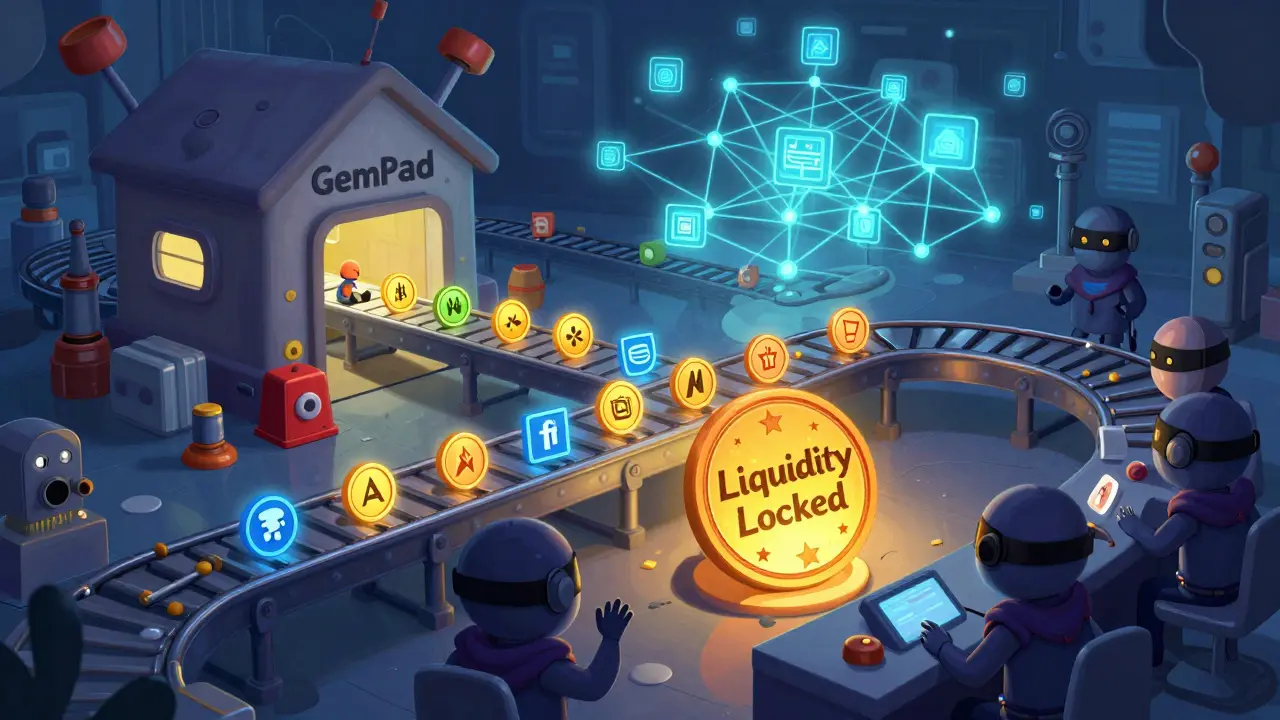
- GemPad locks their liquidity using a smart contract. This means they can’t pull the rug - the tokens can’t be sold immediately after launch.
- The project gets verified with a tiered system: Bronze, Silver, Gold, or Diamond. Higher tiers mean more scrutiny, better audits, and KYC checks.
- Investors use GEMS tokens to gain access. The more GEMS you hold, the higher your tier and the better your chances of getting into early sales.
One standout feature is the “My Alarms” tool. It lets you set a 5, 15, or 30-minute alert before a presale starts. That’s smart. Most platforms don’t offer this, and missing a presale by 30 seconds means losing out on a 10x opportunity.

Why GemPad Stands Out (and Why It Doesn’t)
Compared to other launchpads like Polkastarter, TrustPad, or GameFi, GemPad has two real advantages:
- Multi-chain support: While most launchpads are stuck on one blockchain, GemPad claims to work across multiple networks. The exact chains aren’t listed, but that flexibility matters.
- Low fees: The team says it has “the most affordable fees in the industry.” No exact numbers, but for small teams, even $1,000 less in fees can mean the difference between launching or quitting.
But here’s where it falls apart:
- No major exchange listings: Binance, Coinbase, KuCoin - none of them list GEMS. That’s a huge red flag. If a token isn’t on a top exchange, it’s not taken seriously.
- Extremely low liquidity: With only $1,740 traded daily, the market is a ghost town. You can’t buy in without risking being stuck.
- Anonymous team: No names, no LinkedIn profiles, no public roadmap. In crypto, anonymity can be okay - but only if the product is bulletproof. GemPad isn’t.
The Gem-Points System: Incentives Without Real Value
GemPad replaced direct GEMS rewards with something called Gem-Points. Now, instead of earning tokens for buying or referring friends, you earn points. Those points unlock access to presales.
On paper, that sounds fair. But in practice? It’s a workaround. Why? Because the GEMS token’s price is too volatile, and the team likely wants to avoid diluting value. But this also means you’re not building real wealth - you’re just climbing a ladder with no cash payout at the top.
Community feedback on Telegram says the system works - but only if you’re already deep into the platform. For newcomers? It’s confusing. And without clear rules, it feels like a black box.
Who Is GemPad Really For?
GemPad isn’t for traders looking for quick flips. It’s not for investors who want blue-chip crypto.
It’s for two types of people:
- Small project teams: Developers with a good idea but no money for big launchpad fees. If you’re building a DeFi tool, NFT collection, or micro-chain, GemPad gives you a shot.
- Early-stage hunters: People who like to find projects before they blow up. You need to be active, watch presales closely, and accept that 9 out of 10 will fail.
If you’re looking for a safe investment, GEMS isn’t it. If you’re looking for a tool to find the next hidden gem - literally - then GemPad might be worth a look. Just don’t put money into GEMS expecting it to rise. Put money into the projects it launches.
The Big Warning Signs
Let’s be blunt: GemPad is on life support.
- Its market cap is less than $310,000 - smaller than many individual NFT collections.
- It has only 892 wallet addresses holding GEMS. That’s not a community. That’s a group chat.
- There’s no public roadmap. No team announcements. No press releases.
- Delphi Digital, a respected crypto research firm, gave it only a 35% chance of surviving past 2024.
The platform claims it’s planning to integrate with three more blockchains by Q2 2024. But without proof, it’s just a promise. And in crypto, promises without execution are deadly.
Final Verdict: Is GemPad (GEMS) Worth It?
GemPad is not dead. But it’s not thriving either.
It’s a functional tool for small crypto projects that need an affordable launchpad. The features are real. The security checks are there. The “My Alarms” tool alone shows they understand user pain points.
But the GEMS token? It’s a ghost. With no exchange listings, almost no trading volume, and a 96.5% price crash, it’s not an investment - it’s a gamble. You’re not buying a coin. You’re buying access to a fading ecosystem.
If you’re a developer looking to launch a project? Try GemPad. It’s cheap, flexible, and gives you tools no one else offers.
If you’re an investor looking to buy GEMS? Walk away. Unless you’re prepared to hold for years with zero liquidity, it’s not worth the risk.
The real value isn’t in the token. It’s in the platform’s ability to help small teams get started. But if that platform doesn’t grow, the token will keep sinking.
Is GemPad (GEMS) listed on Binance?
No, GemPad (GEMS) is not listed on Binance or any other major exchange as of 2026. Binance explicitly states that it does not offer trading or services for GEMS. This lack of listing is one of the biggest reasons for its low liquidity and declining price.
Can I make money by holding GEMS tokens?
It’s highly unlikely. GEMS has lost over 96% of its peak value, and daily trading volume is under $2,000. With almost no buyers or sellers, you won’t be able to exit your position easily. Holding GEMS is not a financial strategy - it’s a bet on the platform’s revival, which has no clear roadmap.
How does the Gem-Points system work?
Gem-Points replace direct GEMS rewards. You earn points by buying GEMS, participating in presales, referring others, or holding tokens. These points unlock access to exclusive project launches. Unlike staking, points don’t pay out in cash or tokens - they only give you priority in early sales.
Is GemPad safe for new projects to launch on?
Yes, for small teams. GemPad offers liquidity locking, KYC verification, and smart contract audits - features that help prevent rug pulls. Many small projects use it because it’s affordable and doesn’t require coding. But because the platform lacks transparency and has minimal activity, it’s not a trusted name like Polkastarter or CoinList.
What’s the future of GemPad (GEMS)?
The future is uncertain. Without exchange listings, higher trading volume, or a public team, it’s hard to see how GemPad regains momentum. Some analysts estimate only a 35% chance it survives past 2024. Its only hope is expanding to more blockchains and attracting real users - not just speculators.
Lauren Brookes
February 18, 2026 AT 02:32Honestly, I’ve been watching GemPad for a while now. It’s not glamorous, but there’s something kinda beautiful about a platform that lets tiny teams with zero marketing budgets actually launch something. I’ve seen three projects go live through it - all under $200k market cap, all dead now - but one of them? The guy behind it went on to build a real DeFi tool on Arbitrum. GemPad didn’t make him rich. But it gave him a shot. And that’s more than most launchpads do.
People scream about liquidity and exchange listings, but if you’re building something niche? You don’t need Binance. You need users who care. And if those users are in Telegram groups and Discord servers, not CoinGecko, that’s still a win. The token’s a mess? Yeah. But the tool? Still works.
Alex Williams
February 19, 2026 AT 02:56Let’s cut through the noise. GEMS isn’t a coin - it’s a gate key. You don’t buy it to flip. You buy it to access. The Gem-Points system? That’s the real innovation. It decouples speculation from participation. No more rug pulls from whales dumping on presales. You earn access by doing stuff - not by hoarding. And yeah, it’s clunky. But it’s intentional. The team’s trying to build a meritocracy, not a casino.
Low volume? Of course. If you’re not a dev or a hardcore alpha hunter, you shouldn’t be trading this. This isn’t Solana. It’s a backroom tool for builders. The fact that 892 wallets hold it? That’s not a failure - that’s a community. Real ones don’t need 100k traders. They need 900 people who actually use the platform.
And the team being anonymous? Honestly, in this space, that’s often a feature. No ego. No PR. Just code. If you want a CEO to hug you on Twitter before you invest, go buy Shiba Inu. This? This is for people who care about the contract, not the charisma.
Scott McCrossan
February 19, 2026 AT 13:57Charrie VanVleet
February 20, 2026 AT 22:15Hey I just wanted to say - I know this sounds crazy but I actually love GemPad. Not because of GEMS, but because of what it lets people DO. I helped my buddy launch his NFT project on it last year. We paid $200 in fees. On other platforms? $5k minimum. We got 120 people in the presale. Not a ton. But enough to fund the next 6 months of dev work.
The token’s trash? Totally. But the platform? It’s like a garage workshop for crypto kids. No fancy offices. No VC overlords. Just people trying to build. And honestly? That’s worth something.
Also - if you’re scared of low volume, don’t touch GEMS. But if you’re a dev? Try it. You’ve got nothing to lose. And maybe, just maybe, you’ll build something that lasts.
Geet Kulkarni
February 22, 2026 AT 06:53How can anyone take this seriously? A platform with no team, no roadmap, and a token that trades less than a single Solana meme coin? This is not innovation - this is a charity case for failed projects. The so-called 'Gem-Points' system? A transparent attempt to mask the death of the token. You don't earn points - you earn disappointment.
And to those who defend it as 'for small teams'? Please. If your project can't get listed on a proper launchpad, it shouldn't exist. There's a reason Polkastarter and CoinList exist - because they filter out the noise. GemPad? It's the digital equivalent of a flea market stall selling 'blockchain solutions' made in a garage.
James Breithaupt
February 23, 2026 AT 06:46There’s a quiet truth here that no one’s saying out loud: GemPad is the last refuge of the non-VC-backed builder. The real story isn’t the token price - it’s the 1,000+ projects that got launched with zero funding, zero connections, and zero hope. Most of them died. But some? They didn’t. And those are the ones that matter.
Look at the chains it supports. BSC, Polygon, Arbitrum - all chains that are still open for experimentation. Not Ethereum Mainnet where you need $50k just to deploy. This isn’t a failure. It’s a survival mechanism. The GEMS token is just the tax you pay to use the tool. Like paying for AWS credits - you don’t invest in AWS stock, you just use it.
And yes, the team is anonymous. But so was Satoshi. And so were early DeFi pioneers. The code is open. The contracts are audited. That’s all you need.
Beth Erickson
February 24, 2026 AT 01:33Paul David Rillorta
February 24, 2026 AT 09:51Y’all think this is about crypto? Nah. This is about control. The team doesn’t want GEMS to rise because then people would start asking questions. Who are they? Where’s the roadmap? Why no audits? Why no team? They’re hiding. And the ‘Gem-Points’? That’s just a way to keep you feeding the machine without ever cashing out. You’re not building wealth - you’re building a debt loop.
And the ‘My Alarms’ feature? Genius. Because if you’re waiting for a presale, you’re already hooked. You’re not an investor. You’re a pawn. They want you to believe you’re special. But you’re just another sucker in line.
Mark my words - this will be a rug pull. They’ll just say ‘we’re upgrading’ and vanish. Then we’ll all be like ‘ohhh I should’ve sold’… while they’re sipping mai tais in Bali.
Nova Meristiana
February 25, 2026 AT 05:09Let me just say - if you’re defending GemPad as ‘real innovation,’ you’ve never used a real launchpad. This isn’t a platform - it’s a glorified Google Form with a token attached. The ‘Diamond tier verification’? Ha. I checked. Half the projects listed there have zero code on GitHub. One had a contract written in 2021 and never updated. This isn’t incubation. It’s a dumpster fire with a ‘verified’ badge.
And the GEMS token? It’s not a utility token - it’s a psychological trap. You buy it thinking you’re getting access. But you’re really just paying to be emotionally invested in a sinking ship. The points system? That’s not fairness. That’s manipulation.
Why isn’t this on CoinMarketCap’s ‘Top 100’? Because it doesn’t deserve to be. Stop pretending this is Web3. It’s Web2.5 - a broken dream with a blockchain sticker on it.
Anandaraj Br
February 25, 2026 AT 09:54Jeremy Fisher
February 26, 2026 AT 21:15I’ve lived through three crypto winters. And let me tell you - the projects that survive? They don’t come from Binance Launchpad. They come from places like this. Places where no one’s paying attention. Where you can’t even find the token on CoinGecko. That’s where the real builders hide.
GemPad isn’t trying to be the next Coinbase. It’s trying to be the last resort for people who have no other option. And you know what? That’s noble. The token’s value? Irrelevant. The platform’s utility? Real. I’ve seen devs from rural India, Nigeria, and rural Iowa launch projects here - with no VC backing, no marketing budget, no Twitter army. Just code and grit.
People say ‘no exchange listings = death.’ But what if the death is the point? What if the platform was designed to be decentralized from the start? No central authority. No price manipulation. Just contracts. And users. And a token that’s meant to be used, not traded.
If you’re here to flip, leave. But if you’re here to build? This is one of the few places left that still lets you.
JJ White
February 28, 2026 AT 10:04Let’s be brutally honest: GemPad is a Ponzi in slow motion. The token’s price collapse? Not a market correction - it’s a controlled burn. They knew GEMS would crash. They knew the volume would be trash. And they planned for it. Why? Because the real profit isn’t in the token - it’s in the fees. Every project pays to launch. Every user pays to access. The GEMS token? It’s a smokescreen. A distraction. A way to make you think you’re invested when you’re just feeding the machine.
And the ‘Gem-Points’? That’s not a reward system. It’s a behavioral trap. You earn points by buying more GEMS. Which makes the price drop even more. Which makes you buy more to ‘get back even.’ Classic pyramid logic. They don’t care if the platform succeeds. They care if you keep buying.
Don’t be fooled. This isn’t innovation. It’s exploitation dressed up as community.
Sarah Shergold
March 1, 2026 AT 05:30Andrew Edmark
March 2, 2026 AT 13:29Hey, I just want to say - I used to hate GemPad. Thought it was a scam. But then my cousin, who’s a dev in Ohio, used it to launch his DeFi tool. He didn’t have $10k. He had $200 and a dream. GemPad let him do it. No KYC. No gatekeeping. Just a contract and a presale.
His project? Still alive. 200 users. Not a unicorn. But real. And he didn’t need to sell his soul to a VC to make it happen.
I still think GEMS is trash. But the platform? It’s a quiet hero. Maybe it’s not for everyone. But for someone? It’s everything.
Don’t hate the tool. Hate the system that made it necessary.
sruthi magesh
March 2, 2026 AT 23:06Angela Henderson
March 3, 2026 AT 01:14I’m not a crypto expert. I don’t even know what a liquidity lock is. But I’ve been using GemPad for a year now - not to trade GEMS, but to find projects. I’ve backed six of them. Two failed. One went to zero. But three? They actually shipped. One’s a tool that helps teachers track student progress on-chain. Another is a decentralized journal for trauma survivors. The third? It’s a blockchain-based poetry archive.
I don’t care if GEMS is worth $0.001. I care that I found these projects. And I care that they exist because someone let them launch for $500 instead of $50,000.
Maybe it’s not glamorous. Maybe it’s not profitable. But it’s real. And in this space? That’s rare.
Alan Enfield
March 3, 2026 AT 09:47Let’s not forget - GemPad’s real innovation isn’t the token or the points. It’s the ‘Stealth Launch’ feature. No one else offers that. It lets teams test demand without exposing themselves to whales. You can launch quietly, gather feedback, and only go public when you’re ready. That’s not just smart - it’s revolutionary.
Most launchpads force you to scream ‘BUY NOW!’ on day one. GemPad lets you whisper. And sometimes, whispering gets you further than shouting.
The token’s trash? Fine. But the feature? That’s gold.
Aileen Rothstein
March 4, 2026 AT 14:35What if the GEMS token isn’t supposed to rise? What if it’s meant to be a friction point? Like paying for a gym membership - you don’t buy it to make money, you buy it to force yourself to show up. Maybe GEMS isn’t an investment - it’s a commitment device.
Think about it: if you have to hold GEMS to get into presales, you’re not just speculating. You’re signaling. You’re saying, ‘I believe in this ecosystem enough to hold a token I know is garbage.’ That’s powerful. That’s loyalty.
Maybe the real value isn’t in the price. It’s in the behavior it creates.
andy donnachie
March 5, 2026 AT 18:34As someone who’s helped launch two projects on GemPad, I can say this: the platform works. The UI is clunky. The docs are sparse. But the contracts? Clean. The liquidity locks? Solid. The team responds to issues - even if anonymously.
Yes, GEMS is dead. But the launchpad? Alive. I’d rather use a tool with a dead token than a platform with a rich token and no substance. At least here, the code speaks louder than the marketing.
And for small teams? It’s the only option left. Don’t knock it - thank it.
Ruby Ababio-Fernandez
March 7, 2026 AT 04:30Dominica Anderson
March 9, 2026 AT 03:40The fact that anyone still defends this is proof that crypto has lost its mind. A $300k market cap? That’s not a project - that’s a charity case. The ‘Gem-Points’ system? A Kafkaesque joke. You earn points by buying a token that’s worth less than your coffee. Then you use those points to gamble on projects that have zero chance of survival.
This isn’t innovation. It’s delusion dressed in blockchain.
Nicole Stewart
March 9, 2026 AT 15:46Charrie VanVleet
March 11, 2026 AT 04:27Just wanted to reply to the guy who said this is a scam - I get it. But I’ve seen what happens when you take away platforms like this. Last year, a team from Ghana tried to launch on a ‘premium’ launchpad. They got rejected. No KYC. No pedigree. No VC backing. They walked away. And their project? It never got built.
GemPad didn’t make them rich. But it let them try. And sometimes… that’s enough.