

Imagine trying to get a home loan in a region where traditional banks simply don't operate or demand impossible interest rates. For millions of people across Africa, this isn't a hypothetical-it's the reality of the housing market. Empowa (EMP) is a RealFi (Real World Finance) property platform built on the Cardano blockchain that aims to fix this by decentralizing how affordable housing is funded. Launched in 2020, it doesn't just trade tokens for the sake of speculation; it connects global investors with sustainable building projects on the ground in Africa.
Quick Summary: The Essentials of EMP
- Purpose: Financing affordable, eco-friendly homes in Africa.
- Blockchain: Built on Cardano.
- Token Utility: Used as a unit of value for investments and platform operations.
- Key Feature: RealFi approach, bridging DeFi liquidity with physical real estate.
- Recognition: Recipient of the Blockchain for Good Award (2022, 2024).
How Empowa Actually Works
A common mistake people make is thinking Empowa is a construction company. It's not. Instead, it acts as a financial bridge. It identifies housing projects that meet strict criteria for affordability and sustainability, then creates a pathway for funding to reach those projects through decentralized means.
The engine behind this is the EMP Token, which serves as the common currency for the entire ecosystem. By using a single token, the platform removes the headache of dealing with dozens of different local currencies and the volatility that comes with them. When someone buys an "Impact Card," the platform converts that currency into EMP at the current market rate. To keep the ecosystem stable, these tokens are sent to a currency stabilizer-a smart contract that locks tokens to manage supply and prevent wild price swings.
The Role of NFTs in RealFi
Empowa doesn't just rely on a single coin; it integrates Non-Fungible Tokens (NFTs), which are unique digital assets used here to facilitate property investments and transactions. These aren't just digital art pieces; they have actual utility. Some NFTs are used to track investments in specific property projects, while others, like the Founding Community NFTs, grant holders special privileges and access to the real-world impact stories of the families being housed.
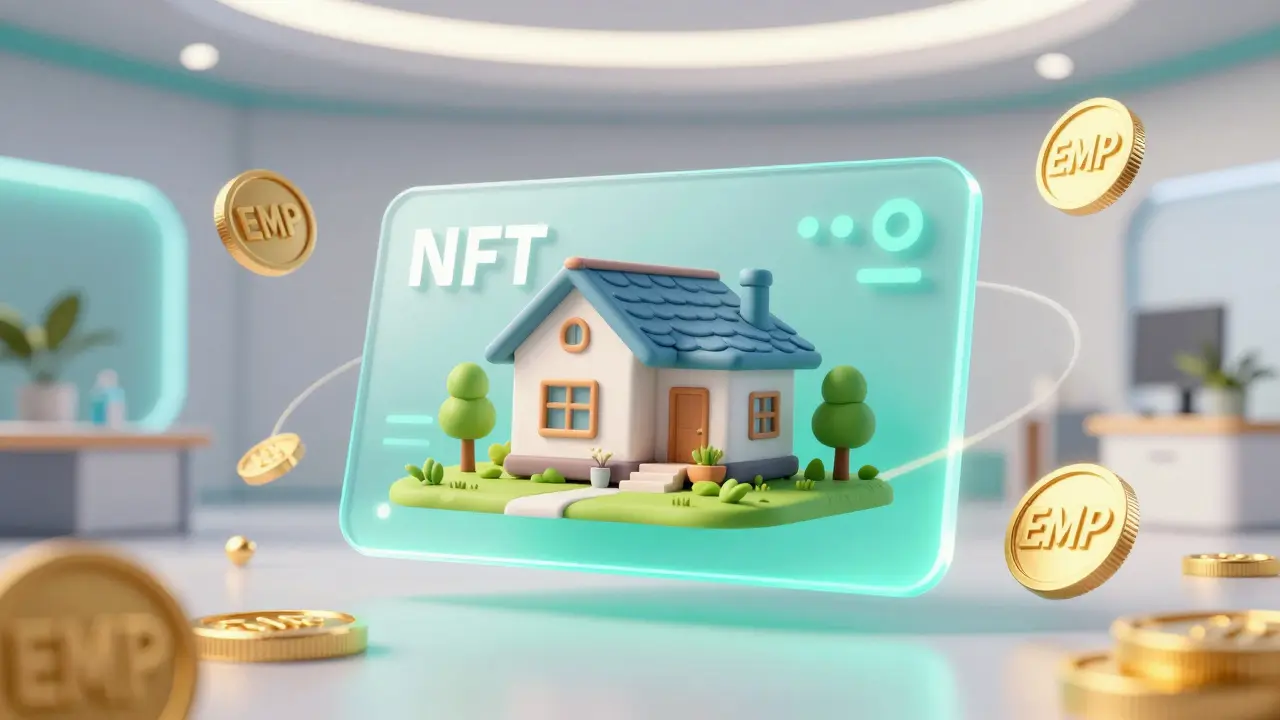
Risk Management and the Insurance Pool
Real estate in developing regions comes with risks-land disputes are a prime example. If a house had to be relocated due to a legal battle over land, the rental income for an investor would vanish. To stop this from happening, Empowa created an insurance pool.
This pool accumulates EMP tokens over time. If a project hits a major snag, the pool provides a safety net to cover unforeseen costs, ensuring that the ability to generate income isn't completely wiped out. It's a pragmatic approach to risk that acknowledges the reality of the African mortgage market rather than ignoring it.
| Attribute | Value / Detail |
|---|---|
| Ticker Symbol | EMP |
| Max Supply | 200 Million EMP |
| All-Time High (May 2024) | $0.55 |
| Current Price (Coinbase) | $0.0244 |
| Market Capitalization | ~$311.61K |
| Blockchain Network | Cardano |
Investment Returns and Social Impact
For those wondering how to actually make money here, the model relies on collateralization. Investors use their EMP tokens to participate in financed housing projects. The goal is to create a win-win: the resident gets a greener, affordable home, and the investor earns returns based on the success and rental income of those properties.
This is where the "RealFi" label comes in. Unlike many crypto projects that exist only in a digital vacuum, Empowa ties its value to physical bricks and mortar. By focusing on the underserved African mortgage market, they are attempting to turn social good into a sustainable asset class.

The Reality of the Market Price
If you're looking at the charts, the numbers can be jarring. After hitting a peak of $0.55 in 2024, the price has dropped significantly, sitting around $0.0244 in April 2026. This represents a massive decline from its high, which is common in the volatile world of altcoins. However, the recent monthly trend showed a 21.68% increase, suggesting that while the long-term trend has been downward, there are still pockets of activity and recovery.
It's worth noting that trading volume on some major trackers has appeared low or even at zero, which often indicates that the token is traded on specific exchanges rather than the biggest global platforms. This makes liquidity a key point to consider for anyone looking to enter or exit a position.
Is Empowa a construction company?
No, Empowa is a fintech platform. It doesn't build the houses itself; instead, it acts as a decentralized financier that bridges the gap between global investors and the developers who build affordable housing in Africa.
What happens if a property project fails?
Empowa uses an insurance pool that accumulates EMP tokens. This pool is designed to cover unforeseen costs, such as land disputes, to protect the rental income and the overall investment ecosystem.
What is the difference between EMP and Empowa NFTs?
The EMP token is the primary utility coin used for value exchange and stabilization. The NFTs are specialized assets used for specific property investments, e-commerce utility, and providing special access to the community.
Which blockchain does Empowa use?
Empowa is built on the Cardano blockchain, leveraging its security and smart contract capabilities to manage its currency stabilizer and insurance pool.
How do I earn returns with EMP?
Investors can earn returns by collateralizing their EMP tokens to participate in the financing of real-world housing projects, effectively earning a share of the value generated by those properties.
Next Steps for Potential Users
If you're interested in the RealFi space, start by visiting the official empowa.io site to see which projects are currently being funded. If you're a trader, keep a close eye on the volume across different exchanges, as the discrepancy between CoinMarketCap and Coinbase data suggests liquidity can be thin.
For those focused on social impact, look into the Founding Community NFTs. These offer more than just a financial stake; they provide a window into how decentralized finance is actually changing lives in regions where traditional banking failed.
Felix Eduardo Velasquez
April 25, 2026 AT 12:54The intersection of blockchain and tangible assets is the only way we actually move past the speculative bubble phase of crypto. Bridging liquidity from a global pool to resolve systemic failures in local banking infrastructure is a profound use of smart contracts. It shifts the paradigm from gambling on price action to generating value through utility and social equity. However, the reliance on a currency stabilizer is a critical point because the stability of the underlying asset determines the long-term viability of the housing projects themselves. If the stabilizer fails or the token experiences a liquidity crunch, the real-world impact could be compromised. We have to consider if a decentralized insurance pool is truly sufficient to cover the systemic risks of land disputes in emerging markets. Usually, these disputes require legal frameworks that exist outside the blockchain, creating a potential friction point between the digital record and the physical reality. The success of RealFi depends on this exact synthesis of code and local law. It is a fascinating experiment in economic sociology.
Emily A
April 25, 2026 AT 13:24The price drop from $0.55 to $0.0244 is a textbook example of a project failing to maintain market momentum. Regardless of the social goals, the financial metrics are frankly embarrassing.
Gabby Puche
April 26, 2026 AT 07:09Love seeing crypto actually doing something good for people! 🏠✨ Let's hope this really helps families get their own homes!! 💖
Lynne Teperman
April 27, 2026 AT 07:42this is some real heavy lifting for the community keeping things grounded in actual brick and mortar is a vibe
Lloyd I
April 28, 2026 AT 05:08I think we can all agree that this approach is super inclusive. It's great to see a way for people to get involved in global development without needing a massive bank account. We should definitely keep supporting these kinds of initiatives!
Robert Smith
April 28, 2026 AT 10:21RealFi is the way 🚀
Bevon Findley
April 29, 2026 AT 06:30Typical Cardano project. Cute, but not quite a game changer :)
Kristi Swartz
April 30, 2026 AT 01:06helping people is the only right way to use money and this is a good way to do it without banks stealing everything
Alex Mazonowicz
May 1, 2026 AT 05:41This is absolutely wonderful!!! The world needs more of this kind of innovation!!!!
Veronica Bago
May 1, 2026 AT 14:03Sounds like a cool way to invest if you're not just looking for a quick flip.
Arti Jain
May 3, 2026 AT 06:59Only a few of these projects actually deliver. Most are just hype.
Harvey Alford
May 4, 2026 AT 00:28I'm in. How do I buy?
VIVEK SINGH
May 5, 2026 AT 01:49Oh wow, another "revolutionary" token that lost 95% of its value. Truly a masterclass in financial stability. I'm sure the insurance pool is doing a great job while the price craters.