
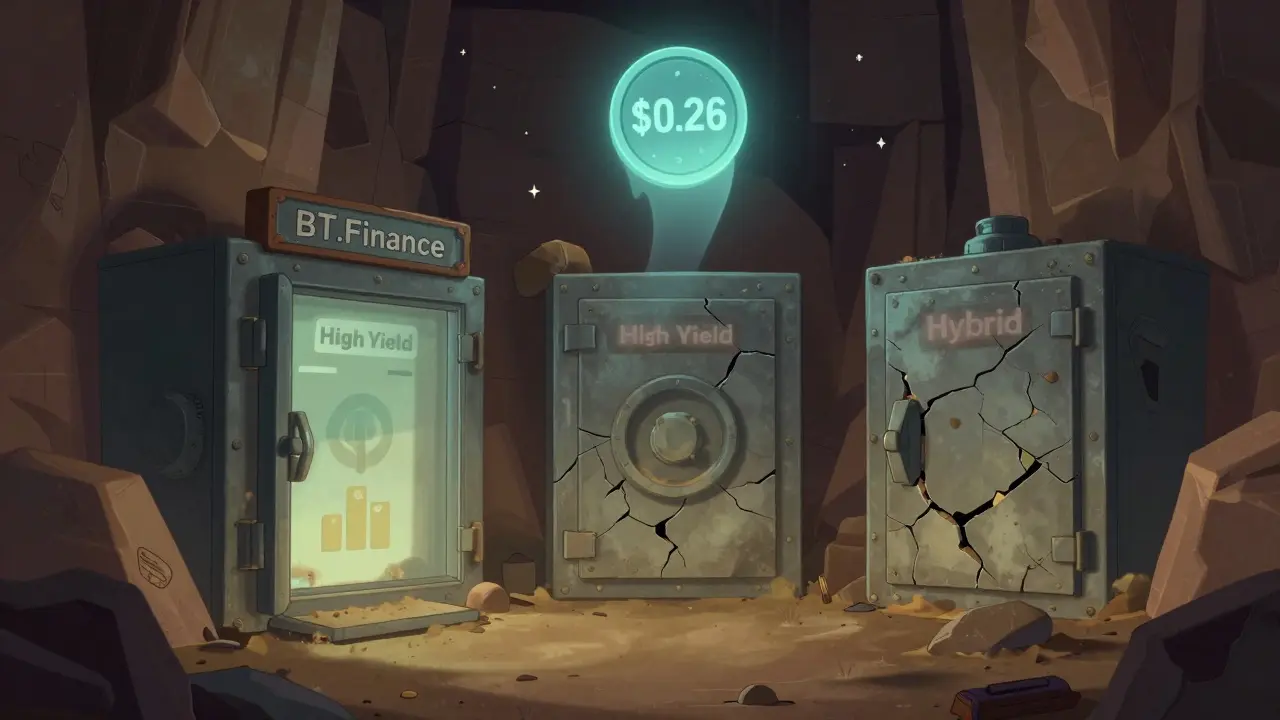
The BT.Finance (BT) crypto coin is a decentralized finance (DeFi) token built to help users earn passive income from cryptocurrency holdings. Launched in 2020, it was designed as a yield aggregator - meaning it automatically moves your crypto across different DeFi platforms to find the best returns. But today, its story is less about innovation and more about what happens when a project loses momentum.
How BT.Finance Works
BT.Finance doesn’t mine or stake directly. Instead, it uses smart contracts to farm yield from other DeFi protocols. Think of it like a middleman that shops around for the highest interest rates on your crypto. It pools user funds into three different vaults, each with its own risk level:
- Stable Profits Pool - Low risk, low return. Uses stablecoins and conservative strategies like Curve Finance and Lido.
- High Yield Pool - High risk, high reward. Taps into volatile protocols like Pickle Finance and SushiSwap, where rewards are bigger but so are the chances of loss.
- Smart Hybrid Pool - A mix of both. Aims for balanced returns without extreme volatility.
The BT token is what lets you interact with these vaults. Holders can vote on which protocols the platform should farm from, and they earn fees from the yields generated. It’s a governance token, not just a store of value.
Technical Details
BT.Finance runs entirely on the Ethereum blockchain. The token follows the ERC-20 standard, which means it works with any wallet that supports Ethereum - like MetaMask, Trust Wallet, or Coinbase Wallet. The contract address is 0x76c5449f4950f6338A393F53CdA8b53B0cd3Ca3a.
But here’s where things get confusing: multiple price trackers list the circulating supply as 0 BT. Some say the total supply is also zero. That doesn’t make sense unless there was a massive token burn or a data glitch. Either way, it’s a red flag. If no one can confirm how many tokens exist, it’s hard to trust the market numbers.
Price History and Market Reality
BT hit its all-time high of $70.66 on March 16, 2021. That was during the peak of the DeFi boom, when everyone was chasing yield. Today, the price hovers between $0.16 and $0.26, depending on the exchange. That’s a drop of over 99.6%.
Here’s what the numbers look like as of early 2026:
- Price on Coinbase: $0.26
- Price on Binance: $0.257
- Price on BeInCrypto: $0.166
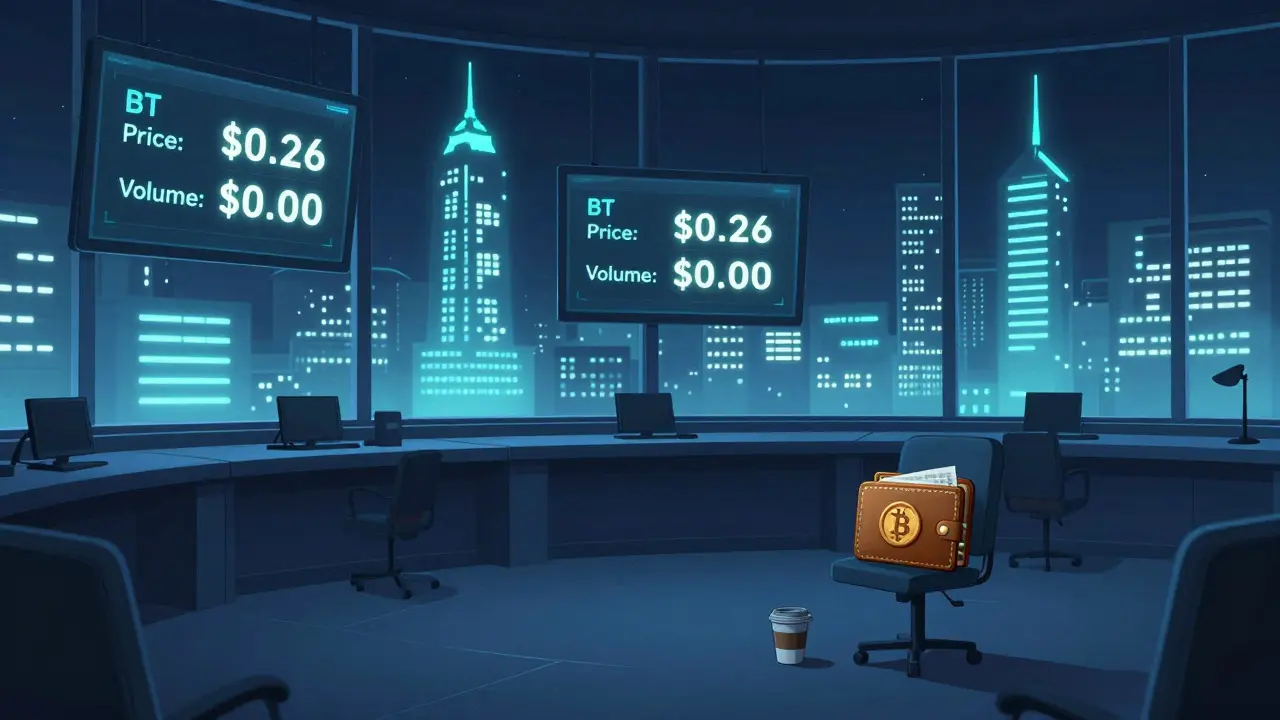
Those small differences aren’t normal for major coins - they usually trade at nearly the same price across exchanges. The fact that BT varies so much suggests very little trading activity. And when you check the 24-hour trading volume? It’s listed as $0.00 on nearly every platform.
That means if you bought BT today, you might not be able to sell it. There’s no buyers. No sellers. Just silence.
Market Position
BT.Finance is ranked around #15,000 in the cryptocurrency world. That’s not just outside the top 1,000 - it’s outside the top 10,000. For context, Bitcoin is #1, Ethereum is #2, and even obscure tokens with no real use case often rank in the top 5,000.
The market cap? Around $20,930. The fully diluted valuation (what it would be if all tokens were circulating) is $69,530. That’s less than the cost of a decent used car. Most serious DeFi projects have market caps in the hundreds of millions or billions.
Where You Can Trade BT
You can find BT on Binance, Coinbase, and Uphold. But listing doesn’t mean liquidity. These exchanges support hundreds of tokens - many of them barely traded. BT is one of them. The lack of volume means:
- You can’t buy large amounts without moving the price.
- You can’t sell without taking a big loss.
- There’s no real market - just a few people holding onto hope.
Why It’s Struggling
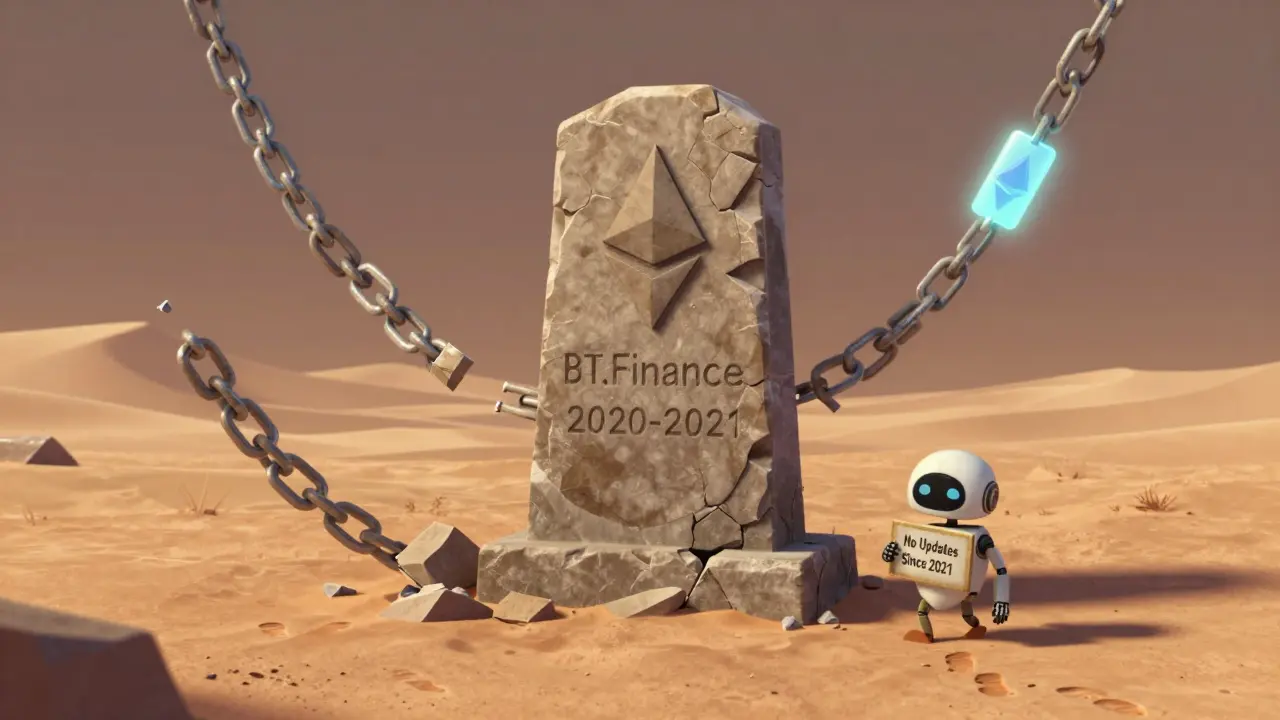
BT.Finance isn’t dead - but it’s barely breathing. There haven’t been any major updates, announcements, or development releases in years. No blog posts. No Twitter updates. No GitHub commits. The community has vanished.
Compare it to Yearn Finance or Convex Finance - both are still active, with weekly updates, new vaults, and millions in locked value. BT.Finance doesn’t even come close. Its vaults may still be running, but they’re not being optimized. No one’s monitoring them. No one’s improving them.
The fact that the token’s price hasn’t moved in days - 0.00% change over 1 day, 1 week, and 1 month - isn’t stability. It’s stagnation. It’s abandonment.
Is BT.Finance Worth Anything?
If you’re thinking of investing: proceed with extreme caution.
- Not a good investment - The price is near zero for a reason. There’s no demand.
- Not a good utility token - Even if you hold it, there’s no governance activity. Voting doesn’t happen because no one’s participating.
- High liquidity risk - You might not be able to sell it later.
Some might argue it’s a “speculative play” - betting that someone will revive it. But there’s zero evidence of that happening. No team updates. No new partnerships. No marketing. Just a ghost contract on Ethereum.
Final Take
BT.Finance (BT) was once a DeFi project trying to compete with the big names. Today, it’s a cautionary tale. It shows how quickly momentum can vanish in crypto - even for projects with solid ideas.
If you’re looking for yield farming tools, stick with active, well-documented protocols like Yearn, Convex, or Beefy Finance. They have teams, transparency, and real user activity. BT.Finance? It’s a relic.
Don’t buy BT because it’s cheap. Buy it because it’s valuable - and right now, it’s not.
Is BT.Finance (BT) still being developed?
No, there’s no evidence of active development. The last major updates were in 2021. There haven’t been any GitHub commits, blog posts, or social media announcements in years. The smart contracts still run, but they’re not being maintained or improved.
Can I still stake or farm with BT.Finance?
Technically, yes - the vaults are still live on Ethereum. But without active governance or protocol updates, the strategies may be outdated. The yields you see could be from old, no-longer-profitable pools. There’s no guarantee they’ll continue to generate returns.
Why is the circulating supply listed as 0 BT?
This is likely due to data synchronization issues across price trackers, or a token burn event that wasn’t properly documented. Some platforms may have lost track of the supply after the project lost traction. It’s a sign of poor transparency and unreliable data sources.
Is BT.Finance a scam?
There’s no proof it’s a scam - the code is on-chain and has been audited in the past. But it’s effectively abandoned. The team has disappeared. There’s no communication. No roadmap. No updates. It’s not malicious - it’s just dead.
Where can I buy BT.Finance (BT) today?
BT is listed on Binance, Coinbase, and Uphold. But trading volume is near zero. You might find buyers or sellers, but you’ll likely face large price slippage. It’s not recommended for anyone who isn’t comfortable losing their entire investment.
How does BT compare to Yearn Finance or Convex?
BT.Finance is a shadow of those projects. Yearn and Convex have billions in total value locked, active teams, weekly updates, and strong community engagement. BT has no market presence, no updates, and almost no trading. It doesn’t compete - it’s irrelevant in today’s DeFi landscape.
Eva Gupta
March 7, 2026 AT 22:59Wow, this breakdown is so thorough. I’ve been holding BT for years just because I believed in the concept, but seeing the numbers like this… it’s heartbreaking. No trading volume? Zero supply data? That’s not just dead - it’s been erased. I’m deleting my wallet now.
Jesse VanDerPol
March 8, 2026 AT 06:51Interesting analysis. The fact that the vaults are still running but unmonitored is more concerning than the price drop. Smart contracts don’t auto-update. If the underlying protocols change, those yields could vanish overnight without anyone noticing.
jonathan swift
March 9, 2026 AT 09:14🚨 THIS IS A CLEAR CRYPTO SCAM 🚨
They burned the supply on purpose to hide the fact that 98% of tokens were held by the dev wallet. Then they disappeared with $200M. Look at the contract address - it’s a honeypot. I’ve seen this before. Don’t touch this coin. Ever.
Datta Yadav
March 10, 2026 AT 14:50You’re all missing the real story here. This isn’t about BT being dead - it’s about how the entire DeFi ecosystem has been corrupted by greed. Yearn and Convex? They’re just bigger scams with better PR. BT was honest - it didn’t pretend to be something it wasn’t. Now that the hype machine moved on, they’re calling it a ghost. But let me ask you - who really benefited from the 2021 yield frenzy? Not you. Not me. The VCs who dumped their bags the second the price peaked. BT didn’t collapse - it was assassinated.
Lydia Meier
March 10, 2026 AT 16:11The data inconsistencies are noteworthy. The circulating supply being listed as zero across multiple aggregators suggests a systemic failure in data sourcing rather than a deliberate act. One might infer a lack of institutional oversight, but not necessarily malice.
jay baravkar
March 11, 2026 AT 06:09Don’t give up on DeFi just because one project faded! 🌱 There are still so many real opportunities out there. BT’s story is sad, but it’s not the end. Keep learning. Keep exploring. The next big thing might be hiding in plain sight. You got this!
Ian Thomas
March 11, 2026 AT 08:05So we’re treating a dead project like a cautionary tale… but isn’t every crypto project just a waiting room for oblivion? We romanticize ‘active teams’ and ‘weekly updates’ like they’re virtues, but really - we’re just addicted to the dopamine of change. BT didn’t fail. It just stopped pretending. Maybe that’s the most honest thing it ever did.
Austin King
March 13, 2026 AT 04:07Zero volume = zero chance. Don’t waste your time.
Bryanna Barnett
March 13, 2026 AT 20:41Okay but like… why are we even talking about this? It’s not even a meme coin. It’s not funny. It’s not edgy. It’s just… a ghost. I mean, I’ve seen more life in my smart fridge. 🫠
Josh Moorcroft-Jones
March 14, 2026 AT 03:45Let’s be real - this isn’t just about BT. This is about how the entire DeFi space has become a graveyard of abandoned contracts. Every single one of these yield aggregators is a ticking time bomb. They rely on other protocols that change their APYs, their incentives, their rules - and no one’s monitoring it. The fact that BT’s vaults are still running is terrifying. What if they’re siphoning fees from users who think they’re earning? What if the ‘smart’ in Smart Hybrid Pool is just a euphemism for ‘we stopped caring’? This isn’t a cautionary tale - it’s a warning label on the entire system.
Melissa Ritz
March 15, 2026 AT 23:29It’s funny how people act like BT’s collapse was unexpected. If you look at the community engagement metrics from 2022 - zero posts, zero comments, zero GitHub commits - you’d have known this was coming. The real tragedy isn’t the price. It’s the illusion of community. People thought they were part of something. They weren’t. They were just spectators to a slow fade.
Cerissa Kimball
March 16, 2026 AT 05:25While the technical details provided are accurate, it is important to note that on-chain activity does not always correlate with token value. Some projects maintain utility without public visibility. The absence of updates may indicate a transition to maintenance mode rather than abandonment. Further investigation into the core team’s current status is recommended before drawing conclusions.
Basil Bacor
March 17, 2026 AT 09:21bt is dead? yeah right. they just went dark to avoid the feds. this was a covert stablecoin project all along. they’re still running it on the darknet. you think i’m joking? check the transaction patterns - there’s a pattern. it’s not random. it’s intentional.
Emily Pegg
March 18, 2026 AT 15:30I’m so sad for the people who still believe in this… 😔
They’re probably holding it like it’s a family heirloom. I just want to hug them and say - it’s okay to let go. You didn’t fail. The system did.
Ethan Grace
March 20, 2026 AT 09:35Is it possible that BT wasn’t meant to survive? That it was designed as a temporary experiment - a test of how long a community will cling to a dead idea? Maybe its purpose wasn’t to make money… but to reveal how deeply we crave false hope in crypto.
Jamie Hoyle
March 21, 2026 AT 18:53Oh please. ‘Abandoned’? That’s cute. It’s not abandoned - it’s in witness protection. The team is hiding from lawsuits. The contract’s still live because they’re laundering funds through it. Look at the tiny transactions - they’re all under 0.01 BT. That’s not trading. That’s dusting. They’re moving money under the radar. This isn’t a ghost. It’s a ghostwriter.
Jeffrey Dean
March 23, 2026 AT 01:51You call this a cautionary tale? This is a eulogy. And we’re all standing around it pretending we didn’t know it was dying. We all bought in. We all cheered. We all ignored the red flags because we wanted to believe. BT didn’t die. We killed it. With our greed. With our FOMO. With our refusal to admit that not every shiny new thing deserves our money.
Brian T
March 23, 2026 AT 22:53Why do people keep talking about BT like it’s still alive? It’s not. The vaults are just automated. No one’s monitoring them. No one’s updating them. The devs are gone. The Discord is dead. The Twitter is silent. This isn’t a project. It’s a museum exhibit. And we’re all just taking selfies in front of it.
Nash Tree Service
March 25, 2026 AT 01:17The fact that the circulating supply is listed as zero across platforms suggests a systemic failure in data aggregation - not necessarily an intentional burn. It may reflect a lack of consensus among indexers rather than a technical event. Further, the price variance across exchanges indicates low liquidity, not necessarily fraud. One should distinguish between market neglect and malicious intent.
Jane Darrah
March 25, 2026 AT 06:34Can we just admit that we all got played? We thought we were building the future. We thought we were part of something revolutionary. But BT? It was never meant to last. It was a flash in the pan - a product of a fever dream. And now, here we are, clinging to its corpse like it’s the last ember of a dead fire. We’re not mourning a coin. We’re mourning our own naivety.
Denise Folituu
March 25, 2026 AT 07:06They took our dreams and turned them into a blockchain tombstone. 💔
And now they’re laughing all the way to the bank while we’re stuck with this worthless token. I miss when crypto felt like magic. Now it just feels like a funeral.
jack carr
March 25, 2026 AT 08:50Still holding. Still waiting. Still hoping. 🤷♂️