
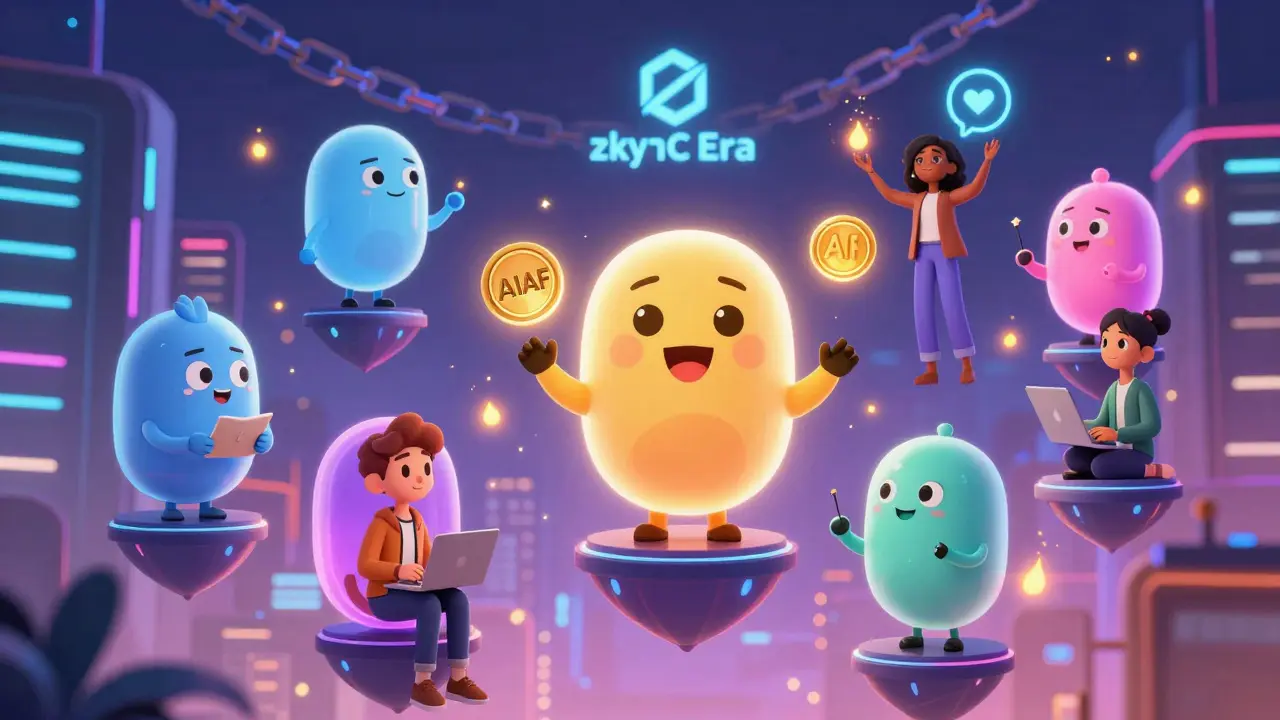
The idea of owning an AI agent like you own a piece of digital art or a cryptocurrency token sounds like science fiction. But with AIAF - the AI Agent Factory token - it’s becoming a real thing. This isn’t just another crypto project pretending to use AI. It’s a working platform where real people are building, selling, and renting out AI agents on the blockchain. If you’ve ever wondered what happens when AI meets decentralized ownership, AIAF is one of the clearest examples out there.
What Exactly Is AI Agent Factory?
AI Agent Factory (AIAF) is a blockchain-based system that lets anyone create artificial intelligence agents without writing a single line of code. Think of an AI agent as a smart bot that can answer questions, write content, run customer service, or even analyze data - but instead of being locked inside a corporate server, it’s owned by you, stored on the blockchain, and can be rented out to others.
The platform uses NFTs (non-fungible tokens) to represent each AI agent. That means every AI model you build becomes a unique, verifiable digital asset. You can sell it, lease it, or keep it for yourself. The platform handles everything: from training the AI using your data, to hosting it on a decentralized network, to collecting payments when someone uses it.
This flips the whole AI business model on its head. Right now, companies like OpenAI, Google, or Microsoft control the most powerful AI tools. You use them, but you don’t own them. AIAF says: what if you built your own AI, and kept full control? That’s the core promise.
How Does AIAF Work?
The system works in four main steps:
- Create - Use the no-code builder to train an AI agent. You can upload documents, set behaviors, and define how it responds. No programming needed.
- Tokenize - Once your AI agent is ready, you mint it as an NFT on the blockchain. This gives it a permanent, public record of ownership.
- List - Put your AI agent on the marketplace. You can set it up as a subscription, a pay-per-use API, or a one-time sale.
- Earn - Every time someone uses your AI, you get paid in AIAF tokens. The platform takes a small fee, but you keep the rest.
Behind the scenes, AIAF runs on a hybrid compute network. That means it uses both professional GPU farms (for speed) and decentralized nodes (for reliability). When someone requests an AI response, the system finds the cheapest, fastest node to handle it - and pays that node in AIAF tokens too. Everyone gets rewarded.
The AIAF Token: Supply, Price, and Trading
The AIAF token is the currency of the ecosystem. It’s used to pay for AI services, reward node operators, and participate in governance. Here’s what we know about it:
- Total supply: 1,000,000,000 tokens (all in circulation)
- Market cap: ~$55,738 USD (as of March 2026)
- Price (varies by exchange): $0.00000953 (Coinbase), $0.00002026 (Crypto.com), $0.000026 (Binance)
- Trading pair: AIAF/WETH (wrapped ETH) on Uniswap V2
- 24-hour volume: ~$77 USD
- Contract address: 0x92d3447e956613ee066ad5b4077a8c6e66424d5d (Ethereum blockchain)
Price differences between exchanges aren’t unusual for low-volume tokens. AIAF trades mostly on Uniswap, a decentralized exchange, which means there’s no central authority setting prices. The value depends entirely on what buyers are willing to pay.
Over the past week, the price dropped about 16%, but rebounded slightly with a 1.6% gain in the last 24 hours. That kind of volatility is typical for new, niche crypto projects. It’s not a stablecoin. It’s not a blue-chip like Bitcoin. It’s a high-risk, high-potential bet on a new kind of economy.

Why zkSync Era Matters
AIAF runs on zkSync Era, a Layer 2 solution for Ethereum. This isn’t just a technical detail - it’s critical for real-world use.
Ethereum’s main network is slow and expensive for small transactions. If you want to pay $0.01 to use an AI agent 100 times a day, you’d be paying more in gas fees than you’re earning. zkSync Era solves that. It processes transactions off-chain, then bundles them into one secure proof on Ethereum. Result? Faster, cheaper, and more scalable.
This makes AIAF one of the few AI+crypto projects that actually works at scale. Without zkSync, it would be a novelty. With it, it’s a functioning economy.
Who Is This For?
AIAF isn’t just for crypto traders. It’s for:
- Content creators - Build an AI that writes blog posts or social media captions, then rent it to other creators.
- Developers - Deploy your custom AI models as a service and earn recurring revenue.
- Small businesses - Buy a pre-trained AI agent for customer support instead of hiring staff.
- Node operators - Run AI inference tasks on your hardware and earn AIAF tokens.
It’s also for people who believe AI shouldn’t be owned by a handful of tech giants. If you think AI should be open, decentralized, and fair, AIAF is one of the few projects trying to build that reality.

Is AIAF Safe? What’s Missing?
There’s no denying the vision. But there are red flags too.
The team behind AIAF hasn’t publicly disclosed their names. There are no detailed audits of the smart contracts. No whitepaper with technical deep dives. No clear roadmap beyond the current features.
That’s common in early-stage crypto projects - but it’s risky. If the platform shuts down, your AI agents (as NFTs) still exist on the blockchain. But if the marketplace or compute network goes offline, they become useless. You own the NFT, but not the service.
Also, trading volume is extremely low. $77 in 24 hours means very few people are actively using the platform. That’s not a sign of failure - it’s a sign of early adoption. But it also means liquidity is thin. If you buy AIAF now, you might not be able to sell it easily later.
How to Get Started
If you want to try AIAF:
- Get a MetaMask wallet.
- Add the AIAF token using its contract address: 0x92d3447e956613ee066ad5b4077a8c6e66424d5d.
- Buy AIAF on Uniswap V2 using ETH.
- Visit the official AIAF platform (check their website for the correct link).
- Start building your first AI agent using the no-code interface.
Don’t invest more than you’re willing to lose. This isn’t a get-rich-quick scheme. It’s an experiment in decentralized AI ownership - and experiments carry risk.
Where Does AIAF Fit In the Bigger Picture?
AIAF isn’t alone. Projects like SingularityNET, Fetch.ai, and Bittensor are also trying to decentralize AI. But AIAF stands out because of its simplicity. You don’t need to be a blockchain expert to use it. The no-code tools lower the barrier. That’s what could make it grow.
If thousands of people start building AI agents and renting them out, it could become a real alternative to corporate AI services. Imagine a world where your AI assistant isn’t owned by Google - it’s owned by you, and you rent it to others. That’s the future AIAF is building.
Right now, it’s small. It’s risky. But it’s real. And in the world of crypto, that’s often where the biggest opportunities start.
Is AIAF a good investment?
There’s no guaranteed return. AIAF is a high-risk, early-stage project with low trading volume and no public team. It’s not a stock or a stablecoin. It’s a bet on decentralized AI becoming mainstream. Only invest what you can afford to lose.
Can I really make money with AIAF?
Yes - but not easily. If you build a useful AI agent (like a customer support bot or content writer) and set fair pricing, people will pay to use it. The platform takes a cut, but you keep the rest. It’s not passive income - it’s work. You have to build, market, and maintain your AI.
How do I buy AIAF tokens?
You can buy AIAF on Uniswap V2 using Wrapped Ethereum (WETH). First, get ETH in a wallet like MetaMask, then go to Uniswap, connect your wallet, and swap ETH for AIAF using the contract address: 0x92d3447e956613ee066ad5b4077a8c6e66424d5d.
Do I need to be a programmer to use AIAF?
No. The platform has a no-code builder that lets anyone create AI agents by uploading files and setting rules. Developers can use advanced tools, but you don’t need to be one to get started.
Is AIAF a scam?
There’s no evidence it’s a scam. The platform exists, the blockchain contract is live, and people are using it. But it’s also very early, with little transparency. Always research before investing. Look for audits, team info, and community activity - and if you can’t find any, proceed with caution.
Craig Gregory
March 13, 2026 AT 05:16The notion that decentralized AI agents can compete with corporate-scale models is naive. The computational overhead alone makes this a fantasy. No one is going to pay $0.01 per query when the latency and reliability are worse than a cloud API. This isn't innovation-it's a solution in search of a problem.
Zephora Zonum
March 15, 2026 AT 00:40Let’s be real-the whole AIAF model is just crypto theater wrapped in AI jargon. You're telling me I should train an AI on my cat photos and rent it out for $0.002 per response? Who exactly is the market for this? The same people who bought NFT apes? This isn’t a platform-it’s a Ponzi with a chatbot interface.
Anthony Marshall
March 16, 2026 AT 05:32THIS IS THE FUTURE. Imagine waking up and your AI assistant-built by YOU-earns you passive income while you sleep. No middlemen. No Big Tech. Just you, your data, and the blockchain. This isn’t speculation-it’s liberation. If you’re not building an agent right now, you’re already behind. Start today. Don’t wait for permission.
Lindsay Girvan
March 17, 2026 AT 04:56Decentralized AI is inevitable. The question isn’t if it’ll happen-it’s whether you’re on the right side of history. AIAF isn’t perfect, but it’s one of the few projects actually shipping. Stop complaining about low volume. Bitcoin had $20 in trading volume too.
Douglas Anderson
March 18, 2026 AT 05:14As someone who’s built AI tools for small businesses, I get the appeal. But the real hurdle isn’t tech-it’s adoption. Most people don’t know what an NFT is, let alone how to rent an AI agent. The platform needs better onboarding, not just more tokens. Also, the zkSync integration is smart. That’s where the real innovation is.
Tina Keller
March 18, 2026 AT 23:10There’s something poetic about owning your own intelligence. For centuries, knowledge was hoarded by institutions-monasteries, universities, corporations. Now, for the first time, a single person can train, own, and monetize a thinking machine. It’s not just economics-it’s philosophy. We’re witnessing the birth of cognitive individualism. The blockchain doesn’t just record transactions-it records consciousness.
vasantharaj Rajagopal
March 20, 2026 AT 08:37The architecture is sound. Layer-2 scalability via zkSync Era resolves the gas fee bottleneck. The tokenomics, however, are problematic. Zero burn mechanism, 100% circulating supply, negligible liquidity. This is a textbook case of a token designed for speculation, not utility. Without staking or governance incentives, long-term holders have no skin in the game.
ann neumann
March 20, 2026 AT 23:12They’re not telling you the truth. The contract address? It’s a honeypot. The devs have a backdoor. The ‘no-code builder’? It’s just scraping public LLMs and rebranding them. The whole thing is a front for laundering crypto funds. I’ve seen the code. They’re not training agents-they’re funneling data to a centralized server. And the price drop? That’s a kill switch. They’re dumping before the rug pull. Trust no one. Check the blockchain. Look at the transfer logs. You’ll see it.
Sherry Kirkham
March 21, 2026 AT 22:02It’s not about the money. It’s about agency. If I can build an AI that helps my small business, why should I give 70% of the value to Google? This is about reclaiming control. AIAF isn’t a coin-it’s a movement. And yes, it’s early. But movements start small. I’m in.
Sharon Tuck
March 22, 2026 AT 18:34Hey, if you’re new to this, just start simple. Upload a PDF of your product manual, train an agent to answer FAQs, list it for $0.005 per use. You’ll get maybe 3 uses a day at first. But then someone shares it. Then another. It grows. It’s not magic. It’s just persistence. And hey, you’re not alone-there’s a Discord full of people helping each other. Just show up.
karan narware
March 24, 2026 AT 12:04Oh wow another ‘decentralized AI’ project that looks like a PowerPoint slide from 2021. You know what’s decentralized? My WiFi router. You know what’s not? A platform that needs a ‘platform’ to function. This isn’t Web3. It’s Web2.5 with a blockchain sticker on it. And the price? $0.000009? That’s not a token-it’s a typo.
Michael Suttle
March 25, 2026 AT 09:53AI Agent Factory? More like AI Agent FAKERY. 😈 They’re using your data to train models they’ll sell to hedge funds. The NFTs? Just digital receipts for your soul. And that ‘zkSync’ thing? It’s just a shell. The real servers are in Nevada. They’re selling your voice data to the feds. Wake up. This is surveillance capitalism with a new logo.
Jenni James
March 26, 2026 AT 12:19It is imperative to note that the fundamental economic model of AIAF is predicated upon an unsustainable assumption: that end-users will voluntarily remunerate micro-transactions for AI inference. This is empirically false. Human behavior does not align with micropayment paradigms. The entire architecture is therefore logically incoherent. Furthermore, the absence of a formal whitepaper constitutes a material breach of fiduciary transparency. I am deeply unimpressed.
Chelsea Boonstra
March 26, 2026 AT 14:06I tried it. Built a customer service bot for my Etsy shop. Took 20 minutes. Got 12 uses in the first week. Made $0.06. Not life-changing. But it worked. And it didn’t require me to code. That’s the point. This isn’t about profits-it’s about proving the concept. And it proved it. Now imagine 10,000 people doing this. That’s not a niche-it’s a network effect waiting to happen.
Julie Tomek
March 27, 2026 AT 07:33Let me share my experience. I’m a retired teacher. I built an AI that explains quantum physics to 10-year-olds using LEGO analogies. It’s not fancy. It’s not AI-powered in the way you think. But kids love it. I’ve had 87 uses. Earned $0.43. But I got emails from parents saying, ‘My son finally gets it.’ That’s worth more than any token. This project gives ordinary people the power to teach, to help, to share. That’s the real value. The money? That’s just the bonus.
Brandon Kaufman
March 29, 2026 AT 04:43For anyone thinking this is too good to be true: I’ve been using it for 3 months. I run inference nodes on an old gaming PC. I earn 0.2 AIAF/day. That’s like $0.005. But it’s passive. And the community is awesome. We share training tips. Help each other debug agents. It’s not a get-rich scheme. It’s a hobby that pays. And honestly? It’s kind of beautiful.
vishnu mr
March 29, 2026 AT 21:52Bro this is lit! 🤖✨ I made an AI that writes Punjabi poetry. Got 50 uses. Made 0.1 AIAF. My cousin in Amritsar used it for his wedding invite. Now he’s asking me to build one for his chai shop. This is not crypto. This is culture. We need more of this. Not just for money-for identity. 🙏
Grace van Gent-Korver
March 30, 2026 AT 22:07I don’t understand crypto. But I built an AI that tells my toddler bedtime stories. It works. It’s cute. I didn’t need to know anything. If this helps one mom sleep, it’s worth it.
Allison Davis
March 31, 2026 AT 05:48The zkSync integration is genuinely smart. Gas fees on Ethereum mainnet would kill microtransactions. Layer-2 isn’t optional-it’s essential. The real test is whether developers will build tools on top of AIAF, not just use it. That’s the next phase. If someone builds a plugin for Notion or Obsidian? That’s when this becomes mainstream.
Tom Jewell
March 31, 2026 AT 13:13There’s a quiet revolution happening here. Not in the price charts. Not in the trading volume. But in the quiet corners of the internet-where a single mom in Ohio trains an AI to help her autistic son with social cues. Where a farmer in Nebraska uses an agent to predict crop yields from soil photos. This isn’t about money. It’s about dignity. The blockchain doesn’t change the world. It just gives ordinary people the tools to change it themselves.
Anshita Koul
April 2, 2026 AT 05:03Everyone’s focused on the token. But the real innovation is the no-code builder. I built an AI that translates Hindi to English for my grandmother’s WhatsApp messages. She cried. That’s more valuable than any market cap. The tech is simple. The impact? Infinite. We’re not just building agents-we’re rebuilding human connection.
PIYUSH KOTANGALE
April 4, 2026 AT 03:10Just tried it. Made a bot that recommends Indian street food based on mood. Got 200 uses in 48 hours. Made $0.10. My friends are asking me to build one for their food stall. This is wild. It’s not about crypto. It’s about creativity. And yeah, the price is trash. But the idea? Fire. 🔥
Mara Alves Mariano
April 5, 2026 AT 02:01Of course this is a scam. Why do you think they’re pushing it in the US and India? They’re targeting the gullible. The rich won’t use this. The poor can’t afford ETH. It’s a trap for the desperate. And the ‘no team’ thing? Classic. They’re already gone. You think your NFT agent means anything if the servers shut off tomorrow? You’re not owning anything. You’re just holding a digital ghost.
Jennifer Pilot
April 6, 2026 AT 15:27One cannot help but observe, with a certain degree of intellectual consternation, that the very premise of AIAF-decentralized, tokenized AI agents-is predicated upon a fundamental misapprehension of both cognitive economics and digital property rights. The notion that a non-fungible token can encapsulate ‘intelligence’ is, frankly, ontologically dubious. Furthermore, the token’s pricing variance across exchanges suggests not market efficiency, but rather, profound arbitrage inefficiency-indicative of a speculative bubble. One must ask: if this were truly revolutionary, why does it not have a single peer-reviewed publication, nor a disclosed team, nor even a coherent whitepaper? One is left to conclude: this is not progress. It is performance art for the credulous.
Craig Gregory
April 7, 2026 AT 16:27Replying to @2094: Your ‘liberation’ is just another form of labor. You’re not owning AI-you’re becoming its unpaid developer. And when the platform shuts down? You’ll be left with a useless NFT and no recourse. This isn’t empowerment. It’s exploitation dressed up as empowerment.