
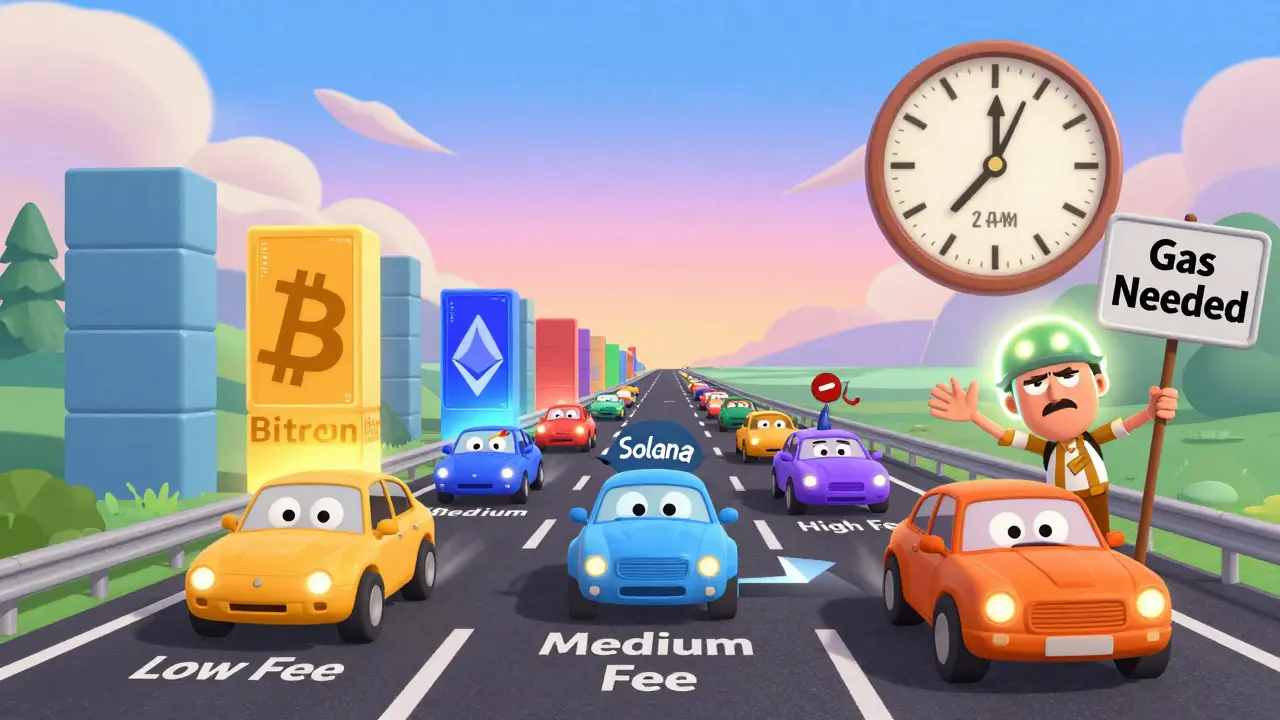
When you send Bitcoin, Ethereum, or any other cryptocurrency, you might notice a small amount deducted from your balance. That’s not a mistake - it’s a transaction fee. These fees aren’t optional. They’re how blockchain networks stay alive, secure, and fast. Without them, your transaction could sit in limbo for hours - or never confirm at all.
Why Do Crypto Transaction Fees Exist?
Think of a blockchain like a busy highway. Every transaction is a car trying to get through. But there are only so many lanes, and only so many cars can fit in each block (a group of transactions). That’s where fees come in. They’re a way to decide who gets to go first. The idea started with Bitcoin in 2009. Satoshi Nakamoto designed fees to stop people from flooding the network with fake transactions. Back then, spam could crash the whole system. Fees made it expensive to send junk, so only real transfers got through. Today, that same system keeps miners and validators paid. They use their computers to check and record every transaction. Without fees, they’d have no reason to keep working - especially as block rewards shrink over time.How Are Fees Calculated?
It’s not about how much money you send. It’s about how much data your transaction creates.- Bitcoin: Fees are based on transaction size in bytes. A simple send from one address to another is small - maybe 250 bytes. A complex one with multiple inputs? That could be 800 bytes or more. The more data, the higher the fee. During quiet times, you might pay $1. During a spike - like when NFTs blew up in 2021 or Bitcoin hit $70,000 in April 2024 - fees jumped over $128.
- Ethereum: Uses gas. Gas is a unit of computational work. Simple transfers cost 21,000 gas. But if you’re swapping tokens, staking, or using a DeFi app? That could be 100,000 gas or more. Multiply that by the current gas price (in gwei), and you get your fee. On a busy day, Ethereum fees can hit $5-$20. On slow days? Under $1.
- Solana, Polygon, Avalanche: These networks were built to handle more transactions per second. Their fees? Usually under $0.01. Sometimes as low as $0.001. That’s why so many DeFi apps moved there.
Some networks, like Komodo, charge a flat 0.0001 KMD per transaction - roughly 0.000005 USD. That’s cheaper than a postage stamp.
What About Exchanges? They Add Their Own Fees
Here’s where things get tricky. When you buy crypto on Binance, Kraken, or Coinbase, you’re not just paying the blockchain fee. You’re also paying the exchange’s fee.- Trading fees: Binance charges 0.1% per trade. Kraken charges between 0.16% and 0.26%, depending on your volume.
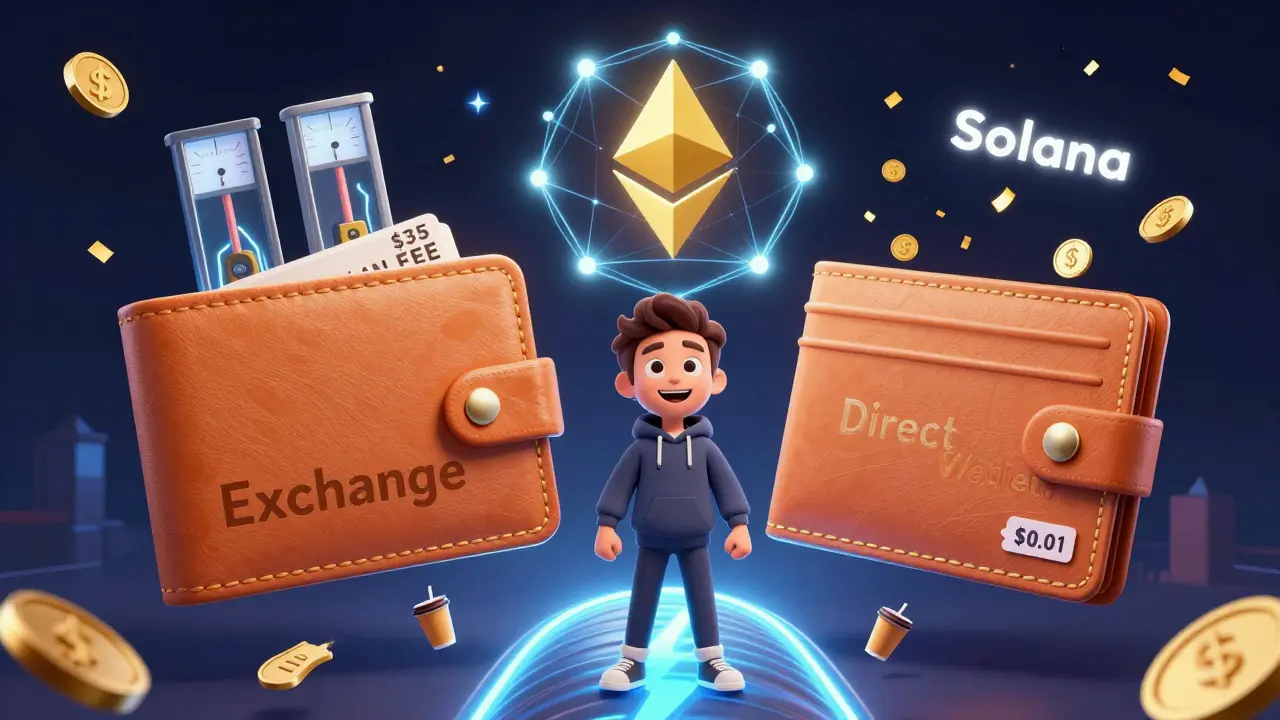
- Withdrawal fees: If you move your Bitcoin from Binance to your personal wallet, Binance charges a fixed fee - usually 0.0005 BTC (around $35 as of early 2026). That’s not the blockchain fee. That’s Binance’s cut. Same with Ethereum - withdrawing ETH might cost you 0.005 ETH ($15) from the exchange, even if the actual network fee is only $2.
That’s why it’s smarter to move funds directly from one wallet to another, instead of using exchanges as middlemen. You avoid double fees.
The Lightning Network: Bitcoin’s Fee Hack
If Bitcoin fees are too high, the Lightning Network is the fix. It’s a second layer built on top of Bitcoin that lets you send tiny payments instantly - for almost nothing. Instead of broadcasting every transaction to the main chain, Lightning routes payments through a network of connected wallets. Only the opening and closing of the channel hit the blockchain. The rest? Off-chain. Fees here are tiny: maybe 0.00001 satoshi per hop (that’s one-millionth of a cent). Node operators charge a small percentage - say 0.001% - of the amount you send. So if you pay $5, you might pay $0.00005 in fees. It’s perfect for coffee, tips, or daily purchases. And it’s growing fast. As of early 2026, the Lightning Network handles over 5,000 transactions per minute - up from 500 in 2023.How to Pay Less in Fees
You can’t avoid fees entirely. But you can slash them.- Send during off-peak hours: Bitcoin fees are lowest between 2-4 AM UTC. Ethereum dips after midnight UTC. Use blockchain explorers like mempool.space or ETHGasStation to see real-time fee trends.
- Use low-fee networks: If you’re not tied to Bitcoin, try Solana, Polygon, or Tron. Their fees are 100x lower than Ethereum’s.
- Use the Lightning Network: For Bitcoin, this is the best option for small, frequent payments.
- Batch your transactions: Sending 5 payments to 5 friends? Combine them into one. One transaction with 5 outputs costs less than 5 separate ones.
- Don’t use exchanges for withdrawals: Move crypto directly from wallet to wallet. Avoid exchange withdrawal fees entirely.
Why Fees Matter More Than Ever
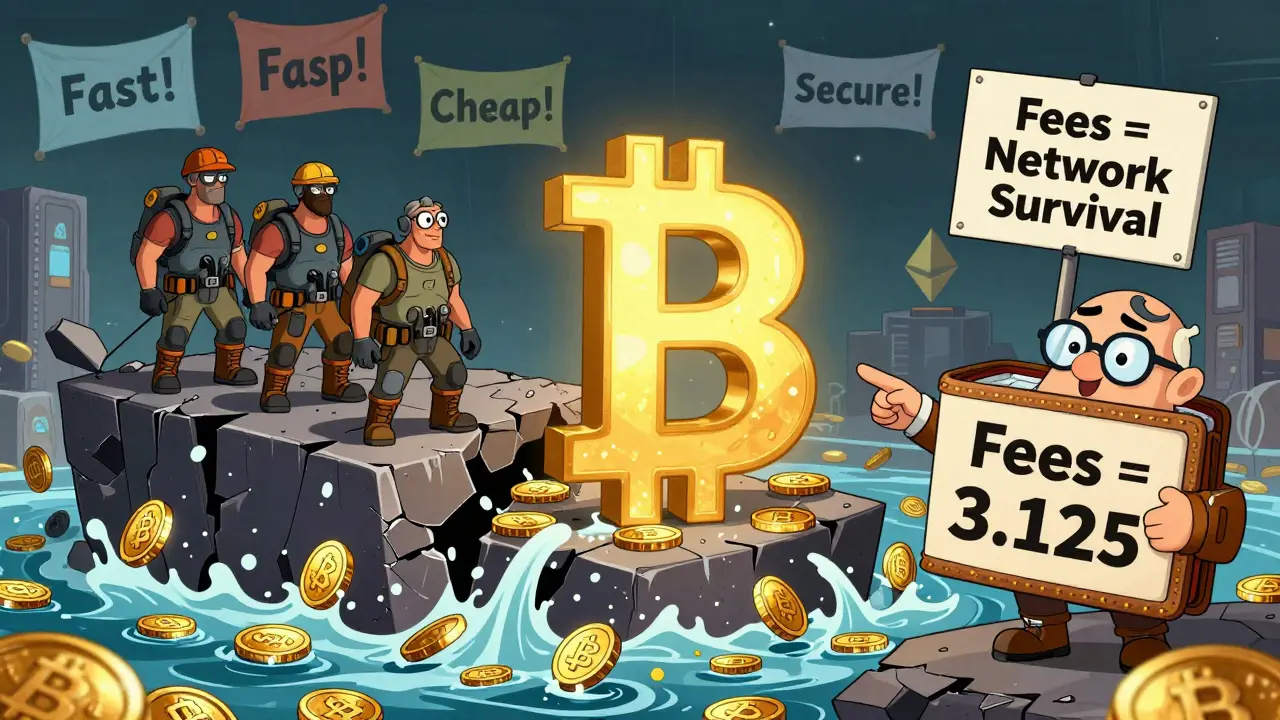
Bitcoin’s block reward - the new coins miners earn - halves every four years. The last halving was in 2024. By 2028, miners will get only 3.125 BTC per block. That’s down from 6.25 BTC in 2020. Soon, fees will make up over 90% of miner income. That means fees aren’t just a cost. They’re the backbone of Bitcoin’s security. If fees drop too low, miners might quit. The network could slow down or become vulnerable. That’s why experts say: high fees today aren’t a bug - they’re a sign the network is working. The real question isn’t “why are fees so high?” It’s “is this network worth the cost?”What’s Next?
The future of crypto fees is competition. New blockchains are racing to offer the lowest fees. But users aren’t just looking for cheap. They want fast, secure, and decentralized. Solana is fast and cheap, but it’s had outages. Ethereum is slower and pricier, but it’s the most trusted. Bitcoin is the most secure - but not for daily use. Layer-2 solutions like Arbitrum, Optimism, and zkSync are helping Ethereum users avoid high fees without giving up security. Meanwhile, Bitcoin’s Lightning Network keeps improving routing and liquidity, making microtransactions more reliable. The winners? Networks that balance cost, speed, and trust. Not the cheapest. Not the fastest. The ones that work reliably - even when the market crashes.Are crypto transaction fees the same for every coin?
No. Each blockchain has its own fee system. Bitcoin charges based on data size, Ethereum uses gas based on complexity, Solana charges a flat $0.00001 per transaction, and Litecoin is somewhere in between. Even within one network, fees change based on demand.
Why is my Bitcoin fee so high even though I’m only sending $10?
Bitcoin fees depend on transaction size, not value. If you’re sending from an old wallet with 20 tiny inputs, your transaction becomes large. That uses more space in a block, so the fee goes up. It has nothing to do with the $10 you’re sending.
Can I set my own transaction fee?
Yes - if you’re using a wallet like Electrum, Sparrow, or Bitcoin Core. Most wallets offer low, medium, and high fee options. Low means slower confirmation (could take hours). High means fast (under 10 minutes). You’re choosing the speed, not the fee amount directly.
Do I pay fees when I buy crypto on an exchange?
You pay two types: the exchange’s trading fee (like 0.1%) and the blockchain withdrawal fee when you move it out. If you leave crypto on the exchange, no blockchain fee applies - but you’re not truly in control of your coins.
Will transaction fees ever disappear?
No. Fees are how blockchains pay miners and validators. Without them, there’s no incentive to secure the network. Even if a network claims "zero fees," it’s likely using a different model - like staking rewards or inflation - to compensate validators. The cost is just hidden.
How do I check real-time Bitcoin or Ethereum fees?
Use mempool.space for Bitcoin - it shows a live fee chart and recommended rates. For Ethereum, check ETHGasStation or Etherscan’s gas tracker. These tools show how long your transaction will take at each fee level.
Is it better to use a low-fee blockchain like Solana instead of Ethereum?
It depends. Solana is cheaper and faster, but it’s less battle-tested. Ethereum has been running for over 9 years with zero major security breaches. If you’re trading NFTs or using DeFi apps, Ethereum’s ecosystem is still the safest. For simple transfers or small payments, Solana is fine. But for high-value or long-term use, Ethereum’s security still wins.
Andrew Edmark
February 18, 2026 AT 04:49Ian Plunkett
February 19, 2026 AT 01:50jennifer jean
February 20, 2026 AT 10:13Sasha Wynnters
February 20, 2026 AT 19:16Rajib Hossaim
February 21, 2026 AT 07:50Beth Erickson
February 22, 2026 AT 06:42Jenn Estes
February 23, 2026 AT 22:27Geet Kulkarni
February 24, 2026 AT 20:27Lauren Brookes
February 25, 2026 AT 18:37Chris Thomas
February 26, 2026 AT 02:22James Breithaupt
February 27, 2026 AT 11:59Alex Williams
February 28, 2026 AT 13:51Sarah Shergold
February 28, 2026 AT 18:02Charrie VanVleet
March 1, 2026 AT 23:43Scott McCrossan
March 2, 2026 AT 02:33Angela Henderson
March 2, 2026 AT 14:41Ruby Ababio-Fernandez
March 3, 2026 AT 03:15Jeremy Fisher
March 4, 2026 AT 20:30Anandaraj Br
March 6, 2026 AT 00:06AJITH AERO
March 7, 2026 AT 03:19