

Imagine handing over the keys to your house. One key opens the door. If you lose it, you’re locked out. If a thief steals it, they’re in. Now imagine that same door requires two different keys turned at the same time by two different people. That is the core logic behind multi-signature wallets, and it is the single biggest upgrade you can make to how you store digital assets.
We often treat private keys like passwords. But in the world of blockchain, a private key is more like a deed to a property. With standard single-signature wallets, one compromised key means total loss. There is no "forgot password" link on Bitcoin. Multi-sig changes this dynamic entirely by distributing control. It turns asset management from a solo act into a team sport, adding layers of verification that make theft exponentially harder while preventing accidental self-sabotage.
How Multi-Sig Wallets Actually Work
To understand multi-sig, you need to forget the idea of a "wallet" as a container holding coins. In reality, your funds sit on the blockchain. Your wallet just holds the keys to move them. A traditional wallet uses one public address linked to one private key. You sign a transaction with that key, and the network accepts it.
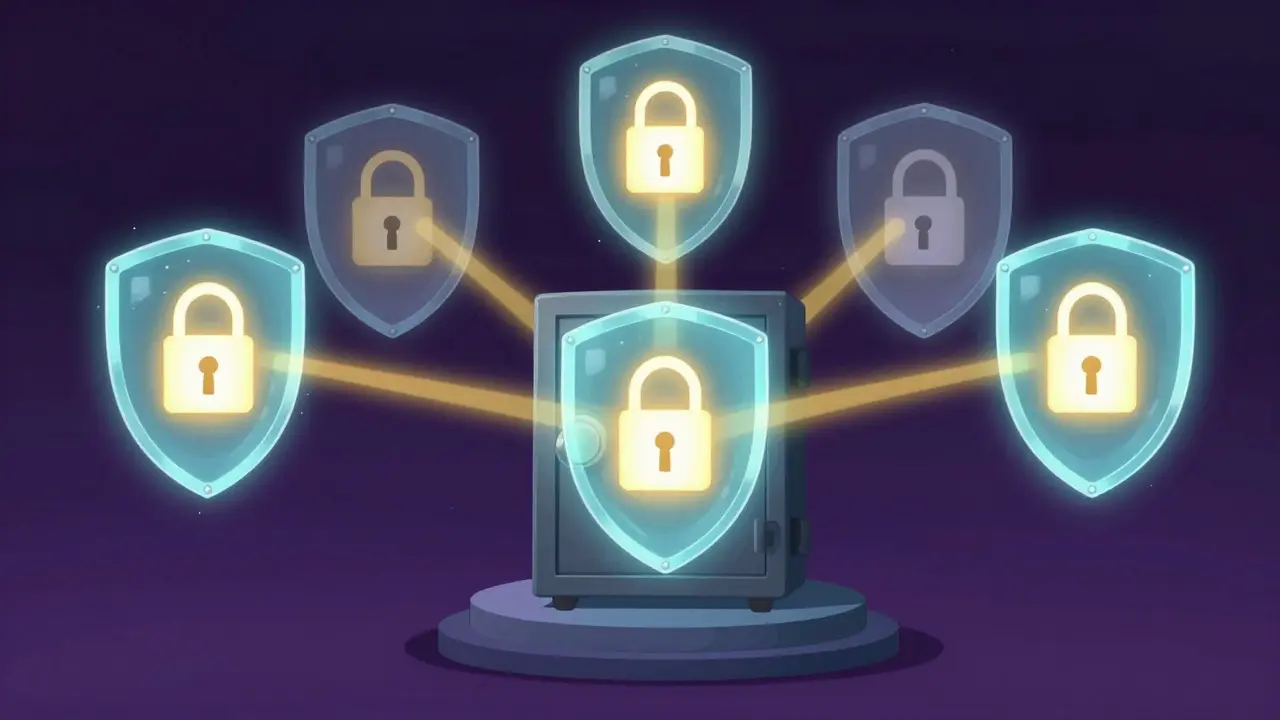
A multi-signature (multi-sig) wallet operates through smart contracts that require multiple cryptographic signatures from predefined private keys to authorize transactions. Instead of one key, the system uses several. These keys are distributed among different devices or people. The rules for moving money are defined by an "M-of-N" structure.
- N is the total number of available keys.
- M is the minimum number of signatures required to execute a transaction.
The most common setup is 2-of-3. This means you generate three distinct private keys. To send funds, you need any two of those three to approve the action. If you lose one key, you still have two left, so your funds are safe. If a hacker steals one key, they still need a second one to drain the account, which they don’t have. This eliminates the single point of failure that has led to billions in losses throughout crypto history.
Why Single-Signature Wallets Are Risky
Let’s look at the math of risk. According to data from Coinbase in 2023, 98% of hacked cryptocurrency exchanges relied on single-signature custodial solutions. When one key is exposed-whether through malware, a phishing email, or a physical break-in-the attacker has full access. There is no backup plan built into the protocol itself.
Multi-sig addresses this by creating a system of checks and balances. Ledger Academy reported a 92% reduction in successful theft attempts when properly implemented multi-sig setups were used compared to single-key alternatives. The difference isn't just theoretical; it's about removing the ability for any single actor to act unilaterally. Whether that actor is a malicious hacker or an employee trying to embezzle funds, the requirement for consensus stops them cold.
Common M-of-N Configurations Explained
You might wonder why we don't just use 1-of-2 or 5-of-5 setups. The configuration depends entirely on your threat model and operational needs. Here is how the industry typically breaks it down:
| Configuration | Total Keys (N) | Required Signatures (M) | Best Use Case | Redundancy Level |
|---|---|---|---|---|
| 2-of-3 | 3 | 2 | Individual high-value storage | High (lose 1 key) |
| 3-of-5 | 5 | 3 | DAOs and corporate treasuries | Very High (lose 2 keys) |
| 4-of-7 | 7 | 4 | Institutional grade / Governments | Extreme (lose 3 keys) |
The 2-of-3 setup is widely considered the sweet spot for individuals. It offers perfect redundancy: you can store one key on a hardware device at home, one in a bank safety deposit box, and one with a trusted family member. As long as two of those locations remain accessible, your funds are recoverable. For organizations, 3-of-5 prevents internal fraud because no single executive can move treasury funds without collusion from two others.
Multi-Sig vs. Single-Sig: The Trade-Offs
Nothing in security comes for free. The primary cost of multi-sig is convenience. BitPay Support data indicates that multi-sig transactions take 47% longer to approve than single-sig ones. This latency comes from the coordination required between signers. You aren't just clicking "send"; you are waiting for confirmation from other parties or devices.
There is also a learning curve. Trezor user data shows that 68% of retail consumers who tried multi-sig abandoned it due to perceived complexity. Setting up a 2-of-3 wallet involves generating keys, securing them in different environments, and understanding recovery procedures. It takes time. BitGo recommends allocating 6-10 hours for initial institutional setup, including testing. For a casual trader buying $50 worth of tokens, this overhead is unnecessary. For someone storing $50,000 or more, it is non-negotiable.
However, the security payoff is massive. Single-sig wallets offer speed but zero fault tolerance. Multi-sig offers resilience. If you prioritize ease of use above all else, stick to single-sig hot wallets for small amounts. If you prioritize asset preservation, multi-sig is the only logical choice.
Who Should Use Multi-Sig Wallets?
Not everyone needs a multi-sig setup. Chainalysis reports that 83% of crypto assets exceeding $1 million in value utilize multi-sig architectures, while only 7% of retail investors do. Here is how to decide if it’s right for you:
- Individual Investors with Significant Holdings: If your portfolio exceeds what you would comfortably carry in cash, use a 2-of-3 setup. Distribute keys geographically to protect against fire, flood, or burglary.
- Businesses and DAOs: Shared financial control is essential. A 3-of-5 setup ensures that no single founder or developer can rug-pull the treasury. Colony Blog noted that 3-of-5 configurations prevented $4.7 million in attempted fraudulent transfers in Q1 2023 alone.
- Estate Planning: Multi-sig allows you to create inheritance protocols. You can set it up so that your spouse and a lawyer must both sign to access funds after your passing, ensuring the assets go to the right people without relying on a single seed phrase that might be lost.
If you are a beginner just dipping your toes into crypto with small amounts, start with a reputable single-signature hardware wallet. Learn the basics of self-custody first. Once you understand the weight of private keys, graduate to multi-sig.

Setting Up Your First Multi-Sig Wallet
The process varies slightly depending on the platform, but the principles remain the same. Popular platforms include Gnosis Safe (now Safe), BitGo, and Sparrow Wallet. Here is a simplified workflow for a 2-of-3 setup:
- Choose Your Platform: Select a trusted multi-sig interface. Safe is dominant on Ethereum and EVM chains, while Sparrow is popular for Bitcoin.
- Generate Keys: Create three distinct private keys. Do not generate them on the same computer if possible. Use separate hardware wallets (like Ledger or Trezor) for each key to maximize security.
- Distribute Keys: Store Key 1 at home, Key 2 in a secure off-site location (like a safety deposit box), and Key 3 with a trusted third party or another device.
- Create the Contract: Input the public keys of all three devices into the multi-sig interface. Set the threshold to 2.
- Fund the Wallet: Send your crypto to the new multi-sig address generated by the contract.
- Test Immediately: Send a tiny amount to yourself using two of the keys. Verify the transaction goes through. Then try sending with only one key to confirm it fails.
Documentation quality matters here. Safe scores highly for clarity, while lesser-known implementations may lack support. Ensure you have written instructions for how to recover funds if one key is lost. Without a plan, complexity becomes a liability.
Future Trends and Quantum Resistance
The technology is evolving rapidly. We are seeing integration with social recovery mechanisms, where trusted contacts can help restore access without holding full signing authority. More importantly, quantum computing poses a theoretical threat to current cryptographic standards. BitGo announced post-quantum cryptography integration scheduled for late 2024, signaling that multi-sig infrastructure is preparing for next-generation threats.
Regulatory bodies are also taking notice. The U.S. Office of the Comptroller of the Currency confirmed in 2022 that properly implemented multi-sig satisfies "dual control and segregation of duties" requirements for banking activities. This legitimizes multi-sig not just as a tech feature, but as a compliance tool for institutions.
Conclusion
Multi-signature wallets are not just a feature; they are the foundation of serious cryptocurrency security. By moving away from the single-point-of-failure model, you gain peace of mind that no single event-a stolen laptop, a lost phone, or a rogue employee-can wipe out your savings. While the setup requires effort and the daily use is slower, the protection it offers is unparalleled. For anyone holding significant value in digital assets, transitioning to an M-of-N structure is the most important step you can take toward true self-custody.
Is multi-sig better than a hardware wallet?
It depends on how you define "better." A hardware wallet stores a single private key securely offline. Multi-sig is an architecture that often uses hardware wallets to store multiple keys. Multi-sig is superior for redundancy and shared control because losing one hardware device doesn't mean losing your funds. However, a standard hardware wallet is easier to use for simple transactions.
Can I recover my funds if I lose one key in a 2-of-3 setup?
Yes. In a 2-of-3 configuration, you only need two keys to sign a transaction. If you lose one key, you still have two remaining, allowing you to continue accessing and moving your funds normally. You would only be locked out if you lost two or more keys.
Are there fees for using multi-sig wallets?
Multi-sig transactions often incur higher gas fees on networks like Ethereum because the transaction data is larger (multiple signatures). Additionally, some managed multi-sig services charge subscription fees. Self-hosted solutions like Gnosis Safe only charge network gas fees.
What happens if one signer disagrees with a transaction?
The transaction will not execute until the required number of signatures (M) is reached. In a 2-of-3 setup, if one person refuses to sign, the other two can still proceed. This prevents deadlocks while maintaining security against unilateral actions.
Is multi-sig suitable for everyday spending?
Generally, no. The added steps of coordinating signatures make it too slow for buying coffee or making quick trades. Most users keep a small amount in a fast single-sig hot wallet for daily spending and use multi-sig for long-term savings and large holdings.