

When you look at Bitcoin’s blockchain, you’re not just seeing a list of transactions. You’re seeing a record of money that’s been sitting still-sometimes for days, sometimes for over a decade. That’s where UTXO age distribution comes in. It’s not a fancy term for marketing. It’s a real, measurable way to understand what Bitcoin holders are actually doing. Are they hoarding? Selling? Accumulating? The answer is hidden in how long their coins have gone unspent.
What Exactly Is a UTXO?
Before we talk about age, you need to know what a UTXO is. Every Bitcoin transaction spends previous outputs and creates new ones. A UTXO-Unspent Transaction Output-is a chunk of Bitcoin that hasn’t been used yet. Think of it like a bill in your wallet. If you receive 0.5 BTC in one transaction and 0.3 BTC in another, you now have two UTXOs: one of 0.5 BTC and one of 0.3 BTC. When you spend 0.6 BTC, you combine those two and send 0.6 BTC out, leaving 0.2 BTC as change in a new UTXO.
Unlike account-based systems like Ethereum, Bitcoin doesn’t track balances. It tracks these individual pieces of unspent money. That makes UTXOs the building blocks of Bitcoin’s entire economy.
Why Age Matters
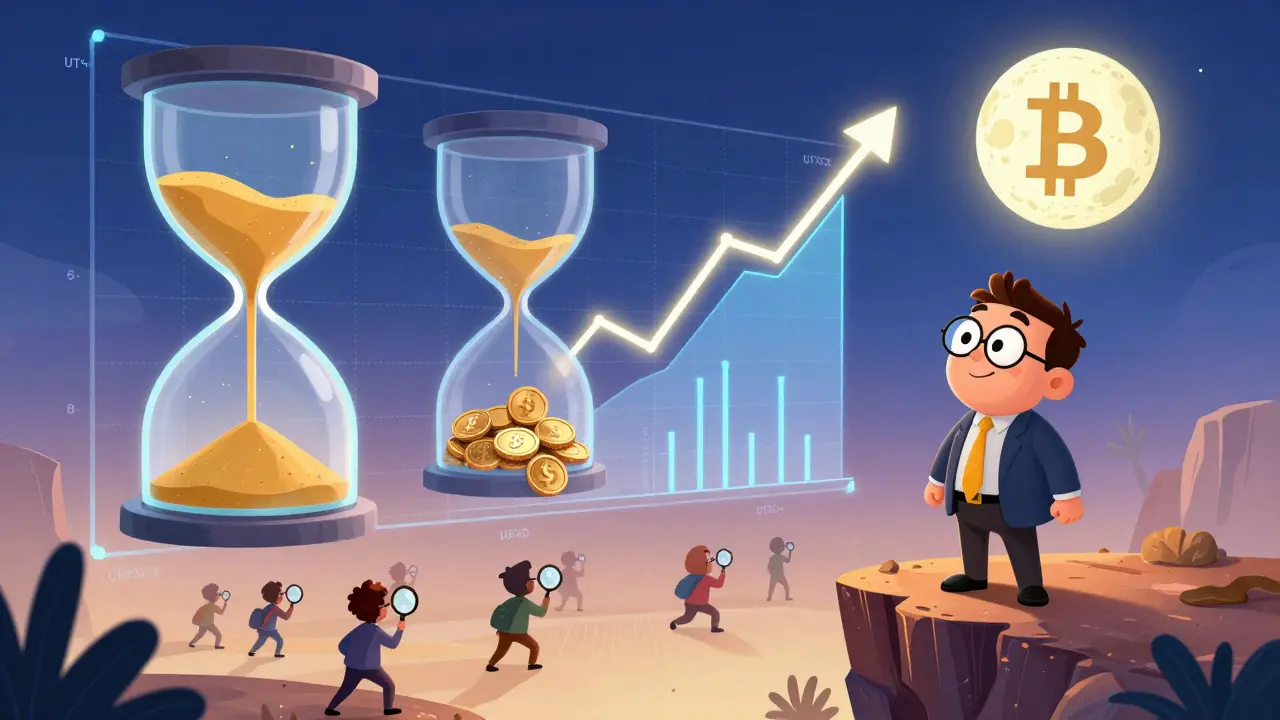
Age, in this context, means how long a UTXO has sat untouched since it was last received. A UTXO created yesterday is new. One created in 2013 is old. When you group thousands of UTXOs by their age-say, under 1 day, 1-7 days, 1-3 months, 1-2 years, 2-5 years, 5+ years-you start seeing patterns.
Old UTXOs that suddenly move are a big deal. If coins that haven’t moved in 8 years suddenly get spent, it usually means someone is cashing out. That’s not normal behavior. It’s a signal. In 2020, over 1.2 million BTC that hadn’t moved since before 2017 were spent. That wasn’t random. It was a wave of long-term holders finally selling after the halving.
On the flip side, if UTXOs under 24 hours are piling up, it means people are buying and quickly moving coins around-maybe speculating, maybe trading. If UTXOs over 1 year are growing, it means people are holding. That’s accumulation.
How Analysts Measure UTXO Age
Tools like Glassnode, CryptoQuant, and Blockchain.com’s explorer track UTXO age in real time. They don’t guess. They calculate it down to the minute. Every time a Bitcoin is sent, the system checks the age of every input used in that transaction. It then updates the age of the new outputs.
Analysts group these into buckets:
- 0-1 day: Short-term holders, traders, exchange activity
- 1-7 days: Active market participants
- 1-3 months: Medium-term holders
- 3-12 months: Investors with moderate conviction
- 1-2 years: Strong holders, often called "diamond hands"
- 2-5 years: Long-term accumulators
- 5+ years: The most committed holders-sometimes called "HODLers"
These aren’t arbitrary. They match real behavioral shifts. For example, after the 2020 halving, UTXOs aged 1-2 years spiked in value as people moved coins out of exchanges and into cold storage. That wasn’t speculation. That was conviction.
What UTXO Age Tells You About Market Cycles
UTXO age distribution is one of the best leading indicators for Bitcoin cycles. Here’s how it works in practice:
- Early bull market: Short-term UTXOs (under 7 days) rise as new buyers enter. Long-term UTXOs stay mostly still.
- Mid bull market: Medium-term UTXOs (3-12 months) start moving. More people are selling to take profit.
- Peak: Long-term UTXOs (2+ years) begin moving. This is the red flag. If coins held since 2018 or earlier are being spent, it’s often a sign the top is near.
- Bear market: Long-term UTXOs stop moving. People are holding through the pain. Short-term UTXOs vanish. The network becomes quiet.
- Recovery: UTXOs over 1 year start growing again. People are buying and not selling. This is the quiet accumulation phase.
In 2023, UTXOs over 5 years increased by 18% while UTXOs under 7 days dropped by 32%. That’s not noise. That’s a clear signal: retail traders were out. Long-term holders were in. The next bull run started soon after.
Real Examples: When UTXO Age Predicted Moves
In March 2024, just before Bitcoin hit $70,000, over 300,000 BTC that hadn’t moved since 2019 were spent. That’s not a coincidence. Those were coins bought under $5,000. The people holding them had waited five years. When they moved, it wasn’t panic. It was profit-taking after a major rally.
Contrast that with January 2025, when Bitcoin was stuck at $58,000. UTXOs over 3 years increased by 12% in just 30 days. Meanwhile, UTXOs under 1 day dropped to their lowest level since 2020. That meant one thing: people weren’t trading. They were holding. And within six weeks, Bitcoin broke $70,000 again.
These aren’t guesses. They’re facts pulled from the blockchain. Every transaction leaves a timestamp. Every UTXO has a birth date. And when those dates start shifting en masse, the market is speaking.

What UTXO Age Doesn’t Tell You
UTXO age doesn’t tell you who owns the coins. It doesn’t tell you if it’s a whale, an exchange, or a grandma with a hardware wallet. That’s a limitation. But you don’t need to know who. You just need to know what they’re doing.
Also, UTXO age doesn’t predict price directly. It predicts behavior. And behavior drives price. If long-term holders are accumulating, price tends to rise over time. If they’re selling, it’s a warning.
And don’t confuse UTXO age with supply metrics. A UTXO isn’t the same as a coin in circulation. One UTXO can be worth 0.001 BTC or 100 BTC. Age tells you how long it’s been sitting, not how big it is.
How to Use This in Your Own Analysis
You don’t need to be a data scientist to use UTXO age. Here’s how to start:
- Go to Blockchain.com Charts and check "UTXO Age Distribution"
- Look at the 5+ year line. Is it rising? That’s accumulation.
- Watch for sudden drops in the 1-2 year or 2-5 year lines. That’s profit-taking.
- Compare it to price. If price is rising but long-term UTXOs aren’t moving, the rally is healthy.
- If price is rising and long-term UTXOs are moving, be cautious.
Set a monthly alert. Look at the chart once a month. You’ll start seeing patterns. In 2025, the 5+ year UTXO line crossed 2.5 million BTC for the first time. That’s more than 12% of all Bitcoin ever mined. And most of it hasn’t moved in over 7 years.
What This Means for the Future
The longer Bitcoin stays alive, the more its UTXO age distribution becomes a mirror of its culture. Early adopters are still holding. Miners from 2015 are still sitting on coins. Even the 2017 bubble buyers are mostly still in.
That’s not just luck. It’s belief. And belief, when held by enough people, becomes a force.
UTXO age distribution doesn’t tell you when Bitcoin will hit $100,000. But it tells you who believes it will. And in crypto, that’s the most powerful signal of all.
What does it mean if UTXOs over 5 years suddenly start moving?
If UTXOs over 5 years start moving, it usually means long-term holders are cashing out. This often happens near market tops. In 2021 and 2024, spikes in 5+ year UTXO movement preceded major price corrections. It’s not a guarantee, but it’s one of the strongest warning signs in Bitcoin analytics.
Can UTXO age predict a Bitcoin bull run?
It doesn’t predict the start, but it confirms the strength. When UTXOs under 1 year drop and those over 2 years rise, it means new buyers are holding, not trading. That’s a sign of a healthy, sustainable rally-not a pump-and-dump. The 2023-2024 bull run started exactly when this pattern appeared.
Is UTXO age analysis only useful for Bitcoin?
It’s most reliable for Bitcoin because it has the longest history and the most stable UTXO structure. Other blockchains like Litecoin or Bitcoin Cash use UTXOs too, but they don’t have the same depth of historical data or holder behavior patterns. For altcoins, UTXO age is less meaningful.
Do exchanges affect UTXO age data?
Yes, but it’s easy to filter. Exchange wallets often have thousands of tiny UTXOs moving daily. Analysts exclude those by identifying known exchange addresses. What’s left are the UTXOs held by individuals and long-term investors-the real signal.
How often should I check UTXO age data?
Once a month is enough for most people. Daily changes are noisy. Look for trends over weeks or months. The biggest moves happen over 3-6 month periods. Checking monthly lets you spot accumulation or distribution without getting distracted by short-term noise.
UTXO age distribution isn’t a crystal ball. But it’s one of the few tools that shows you what real holders are doing-not what traders are saying, not what influencers are posting, but what’s actually happening on the blockchain. And in Bitcoin, that’s the only truth that matters.
Abdulahi Oluwasegun Fagbayi
January 26, 2026 AT 23:18UTXOs are like time capsules. Every unspent output is a story of patience, fear, or conviction. The blockchain doesn’t lie - it just waits. And when those 5-year-old coins finally move, it’s not a trade. It’s a memoir being published.
Ashok Sharma
January 28, 2026 AT 06:27This is a very clear explanation. UTXO age shows us real behavior, not noise. If long-term holders are holding, the market is strong. Simple as that.
Margaret Roberts
January 28, 2026 AT 20:25Or maybe the government is forcing people to sell through inflation taxes and crypto bans. They’ve been watching this data for years. This isn’t organic. It’s engineered.
Tselane Sebatane
January 30, 2026 AT 02:24Listen. This is the most beautiful thing about Bitcoin - it doesn’t care who you are. It doesn’t care if you’re rich or poor or from Lagos or LA. It just records. And when you see 2.5 million BTC sitting untouched for over seven years? That’s not data. That’s devotion. That’s faith in something bigger than Wall Street. That’s the soul of the network. Don’t you feel that? Don’t you see it? This isn’t speculation. This is legacy.
Linda Prehn
January 30, 2026 AT 06:00Everyone’s acting like UTXO age is some secret code but honestly it’s just tracking who didn’t panic sell in 2018 and now they’re cashing in. Big deal. The market’s always been this way.
Arielle Hernandez
January 30, 2026 AT 19:01The elegance of UTXO-based accounting lies in its atomicity and immutability. Unlike account-based ledgers, Bitcoin’s model ensures that every unit of value has a verifiable provenance, which enables precise temporal analysis of holder behavior. This is not merely a metric - it is a cryptographic narrative of economic conviction.
HARSHA NAVALKAR
January 31, 2026 AT 13:57I’ve been holding since 2016. I know what it’s like to watch the price drop while everyone else sells. But I never doubted. I just waited. Now I see others doing the same. It’s quiet. But it’s powerful.
Ryan Depew
February 1, 2026 AT 20:52Bro, this is why I don’t trust any chart that doesn’t show UTXO age. You see a pump? Check if the 5+ year coins are moving. If they’re not? It’s clean. If they are? Run. I’ve made and lost six figures just by watching this one chart.
Mathew Finch
February 2, 2026 AT 11:22Utter nonsense. Only Americans care about this stuff. In real economies, people use banks. This blockchain voodoo is just crypto bros pretending they’re economists. It’s theater.
Tammy Goodwin
February 3, 2026 AT 05:54My grandfather still has his first Bitcoin. He doesn’t even know what a UTXO is. But he knows it’s worth more than it was. He doesn’t touch it. He just smiles. That’s the real story here.
Andy Simms
February 5, 2026 AT 03:55For beginners: if you want to track this, go to blockchain.com/charts and look at the UTXO age distribution chart. Focus on the 5+ year line. Rising? Accumulation. Dropping? Distribution. That’s it. No need to overcomplicate.
Shamari Harrison
February 6, 2026 AT 15:56What’s fascinating is how this data aligns with macro cycles. The 2020 halving triggered a massive shift from exchange wallets to cold storage. That’s when the 1-2 year UTXOs spiked. It wasn’t speculation - it was institutional-grade conviction. This isn’t gambling. It’s a slow, deliberate transfer of wealth.
Nadia Silva
February 8, 2026 AT 13:48Canada has better infrastructure than this. Why are we even talking about blockchain data like it’s gospel? In my country, we use real financial tools - not cryptic charts made by guys who think ‘HODL’ is a strategy.