
DeFi Yield Calculator
Calculate your potential returns by combining DeFi protocols like Aave, Uniswap, and Yearn. Enter your investment amount to see estimated APY and risk level.
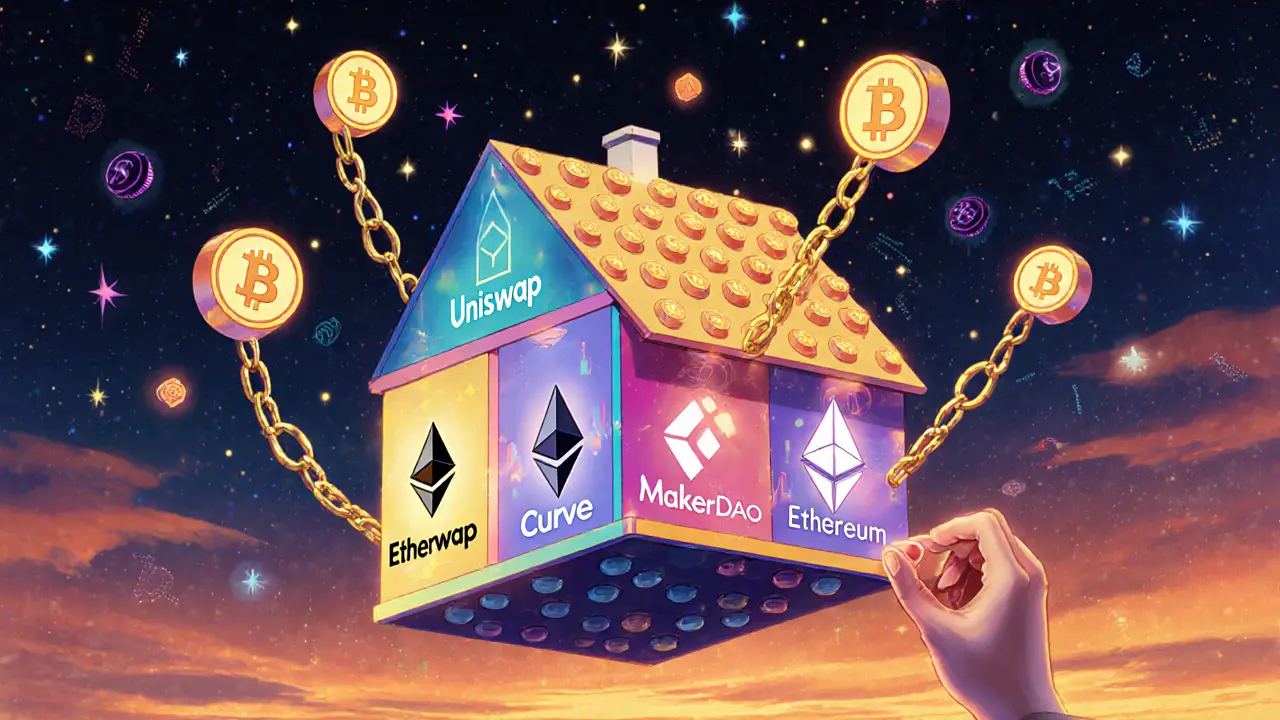
Imagine building a house using pre-made LEGO bricks instead of carving wood and pouring concrete. You snap together walls, windows, and roofs that already work perfectly - no need to reinvent each piece. That’s exactly what DeFi Money Legos are in the world of decentralized finance. They’re not fancy gadgets or secret codes. They’re simple, open-source financial tools that anyone can plug into other tools to create something entirely new - without writing code from scratch.
What Exactly Are DeFi Money Legos?
DeFi Money Legos are modular financial protocols that work together because they’re built on the same blockchain, usually Ethereum. Each one does one job well: lending money, swapping tokens, earning interest, or issuing stablecoins. When you combine them, you get complex financial systems - like automated investment strategies or insurance pools - built from pieces that already exist.
Think of them like apps on your phone. You don’t build a new camera app every time you want to take a photo. You use Instagram, Snapchat, or the default camera - and then link them to other apps to share, edit, or post. DeFi works the same way. Aave lends you money. Curve lets you swap stablecoins with low fees. Yearn automatically moves your funds to the highest-yielding spot. You can chain them together in any order.
How Do They Actually Work?
Every Money Lego runs on a smart contract - self-executing code on a blockchain. These contracts don’t need banks, brokers, or middlemen. They just follow rules written in code. When you deposit ETH into MakerDAO, it locks your asset and gives you DAI, a stablecoin pegged to $1. That DAI can then be deposited into Compound to earn interest. Or you can swap it on Uniswap for another token. You can even use that token as collateral for a flash loan on Aave to make a quick trade.
The magic isn’t in any single tool. It’s in how they talk to each other. A smart contract can call another smart contract. One protocol can read data from another. You don’t need permission. No one shuts you down. If the code works, it runs. That’s composability: the ability to stack, layer, and reuse.
Real-World Example: A Single Transaction, Five Legos
Here’s how it looks in practice. Say you have 10 ETH. You do this:
- Lock your ETH in Aave as collateral and borrow 15,000 DAI.
- Send 7,500 DAI to Curve to earn yield from stablecoin liquidity pools.
- Swap the other 7,500 DAI for LINK on Uniswap.
- Stake your LINK in a yield aggregator like Yearn to auto-compound returns.
- When your yields hit a target, sell LINK back to DAI, pay back your Aave loan, and pocket the profit.
All of that happens through smart contracts. No forms. No customer service. No waiting days. You do it in one transaction, or even automate it with a script. Platforms like Furucombo let you drag and drop these steps visually - like building a recipe out of pre-made ingredients.
Why Do Developers Love This?
Building a DeFi app from zero used to take months - writing secure code, testing for exploits, getting users to trust it. Now, developers start with existing legos. Want to create a lending platform? Use Aave’s code as a base. Need a stablecoin? Use MakerDAO’s model. Need to let users swap tokens? Plug in Uniswap’s liquidity pools.
This cuts development time from months to days. It also lowers risk. If a protocol like Compound has been audited, used by millions, and survived market crashes, why rebuild it? Just use it. That’s why hundreds of new DeFi apps popped up in just a few years after MakerDAO and Compound launched in 2017-2018.

Key Protocols That Are DeFi Legos
These are the most common building blocks you’ll find in any DeFi setup:
- MakerDAO - Issues DAI, the most used stablecoin in DeFi. You lock crypto to mint it.
- Aave - Lets you lend and borrow crypto with variable or fixed rates.
- Uniswap - A decentralized exchange that lets you swap tokens using automated liquidity pools.
- Curve - Optimized for swapping stablecoins with minimal slippage and fees.
- Yearn.finance - Automates yield farming by moving your funds between protocols to maximize returns.
- Synthetix - Lets you trade synthetic assets (like gold, stocks, or crypto) without owning the real thing.
- Polygon - Not a financial tool itself, but a scaling network that makes Ethereum faster and cheaper to use - so legos work better.
Each of these is a Lego brick. Together, they form entire financial systems - from savings accounts to derivatives markets - all without banks.
It’s Not Just Ethereum
Most DeFi legos live on Ethereum because it has the most users, the most locked value, and the most mature code. But it’s not the only place. Solana, for example, has Hubble Protocol, which issues USDH - a crypto-backed stablecoin similar to DAI. Avalanche, Arbitrum, and Base are also hosting their own versions of these building blocks.
The future isn’t one blockchain. It’s cross-chain legos. Projects like Wormhole and LayerZero let you take DAI from Ethereum and use it in a lending protocol on Solana. The legos are starting to snap across different systems. That’s the next level of composability.
Why This Matters to You
You don’t need to be a coder to benefit. If you’ve ever earned interest on crypto, swapped tokens, or used a wallet like MetaMask, you’ve already touched DeFi legos. The real power is in control. No bank can freeze your funds. No government can block your access. You own the keys. And if you want to get smarter, you can start experimenting - even with small amounts.
It’s also about innovation. In traditional finance, new products take years to launch. A new ETF? A new loan product? Regulatory hurdles, paperwork, legal teams. In DeFi, someone writes a smart contract, deploys it, and it’s live in minutes. The system evolves as fast as developers can code.

Potential Risks
Legos are fun - until one breaks. If one protocol has a bug, it can affect everything built on top of it. In 2022, a vulnerability in a lending protocol caused cascading losses across multiple projects. That’s the downside of interconnected systems.
Also, gas fees on Ethereum can be high. Using five legos in one transaction might cost $50 in fees. That’s why tools like Polygon or zkSync exist - they make the legos cheaper to snap together.
And yes, code isn’t perfect. Bugs happen. Scams exist. Always check audits. Don’t put more in than you can afford to lose.
The Bigger Picture
DeFi Money Legos aren’t just about crypto. They’re a new way to build financial systems - open, transparent, and global. Anyone with a smartphone and internet can use them. No ID. No credit score. No approval needed.
This is the foundation of a new financial internet. It’s not replacing banks tomorrow. But it’s showing that finance doesn’t have to be slow, expensive, or controlled by a few institutions. You can build your own system. Borrow, lend, earn, swap - all from one wallet. And if you’re curious, you can start today with just $10 and a few clicks.
What does "composability" mean in DeFi?
Composability means that DeFi protocols can be combined like building blocks. Each protocol - like a lending app or exchange - works independently, but their smart contracts can interact with each other. This lets developers create complex financial tools by stacking simple ones, without rewriting code from scratch.
Can I use DeFi Money Legos without coding?
Yes. Platforms like Furucombo, Zapper, and DeFi Saver let you drag and drop protocols to create automated strategies - like depositing ETH, borrowing DAI, and staking it - all with a few clicks. You don’t need to write a single line of code.
Which blockchain has the most DeFi legos?
Ethereum has the largest number and value of DeFi legos, with over $50 billion locked in its protocols as of 2025. But other chains like Polygon, Arbitrum, and Solana are growing fast, offering cheaper and faster versions of the same building blocks.
Are DeFi legos safe?
They’re not risk-free. Smart contracts can have bugs. If one protocol fails, it can affect others built on top of it. Always check for audits from firms like CertiK or OpenZeppelin. Start small. Never invest more than you’re willing to lose.
How do I get started with DeFi legos?
First, get a wallet like MetaMask. Buy a small amount of ETH or USDC. Then try a simple platform like Aave to lend your stablecoin, or Uniswap to swap tokens. Use Furucombo to test combinations before committing large amounts. Learn one lego at a time.
Can I make money with DeFi legos?
Yes, but it’s not guaranteed. Many users earn interest, trade for profit, or farm tokens. But high returns often come with high risk - including smart contract failures or price drops. Treat it like investing, not gambling. Focus on learning before chasing yields.
What Comes Next?
DeFi legos are evolving. We’re seeing automated agents that manage your portfolio across chains. Insurance protocols that cover smart contract failures. Tokenized real-world assets like bonds or real estate being wrapped into DeFi. The pieces are getting more complex - but the principle stays the same: build on what already works.
It’s not about owning the most expensive tool. It’s about understanding how the pieces connect. The next big innovation won’t come from a startup with a new app. It’ll come from someone stacking existing legos in a way no one thought of before.
Missy Simpson
November 6, 2025 AT 08:42This is literally the most exciting thing to happen to finance since the ATM!! 😍 I just used Furucombo yesterday to stack Aave + Yearn and made $3 in a week-no cap, it’s magic! 🤩
Kyung-Ran Koh
November 6, 2025 AT 19:49Actually, let me clarify: DeFi legos aren't 'new'-they're just the first time non-bankers have been allowed to use them. The composability model has been theorized since 2009, but Ethereum made it executable. And yes, you can build a yield farm without coding-just use Zapper. But please, please, please audit your contracts before depositing. I lost $400 in 2021 because I didn't. 😔
Michelle Stockman
November 7, 2025 AT 04:43Wow. So you’re telling me the future of finance is… a bunch of kids dragging and dropping apps like they’re on Roblox? 🤡
Alexis Rivera
November 8, 2025 AT 20:29What’s fascinating isn’t just the tech-it’s the philosophy. You don’t need permission to participate. No credit check. No paperwork. No gatekeeping. That’s not innovation. That’s liberation. And it’s happening in real-time, right now, while you’re reading this. Slow down. Breathe. This is bigger than crypto.
Eric von Stackelberg
November 9, 2025 AT 09:19Let’s be clear: this is a centralized deception disguised as decentralization. The smart contracts are audited by the same firms that worked with FTX. The ‘open-source’ code is hosted on GitHub, which is owned by Microsoft. The ‘permissionless’ system still requires ETH, which is controlled by miners. This isn’t freedom. It’s a more elegant pyramid scheme.
Emily Unter King
November 10, 2025 AT 17:50Composability enables atomic transactions across trust-minimized primitives, effectively abstracting counterparty risk into protocol-level interoperability. The real win? Liquidity fragmentation is being re-aggregated via yield optimizers like Yearn, creating non-linear return surfaces that outperform traditional fixed-income instruments. Also, gas fees are still a bitch on Ethereum mainnet-use zkSync if you’re not a masochist.
Michelle Sedita
November 10, 2025 AT 20:55I love how this feels like a secret society that just got leaked to the public. Like, imagine if your grandma suddenly found out she could earn interest on her savings without going to a bank… and she didn’t even need to know what a blockchain is. That’s the real beauty here. It’s not for the techies. It’s for everyone who’s ever been told ‘no’ by a system that didn’t care.
John Doe
November 11, 2025 AT 06:50They’re lying. Every single one of these ‘legos’ is controlled by a private foundation with a secret wallet. I checked the transaction history on Etherscan-90% of the liquidity is held by 3 addresses. This isn’t decentralized. It’s a honeypot. And they’re watching you right now. 🕵️♂️
Ryan Inouye
November 13, 2025 AT 00:09Why are we letting a bunch of tech bros from Silicon Valley redesign money? We don’t need this. We need real jobs, real banks, real laws. This is just another way for rich guys to make money off the gullible. America is falling apart because of this nonsense.
Cierra Ivery
November 14, 2025 AT 01:57Wait-so you’re saying I can use a stablecoin to earn interest… and then swap it… and then stake it… and then… what? You’re telling me I don’t need to trust a bank? That’s… impossible. That’s not how the world works. I’m not buying it. 😒
Veeramani maran
November 14, 2025 AT 05:05bro i tried this on solana with usdc and it work but gas fee on eth is too much i lost 12$ just to swap lol but i got 3$ profit so its ok 🤷♂️
Kevin Mann
November 15, 2025 AT 10:08Okay. So picture this: I’m sitting on my couch at 2 a.m. in my dinosaur PJs. My wallet’s connected. My phone’s buzzing. I just did a five-lego combo: Aave → Curve → Uniswap → Yearn → SushiSwap. And guess what? I turned $50 into $58.72 in 14 hours. No one told me to do it. No one gave me permission. I just… did it. And now I’m crying. Not because I made money. But because I finally felt… free. Like I’m not a customer. I’m a builder. And this? This is the future. And I’m not going back. 🥹🔥
Matthew Gonzalez
November 17, 2025 AT 08:20It’s not about the money. It’s about agency. For the first time in human history, you can participate in global finance without asking anyone’s permission. No ID. No background check. No ‘we’re sorry, your credit score is too low.’ This isn’t finance. It’s a social contract rewritten in code. And it’s fragile. And beautiful. And terrifying. And real. We’re not just using tools-we’re rewriting the rules of belonging.
Tara R
November 18, 2025 AT 20:17While the concept of composability in decentralized finance is theoretically intriguing, the practical implementation remains fraught with structural inefficiencies and existential vulnerabilities. The reliance on immutable smart contracts, which are neither auditable by laypersons nor regulatable by sovereign authorities, constitutes a profound governance failure. One must question whether the allure of speculative yield justifies the systemic fragility of an architecture designed without accountability. In sum: elegant in theory, dangerous in practice.