
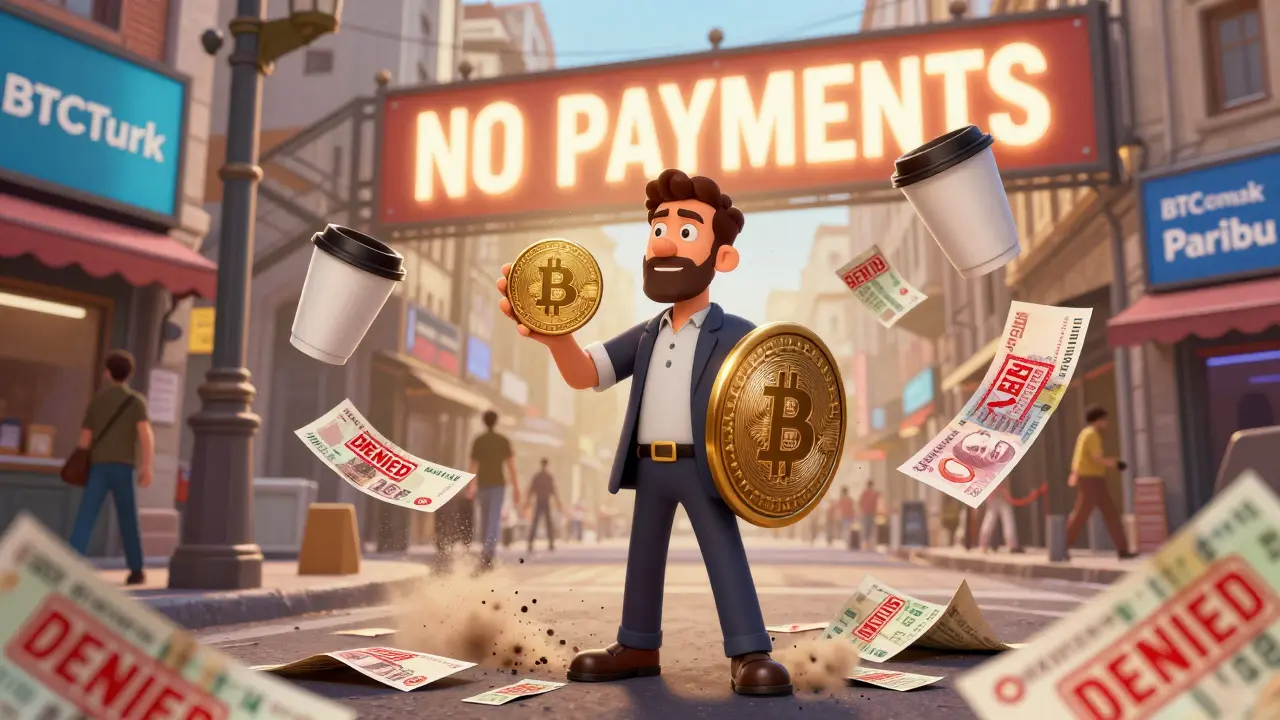
Since April 2021, Turkey has walked a tightrope with cryptocurrency: you can own it, trade it, even hold it as an investment - but you can’t use it to buy coffee, pay rent, or settle a bill. The Turkish lira remains the only legal tender, and the government has built a wall between crypto as an asset and crypto as a payment tool. By February 2026, that wall has become a fortress.
Trading Is Legal. Payments Are Not.
It sounds contradictory, but it’s the core of Turkey’s crypto policy. The Central Bank of Turkey (TCMB) banned the use of digital assets for payments in 2021, citing risks to financial stability and the lira’s sovereignty. That ban is still in full force. You can’t pay for a flight on Turkish Airlines with Bitcoin. You can’t tip a delivery driver in Ethereum. Even stablecoins like USDT or USDC are blocked from being used at point-of-sale terminals.
But here’s the twist: you can still buy, sell, and hold Bitcoin, Ethereum, and hundreds of other coins. Turkish exchanges like BTCTurk and Paribu still see millions in daily trading volume. Why? Because the lira has lost nearly 70% of its value against the dollar since 2021. For many Turks, crypto isn’t speculation - it’s survival. People use it to protect savings from inflation, send money abroad, or store value when banks offer negative real interest rates.
The New Rules: Licensing, Capital, and Surveillance
In July 2024, Turkey passed major amendments to its Capital Markets Law. Starting February 2025, every crypto exchange, wallet provider, or custodian operating in Turkey must be licensed by the Capital Markets Board (CMB). No exceptions. The cost? A minimum capital requirement of 150 million Turkish lira ($4.1 million) for exchanges and 500 million lira ($13.7 million) for custodians. That’s not just high - it’s among the highest in the world.
Compare that to the EU’s MiCA framework, where licensing thresholds are often under €1 million. Turkey’s rules are designed to push out small players. Many local startups have already shut down. Only well-funded firms - often backed by foreign investors - can now enter the market.
It’s not just about money. Every licensed firm must pass a technical audit by TÜBİTAK, Turkey’s national science council. They must also install real-time transaction monitoring systems and report every trade - even canceled ones - to the CMB. The Financial Crimes Investigation Board (MASAK) now demands full KYC on every user. If you send or receive more than 15,000 Turkish lira ($425) in crypto, you’re required to verify your identity with a government-issued ID. No anonymous wallets allowed.
What’s Coming: Account Freezes and Blacklists
The biggest change on the horizon isn’t about licensing - it’s about control. Draft legislation, expected to pass in early 2026, will give MASAK the power to freeze crypto accounts outright. Not just freeze - shut them down permanently. If MASAK suspects a wallet is being used for money laundering, gambling, or fraud, they can block it, freeze its funds, and add it to a national blacklist.
This targets what locals call “rented accounts” - people who sign up for crypto wallets and rent them out to criminals for a small fee. These accounts are often used to move stolen funds, launder money from online scams, or pay for illegal gambling. The government says it’s cracking down on crime. Critics say it’s a backdoor to surveillance.
Under the new rules, MASAK won’t just target exchanges. Banks, electronic money institutions, and even peer-to-peer platforms could be forced to comply. If your wallet is flagged, you’ll have to prove your innocence - with documents - to get access back. No appeal process is built in yet.

How People Are Adapting
Despite the rules, crypto use in Turkey hasn’t dropped. It’s just gone underground. Many traders now rely on peer-to-peer platforms like LocalBitcoins or Telegram-based groups to swap crypto for lira. These deals happen in person, over cash, or via bank transfer - outside the regulated system. But that’s risky. If you get caught, you could be investigated for circumventing capital controls.
Some users convert crypto to lira, then immediately move it into foreign bank accounts or buy dollar-denominated assets. Others use decentralized exchanges like PancakeSwap - though the CMB blocked access to it in 2024. Many now use VPNs and offshore wallets to trade, but that violates Turkey’s laws and could lead to asset seizures.
Reddit threads and Turkish Telegram groups are full of complaints. “I can’t pay my electric bill with Bitcoin, but I can’t afford my lira salary either,” wrote one user in Istanbul. Others praise the clarity: “At least now I know what’s legal. Before, I was scared to even buy Bitcoin.”
Why This Matters Beyond Turkey
Turkey’s model is unique. Most countries either ban crypto (like China) or embrace it as payment (like El Salvador). Turkey chose a middle path: treat crypto like stocks, not cash. The EU’s MiCA framework allows regulated payments. The U.S. lets states decide. Turkey says: no payments, but yes to trading - and we’ll make sure you pay for the privilege.
It’s a warning to other emerging markets. If your currency is falling, you might want to let people use crypto to protect their wealth. But if you’re scared of capital flight, you’ll lock it down hard. Turkey’s system is a blueprint for countries torn between inflation and control.

What’s Not Covered (Yet)
One big question remains unanswered: taxes. As of early 2026, profits from crypto trading are still untaxed in Turkey. No capital gains, no reporting, no paperwork. But with the government tightening controls everywhere else, a tax law is almost inevitable. Experts expect a proposal by late 2026 - possibly 15-20% on gains over 100,000 lira.
Stablecoin transfers are also under review. The Finance Ministry is preparing rules to limit how much USDT or USDC can be moved into or out of the country. This is meant to stop people from using crypto to bypass currency controls - but it also hurts legitimate users who rely on stablecoins to avoid lira volatility.
Bottom Line
Turkey’s crypto rules aren’t about banning innovation. They’re about control. The government wants to stop money laundering, prevent capital flight, and protect the lira - even if it makes crypto less useful. For traders, it means higher costs, more paperwork, and less privacy. For everyday users, it means crypto is a savings tool, not a spending tool.
If you’re in Turkey, you can still trade. But you’ll need to jump through hoops. If you’re outside Turkey, this is a case study in how a country can strangle crypto’s utility while letting it live - barely.
AJITH AERO
February 21, 2026 AT 04:59Someone should send a Bitcoin to the Central Bank and see if they cash it. I'd watch that livestream.
Geet Kulkarni
February 21, 2026 AT 09:11And the capital requirements? 150 million TRY? That’s not regulation - it’s a gatekeeping masterpiece. Only the oligarchs get to play. 💸
Paul David Rillorta
February 22, 2026 AT 18:51they’re gonna freeze your wallet for sending 425 lira? bro that’s like 10 bucks. who even uses lira anymore?
andy donnachie
February 23, 2026 AT 05:56Yes, it pushes out small players - but that’s often necessary when the underlying currency is in freefall. The real issue is enforcement. If MASAK can freeze accounts without due process, that’s a legal red flag.
Alex Williams
February 24, 2026 AT 11:52They’re not stopping crime. They’re stopping freedom. You can’t pay for rent with crypto? Fine. But you also can’t pay your rent with your salary anymore. So what’s the difference?
It’s a trap. You’re forced to convert to USD or crypto, then taxed on it later. Classic.
Sarah Shergold
February 26, 2026 AT 03:33It’s like being forced to wear a tuxedo to a food bank.
Nicole Stewart
February 27, 2026 AT 22:05Alan Enfield
March 1, 2026 AT 02:41If you’re buying crypto via Telegram and getting paid in cash, you’re not a criminal - you’re just trying to survive. The system should protect them, not punish them.
Jennifer Riddalls
March 2, 2026 AT 09:32It’s not about being tech-savvy. It’s about being smart. And yeah, the rules are messy. But you’re doing the right thing. Keep going.
kieron reid
March 2, 2026 AT 23:36Next thing you know, the state owns your Bitcoin. And you’ll be the one asking why you didn’t move it to Canada.
Avantika Mann
March 3, 2026 AT 13:50But I also think this is the most honest crypto policy I’ve seen. No pretending. No 'blockchain innovation' buzzwords. Just: we’re scared of inflation, so we’ll let you trade - but not spend.
It’s brutal. But it’s real.
george chehwane
March 4, 2026 AT 04:34It’s like allowing someone to worship God but forbidding prayer. The ritual must continue, even if the meaning is hollow.
The lira is not a currency. It’s a sacrament. And crypto? A heresy. And heretics must be monitored.
And yet - we all know the truth. The lira is already dead. It just hasn’t been buried yet.
Charrie VanVleet
March 5, 2026 AT 11:29So they made it a savings tool. It’s not perfect - but it’s the most pragmatic thing I’ve seen in emerging markets.
And hey - if you’re using crypto to protect your family’s future? That’s not a crime. That’s love. 💪❤️