
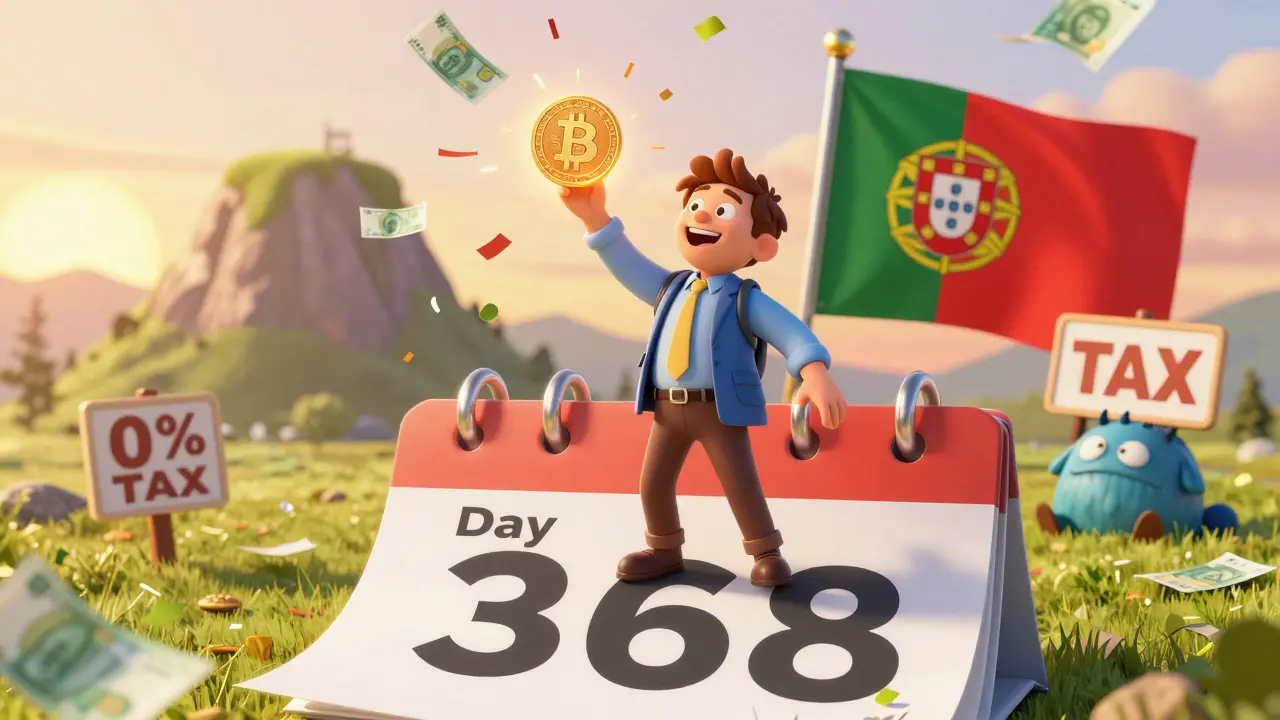
If you’ve held crypto for over a year and want to cash out without paying a cent in taxes, Portugal is still one of the few places in the world where that’s legally possible. Unlike most countries that tax you the moment you sell, Portugal lets you keep every euro of profit-if you play by their one-year rule.
How Portugal’s Crypto Tax System Works
Portugal doesn’t tax you on crypto price increases. You don’t pay anything just because Bitcoin went from €30,000 to €70,000. Taxes only kick in when you turn crypto into cash-or use it to buy something. That’s called a realization event. And even then, you only pay if you held it for less than 365 days.If you bought Ethereum in March 2024 and sold it in April 2025, you owe nothing. That’s because you held it longer than a year. But if you sold it in February 2025? You pay 28% on the profit. Simple. No brackets. No complicated calculations.
The Portuguese tax code breaks crypto income into three buckets:
- Category G (Capital Gains): Selling crypto after less than a year → 28% tax.
- Category G (Long-term): Selling crypto after 365+ days → 0% tax.
- Category E (Passive Income): Staking, lending, or earning interest on crypto → 28% flat tax, no matter how long you held.
- Category B (Professional Activity): If you’re trading full-time, mining, or running a crypto business → taxed as regular income, up to 53%.
That last one matters. If you’re just buying and holding, you’re not a professional. But if you’re making 10 trades a day, running a bot, or getting paid in crypto for services, you might be classified as self-employed. That changes everything.
What’s Still Tax-Free?
The big win? Crypto-to-crypto trades. Swap Bitcoin for Solana? No tax. Trade Ethereum for a stablecoin? Still no tax. The moment you convert to euros, dollars, or use crypto to buy a laptop, that’s when the clock starts ticking.Even NFTs aren’t treated the same as regular crypto under Portuguese law. If you buy and sell an NFT, it’s not automatically subject to the 28% rule. The tax authority hasn’t fully clarified this yet, but most tax advisors treat NFTs as separate assets-meaning you might avoid taxes if you hold them long enough. But tread carefully. Rules can shift.
Staking rewards? Those are taxed at 28% every time you get them. Even if you hold the staked tokens for five years, the rewards themselves are income. You can’t avoid that tax by waiting. But if you sell the original coin after a year, you pay nothing on the original purchase profit-only on the staking rewards you’ve collected.
How Portugal Compares to the Rest of Europe
In 2025, Portugal is still one of the best in Europe for long-term holders. Here’s how it stacks up:| Country | Short-Term Gain Tax | Long-Term Gain Tax | Staking/Lending Tax |
|---|---|---|---|
| Portugal | 28% | 0% | 28% |
| Germany | 28% | 0% | 28% |
| Spain | 19-47% | 19-26% | 19-47% |
| France | 30% | 30% | 30% |
| Italy | 26% | 26% | 26% |
Germany matches Portugal on long-term exemptions, but its rules are messier. You need to prove your holding period for every single coin, and if you sell more than €600 in a year, you might trigger reporting requirements. Portugal doesn’t have that threshold.
Spain and France are harsher. Spain taxes long-term gains too, with rates going up to 47% for high earners. France taxes everything at 30%, no exceptions. Portugal’s flat 28% for short-term gains is actually lower than Spain’s top rate-and far simpler.

What You Need to Keep Track Of
Portugal doesn’t require you to file crypto-specific forms. But you still need to prove your holding period if the tax office asks. That means keeping records of:- When you bought each coin (date and time)
- How much you paid (in EUR or equivalent)
- When you sold or spent it
- The value in EUR at the time of sale
Use a tool like CoinTracking, Koinly, or CryptoTaxCalculator. These platforms auto-import your trades from exchanges, calculate your holding periods, and flag taxable events. Most have built-in templates for Portuguese tax filings.
Don’t rely on exchange statements alone. Many exchanges don’t track your exact purchase cost, especially if you moved coins between wallets. You need the original transaction hash and wallet address history.
What Doesn’t Count as a Taxable Event
You won’t owe tax if you:- Buy crypto with euros (no gain yet)
- Move crypto between your own wallets
- Gift crypto to family (unless it’s part of a business arrangement)
- Swap one crypto for another (BTC → ETH, etc.)
- Hold crypto and its value goes up
But if you use crypto to buy a car, a vacation, or even a coffee? That’s a sale. You’ve triggered a taxable event. If you held it under a year, you pay 28%. If you held it over a year? You pay nothing.
Who Should Consider Moving to Portugal?
If you’re a digital nomad, remote worker, or crypto investor with a portfolio over €50,000, Portugal’s tax rules are a game-changer. You don’t need to be a citizen. You just need to be a tax resident.To become a tax resident, you must either:
- Live in Portugal for more than 183 days in a calendar year
- Own a home in Portugal and intend to live there permanently
Many people use the D7 visa (passive income visa) or D8 visa (digital nomad visa) to get residency. Once approved, you’re eligible for Portugal’s crypto tax benefits.
People who’ve made the move report saving tens of thousands in taxes over just a few years. One investor from the UK sold €200,000 worth of Bitcoin after holding it for 15 months. He paid €0 in tax. In the UK, that would’ve cost him over €70,000.

Common Mistakes to Avoid
Even with clear rules, people mess up:- Thinking staking rewards are tax-free. They’re not. You pay 28% on them every time you receive them.
- Assuming crypto-to-crypto trades are taxable. They’re not. Only fiat conversions count.
- Not tracking purchase dates. If you can’t prove you held it a year, the tax office assumes you didn’t.
- Using a non-EU exchange. If your crypto is held on a U.S.-based exchange and you’re a Portuguese tax resident, you might still be taxed if the asset is classified as a security.
- Ignoring the professional trader rule. If you’re trading daily, you might be classified as self-employed. That means higher taxes.
What’s Next for Portugal’s Crypto Tax Rules?
The 2023 rules were meant to be the final version. After years of uncertainty, the government wanted clarity. And they got it.The EU’s MiCA regulation (Markets in Crypto-Assets) is now in force, but it doesn’t touch taxation. Portugal still has full control over its rates. Experts expect the 365-day rule to stay for the foreseeable future.
DeFi, yield farming, and new token types are being monitored. But so far, the tax authority hasn’t changed its stance. If you hold a token for over a year and sell it for euros? Still tax-free.
The only risk? If you’re holding crypto that’s later classified as a security-like some tokens issued under ICOs. Those might be taxed differently. Stick to Bitcoin, Ethereum, and major coins to stay safe.
Final Thoughts
Portugal’s crypto tax system isn’t perfect. Staking rewards hurt. Professional traders get hit hard. But for the average investor who buys, holds, and waits? It’s the best deal in Europe.One year. That’s all it takes. Buy your crypto. Hold it. Don’t touch it until the calendar flips. Then cash out. Keep 100% of your gains. No forms. No audits. No surprises.
If you’re serious about keeping your crypto profits, Portugal isn’t just an option. It’s the smartest one left.
Do I have to be a Portuguese citizen to get tax-free crypto gains?
No. You just need to be a tax resident. That means living in Portugal for more than 183 days a year or owning a home there with the intent to stay. Citizenship isn’t required.
What if I sell crypto after 366 days but bought it with euros from a non-EU bank?
It doesn’t matter where your euros came from. Only the holding period of the crypto matters. As long as you held it for over a year and converted it to euros in Portugal, you pay zero tax.
Are crypto-to-crypto trades taxed in Portugal?
No. Swapping Bitcoin for Ethereum, or Solana for USDC, is not a taxable event in Portugal. Taxes only apply when you convert crypto into fiat currency like euros.
Do I need to report my crypto holdings to the Portuguese tax authority?
You don’t report holdings. You only report gains if you sold crypto within a year. If you held over 365 days, you don’t report anything. But keep records for at least five years in case of an audit.
Can I use a U.S.-based exchange and still get the tax exemption?
Yes, as long as you’re a Portuguese tax resident and you’re holding the crypto for over a year. The location of the exchange doesn’t affect the tax treatment. But if the asset is classified as a security by Portuguese authorities, rules may differ.
What happens if I move out of Portugal after holding crypto for 360 days?
You lose the exemption. The tax benefit only applies while you’re a Portuguese tax resident. If you move before hitting 365 days, any sale after leaving Portugal will be taxed under your new country’s rules.
steven sun
January 22, 2026 AT 17:30tim ang
January 24, 2026 AT 14:39katie gibson
January 26, 2026 AT 09:45Ashok Sharma
January 27, 2026 AT 16:07Margaret Roberts
January 29, 2026 AT 12:05Harshal Parmar
January 31, 2026 AT 07:59Darrell Cole
January 31, 2026 AT 13:54Matthew Kelly
February 1, 2026 AT 23:05Dave Ellender
February 3, 2026 AT 11:08Adam Fularz
February 4, 2026 AT 09:23Linda Prehn
February 4, 2026 AT 16:48Adam Lewkovitz
February 5, 2026 AT 22:29Brenda Platt
February 6, 2026 AT 12:20Melissa Contreras López
February 7, 2026 AT 00:40