
You’ve probably heard the hype around decentralized exchanges (DEXs). They promise lower fees, faster transactions, and total control over your assets. But not every platform delivers on that promise. SolidLizard is a community-driven decentralized exchange operating on the Arbitrum blockchain. It launched in January 2023 with a bold claim: it uses a unique governance model called ve(3,3) to reward long-term holders.
But here’s the thing-just because a project has an innovative idea doesn’t mean it’s ready for prime time. I’ve looked into the numbers, the tech, and the user experience so you don’t have to gamble blindly. This isn’t just another list of features; it’s a real-world check-up on whether SolidLizard can actually compete with giants like Uniswap or PancakeSwap.
The Core Concept: What Makes SolidLizard Different?
To understand SolidLizard, you first need to understand its backbone: the ve(3,3) model. This isn’t just marketing jargon. It’s a specific economic framework that combines two powerful concepts from the DeFi world.
First, there’s the "vote-escrowed" part, often written as ve. This comes from protocols like Curve Finance. When you lock up your tokens for a set period, you get voting power in the protocol’s governance. The longer you lock them, the more power you have. Second, there’s the (3,3) game theory mechanic, popularized by OlympusDAO. In this model, everyone wins if they cooperate. If you hold and stake, the price goes up, which benefits everyone else who holds. If you sell, the price drops, hurting everyone.
SolidLizard merges these ideas. Its native token, SLIZ, acts as both the currency for trading fees and the key to governance. The goal is to create a self-sustaining ecosystem where users are incentivized to keep their tokens locked rather than selling them for quick profits.
On paper, this sounds robust. In practice, however, execution matters far more than theory. Let’s look at how this plays out in the current market.
Security and Transparency: A Rare Bright Spot
In the world of DeFi, security is non-negotiable. One major red flag for many projects is the use of proxy contracts. Proxy contracts allow developers to upgrade the underlying code of a smart contract without changing the address. While this offers flexibility, it also introduces risk. If the developer team turns malicious or makes a mistake during an upgrade, your funds could be at risk.
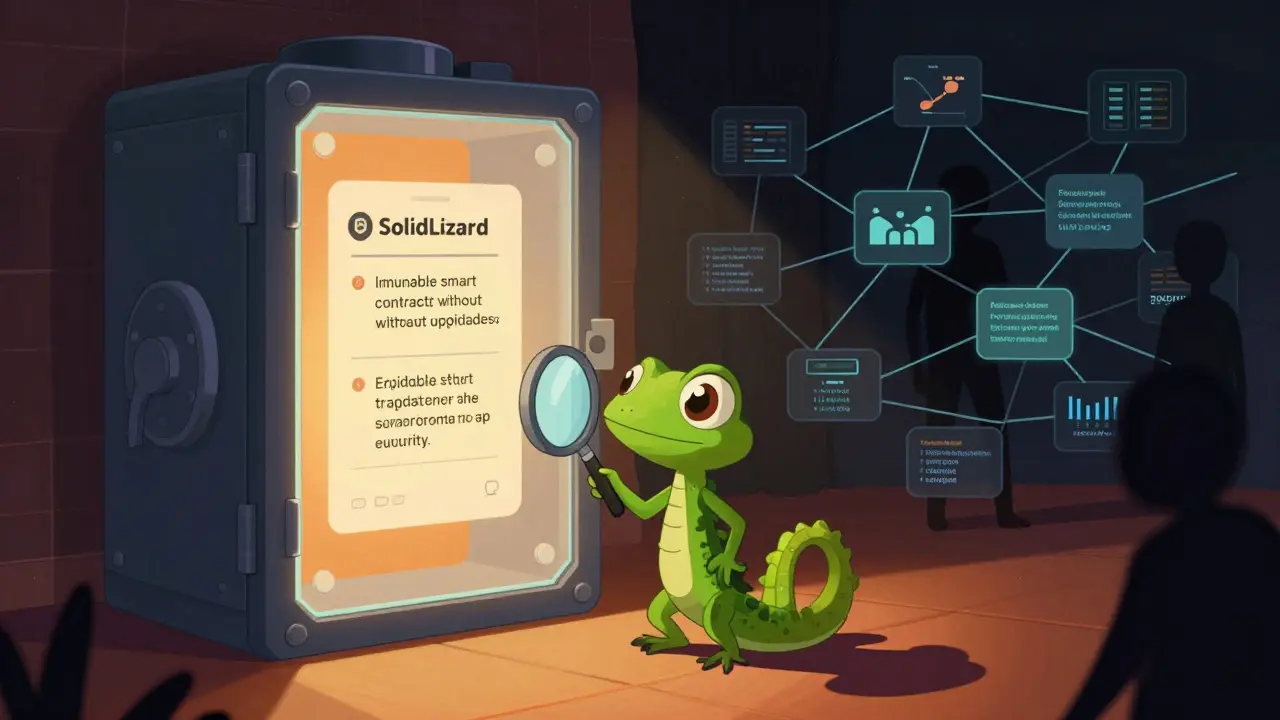
SolidLizard takes a different approach. The platform emphasizes transparency through publicly verified smart contracts with no proxy contracts. This means the code you see is the code that runs. You can audit it yourself, or trust that independent auditors have done so. For users who prioritize security and immutability, this is a significant advantage over many newer DEXs that rely on upgradeable patterns.
This commitment to transparency aligns with the broader ethos of Arbitrum, the Layer 2 network where SolidLizard operates. Arbitrum itself is known for its strong security track record and compatibility with Ethereum’s existing infrastructure.
The Liquidity Problem: Why Volume Matters
Here’s where things get tricky. Even the best-designed exchange fails if no one is using it. Liquidity is the lifeblood of any DEX. Without deep liquidity pools, you face high slippage-meaning the price you see when you click “swap” might be drastically different from the price you actually get.
Let’s look at the data. As of mid-2026, SolidLizard’s trading volume is... well, let’s call it minimal. Reports indicate that the maximum trading volume for the primary SLIZ/WETH pair reached only about $115. To put that in perspective, major DEXs process billions in daily volume. Even smaller niche exchanges handle millions.
This low volume creates a vicious cycle. Low liquidity scares away traders. Fewer traders mean less liquidity. And without liquidity, the ve(3,3) model struggles to function effectively because there aren’t enough participants to drive the cooperative game theory mechanics.
If you’re trying to trade even a modest amount of SLIZ, you could easily move the market against yourself. That’s not exactly what you want when you’re looking for efficient swaps.
| Feature | SolidLizard | Uniswap V3 | PancakeSwap |
|---|---|---|---|
| Network | Arbitrum | Ethereum + L2s | BSC + Multi-chain |
| Governance Model | ve(3,3) | Standard DAO | Standard DAO |
| Proxy Contracts | No (Immutable) | Yes (Upgradeable) | Yes (Upgradeable) |
| Daily Volume | <$1,000 | $Billions | $Billions |
| Market Cap Rank | #7708+ | Top 10 | Top 10 |
Tokenomics and Market Reality
The economics behind SLIZ tell a story of extreme volatility and uncertainty. The total supply is fixed at approximately 40.4 million tokens. However, the circulating supply data is confusing. Some sources report zero tokens in circulation, while others show active but tiny trading pairs.
The price reflects this ambiguity. SLIZ trades in fractions of a cent, fluctuating between $0.000029 and $0.000041 USD. The fully diluted valuation (FDV) hovers around $1,400. Yes, you read that right. Fourteen hundred dollars. Compare that to Uniswap’s multi-billion dollar valuation, and you’ll see why experts are hesitant to recommend SolidLizard for serious trading.
There’s also a discrepancy in listing data. Some trackers say SLIZ isn’t listed on any centralized exchanges (CEXs) or major DEXs, while others show internal trading on the SolidLizard platform itself. This lack of clear, consistent data makes it hard to assess true market interest.
User Experience and Community Engagement
Using a DEX usually requires connecting a wallet like MetaMask or Trust Wallet. SolidLizard follows this standard pattern. However, the user experience beyond that connection is sparse. Documentation is limited primarily to the official website, solidlizard.finance. There’s little in the way of tutorials, FAQs, or community support channels.
Community engagement is equally thin. Social media presence exists on Twitter and Facebook, but meaningful discussion on platforms like Reddit or Discord is virtually non-existent. For a project relying on community governance (as ve(3,3) models do), this is a critical weakness. Governance requires active participation. Without a vibrant community, the voting mechanisms become irrelevant.
If you’re new to DeFi, the learning curve here is steep not because the tech is complex, but because there’s no hand-holding. You’re on your own.

Risks You Should Know Before Connecting Your Wallet
I’m not here to sell you anything. I’m here to help you protect your capital. Here are the specific risks associated with SolidLizard right now:
- High Slippage: Due to low liquidity, large trades will likely result in poor execution prices.
- Liquidity Risk: If the few remaining liquidity providers withdraw their funds, the pool could drain completely, leaving you unable to exit your position.
- Smart Contract Risk: While SolidLizard avoids proxy contracts, all smart contracts carry inherent risk. Bugs can still exist in immutable code.
- Regulatory Uncertainty: As DeFi faces increased scrutiny globally, smaller projects with unclear jurisdictions may find themselves in legal gray areas.
- Opportunity Cost: Capital tied up in low-volume assets like SLIZ could potentially earn higher yields or appreciate more steadily in established protocols.
Is SolidLizard Worth Your Attention?
So, where does that leave us? SolidLizard is an interesting experiment in ve(3,3) tokenomics on the Arbitrum network. Its commitment to immutable smart contracts is commendable and sets it apart from many competitors. However, innovation alone doesn’t make a viable exchange.
For the average trader looking to swap tokens efficiently, SolidLizard is currently impractical. The lack of liquidity, minimal community engagement, and confusing market data make it a poor choice for everyday use. It’s better suited for researchers, die-hard DeFi enthusiasts, or those willing to take high-risk bets on early-stage protocols.
If you decide to proceed, start small. Never invest more than you can afford to lose. Use hardware wallets for added security. And always double-check the contract addresses directly from the official website before interacting with any interface.