
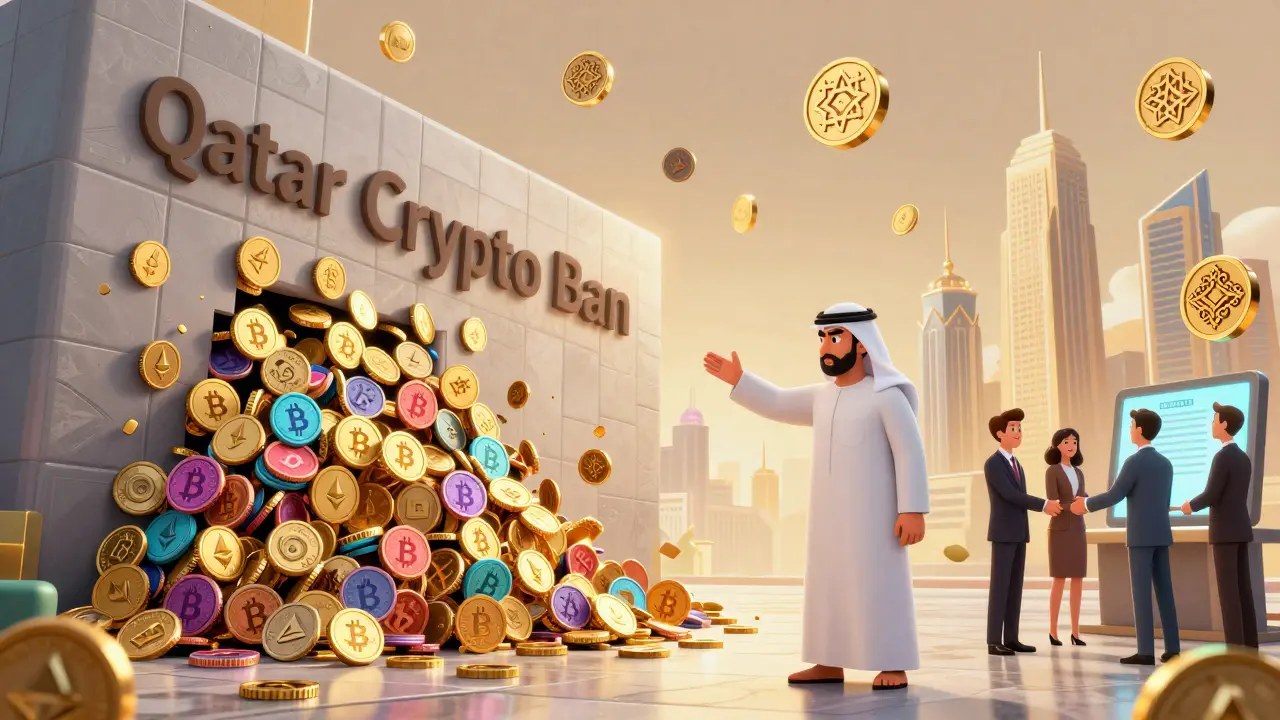
Qatar doesn’t just discourage cryptocurrency-it blocks it entirely. Since 2018, the Qatar Central Bank has forbidden all banks, financial firms, and licensed entities from touching Bitcoin, Ethereum, or any other crypto asset. No trading. No holding. No exchanges. Not even stablecoins. This isn’t a gray area-it’s a hard wall. And in 2024, instead of lifting it, Qatar built a new path around it.
Why Qatar Banned Crypto in the First Place
The ban didn’t come out of nowhere. In February 2018, the Qatar Central Bank issued Circular No. (6), making it clear: financial institutions must not engage with virtual assets. The reasoning? Volatility, lack of oversight, and the risk of money laundering. Crypto wasn’t just unregulated-it was seen as a threat to financial stability. At the time, most Gulf countries were still watching. Qatar didn’t wait. It moved first. Then, in December 2019, the Qatar Financial Centre Regulatory Authority (QFCRA) doubled down. Its alert banned virtual asset services inside the Qatar Financial Centre (QFC)-the country’s financial free zone. That meant no crypto-to-fiat trading, no custody services, no token sales. Even if you were a foreign firm operating in QFC, you couldn’t touch crypto. The message was simple: if you want to do business here, leave crypto at the door. Unlike the UAE, which created a full regulatory body for crypto (VARA), or Bahrain, which licensed exchanges, Qatar chose isolation. It didn’t want to regulate crypto. It wanted to erase it from its financial system.The Big Shift: Tokenization Instead of Trading
But here’s where things changed. On September 1, 2024, the QFC Authority and QFCRA announced something unexpected: the QFC Digital Assets Regulations 2024. This wasn’t a repeal of the ban. It was a redirection. The new rules still ban cryptocurrencies. They even define them clearly as “Excluded Tokens”-virtual assets that don’t represent real property or are meant to replace money. That includes Bitcoin, Ethereum, Dogecoin, and even USDT or USDC. But here’s the twist: they now allow tokenized real-world assets. What does that mean? Say you own a commercial building in Doha worth QAR 150 million. Instead of selling the whole thing to one investor, you can break it into 150,000 digital tokens, each representing 0.001% ownership. These tokens aren’t crypto. They’re digital deeds. And under Qatar’s new rules, they’re legal, enforceable, and tradable within the QFC’s controlled environment. This isn’t theory. Barwa Real Estate did it in Q1 2025. They tokenized a commercial tower. Settlement time dropped from 30 days to under two days. Investors didn’t buy Bitcoin-they bought a slice of real estate, digitally recorded on blockchain.What’s Allowed? What’s Still Forbidden?
The line between allowed and banned is sharp:- Allowed: Tokenized real estate, sukuk (Islamic bonds), commodities, private equity, art, carbon credits. These must be backed by tangible assets with clear ownership rights.
- Forbidden: Any token that’s not tied to a physical asset-Bitcoin, Ethereum, stablecoins, NFTs as collectibles, DeFi protocols, mining operations.
How Qatar Compares to the Rest of the GCC
Qatar isn’t alone in the Gulf, but it’s the outlier.- UAE: Fully licensed crypto exchanges. VARA oversees everything. Dubai is a crypto hub.
- Bahrain: Licensed crypto exchanges since 2019. Active retail market.
- Saudi Arabia: Framework exists, but no exchanges licensed yet. Waiting.
- Kuwait: Total ban. Even crypto payments are illegal.
- Qatar: Crypto? Ban. Tokenized assets? Welcome.
Who’s Using This System? And How Hard Is It?
As of March 2025, only 12 businesses have registered under the new tokenization rules. That’s low-but it’s early. The setup isn’t easy. Companies need:- A legal opinion confirming the underlying asset is valid and transferable
- Technical specs for the blockchain platform (permissioned, not public)
- Custody arrangements approved by QFCRA
- Compliance with anti-money laundering and investor protection rules
The Human Cost: Frustration on the Ground
The ban isn’t popular with everyone. On Reddit’s r/CryptoQatar forum, with over 1,200 members, users complain about having to use offshore exchanges. One trader said he pays 2.5% more per trade just to get access. Others say they’re stuck using unregulated platforms with no recourse if things go wrong. Financial firms report 15% higher compliance costs than regional peers because they must constantly check that transactions don’t involve crypto. That’s not just paperwork-it’s time, software, audits, and legal reviews. A February 2025 Qatar University survey found 68% of citizens aged 18-35 support limited crypto legalization. That’s a generation raised on global finance, not isolation.Why This Strategy Makes Sense for Qatar
Qatar isn’t anti-tech. It’s anti-risk. The country’s wealth comes from oil and gas, but its future is in finance. Qatar National Vision 2030 wants to turn the country into a global financial hub-not a crypto casino. By banning crypto, Qatar avoids the volatility that wiped out retail investors in the 2022 crash. By allowing tokenization, it gains efficiency, transparency, and access to global institutional capital. Islamic finance products make up 58% of all tokenization projects-perfect for a country that wants Sharia-compliant innovation. The Qatar Central Bank’s governor put it plainly in January 2025: “Our regulatory framework prioritizes investor protection and financial system stability over short-term market participation.” It’s a long game. And Qatar is playing it carefully.What’s Next for Qatar’s Digital Assets?
The roadmap is clear. By 2027, Qatar plans to expand tokenization to:- Carbon credits
- Intellectual property rights
- Art and collectibles
Is cryptocurrency illegal in Qatar?
Yes. Since 2018, the Qatar Central Bank has banned all financial institutions from dealing with cryptocurrencies. This was reinforced in 2019 by the QFCRA, which extended the ban to the Qatar Financial Centre. Trading, holding, or exchanging crypto through regulated entities is illegal. The ban remains in full force as of 2026.
Can I buy Bitcoin in Qatar?
You can’t buy Bitcoin through any licensed Qatari bank or exchange. However, some individuals use offshore platforms, peer-to-peer apps, or crypto ATMs outside the country. These methods carry legal and financial risks, including no consumer protection, higher fees, and potential violations of Qatar’s financial regulations.
Is tokenization legal in Qatar?
Yes. Since September 2024, the QFC Digital Assets Regulations allow the tokenization of real-world assets like real estate, sukuk, bonds, and commodities. These are not cryptocurrencies-they are digital representations of physical assets with clear legal ownership rights, regulated by the QFCRA.
What’s the difference between crypto and tokenized assets in Qatar?
Crypto (like Bitcoin) has no underlying asset-it’s a digital currency. Tokenized assets represent ownership in something real, like a building or a bond. In Qatar, crypto is banned. Tokenized assets are legal, regulated, and backed by physical property. The blockchain records ownership, but the value comes from the asset, not the token itself.
Can foreigners invest in tokenized assets in Qatar?
Yes. The QFC welcomes international institutional investors to participate in tokenized asset offerings. Over 47 firms from abroad have inquired since the 2024 regulations launched. However, access is limited to licensed participants-individual retail investors cannot directly buy tokens yet.
Will Qatar ever legalize cryptocurrency?
Experts believe not before 2030. Qatar’s leadership has consistently prioritized financial stability over crypto speculation. While the government is open to innovation, it’s focused on tokenized real-world assets, not decentralized currencies. Any future change would likely involve strict controls, not open access.
Bill Sloan
January 16, 2026 AT 15:50Okay but imagine if your apartment could be split into 10,000 tokens and you could buy one like a stock? That’s wild. Qatar’s basically turning real estate into a blockchain dividend.
And no, I’m not buying Dogecoin to pay rent.
Chris Evans
January 16, 2026 AT 22:33This isn’t a ban-it’s a philosophical stance. Crypto is speculation masquerading as innovation. Tokenization is property made efficient. One is gambling with code. The other is ownership made legible.
Qatar’s not rejecting tech. It’s rejecting chaos. And honestly? I respect that.
ASHISH SINGH
January 17, 2026 AT 12:27Let me guess-this is all a front for the Saudis to funnel petrodollars into private equity under ‘blockchain’ branding. They’re not banning crypto, they’re just hiding it behind lawyers and Sharia compliance.
Tokenized real estate? Sure. Next they’ll tokenize the desert and sell shares to Elon. Wake up, sheeple.
Alexis Dummar
January 18, 2026 AT 19:42People keep calling this a ‘ban’ like it’s repression. But it’s not. It’s curation. Qatar’s saying: we don’t want your hype coins, but we’ll take your billion-dollar buildings digitized with smart contracts.
Most countries are trying to catch up to crypto. Qatar’s building the next thing. And honestly? It’s smarter.
Pat G
January 19, 2026 AT 20:19Of course they banned crypto. America’s been letting crypto turn into a casino and look what happened-pension funds wiped out, kids borrowing on credit cards to buy Shiba Inu.
Qatar’s protecting its people. We should be doing this too. Not everyone needs to be a degenerate trader.
Rod Petrik
January 20, 2026 AT 05:36Tokenization? Yeah right. Blockchain’s just a fancy database. The QFC’s just using blockchain so they can charge more fees and pretend they’re cutting-edge. They’re not innovating-they’re rebranding old finance with buzzwords.
And don’t get me started on ‘Sharia-compliant NFTs’-that’s just capitalism with a prayer mat.
Katherine Melgarejo
January 20, 2026 AT 20:26So Qatar banned crypto but lets you tokenize your mansion? That’s like banning beer but selling wine in fancy glass bottles.
Same buzz, different label. Still, I’ll admit-the 2-day settlement thing sounds kinda nice. I hate waiting 30 days for a house sale.
Shaun Beckford
January 22, 2026 AT 19:09Let’s be real: 12 companies registered? That’s a failure. QAR 850k to launch? That’s a luxury tax for billionaires. This isn’t innovation-it’s a gated community for hedge funds.
And ‘no retail investors’? Classic. They want your money but not your voice. Welcome to finance 2.0: exclusion with blockchain branding.
Ashlea Zirk
January 24, 2026 AT 10:50The distinction between excluded tokens and tokenized assets is legally and economically sound. The regulatory clarity around smart contracts as binding instruments is unprecedented in the region.
Qatar has created a sandbox for institutional-grade digital asset infrastructure-something no other GCC nation has achieved with the same rigor.
Deb Svanefelt
January 26, 2026 AT 02:59I used to think crypto was the future. Then I saw how many people lost their life savings chasing memes. Qatar’s approach feels… human. It doesn’t pretend tech is neutral. It knows power flows to whoever controls the ledger.
Tokenizing property means real people can own pieces of something real. That’s not hype. That’s justice.
CHISOM UCHE
January 26, 2026 AT 05:48The regulatory architecture here is a masterclass in fintech governance. The permissioned blockchain layer ensures auditability, while the legal enforceability of smart contracts creates a frictionless settlement layer.
What’s remarkable is the alignment with Islamic finance principles-asset-backing, prohibition of gharar, and avoidance of speculative instruments. This isn’t just compliance-it’s cultural engineering.
Tony Loneman
January 27, 2026 AT 14:10Oh please. They’re not building the future-they’re building a museum. Tokenized real estate? That’s 1980s paper deeds with a QR code.
Meanwhile, the rest of the world is moving to DeFi, DAOs, and self-custody. Qatar’s clinging to analog wealth and calling it innovation. They’re not ahead-they’re nostalgic.
myrna stovel
January 28, 2026 AT 07:32For everyone saying this is elitist: remember, retail investors got crushed in 2022. This isn’t about keeping people out-it’s about protecting them until they’re ready.
Let institutions build the rails. When the system’s stable, maybe retail gets on board. Patience isn’t oppression. It’s responsibility.
Kelly Post
January 28, 2026 AT 14:51I love how Qatar’s turning finance into a quiet revolution. No tweets. No influencers. No moon emojis.
Just contracts, code, and concrete. No one’s getting rich overnight-but no one’s losing everything either. Sometimes the most radical thing you can do is choose stability.
Sarah Baker
January 30, 2026 AT 01:37Imagine being 22 and seeing your cousin in Dubai buy a crypto coin that went from $1 to $1000-and you’re stuck in Qatar with a tokenized apartment that pays 2.3% annual yield.
It’s not fair. But maybe… it’s wiser? I don’t know. I just want to buy Bitcoin without using a VPN and a friend’s Nigerian bank account.
Haley Hebert
January 31, 2026 AT 04:16Okay, I’ll admit-I used to think crypto was freedom. Now I think it’s just a really expensive way to gamble. I’ve seen people lose their rent money on Solana. I’ve seen my uncle cry because he bought Dogecoin after a meme.
Qatar’s system? It’s boring. But it’s safe. And after everything we’ve seen? Maybe boring is the new brave.
Hailey Bug
January 31, 2026 AT 15:33Tokenization isn’t new-it’s just being applied differently. Think of it like the first stock certificates in 17th-century Amsterdam. Back then, people thought shares in a trading company were absurd too.
Qatar’s doing the same thing with real estate. This isn’t crypto. It’s capitalism with better tech. And honestly? That’s the future.
Vinod Dalavai
February 1, 2026 AT 19:04Bro, I’m from India. We’ve got 100 million people trying to buy crypto on PhonePe. And here’s Qatar, making it illegal but letting you own 0.001% of a building.
They’re not behind. They’re just not trying to be viral. Sometimes the smartest move is to ignore the noise.
Jill McCollum
February 1, 2026 AT 22:21Wait so if I tokenize my grandma’s jewelry collection, can I sell it to someone in London? That’s actually kind of beautiful. Like digital heirlooms.
Also-why does everyone assume blockchain = crypto? They’re not the same. This is like saying ‘if you use a printer, you must be printing porn.’
Josh V
February 3, 2026 AT 12:42Tokenization is the future and you know it
Qatar gets it
no more crypto gambling
just real stuff on chain
game changer
Alexandra Heller
February 3, 2026 AT 15:33There’s a quiet arrogance in calling Bitcoin ‘speculation’ while building a gated digital economy for the ultra-wealthy. Who decides what’s ‘real’ enough to be tokenized?
Is a painting real? What about a song? What about your digital identity?
Qatar’s not banning crypto. It’s deciding what humanity is allowed to own. And that’s more dangerous than any meme coin.
Chidimma Okafor
February 5, 2026 AT 12:23What a breathtaking demonstration of strategic foresight! The Qatari authorities have masterfully navigated the treacherous waters of financial modernization by rejecting the volatility of decentralized speculation while embracing the transformative potential of asset-backed digital instruments.
This is not mere regulation-it is cultural alchemy. By anchoring value in tangible, Sharia-compliant, legally enforceable assets, they have engineered a financial ecosystem that is both globally competitive and domestically resilient.
Where others chase hype, Qatar cultivates heritage. Where others gamble, Qatar builds legacies. The 12 registered firms? They are not a failure-they are the vanguard of a new paradigm.
The future of finance does not live on decentralized exchanges. It lives in the quiet precision of smart contracts, the dignity of property rights, and the unwavering commitment to stability over spectacle.
May the rest of the world catch up-not with noise, but with wisdom.