

For years, Portugal crypto tax benefits for Bitcoin investors, the landscape shifted dramatically after 2023. If you are planning to move your digital assets or relocate to Lisbon, understanding the current rules is critical. The days of completely tax-free cryptocurrency income are over, but Portugal remains one of the most attractive jurisdictions in Europe if you play by the new book.
The core change introduced by the Orçamento de Estado (State Budget) reform was the end of the blanket exemption. Before this update, cryptocurrencies didn't fit into any existing income category, so they were effectively ignored by the taxman. Today, the Portuguese tax authorities have a clear framework. This structure rewards patience and punishes short-term speculation. For many Bitcoin holders, the benefits still outweigh those in neighboring countries like France or Germany, provided you hold your assets for more than a year.
How the Three-Category System Works
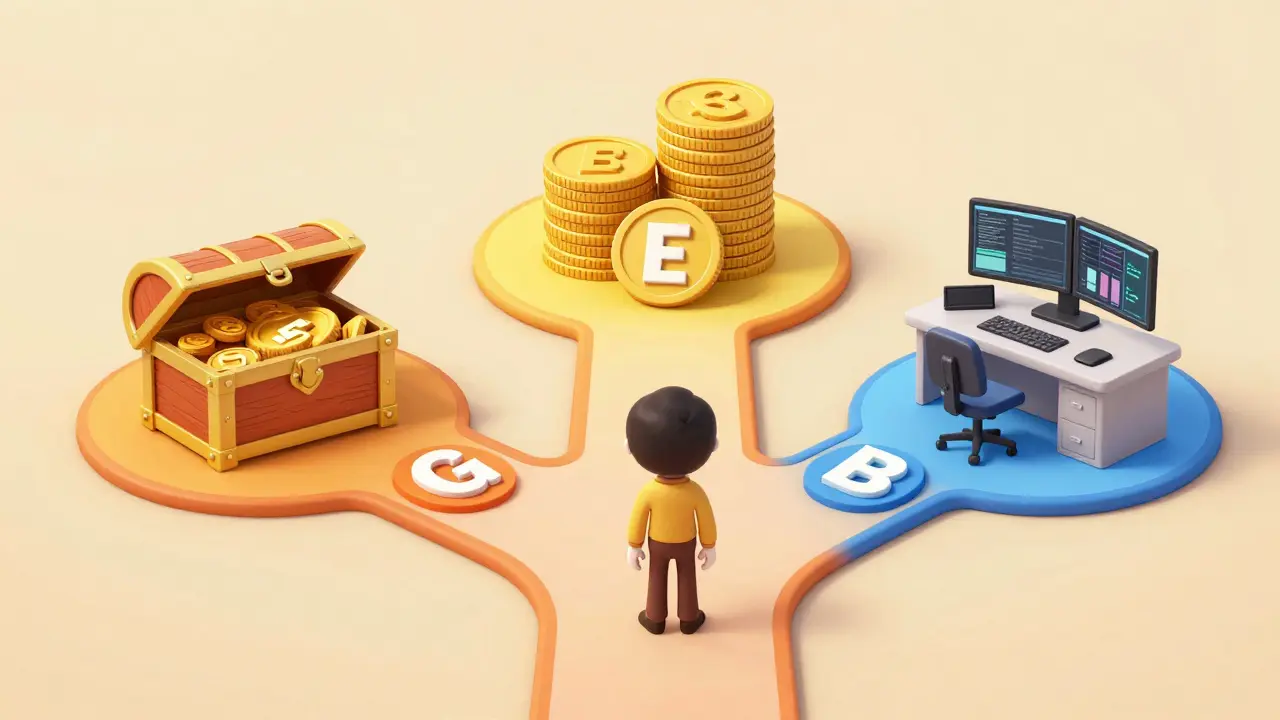
To understand your liability, you need to know which bucket your activity falls into. The Portuguese Personal Income Tax Code (PIT Code) splits crypto activities into three distinct categories. Getting this classification right is the difference between paying nothing and facing a steep bill.
| Category | Activity Type | Tax Rate | Key Condition |
|---|---|---|---|
| Category G | Capital Gains (Trading) | 28% flat rate OR 0% | Holding period determines rate |
| Category E | Passive Income (Staking, Lending) | 28% flat rate | No withholding tax |
| Category B | Professional Activity (Mining, High-Freq Trading) | Progressive (14.5% - 53%) | Treated as business income |
Category G: Capital Gains is where most individual Bitcoin investors live. This applies when you buy Bitcoin and later sell it for fiat currency (like Euros). Here is the golden rule: if you hold the Bitcoin for less than 365 days, the profit is taxed at a flat 28%. However, if you hold it for more than one year, the gain is completely tax-free. There is a catch, though. This exemption applies unless the asset is classified as a security or held outside the European Economic Area (EEA). Since Bitcoin is generally not considered a security in this context, long-term holders benefit immensely.
Category E: Capital Income covers passive earnings. This includes staking rewards, lending interest, and airdrops. These are taxed at a uniform 28% flat rate. Unlike some other European nations that add social contributions on top of income tax, Portugal keeps it simple with this single rate. There is no withholding tax, meaning you declare and pay it during your annual return.
Category B: Self-Employment Income is the danger zone for active traders. If you mine Bitcoin, run a validation node for profit, or trade frequently enough to be deemed "professional," your profits are treated as business income. This means progressive tax rates ranging from 14.5% up to 53%, depending on your total annual earnings. For high-volume traders, this can significantly erode returns compared to the flat 28% rate for occasional investors.
Why Long-Term Holding Is Your Best Strategy
The biggest Portugal crypto tax benefit for Bitcoin investors is the long-term exemption. In many countries, even if you hold an asset for five years, you still pay capital gains tax. In Portugal, the clock starts ticking the moment you acquire the asset. You must track your acquisition dates precisely. The 365-day period is calculated from the purchase date to the sale date.
This rule encourages a "buy and hold" mentality. It aligns well with the ethos of many Bitcoin maximalists who view the asset as a store of value rather than a trading vehicle. By simply waiting a year, you eliminate the tax liability on your gains entirely. This makes Portugal far more attractive than Germany, which also offers a one-year exemption but applies progressive income tax rates up to 45% for short-term holdings. Portugal’s cap at 28% for short-term trades is a significant advantage for those who cannot wait the full year.
Consider this scenario: You buy €10,000 worth of Bitcoin. After 14 months, it is worth €20,000. You sell it. In Portugal, your €10,000 profit is tax-free. In France, you would face a 30% flat tax plus social contributions, potentially costing you thousands. In Spain, you might face progressive rates depending on your overall income bracket. The clarity and generosity of the long-term exemption in Portugal are hard to beat in the EU.
Crypto-to-Crypto Swaps: A Hidden Advantage
One specific feature of the Portuguese system that often goes unnoticed is the treatment of crypto-to-crypto exchanges. When you swap Bitcoin for Ethereum, or Bitcoin for a stablecoin, this is generally not considered a taxable event in Portugal. Many jurisdictions treat every swap as a disposal, triggering immediate capital gains calculations based on the fair market value at the time of the swap.
In Portugal, you can rebalance your portfolio without triggering immediate tax liabilities. This allows for greater flexibility in managing your investments. You only trigger a tax event when you convert cryptocurrency back into fiat currency (or possibly goods/services, though the latter is less clearly defined). This feature enables sophisticated portfolio optimization strategies that are impossible in stricter regimes. Just remember that once you eventually sell for fiat, the holding period for the original asset may reset or need careful tracking depending on how the transaction is structured, so consulting a local expert is wise for complex swaps.
Comparing Portugal to Other European Hubs
How does Portugal stack up against its neighbors? Let's look at the numbers. France imposes a 30% flat tax on all crypto gains, covering both capital gains and social contributions. Furthermore, crypto-to-fiat conversions are always taxable, and staking or mining is subject to progressive rates up to 45%. Germany offers similar long-term exemptions for crypto held over one year but applies progressive income tax up to 45% for short-term holdings. Portugal’s 28% short-term rate and complete long-term exemption position it favorably against these major European markets.
Switzerland is often cited as a competitor, offering favorable cantonal taxes, but the complexity varies wildly by region. Portugal provides a unified national framework, making compliance more predictable for expats and residents alike. The Global Citizens Solutions analysis emphasizes Portugal's "most attractive and transparent" tax framework in Europe, particularly noting the distinction between individual investors and professional traders.
Compliance and Reporting Requirements
Enjoying these benefits requires strict adherence to reporting rules. The Portuguese tax authorities, known as Autoridade Tributária e Aduaneira, are developing their infrastructure for crypto enforcement. While resources are currently limited, the trend is toward greater scrutiny. You must file an annual declaration, categorizing your crypto activities under the appropriate PIT Code categories.
You need to keep detailed records of every transaction. This includes:
- Date of acquisition
- Date of disposal
- Cost basis (purchase price + fees)
- Sale proceeds
- Exchange used
Tools like CoinTracking and CoinLedger are popular among expats in Portugal. These platforms allow you to import trades from various exchanges, automatically calculate gains and losses, and generate reports formatted for Portuguese tax compliance. Using such software is highly recommended to avoid manual errors. The key is distinguishing between occasional trading (Category G) and professional trading (Category B). If you trade frequently, use leverage, or employ automated bots, you risk being reclassified as a professional trader, which exposes you to the higher progressive rates.

The Role of the Non-Habitual Residence (NHR) Program
Many Bitcoin investors combine the crypto tax benefits with the Non-Habitual Residence (NHR) Program. This program offers qualifying individuals a 20% flat rate on Portuguese-sourced income and exemptions on most foreign earnings. For digital nomads and remote workers, this creates a powerful synergy. If your crypto income is considered foreign-sourced (which can be complex), NHR might offer additional shields. However, recent changes to NHR eligibility mean you should verify current criteria before relying on it. The combination of crypto-friendly policies with NHR benefits has made Portugal a hotspot for digital nomads seeking financial efficiency.
Future Outlook and Risks
As of 2026, the regulatory environment remains stable. There are no immediate indications of major policy reversals that would eliminate the long-term exemption. However, authorities continue to develop technological capabilities to monitor compliance. The implementation of the EU's Markets in Crypto-Assets (MiCA) regulation also adds a layer of oversight. While MiCA focuses more on consumer protection and licensing for service providers, it indirectly increases transparency for individual holders.
Investors should monitor potential future adjustments to professional trading thresholds. What constitutes "professional" trading can be subjective. If the authorities tighten this definition, more active traders could find themselves pushed into Category B. Additionally, ensure your assets are held within the EEA to maintain the cleanest tax profile. Holding Bitcoin on non-EEA exchanges might complicate your tax position due to international reporting standards like CRS (Common Reporting Standard).
Is Bitcoin still tax-free in Portugal?
No, not entirely. Prior to 2023, it was effectively tax-free. Now, short-term gains (held less than 365 days) are taxed at 28%. However, long-term gains (held more than 365 days) remain completely tax-free for private investors.
What is the tax rate for crypto staking in Portugal?
Staking rewards are classified as Category E (Capital Income) and are taxed at a flat rate of 28%. There is no additional withholding tax, simplifying the reporting process.
Do I pay tax when swapping Bitcoin for Ethereum?
Generally, no. Crypto-to-crypto exchanges are not considered taxable events in Portugal. Tax is only triggered when you convert cryptocurrency into fiat currency or use it to purchase goods and services.
When does my Bitcoin become a professional trading activity?
There is no strict numerical threshold. Factors include frequency of trades, use of leverage, employment of algorithms/bots, and whether trading is your primary source of income. Professional activity is taxed as business income (Category B) with progressive rates up to 53%.
How do I prove my holding period to the tax authorities?
You must keep detailed records of all transactions, including dates, amounts, and exchange names. Using crypto tax software like CoinTracking to generate comprehensive reports is highly recommended to substantiate your claims during audits.
Nick Wengel
July 6, 2026 AT 12:22Hey everyone, just wanted to share that Portugal is still pretty great for crypto folks if you play the long game. The new rules are clear enough and it feels good to see a country trying to balance things out instead of just taxing everything into oblivion.
Alicia Hull
July 7, 2026 AT 18:41I find this entire situation rather alarming given the sudden shift in policy. How can anyone trust a system that changes its fundamental rules so drastically? It seems like a trap for those who moved there based on old information. I demand more clarity on what constitutes 'professional' trading because the vagueness is unacceptable.
Johan Otto
July 8, 2026 AT 00:21Boring stuff. Just buy BTC and hold it. Why read all this tax nonsense? 😂
Anuj Kashyap
July 8, 2026 AT 21:08The philosophical implication here is fascinating 🤔. We are essentially being rewarded for patience and punished for greed. Is not the act of holding Bitcoin a form of digital meditation? The state tries to categorize our spiritual journey into buckets G, E, and B, but can they really quantify value? 🧘♂️💸
Tracy Marshall
July 10, 2026 AT 15:13its obvious they want to track every single satoshi u move :-( the government doesnt care about freedom they just want control over ur money and ur life u think hiding in portugal helps but they have eyes everywhere be careful out there :-|
Guy Davis
July 12, 2026 AT 03:05Tax evasion is wrong ppl should pay their fair share stop trying to cheat the system its immoral and bad for society we need to support the infrastructure not hide from it
KEITH WONG
July 13, 2026 AT 21:41Listen up losers 👋 If you cant handle a 28% tax then maybe crypto isnt for you. Smart money knows how to use the 1 year rule. Dont be dumb and trade daily unless you wanna get hit with the progressive rates. Do your homework or stay poor 📉🚫
Natalie Lucas
July 15, 2026 AT 03:33omg this is such good news for people like me who just want to chill and let my portfolio grow! i love that i can swap btc for eth without paying tax right away. lets gooo! 💖✨
Curtis Johnson
July 17, 2026 AT 02:46Wow this is quite dramatic isn't it? But honestly, having a clear framework is better than chaos. I appreciate the transparency even if the rates sting a bit for short termers. Let's keep the peace and just follow the rules folks 🙏
Steven Briggs
July 17, 2026 AT 19:22i guess it makes sense. just keep records.
Hamza k
July 17, 2026 AT 19:48My jaw literally dropped when I saw the Category B rates. 53%?! That’s not taxation, that’s confiscation wrapped in bureaucratic tape! If you’re mining or day-trading, you’re basically funding the empire. Run while you can, friends! 🏃♂️💨
Kim Kay
July 19, 2026 AT 05:05hey guys just a thought that maybe we should all help each other understand these rules. it can be confusing but we got this. dont forget to backup ur keys tho! 🔑
John Harman
July 19, 2026 AT 10:39You're all missing the point. The real trick is the crypto-to-crypto swap loophole. You can rebalance your entire portfolio without triggering a taxable event. Only cashing out triggers the tax. This is why Portugal beats Germany hands down for flexibility.
Antony Lopez
July 19, 2026 AT 15:16Typical European softness. In America we pay our taxes and don't whine about it. This whole relocation thing is weak. Stay in the US and contribute to the greatest economy on earth instead of hiding in Lisbon playing financial games.
DJ Maleko
July 20, 2026 AT 10:01Let's analyze the psychological profile of someone who moves to Portugal for tax breaks. They are likely risk-averse yet greedy, seeking validation through savings. It's pathetic really. You're not smart, you're just cheap. And the government knows it. 📊😒
Erika Pozzetto
July 20, 2026 AT 18:43In light of the aforementioned regulatory shifts one must consider the broader implications for international capital flows particularly within the context of the European Economic Area where harmonization efforts continue to exert pressure on individual jurisdictional autonomy thereby necessitating a meticulous approach to compliance documentation and strategic asset allocation over extended temporal horizons which ultimately serves to mitigate potential fiscal liabilities while ensuring adherence to the evolving legal frameworks established by the relevant authorities.
Russ Fincham
July 20, 2026 AT 18:46The distinction between Category G and Category B is the most critical aspect of this analysis. Most retail investors fail to realize that frequency alone does not define professionalism; intent and infrastructure do. If you are using leverage or automated bots, you are already in the danger zone regardless of your volume. Be precise.
Linda Hilliard
July 21, 2026 AT 05:14Darling, if you cannot navigate the PIT Code categories, perhaps you lack the intellectual fortitude for high-stakes investing. The 28% flat rate is a mercy compared to the progressive slaughterhouse of Category B. Educate yourself or perish in mediocrity. :P
Winston Lacewing
July 21, 2026 AT 15:34I feel attacked by this post 😭😭😭 Why is everyone so focused on the numbers? What about the soul of the investor? 😢 Also, did you know that staking rewards are taxed at 28%? That hurts my feelings and my wallet! 😡💔
Eric Braddock
July 23, 2026 AT 00:04This is all part of the grand narrative to integrate crypto into the traditional banking system so they can devalue it via inflation and surveillance. The 'benefits' are just bait to get you on-chain and identifiable. Wake up sheeple. The MiCA regulation is the final nail in the coffin of privacy. 🐑🔗
Nick G
July 23, 2026 AT 18:54It is truly remarkable how different cultures approach wealth preservation. While some nations view profit as a sin to be punished, others recognize it as a reward for innovation and patience. Portugal’s approach, though imperfect, offers a respectful dialogue between the state and the individual investor, fostering an environment where long-term thinking is valued over speculative frenzy.
Kat Barr
July 25, 2026 AT 10:14OMG!! This is SO exciting!!! 🎉 I mean, sure, taxes are annoying BUT at least we have options!! Keep smiling and stacking sats!!! You got this!!! ✨💪💰
Logan Edmison
July 27, 2026 AT 06:06the matrix wants u to pay tax but the code says wait 365 days and free money. its like the red pill but for your wallet. dont let the agents catch u trading too fast lol
Michelle Walker
July 27, 2026 AT 08:47Stop crying. Read the table. Hold for a year. Pay zero. It's basic math. If you can't do that, you deserve to lose money. Simple as that.