

If you’ve heard about the PHA airdrop from Phala Network, you’re not alone. Thousands of blockchain enthusiasts are trying to claim their 30 PHA tokens - but not everyone knows how, or if it’s even worth it. This isn’t another social-media-only airdrop where you just follow a Twitter account and call it a day. This one demands real work. You need hardware. You need patience. And you need to understand what you’re signing up for.
What Is the PHA Airdrop?
The Phala Network PHA airdrop is a targeted token distribution designed to bootstrap its privacy-focused blockchain. Unlike most airdrops that reward early adopters for sharing links or joining Discord, Phala asks you to run a miner node - a piece of software that helps secure the network by processing confidential smart contracts. In return, you get 30 PHA tokens. That’s about $3.09 at today’s price of $0.1029 per PHA.
It sounds simple, but there’s a catch: you can’t just install it and forget it. You need a computer with Trusted Execution Environment (TEE) support - basically, hardware that can run encrypted code without exposing it to the rest of the system. Most modern Intel CPUs (7th gen or newer) and AMD Ryzen processors have this. If your laptop is from 2018 or later, you’re probably fine. Older machines? You’ll hit a wall.
How to Participate in the PHA Airdrop
Here’s the step-by-step breakdown:
- Download the Phala miner software from the official Phala Network website. Don’t use third-party links - scams are common.
- Check your hardware. Open your system info and confirm your CPU supports SGX (Intel) or AMD SEV. If you’re unsure, search your exact model online with “TEE support” or “SGX enabled.”
- Install and configure. Run the installer. It’ll ask for permissions to access system resources. This is normal. Let it run.
- Start the node. Open a terminal or command prompt and type the command to launch the miner. It takes 5-10 minutes to sync.
- Submit proof. Take a screenshot of your miner running - the interface shows your node ID and uptime. Upload it to the Phala airdrop portal. No screenshot? No reward.
- Wait. The reward isn’t sent immediately. It’s locked until the pre-mainnet launch called “Darth Vader” goes live. No date has been announced.
Expect to spend 2-4 hours on setup. If you’re not comfortable with command-line tools or reading technical guides, this isn’t for you. There’s no mobile app. No one-click button. Just code, hardware, and patience.
Why 30 PHA? Is It Worth It?
Thirty PHA tokens might not sound like much. But compared to other airdrops, it’s actually on the higher end. Most airdrops give out $1-$10 worth of tokens. Phala’s is $3, which is solid for a technical task. But here’s the real question: will PHA go up?
Right now, PHA trades at $0.1029 with a daily volume of over $16 million. That’s not a pump - it’s steady. The network has been around since 2020, raised $1.43 million in private rounds, and has a market cap of $76.98 million. It’s not a top-100 coin, but it’s not dead either.
Looking ahead, Phala is making a big move. In November 2025, its Polkadot parachain slot expires. Instead of renewing, the team is shifting fully to Ethereum Layer 2. They’ve already launched a rollup on Ethereum as of January 2025. That means PHA will eventually work within Ethereum’s ecosystem - which is huge. Ethereum has millions of users. If Phala’s privacy tech catches on there, PHA could see real demand.
Price predictions are mixed. Some analysts say PHA could hit $0.117 by 2030. That’s a 14% gain from today. Not explosive, but possible. The real value isn’t in the token price - it’s in the technology. Phala is one of the few blockchains that can run private smart contracts without exposing data. That’s useful for things like confidential financial apps, private voting systems, or secure enterprise contracts.

Who Should Skip This Airdrop?
This isn’t for everyone. If you’re looking for a quick $20 freebie, walk away. You’ll waste hours and get nothing if your hardware doesn’t support TEE. Same if you’re not willing to troubleshoot. I’ve seen forum posts where people spent days trying to get their AMD laptop to work - only to find out their BIOS had SGX disabled by default. They never found the setting. They gave up.
Also skip it if you’re expecting instant rewards. Phala hasn’t said when “Darth Vader” will launch. It could be weeks. It could be months. You’re essentially donating your computing power now for tokens that might not arrive until late 2025 or early 2026.
How Phala Compares to Other Privacy Blockchains
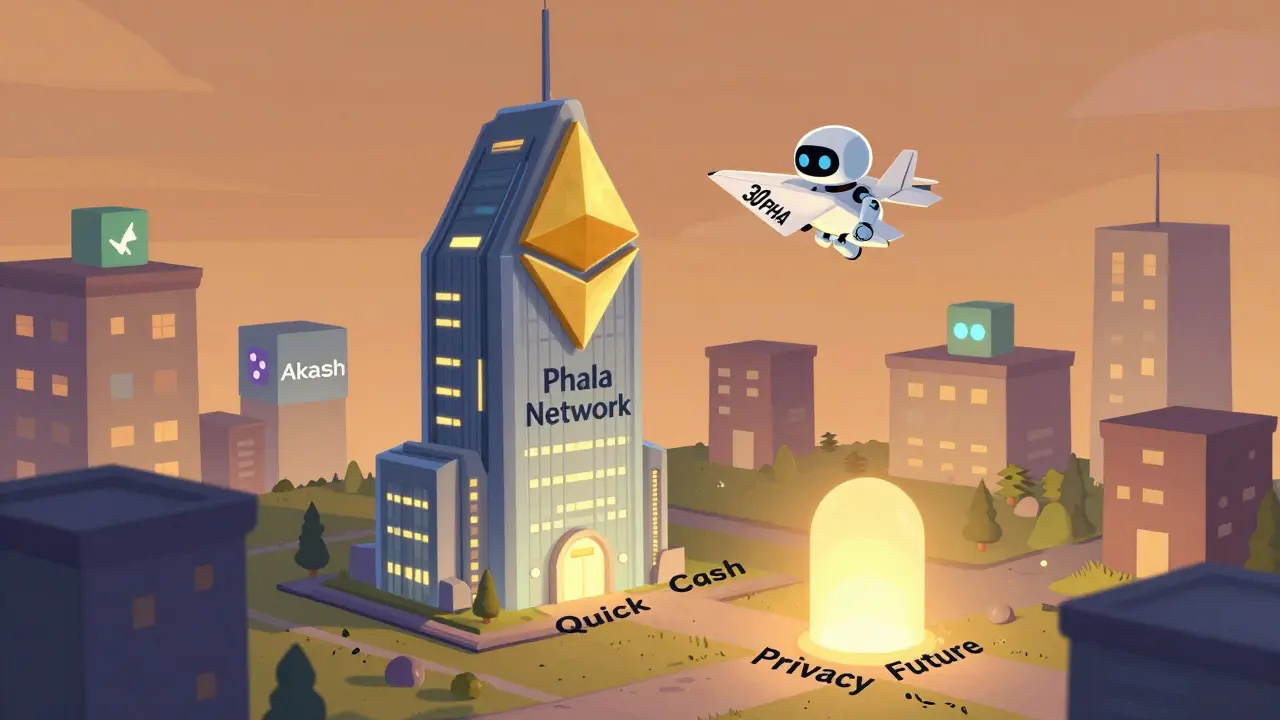
Phala isn’t alone in the privacy space. Projects like Oasis (ROSE), The Graph (GRT), and Akash Network (AKT) also offer decentralized computing. But here’s what sets Phala apart:
| Project | Privacy Tech | Core Use Case | Airdrop Barrier |
|---|---|---|---|
| Phala Network | Trusted Execution Environment (TEE) | Confidential smart contracts | Hardware-dependent (SGX/SEV) |
| Oasis Network | Confidential Compute | Data marketplaces | Wallet connection only |
| The Graph | Query indexing | Decentralized data APIs | Staking or delegation |
| Akash Network | None (compute marketplace) | Cloud computing rental | Staking or provider setup |
Phala is the only one that requires physical hardware to participate. That’s a double-edged sword. It filters out casual users - but it also means the network is secured by real machines, not just wallets. That’s more resilient.
What’s Holding Back PHA Adoption?
Phala’s biggest problem isn’t tech - it’s visibility. Most people don’t know what TEE means. Even fewer understand why private smart contracts matter. While other chains chase DeFi and NFT hype, Phala quietly builds infrastructure for enterprise use. That’s smart. But it’s also slow.
The migration to Ethereum Layer 2 is the make-or-break moment. If PHA becomes a standard privacy layer for Ethereum dApps, adoption could explode. If it gets lost in the noise of hundreds of other L2s, it might fade.
Right now, the community is split. Some miners are thrilled - they believe in the tech. Others are frustrated. They’ve run nodes for over a year and still haven’t seen a single PHA token. The lack of a clear timeline for “Darth Vader” is the biggest complaint.
Final Verdict: Should You Join?
If you’ve got a modern PC, like tinkering with tech, and don’t mind waiting - go for it. Run the miner. Submit the screenshot. It’s free compute time. Worst case? You spend a few hours and get $3. Best case? You help build the backbone of private blockchain apps, and PHA becomes something bigger.
If you’re looking for a quick profit, skip it. There are easier ways to earn crypto. But if you believe in privacy as a fundamental feature - not just a buzzword - then this is one of the few airdrops that actually asks you to contribute something real.
Do I need to buy hardware to join the PHA airdrop?
No, you don’t need to buy anything new. If your computer is from 2018 or later with an Intel Core i5/i7 or AMD Ryzen 2000+ CPU, it likely supports Trusted Execution Environment (TEE). Check your BIOS settings for SGX or SEV - if it’s there and enabled, you’re good to go. Older machines or basic laptops without these features won’t work.
When will I receive my 30 PHA tokens?
There’s no fixed date. Rewards are locked until the pre-mainnet launch called “Darth Vader” goes live. Phala Network hasn’t announced a timeline. It could be weeks or months from now. Don’t expect immediate payouts - this is a long-term commitment.
Is the PHA airdrop still active in 2026?
Yes. As of March 2026, the airdrop is still open. The Phala Network hasn’t shut it down. However, with the network preparing to fully migrate to Ethereum Layer 2 by November 2025, participation may slow as attention shifts to the new infrastructure. The airdrop remains active for now.
Can I run multiple miner nodes to get more PHA?
No. The airdrop limits rewards to one 30 PHA payout per person, regardless of how many nodes you run. The system detects wallet addresses and hardware fingerprints to prevent duplication. Running extra nodes won’t increase your reward - it just uses more power.
What happens if my node stops running?
If your node shuts down for more than 24 hours, your eligibility for the airdrop reward may be canceled. You’ll need to restart the miner and submit a new screenshot. Consistent uptime is required - this isn’t a one-time setup. The network needs reliable participants.
Is the PHA token a good long-term investment?
It depends. PHA isn’t a hype coin. Its value comes from real utility - enabling private smart contracts on Ethereum. If Phala succeeds in becoming a standard privacy layer for Ethereum dApps, PHA could grow steadily. But if adoption stalls, it may stay flat. Don’t invest more than you’re willing to hold for years.
Next Steps
If you’re ready to try:
- Go to phala.network and download the miner.
- Check your CPU specs - search “your CPU model + SGX support”.
- Enable TEE in BIOS if needed (instructions vary by manufacturer).
- Run the node, submit your screenshot, and wait.
If you hit a wall, check the Phala Discord. The community is small but active. Most problems are hardware-related - and someone else has probably solved it already.
Taylor Holloman.
March 17, 2026 AT 04:49Marc Morgan
March 17, 2026 AT 06:14Anastasia Thyroff
March 17, 2026 AT 10:27Shreya Baid
March 17, 2026 AT 19:42Christopher Hoar
March 17, 2026 AT 20:32Robert Kunze
March 19, 2026 AT 13:18Heather James
March 19, 2026 AT 19:41Ross McLeod
March 21, 2026 AT 19:11rajan gupta
March 23, 2026 AT 02:12Cheri Farnsworth
March 24, 2026 AT 13:45Gene Inoue
March 25, 2026 AT 22:26Ricky Fairlamb
March 27, 2026 AT 21:27Jessica Beadle
March 29, 2026 AT 21:57Patty Atima
March 30, 2026 AT 05:37Lucy de Gruchy
April 1, 2026 AT 04:52Lauren J. Walter
April 2, 2026 AT 05:12Carol Lueneburg
April 3, 2026 AT 14:29Ernestine La Baronne Orange
April 3, 2026 AT 17:05Manali Sovani
April 5, 2026 AT 06:15Konakuze Christopher
April 5, 2026 AT 14:43S F
April 6, 2026 AT 05:15Bryan Roth
April 7, 2026 AT 21:21sai nikhil
April 8, 2026 AT 09:23Robert Kunze
April 9, 2026 AT 20:09