
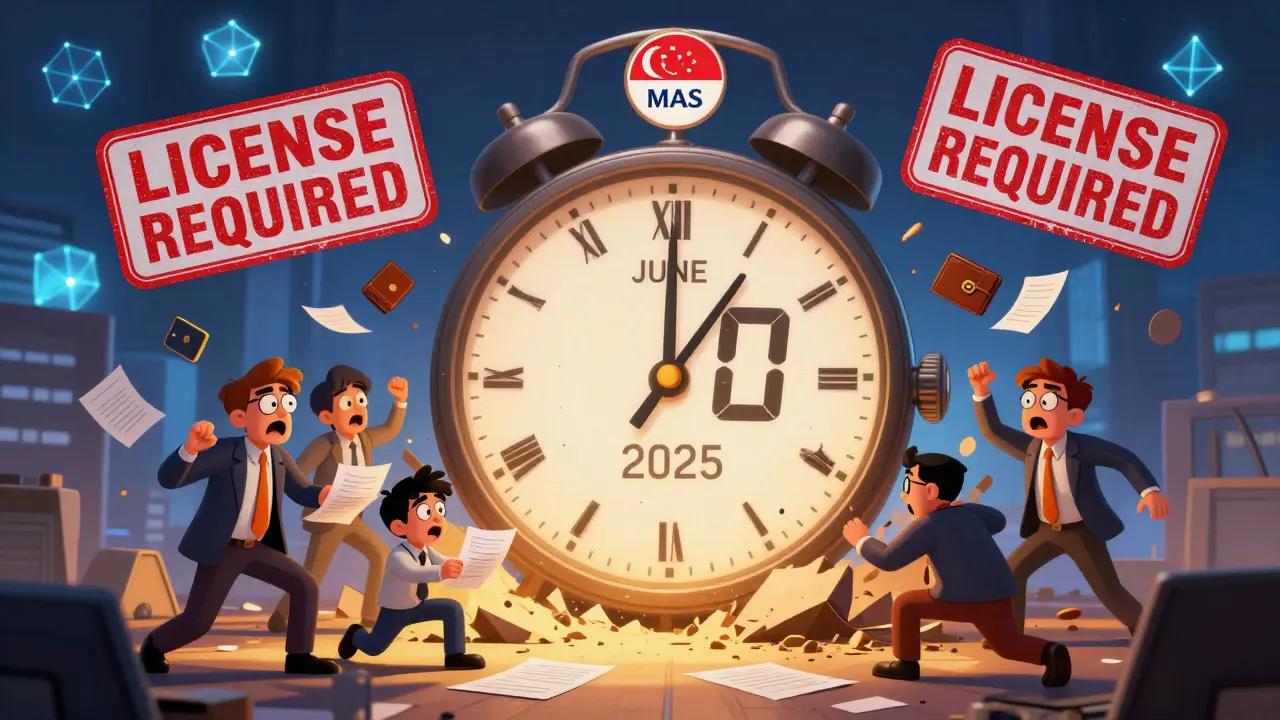
If you're running a crypto business or using crypto services in 2026, you can't afford to ignore the Payment Services Act (PSA) and its global ripple effects. This isn't just another regulatory update-it's a full overhaul of how digital assets are treated as financial instruments. Different countries have taken wildly different paths, and getting it wrong could mean losing your license, facing fines, or even shutting down operations overnight. There's no gray area anymore. The clock is ticking, and the rules are strict.
Singapore’s Absolute Deadline: No Extensions, No Mercy
Singapore’s Monetary Authority of Singapore (MAS) didn’t just set a deadline-they drew a line in the sand. By June 30, 2025, every crypto platform offering digital token services had to be fully licensed under the Financial Services and Markets Act (FSMA). No grace period. No exceptions. If you weren’t compliant by then, you’re done. No warnings. No appeals.
This isn’t about paperwork. It’s about behavior. MAS requires platforms to prove they can protect retail investors just like banks do. That means clear, unavoidable risk disclosures before any trade. No more flashy ads promising quick profits. No more letting people buy crypto with credit cards-those transactions are outright banned. You also can’t just assume a user knows what they’re doing. You must assess their experience, risk tolerance, and financial situation before letting them trade.
And then there’s the Travel Rule. If you send or receive crypto worth more than a set threshold (usually $1,000 or equivalent), you must share full details about both parties: name, address, account number, and transaction purpose. It doesn’t matter if it’s Bitcoin, Ethereum, or a stablecoin. The rule applies to every blockchain. Your system has to capture, store, and transmit this data automatically. Failure means non-compliance-and MAS doesn’t mess around.
Europe’s Balancing Act: PSD2 Meets MiCA
In Europe, the story is more complex. The European Banking Authority (EBA) issued guidance in early 2026 that crypto transfers can be treated as payment services under PSD2, but only under strict conditions. As of March 2, 2026, any firm offering crypto payment services must get authorized under PSD2. But here’s the twist: if you’re already licensed under MiCA as a Crypto-Asset Service Provider (CASP), you can use that information to speed up your PSD2 application. It’s not double work-it’s smarter work.
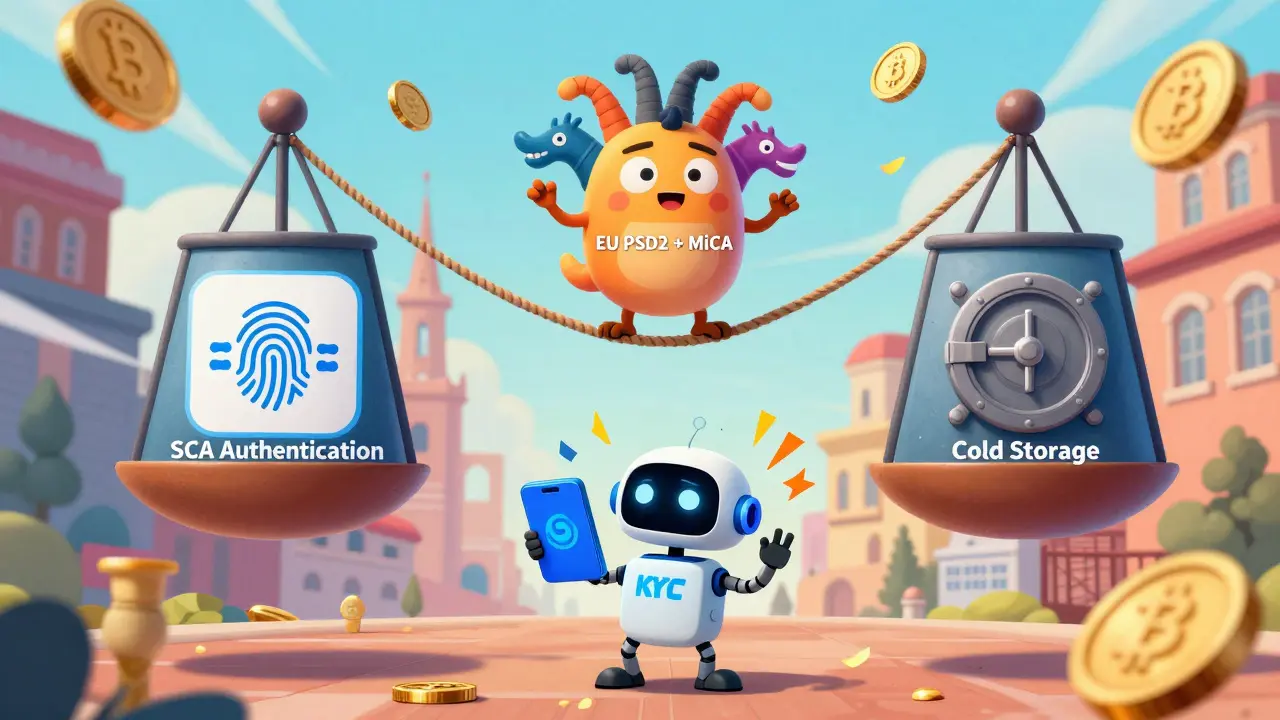
But not everything under PSD2 applies. Once you’re authorized, regulators won’t push you to follow every PSD2 rule. You don’t need to use IBANs. You don’t have to meet the same execution time rules. You don’t need to follow open banking protocols. What you do need to nail? Strong Customer Authentication (SCA). If someone logs into a custodial wallet that acts like a payment account, they must go through two-factor authentication. You must report fraud immediately. And you must calculate your capital reserves the same way a bank would-no shortcuts.
Here’s what doesn’t count as a payment service under this rule: swapping one crypto for another (like BTC for ETH) or exchanging crypto for fiat currency. Those fall under MiCA’s direct jurisdiction, not PSD2. That’s critical for platforms that focus on trading, not payments. Know the difference-or risk misclassifying your services and getting hit with penalties.
Japan’s Systematic Evolution: Cold Storage, Advertising, and Licensing
Japan’s Payment Services Act has been evolving since 2009, but the 2025 amendments show they’re not done yet. The big change? They made cold wallet storage mandatory. If you’re holding users’ crypto, at least 95% of it must be stored offline-no exceptions. Hot wallets are for small, daily transactions only. The rest? Locked away in air-gapped systems. This isn’t a suggestion-it’s a legal requirement.
Advertising? Heavily regulated. You can’t say crypto is “safe” or “guaranteed.” You can’t use influencers to push tokens without clear risk disclaimers. Even your website’s homepage has to show warnings before users can access trading. The 2019 shift from “virtual currency” to “crypto assets” wasn’t just semantic-it meant legal clarity. Now, if a token gives you a share of profits? That’s a security under the Financial Instruments and Exchange Act. You can’t treat it like a coin.
Japan also has a three-tier licensing system: Type 1 for full-service exchanges, Type 2 for domestic-only services, and Type 3 for limited operations. Each has different capital requirements and reporting obligations. The March 2025 cabinet approval hints at more changes coming-possibly around DeFi and stablecoins-but the core rules are already locked in. If you operate in Japan, you need to know your type. No guesswork.
The U.S. CLARITY Act: Classify or Get Out
The U.S. doesn’t have a single “Payment Services Act,” but the CLARITY Act (Clarifying Law Around Intent of Congress To Regulate Your) is the closest thing. It’s designed to end the chaos of “regulation by enforcement.” Instead, it gives clear categories:
- Digital commodities (like Bitcoin and Ethereum) → overseen by CFTC
- Investment contract assets (tokens sold as profit opportunities) → overseen by SEC
- Permitted payment stablecoins (backed 1:1 by USD or reserves) → treated like electronic money
Platforms can now broker, trade, or custody digital commodities without SEC interference-as long as they’re registered with the CFTC. The SEC can’t block an exchange just because it lists Bitcoin alongside a security. That’s huge. It means platforms can offer both without fear of being shut down.
Recordkeeping? Modernized. You can now use blockchain-based ledgers for books and records-no more PDFs and spreadsheets. And for DeFi? The SEC is instructed to create exemptions for decentralized protocols that don’t have a central operator. It’s not a free pass, but it’s a path forward.

Why This Matters for Global Operators
If your business operates in more than one country, you’re not dealing with one rulebook-you’re juggling three or four. Singapore demands real-time Travel Rule compliance. Europe wants SCA and fraud reporting. Japan insists on cold storage. The U.S. wants you to classify every token correctly.
There’s no one-size-fits-all solution. You can’t use one KYC system for all regions. You can’t use the same wallet architecture. You need separate compliance teams, different tech stacks, and localized legal oversight. A platform that works in Singapore might fail in Japan because their cold storage rules are stricter. A U.S.-based exchange might think they’re fine until they start serving European users and get hit with PSD2 fines.
The cost? High. The risk? Higher. But the alternative? Shutting down. No regulator is bluffing. Singapore enforced its deadline. Europe is auditing. Japan is inspecting. The U.S. is filing lawsuits.
What You Need to Do Now
Here’s what to check if you’re still operating:
- Where do you operate? Map your user base. Are you serving Singapore? Europe? Japan? The U.S.? Each has different rules.
- What services do you offer? Are you trading? Custody? Payments? Stablecoin issuance? Each triggers different regulations.
- Are you using cold storage? If you’re in Japan or planning to be, 95% of assets must be offline.
- Are you sharing Travel Rule data? If you’re in Singapore or dealing with EU entities, you must transmit sender/receiver details on transfers above threshold.
- Are you using SCA? If you’re in Europe and your wallet acts like a payment account, two-factor login is mandatory.
- Have you classified your tokens? If you’re in the U.S., you must determine if each token is a commodity, security, or stablecoin.
Don’t wait for a notice. Don’t assume your lawyer knows everything. Regulatory bodies are actively monitoring. They’re not asking-they’re enforcing. The window for excuses is closed.
Does the Payment Services Act apply to decentralized exchanges (DEXs)?
It depends. In Singapore and Japan, if a DEX has any centralized component-like a wallet provider, customer support, or fiat on-ramp-it can be treated as a regulated entity. In Europe, MiCA excludes pure DeFi protocols from the Payment Services Act, but if a DEX offers custodial services or processes payments, it may fall under PSD2. In the U.S., under the CLARITY Act, DeFi protocols without a central operator are exempt from SEC oversight, but if they facilitate payments, they may still trigger CFTC or FinCEN rules. No blanket answer exists-it’s based on function, not structure.
Can I use the same KYC system for all countries?
No. Singapore requires real-time identity verification and risk scoring. Japan demands in-person verification for high-value users. The EU requires SCA integration with biometric or hardware authentication. The U.S. allows risk-based thresholds but requires strict AML reporting. Using one system across regions will likely leave you non-compliant in at least one jurisdiction. Build country-specific workflows or use modular software that adapts to local rules.
What happens if I miss the deadline in Singapore?
Immediate shutdown. MAS doesn’t issue warnings. If you’re not licensed by June 30, 2025, your platform is illegal. They can freeze assets, block domain access, and pursue criminal charges against directors. There’s no grace period, no appeal, and no leniency. Many platforms simply closed rather than risk penalties.
Are stablecoins treated the same everywhere?
No. In Singapore, stablecoins are treated as digital tokens and subject to full Travel Rule compliance. In the EU, if they’re used for payments, they fall under PSD2. In Japan, they’re regulated under the Payment Services Act with specific reserve requirements. In the U.S., permitted payment stablecoins are treated as electronic money under the CLARITY Act, with separate rules for issuance and redemption. Each jurisdiction has its own reserve, transparency, and redemption rules.
Do I need a license if I only accept crypto for goods?
It depends. If you’re just accepting crypto as payment and immediately converting it to fiat, you may not need a license in some jurisdictions. But if you hold crypto for more than 24 hours, store user funds, or offer wallet services, you’re likely providing a payment or custody service-and you’ll need authorization. In Singapore and Japan, even merchants who hold crypto for more than a day must register. In the U.S., if you’re acting as a money transmitter, FinCEN requires registration. Don’t assume you’re exempt-check your activity against local definitions.
Robert Kunze
March 20, 2026 AT 07:46so like i was readin this and thought wow this is insane but then i realized half the stuff theyre talkin bout is already happenin in the bg like my exchange just auto-blocked my credit card purchase and i was like huh?? turns out its the singapore rule lol
also why does every country have to do their own thing?? i just wanna buy eth without fillin out 17 forms
typo: its not 'psa' its 'psa2' wait no im wrong again
Heather James
March 20, 2026 AT 15:56Let’s be real: if you’re still using a hot wallet for more than 5% of your assets, you’re playing Russian roulette with your users’ money.
Japan’s 95% cold storage rule? Genius. Not because it’s harsh-it’s because it’s the only sane thing left in this circus.
Sarah Hammon
March 21, 2026 AT 16:37So many people don’t get that the Travel Rule isn’t just about surveillance-it’s about traceability. If someone gets scammed with $50k in USDT, regulators need to know where it went. No one wants to be the next Mt. Gox, right?
Also, if you’re a small operator, don’t panic. Start with Singapore and EU first-they’re the clearest. Japan and US? They’ll catch up. Just keep your books clean.
And hey-use open-source tools. There are free compliance SDKs out there. No need to reinvent the wheel.
One thing I wish more folks understood: it’s not about limiting innovation. It’s about making sure innovation doesn’t bury people.
I’ve seen too many devs build beautiful DeFi apps that crash because someone didn’t verify an address. That’s not tech failure. That’s process failure.
Don’t treat compliance like a tax. Treat it like your product’s seatbelt.
And yes, I’ve been in this space since 2017. I’ve seen it all. You’re not alone.
PS: If you’re reading this and thinking ‘I’ll just ignore it till I get caught’-please, for the love of Satoshi, stop.
PPS: I’m not a lawyer. But I’ve helped 12 startups get licensed. You got this.
iam jacob
March 23, 2026 AT 14:08ugh i just want to trade my dogecoin in peace
why does everything have to be so complicated
can’t we just go back to the wild west days
lol jk i know that’s dumb
but still
Jesse Pals
March 23, 2026 AT 16:39Man I love how Japan just said ‘nope, no hot wallets’ and walked away 😎
It’s like they looked at the last 5 years of hacks and went ‘nah, we’re not doing that again’
Meanwhile the US is still arguing over whether Bitcoin is a currency or a commodity like it’s 2013
Also-cold storage isn’t just safer, it’s cheaper long-term. Less insurance, less drama. Win-win
👍
Diane Overwise
March 25, 2026 AT 01:16Ohhhhh so THAT’S why my exchange asked me to take a selfie with my driver’s license…
I thought it was for a contest.
Turns out… it’s regulation.
How… quaint.
And yet… somehow… I’m not surprised.
Ann Liu
March 26, 2026 AT 11:05Clarification: The CLARITY Act does not override state-level money transmitter laws. Federal registration with the CFTC does not exempt you from FinCEN or state licensing. Many operators mistakenly assume federal = full compliance. It does not.
Also, ‘permitted payment stablecoins’ must maintain audited, real-time 1:1 reserves-not just attestations. This is non-negotiable under U.S. law.
Reference: FinCEN Advisory 2025-02 and CFTC Rule 45.21(b).
Dionne van Diepenbeek
March 28, 2026 AT 04:30Why do we even have to do this
Just let people trade
It’s crypto
Not a bank
Why so serious
Graham Smith
March 30, 2026 AT 04:12Frankly, the fact that you’re still asking whether DEXs are regulated suggests you’re operating on 2021-era knowledge. The regulatory architecture has evolved into a multi-layered, jurisdictionally entangled matrix that demands granular functional analysis-not binary yes/no answers.
If you’re not leveraging ISO 20022-compliant metadata tagging for cross-border transfers, you’re already non-compliant in the EU and Singapore. Period.
And don’t get me started on the MiCA-PSD2 overlap. You need a compliance officer with a law degree, a blockchain certification, and a therapist.
Jerry Panson
March 31, 2026 AT 04:00I appreciate the thorough breakdown, but I must respectfully disagree with the implication that compliance is optional.
Regulatory bodies are not advisory councils. They are sovereign authorities with enforcement power, including asset seizure, criminal prosecution, and international cooperation via INTERPOL.
Any suggestion that one might ‘wait and see’ is not merely reckless-it is professionally negligent.
Compliance is not a cost center. It is a strategic imperative.
Katrina Smith
April 1, 2026 AT 01:49Wow. So many rules. I thought crypto was supposed to be… free?
Also, I’m pretty sure ‘Travel Rule’ sounds like a Disney ride.
Also also: Who wrote this? A lawyer who hates fun?
Anastasia Danavath
April 1, 2026 AT 21:32so like… cold storage? yeah ok
but what if i just… hold it on my phone?
its fine right?? 🤷♀️
also who has time for all this paperwork??
im just here for the memecoins 😴
anshika garg
April 3, 2026 AT 17:11There is a deeper truth here: regulation is not the enemy of freedom-it is the structure that allows freedom to survive.
Think of it like the ocean. Without boundaries, the tide drowns everything. With boundaries, the tide nourishes life.
Each country’s approach is a different wave. Some are gentle, some are crashing-but all are necessary.
We are not losing decentralization.
We are learning how to live with it.
And that… is the real revolution.
Bruce Doucette
April 4, 2026 AT 21:31Of course you need a license. If you're not licensed, you're basically running a Ponzi with a website.
And if you think DEXs are exempt? LOL. You're the reason we have 500 dead crypto projects.
Also, why are you even here? Go trade Solana or something.
🫠