

The way we pay for things is changing faster than most of us realize. By 2026, the debate isn't just about whether cash will disappear-it's about who controls your money when it does. You have two main paths ahead: Cryptocurrencies are decentralized digital assets that operate independently of central authority, offering user sovereignty and censorship resistance. On the other side, you have Central Bank Digital Currencies (CBDCs), which are government-issued digital versions of fiat currency. These aren't just theoretical concepts anymore. China has been testing its e-yuan for years, and the European Central Bank aims to launch the digital euro by 2025. The question is no longer "if" but "which one wins," or if they coexist.
The Core Difference: Control vs. Freedom
To understand where this is going, you need to look at the fundamental design philosophy behind each system. CBDCs are centralized. They are issued directly by central banks, meaning the government has total control over supply, value, and transaction rules. Think of them as digital cash with a remote control held by the state. In contrast, cryptocurrencies like Bitcoin are decentralized. No single entity controls the network. This creates a system based on trust in code rather than trust in institutions.
This distinction matters because it changes how you use your money. With a CBDC, transactions are settled instantly through traditional exchange mechanisms managed by the central bank. There is no mining, no energy-intensive proof-of-work process. Instead, the central bank simply updates its ledger. For cryptocurrencies, security comes from distributed networks of nodes validating transactions. This makes them resilient to server failures or government shutdowns, but it also means you are responsible for your own security-protecting private keys and managing wallets.
Consider the stability factor. CBDCs are pegged 1:1 to existing national currencies. Sweden’s e-krona holds the exact same value as the physical krona. Cryptocurrencies, however, fluctuate based on market supply and demand. Bitcoin can swing wildly in value within hours. This volatility makes cryptocurrencies risky for everyday purchases like buying coffee, but attractive for those seeking a hedge against inflation or currency devaluation.
CBDC Features: Programmable Money and Surveillance
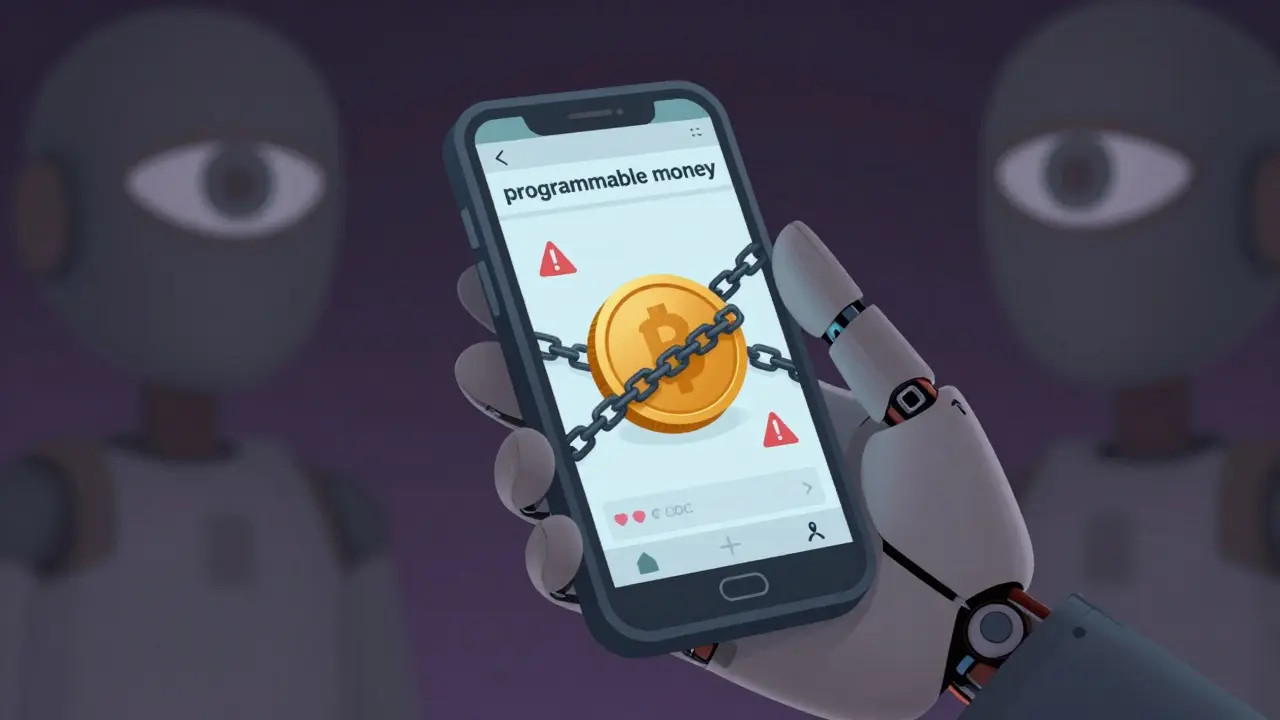
One of the most significant aspects of CBDCs is their programmability. Because they run on smart contract technology, central banks can embed specific rules into the currency itself. This sounds efficient on paper, but it opens up unprecedented levels of control. Imagine negative interest rates that automatically penalize you for saving money, forcing you to spend instead to stimulate the economy. Or think about spending restrictions that prevent you from buying certain categories of goods, perhaps limiting alcohol purchases for specific individuals.
The European Central Bank is the monetary authority of the Eurozone, currently developing the digital euro with a target operational date of 2025. Their proposal highlights these features while promising privacy protections. However, critics argue that any system allowing instant freezing of funds or transaction monitoring inherently compromises financial privacy. If a government can lock your account with a click, your money is no longer truly yours-it's a privilege granted by the state.
China’s e-yuan offers a real-world example of this power. After extensive testing involving businesses, households, and entire cities, including high-profile demonstrations during the Beijing Winter Olympics, the system shows how quickly transactions can be monitored and controlled. While proponents argue this reduces crime and tax evasion, opponents see it as a tool for authoritarian oversight. Under such systems, political dissidents could be cut off from the financial network entirely, unable to buy food or pay rent.
Cryptocurrency Advantages: Sovereignty and Resilience
For many users, the appeal of cryptocurrencies lies in their ability to bypass traditional banking infrastructure. Bitcoin is a decentralized cryptocurrency launched in 2009, designed to operate without central authority and protect user sovereignty. Its architecture prevents any single entity from freezing transactions or seizing assets. This feature is crucial for people living in countries with unstable governments or hyperinflationary economies. When local banks fail or capital controls are imposed, Bitcoin remains accessible.
Cryptocurrencies also excel in cross-border transactions. Traditional international transfers often take days and incur high fees due to intermediary banks. With blockchain technology, you can send value globally in minutes, regardless of borders. This efficiency benefits freelancers, expatriates, and small businesses engaged in global trade. The decentralized nature ensures that no single point of failure can disrupt the network, making it highly resilient to technical outages or geopolitical conflicts.
However, this freedom comes with responsibility. Managing a cryptocurrency wallet requires technical knowledge. Losing your private key means losing access to your funds forever-there is no customer service hotline to call. This barrier to entry limits mass adoption among non-tech-savvy users. Yet, advancements in user interface design and custodial solutions are gradually simplifying the experience, making self-custody more accessible to the average person.
The Rise of Stablecoins: A Hybrid Solution
If CBDCs represent total control and cryptocurrencies represent total freedom, stablecoins occupy the middle ground. Stablecoins are cryptocurrencies pegged to stable assets like fiat currencies, combining blockchain efficiency with price stability. They offer the speed and convenience of crypto transactions without the volatility. During 2024, the stablecoin market reached $27.6 trillion in transaction volume, signaling massive adoption in private sector applications.
Stablecoins function as digital equivalents of fiat currencies in everyday commercial transactions. Businesses accept them for payments, knowing the value won’t swing dramatically between the time of sale and settlement. They dominate decentralized finance (DeFi) applications, serving as the primary medium of exchange within these ecosystems. Unlike CBDCs, most stablecoins are not issued by central banks, preserving a degree of user autonomy. However, they rely on trusted issuers holding reserves, introducing counterparty risk that pure cryptocurrencies avoid.
This hybrid model suggests a future where different tools serve different purposes. You might use a CBDC for paying taxes or receiving government benefits, leverage stablecoins for daily commerce and international transfers, and hold Bitcoin as a long-term store of value. Each instrument addresses specific needs, creating a multi-layered financial ecosystem rather than a single monolithic system.
| Feature | CBDCs | Cryptocurrencies | Stablecoins |
|---|---|---|---|
| Issuer | Central Banks | Decentralized Networks | Private Entities |
| Value Stability | High (Pegged to Fiat) | Low (Market Volatile) | High (Pegged to Assets) |
| Privacy Level | Low (Government Oversight) | High (Pseudonymous) | Medium (Public Ledger) |
| Transaction Speed | Instant | Variable (Minutes to Hours) | Fast (Seconds to Minutes) |
| User Control | None (Revocable Access) | Total (Self-Custody) | Partial (Depends on Issuer) |
Global Adoption Landscape in 2026
The race to implement digital currencies is well underway. According to the Bank for International Settlements, 68 central banks have publicly communicated CBDC development work, with 28 active pilot programs worldwide. This widespread interest reflects a desire to modernize payment systems, reduce costs, and maintain monetary sovereignty in an increasingly digital world. Initial deployments will operate alongside existing cash and banknotes, classified as retail CBDCs aimed at replacing most retail bank user deposits over time.
China leads the pack with its advanced e-yuan implementation. The scale of testing-from individual households to entire cities-demonstrates serious commitment to integrating digital currency into daily life. Meanwhile, the EU’s progress toward the 2025 digital euro launch positions Europe as a major adopter, potentially influencing regulatory frameworks across the continent. Other nations are evaluating similar models, balancing innovation with concerns about privacy and financial inclusion.
Regulatory developments significantly impact adoption trajectories. Governments promoting CBDCs often simultaneously restrict or heavily regulate cryptocurrencies, creating policy tensions. Some view crypto as a threat to monetary policy effectiveness, while others recognize its potential for financial innovation. As 2026 unfolds, evolving regulatory frameworks will shape how these systems coexist. Clear guidelines may encourage business acceptance of both CBDCs and compliant cryptocurrencies, fostering a healthier ecosystem.

Implications for Financial Inclusion and Policy
Proponents of CBDCs argue they can enhance financial inclusion by reaching unbanked populations. Direct distribution of digital currency via mobile phones could bypass traditional banking infrastructure requirements, providing access to basic financial services for millions. This is particularly relevant in developing regions where brick-and-mortar banks are scarce. Real-time economic data collection enabled by CBDCs allows central banks to implement more precise monetary interventions, potentially stabilizing economies faster during crises.
However, exclusion risks remain. If access to CBDCs requires identity verification linked to government databases, marginalized groups facing documentation barriers may still be left out. Moreover, the surveillance capabilities inherent in CBDCs raise ethical questions about consent and proportionality. Not everyone wants their every transaction tracked by the state. For many, the promise of inclusion is outweighed by the loss of privacy.
Cryptocurrencies offer an alternative path to inclusion, albeit with higher technical barriers. Wallets require only internet access, not bank accounts. This democratizes access to global financial markets, enabling participation in DeFi lending, borrowing, and investment opportunities previously reserved for wealthy individuals with bank connections. Yet, education remains critical. Without proper understanding, users risk falling victim to scams or mismanaging their assets.
Navigating Your Personal Strategy
As these technologies mature, your personal strategy should reflect your values and needs. If you prioritize convenience, stability, and seamless integration with existing banking systems, CBDCs may suit you best once available. Be aware of the privacy trade-offs and potential restrictions embedded in their design. Keep some cash on hand as a backup, especially during transition periods.
If you value autonomy, censorship resistance, and protection against institutional failure, cryptocurrencies deserve a place in your portfolio. Start small, learn secure storage practices, and diversify across established assets like Bitcoin and Ethereum. Use reputable exchanges and hardware wallets to safeguard your holdings. Remember, volatility is part of the equation-only invest what you can afford to lose.
Stablecoins provide a practical bridge for daily transactions. Use them for online purchases, international remittances, or earning yield in DeFi protocols. Verify the backing mechanism of any stablecoin you use; fully collateralized options offer greater security than algorithmic variants. Monitor regulatory updates closely, as compliance requirements may affect accessibility.
Ultimately, the future likely involves coexistence rather than competition. CBDCs will serve as digital backbones for national economies, handling domestic transactions and government functions. Cryptocurrencies will continue to thrive in niches demanding privacy and decentralization. Stablecoins will dominate private sector commerce, offering efficiency without extreme volatility. Understanding this landscape empowers you to make informed choices about how you manage and move your money.
Will CBDCs replace physical cash completely?
Initially, no. Most central banks plan to introduce CBDCs alongside existing cash and banknotes. The long-term goal is to reduce reliance on physical currency, but complete replacement depends on public acceptance and technological infrastructure readiness. Cash may persist for niche uses or emergency scenarios.
Are cryptocurrencies legal tender everywhere?
No. Legal status varies by country. El Salvador adopted Bitcoin as legal tender, but most nations treat cryptocurrencies as assets or commodities. Regulations differ widely, affecting taxation, trading, and usage. Always check local laws before engaging in crypto activities.
How do stablecoins maintain their value?
Most stablecoins are backed by reserves of fiat currency or other stable assets held by the issuing entity. Regular audits verify these reserves match circulating supply. Algorithmic stablecoins attempt to maintain pegs through complex mechanisms, but they carry higher risk of depegging under stress.
Can governments freeze my CBDC account?
Yes. Since CBDCs are centrally controlled, authorities can restrict access to funds for various reasons, including suspected illegal activity, political dissent, or economic policy enforcement. This contrasts with cryptocurrencies, where self-custody prevents external freezing.
What happens to my Bitcoin if the internet goes down?
Your Bitcoin remains safe as long as you control your private keys. Transactions cannot be processed offline, but your balance is recorded on the blockchain, which persists even if temporary connectivity issues occur. Once connection resumes, pending transactions settle normally.