

Imagine you are a farmer in Kenya. A drought hits your region. In the past, you would have to wait weeks for an adjuster to visit, assess the damage, argue over the value of your lost crops, and then hope for a check that might never arrive. Now, imagine the money lands in your digital wallet the moment satellite data confirms rainfall dropped below a specific threshold. No paperwork. No arguments. Just code executing exactly as promised.
This is not science fiction. It is parametric insurance powered by blockchain technology. This combination is reshaping how we think about risk, turning a slow, bureaucratic industry into one that is fast, transparent, and accessible to people who were previously ignored by traditional insurers.
The Problem with Traditional Insurance Claims
Traditional insurance works on indemnity. This means the insurer pays you back for the actual financial loss you suffered. To do this, they need proof. They need photos, receipts, repair estimates, and often a physical inspection. This process is expensive and slow. For small claims or for people in remote areas, the cost of sending an adjuster can exceed the payout itself.
Consider a small business owner in a flood-prone area. If their shop floods, they lose inventory. But proving the exact value of that inventory takes time. During that time, they cannot restock. They cannot reopen. The delay hurts them more than the initial event. Traditional insurance struggles here because it relies on human judgment and subjective valuation.
Parametric insurance solves this by removing the 'loss assessment' step entirely. Instead of paying for what you lost, it pays when a specific, measurable event happens. If the wind speed reaches 100 mph, you get paid. If the earthquake magnitude hits 7.0, you get paid. The amount is agreed upon before the event occurs. There is no debate about whether the loss was 'worth' the payout. The trigger is objective.
How Blockchain Automates the Process
So, parametric insurance is great in theory. But who decides if the rain fell? Who releases the money? In the old model, a third-party agency measures the data, sends a report to the insurer, and the insurer writes a check. This still involves humans, delays, and potential errors.
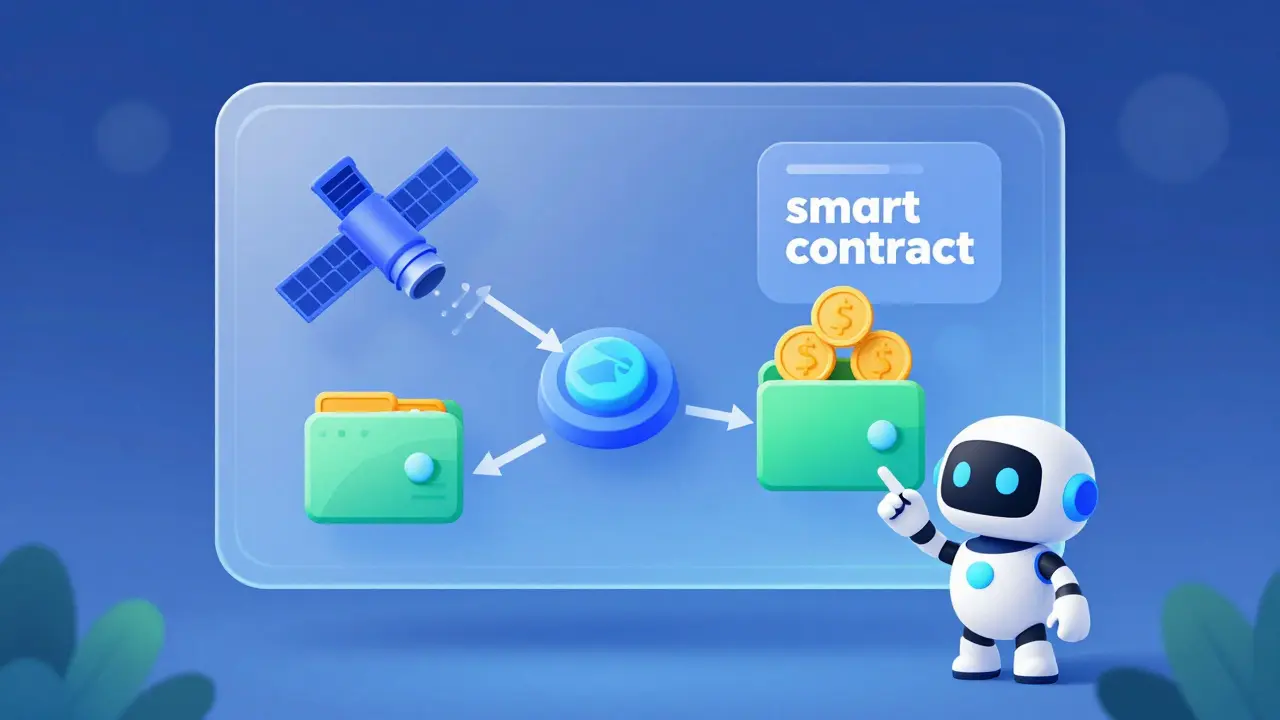
Enter blockchain and smart contracts. A smart contract is a self-executing agreement stored on a distributed ledger. It contains the terms of the policy: "If X happens, pay Y." Because the code is immutable, no one can change the rules after the fact. The insurer cannot deny the claim arbitrarily, and the insured cannot fake the event.
Here is how the technical architecture works:
- Policing Storage: The insurance policy is uploaded to the blockchain. Both parties sign it digitally. This creates a single source of truth that cannot be altered.
- Parameter Encoding: The conditions are written into the smart contract code. For example, "If average temperature exceeds 35°C for three consecutive days, release $5,000 USDC."
- Data Verification: The blockchain needs real-world data. It gets this from oracles, such as Chainlink. These services pull data from trusted sources like weather satellites, seismic sensors, or flight tracking APIs.
- Automatic Execution: Once the oracle confirms the condition is met, the smart contract automatically transfers the funds from the insurer’s pool to the insured’s wallet. No human intervention is required.
This automation eliminates the middlemen. It removes the frictional costs associated with claims processing. According to industry analysis, this efficiency allows insurers to offer lower premiums while maintaining profitability, opening up markets that were previously too risky or expensive to serve.
Real-World Use Cases: From Farmers to Flight Delays
You might wonder who actually uses this. It turns out, many people do, especially those in high-risk environments where traditional infrastructure is weak.
Agriculture: Platforms like Etherisc have created templates for crop insurance. A tea farmer in India can buy coverage against drought. If satellite data shows soil moisture levels drop below a critical point, the payout triggers immediately. This helps farmers survive the season without waiting for government aid or loans.
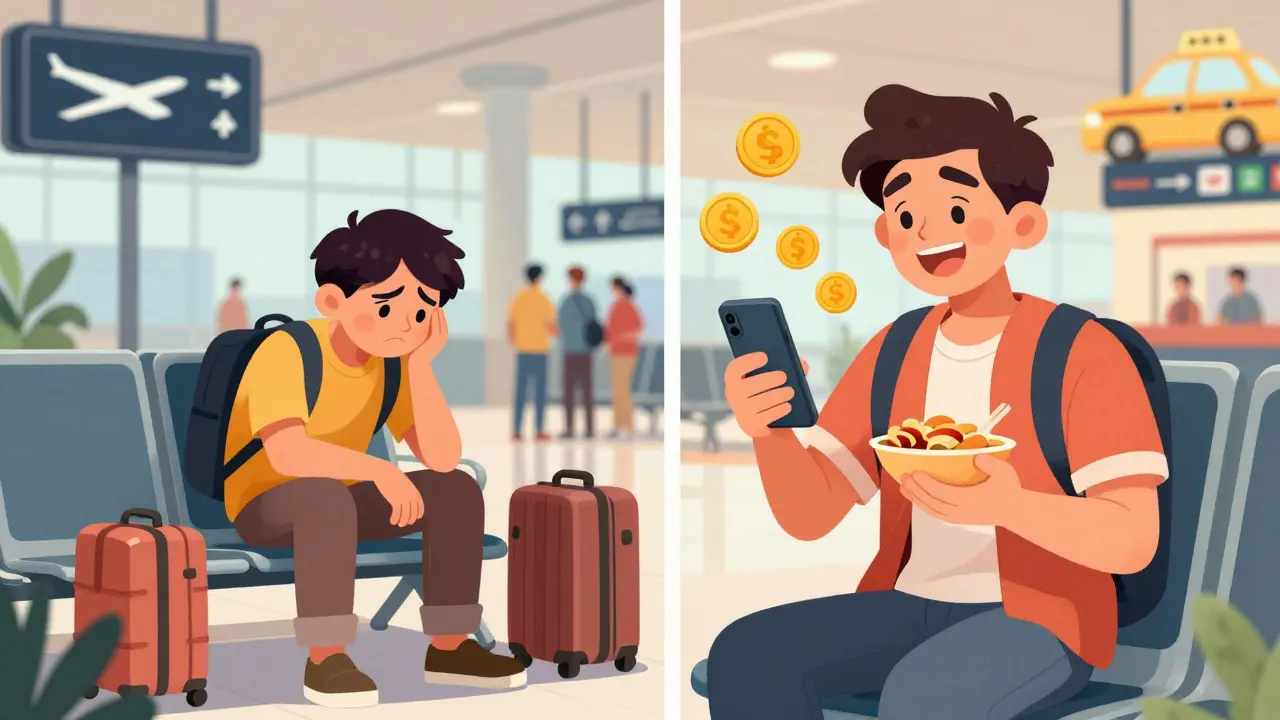
Travel: Have you ever missed a connecting flight due to a delay at the origin airport? You usually get nothing unless the airline decides to compensate you. With parametric travel insurance, if the flight data shows a delay exceeding two hours, the smart contract pays you instantly. You can use that money to grab a taxi or buy food right at the gate.
Natural Disasters: After Hurricane Maria hit Puerto Rico, many residents struggled to get compensation. A parametric policy based on wind speed or power outage duration could have provided immediate relief funds to thousands of households simultaneously, helping communities recover faster.
| Feature | Traditional Insurance | Parametric on Blockchain |
|---|---|---|
| Payout Basis | Actual financial loss assessed | Pre-defined parameter triggered |
| Claims Process | Manual, requires adjusters | Automated via smart contracts |
| Speed | Weeks to months | Minutes to hours |
| Cost | High administrative fees | Lower operational costs |
| Transparency | Opaque internal processes | Fully visible on public ledger |
Bridging the Protection Gap
One of the most compelling arguments for this technology is accessibility. In developing nations, the 'protection gap' is huge. Millions of people live in areas prone to floods, earthquakes, or droughts but cannot afford insurance because the overhead costs are too high for insurers to justify sending agents to rural villages.
Blockchain parametric insurance flips this model. Since there are no local agents needed, the cost of administering the policy drops dramatically. Startups are using this to create micro-insurance products. A fisherman in Southeast Asia can insure his boat against typhoons for a few dollars a month. If a Category 4 typhoon passes within a certain radius, he gets paid. He doesn't need to prove his boat sank; the storm's intensity is enough.
This decentralization shifts power. Instead of relying on a large, distant corporation to honor a claim, the community relies on code and verified data. It feels less like fighting 'David vs. Goliath' and more like having a reliable safety net.
Challenges and Limitations
It is not all perfect. There are hurdles to overcome.
Basis Risk: This is the biggest issue. Basis risk occurs when the trigger does not perfectly match your actual loss. For example, the rain gauge used for the trigger might be five miles away from your farm. It rains heavily at the gauge, so you get paid, but your field stays dry. Or vice versa: your field floods, but the gauge records normal levels, so you get nothing. Improving data granularity is key to solving this.
Oracle Reliability: The system is only as good as its data source. If the weather API fails or is hacked, the smart contract might not trigger correctly. While projects like Chainlink use multiple data sources to verify accuracy, reliance on external inputs remains a vulnerability.
Regulatory Uncertainty: Insurance is heavily regulated. Regulators are still figuring out how to classify decentralized autonomous organizations (DAOs) that underwrite risk. Legal frameworks vary wildly between countries, which can limit global adoption.
The Future of Automated Risk
Experts call parametric insurance on blockchain the 'lowest-hanging fruit' for crypto adoption in finance. Why? Because it fits naturally. Insurance has always been about promises and conditions. Blockchain excels at enforcing promises through code.
We are likely to see this expand beyond agriculture and travel. Think about supply chain disruptions. A shipping company could insure against port closures. If the port authority declares a closure, the payout triggers automatically, covering idle crew wages. Think about political instability. A business operating in a volatile region could insure against civil unrest indices.
As cloud providers like Microsoft Azure integrate these tools, and as regulatory clarity improves, we will move from niche experiments to mainstream products. The goal is simple: make insurance invisible, instant, and fair.
What is the main difference between parametric and traditional insurance?
Traditional insurance reimburses you for the actual financial loss you incur, requiring proof of damage. Parametric insurance pays a fixed amount when a specific, measurable event (like wind speed or rainfall) occurs, regardless of the actual damage.
How do smart contracts ensure payouts are made?
Smart contracts are self-executing codes on the blockchain. When an oracle verifies that the predefined condition (e.g., earthquake magnitude) has been met, the contract automatically transfers the funds from the insurer to the insured without human intervention.
What is basis risk in parametric insurance?
Basis risk is the discrepancy between the trigger event and the actual loss. For example, a rain gauge might record sufficient rain to trigger a payout, but your specific field might still suffer from drought due to localized weather patterns.
Who provides the data for blockchain insurance triggers?
Data is provided by 'oracles,' such as Chainlink. These services connect the blockchain to real-world data sources like satellite imagery, weather stations, and flight tracking systems to verify events objectively.
Is parametric insurance available to individual consumers?
Yes, increasingly so. Platforms like Etherisc offer micro-insurance products for farmers and travelers. While still emerging, more consumer-facing products are being developed for events like flight delays and natural disasters.