
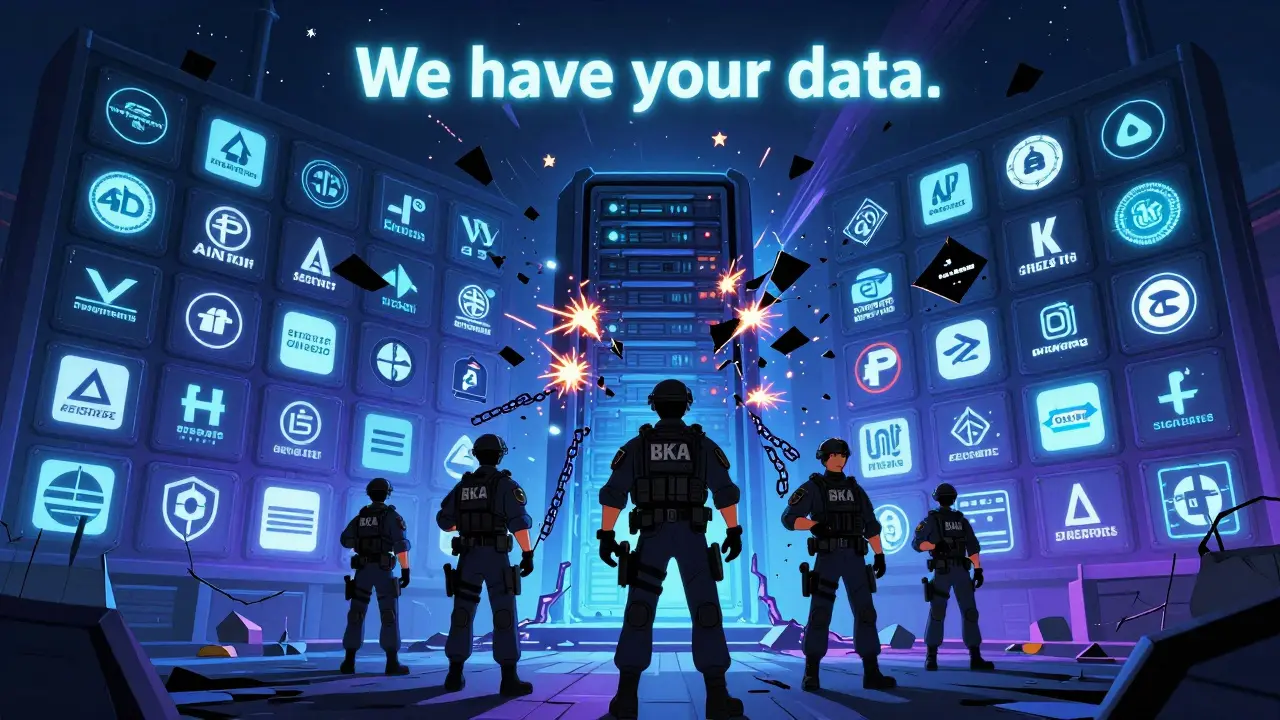
On September 19, 2024, something unprecedented happened in the world of cryptocurrency. Germany’s Federal Criminal Police, the BKA, didn’t just shut down one shady exchange. They wiped out 47 of them - all at once. This wasn’t a routine raid. It was Operation Final Exchange, and it changed how law enforcement fights crypto crime.
These weren’t just any platforms. They were Russian-language, no-KYC crypto exchanges. That means zero identity checks. No name. No phone number. No email. Just deposit crypto, swap it, withdraw cash. Perfect for criminals. And that’s exactly who used them: ransomware gangs, darknet drug sellers, and Russian sanctions evaders.
How They Did It
The BKA didn’t wait for court orders to expire or hope operators made a mistake. They went straight to the source: the servers. Every single one. Development. Production. Backups. All seized. Over 8 terabytes of data were pulled - transaction logs, IP addresses, user registrations, everything. No backups left. No escape route.
And then came the message. Not a quiet takedown notice. Not a press release. A direct, chilling statement posted on the exchanges’ websites: “We have found their servers and seized them - development servers, production servers, backup servers. We have their data - and therefore we have your data. Transactions, registration data, IP addresses. Our search for traces begins. See you soon.”
This wasn’t just enforcement. It was psychological warfare. For users who thought they were anonymous, this was a wake-up call. Your data isn’t safe. Your history is now in the hands of German investigators.
Why This Was Different
Before this, most crypto takedowns targeted one platform at a time. ChipMixer got shut down. Was it a win? Yes. But operators just moved to a new server, changed the name, and kept going. That’s why crypto crime kept growing.
Operation Final Exchange broke that cycle. By hitting 47 exchanges simultaneously, the BKA removed the entire ecosystem. No fallback. No rebuild. No migration. It was like cutting every power line in a city at the same moment - total blackout.
And the targets weren’t random. These exchanges were built for one thing: helping Russian-linked criminals bypass sanctions. They accepted payments from sanctioned banks. They allowed rubles to be converted into crypto, then out again as Bitcoin or Monero. This wasn’t just money laundering. It was state-level evasion, done through private apps.
The Tech Behind the Takedown
None of this would’ve been possible without blockchain analytics. Companies like Chainalysis helped trace the flow of funds across hundreds of thousands of transactions. They mapped how money moved from ransomware payouts → no-KYC exchanges → fiat withdrawals → offshore accounts.
But tech alone wasn’t enough. The BKA needed to understand how these exchanges worked. They weren’t like Coinbase or Kraken. These were instant-swap platforms with no user accounts, no login pages, no customer service. Just a web form. Deposit. Swap. Withdraw. That made them invisible to traditional compliance tools - and perfect for criminals.
German investigators spent months infiltrating Telegram groups, monitoring darknet forums, and tracking IP patterns. They didn’t just find servers. They found the people behind them - and how they communicated.
What Happened After
Within hours of the takedown, Reddit threads lit up. Users on r/cryptocurrency panicked. Telegram channels went quiet. Darknet vendors reported losing access to their main laundering channels. Some said they had to pause operations for weeks.
But not everyone was scared. Compliance-focused users cheered. On BitcoinTalk, comments like “This is what the industry needed” and “Legit crypto can’t survive with these criminals” flooded the boards. CoinGecko’s trust scores for privacy-focused exchanges dropped sharply.
Meanwhile, German prosecutors began working through the 8TB of data. As of late 2024, no arrests had been announced - but authorities confirmed dozens of active investigations. The data isn’t just evidence. It’s a roadmap. Every IP address. Every wallet. Every timestamp. They’re building cases against ransomware operators, drug dealers, and even bank insiders who helped move money.
Global Ripple Effects
This operation didn’t just affect Germany. It sent shockwaves through the entire crypto enforcement world.
EU officials started talking about copying the model. The U.S. Treasury’s FinCEN and FBI watched closely. Blockchain analytics firms saw a 300% surge in demand from law enforcement agencies. The global crypto compliance market hit $1.2 billion in 2024 - and Operation Final Exchange was a major driver.
Lawmakers in Germany used it as proof that aggressive enforcement works. New proposals are now being drafted to give police even more power to seize crypto infrastructure without waiting for international cooperation.
But it’s not all praise. Privacy advocates warn this sets a dangerous precedent. If governments can seize every server and track every transaction, what’s left of financial privacy? Legitimate users who want anonymity - journalists, activists, people in repressive regimes - might now be caught in the same net as criminals.

What This Means for You
If you’re a regular crypto user who uses exchanges with KYC, this probably doesn’t affect you. But if you’ve ever used a no-KYC service - even once - you should know: your data might already be in a German database.
And if you’re a developer or operator of a privacy-focused service? You’re now under a microscope. The days of thinking “we’re just a tool” are over. Authorities now see these platforms as active participants in crime.
The message is clear: anonymity isn’t a right if it’s used to hide illegal activity. And law enforcement is no longer waiting for you to slip up. They’re coming for the infrastructure - before you even make a transaction.
The Bigger Picture
Operation Final Exchange wasn’t about stopping one group of criminals. It was about changing the game.
Before, crypto crime was like a game of whack-a-mole. Take down one exchange, two more pop up. Now, the rules changed. The BKA proved you can hit them all at once. You can seize the data. You can scare users into submission. You can force the entire ecosystem to rethink how it operates.
It’s not perfect. It’s not fair to everyone. But it’s effective. And for the first time, criminals using crypto to evade sanctions, launder ransomware cash, or fund darknet markets now have real reason to fear.
The future of crypto enforcement won’t be slow, bureaucratic, or reactive. It’ll be fast. Coordinated. And brutal. Operation Final Exchange didn’t just shut down 47 exchanges. It showed the world how it’s done.
What exactly is Operation Final Exchange?
Operation Final Exchange is a coordinated law enforcement action carried out by Germany’s Federal Criminal Police (BKA) on September 19, 2024. It targeted 47 Russian-language cryptocurrency exchanges that operated without Know Your Customer (KYC) checks. Authorities seized all server infrastructure - including backups - and collected over 8 terabytes of user data, including transaction histories, IP addresses, and registration details. The operation aimed to disrupt sanctions evasion, ransomware laundering, and darknet market funding.
Why were these exchanges targeted?
These exchanges were specifically designed to serve Russian-speaking users and bypass international sanctions. They allowed users to deposit cryptocurrency and withdraw fiat currency linked to sanctioned Russian banks - all without requiring any personal identification. This made them ideal for laundering money from ransomware attacks, cybercrime, and darknet drug sales. Their no-KYC model meant law enforcement had no way to trace users - until now.
How did German police find and seize the servers?
Using blockchain analytics tools from firms like Chainalysis, German investigators traced cryptocurrency flows from ransomware payments through multiple mixing services to the 47 exchanges. They mapped server locations, identified operators’ communication channels via Telegram and darknet forums, and coordinated with international partners. Once they had the locations and access points, they executed simultaneous seizures across multiple jurisdictions - including physical server raids and remote data pulls.
Did this operation lead to any arrests?
As of early 2026, no public arrests have been announced. However, German authorities confirmed that investigations are actively ongoing, using the seized data to identify individuals linked to ransomware gangs, cybercriminal networks, and sanctions violations. The 8TB of data includes enough information to build hundreds of cases, but legal processes take time - especially when dealing with international jurisdictions.
Is this the end of no-KYC exchanges?
No, but it’s made them far riskier. Many operators have gone underground or moved to harder-to-trace infrastructure. Some have shifted to decentralized protocols or peer-to-peer trading. But the cost of operating has increased dramatically. Developers now face the real threat of server seizures and user data exposure. The operation has forced the entire no-KYC ecosystem to evolve - or disappear.
What does this mean for privacy-focused crypto users?
It’s a double-edged sword. For users seeking privacy for legitimate reasons - like journalists in authoritarian states or people avoiding surveillance - this sets a dangerous precedent. Governments now have the tools to seize and analyze vast amounts of on-chain data. While the operation targeted criminals, the same infrastructure can be used to track anyone who uses non-KYC services. The line between criminal and privacy-conscious user is increasingly blurred in the eyes of regulators.
Will other countries copy Germany’s approach?
Yes, and they already are. The EU is discussing similar coordinated takedowns. The U.S. FBI and FinCEN have studied the operation as a model. Blockchain analytics companies report a surge in law enforcement contracts. The success of Operation Final Exchange has proven that large-scale, simultaneous server seizures work - and it’s now seen as the gold standard for crypto enforcement.
John Doyle
February 12, 2026 AT 17:02kelvin joseph-kanyin
February 14, 2026 AT 00:49Grace Mugambi
February 14, 2026 AT 09:31Benjamin Andrew
February 15, 2026 AT 19:48Christopher Wardle
February 17, 2026 AT 02:54Andrea Atzori
February 18, 2026 AT 18:00Joe Osowski
February 20, 2026 AT 09:38Gaurav Mathur
February 20, 2026 AT 10:04Jeremy Lim
February 21, 2026 AT 15:54Beth Trittschuh
February 21, 2026 AT 22:32Peggi shabaaz
February 22, 2026 AT 03:48Holly Perkins
February 22, 2026 AT 19:13Sanchita Nahar
February 22, 2026 AT 19:57Ben Pintilie
February 22, 2026 AT 23:09Sakshi Arora
February 24, 2026 AT 03:16bala murali
February 25, 2026 AT 08:41Ekaterina Sergeevna
February 25, 2026 AT 15:57Desiree Foo
February 26, 2026 AT 08:20Kaz Selbie
February 26, 2026 AT 20:26Robbi Hess
February 28, 2026 AT 08:04Keturah Hudson
March 1, 2026 AT 12:18Ace Crystal
March 1, 2026 AT 18:20