

You might think that sending Bitcoin or Ethereum is like handing someone cash in a dark alley-untraceable and anonymous. But here’s the truth: every single transaction on a public blockchain is recorded forever. While your name isn’t attached to your wallet address, your digital footprint is visible to anyone who knows how to look. This is where on-chain crypto transaction tracing comes in. It’s not just a buzzword for compliance officers; it’s the backbone of modern financial security, used by everyone from law enforcement agencies tracking ransomware payments to everyday investors trying to avoid scams.
In this guide, we’ll break down exactly how these techniques work, why they matter, and what tools are actually being used in 2026. We’re skipping the academic jargon and getting straight to the mechanics of following money across the blockchain.
What is on-chain crypto transaction tracing?
It is the systematic process of tracking cryptocurrency movements across blockchain networks to identify patterns, attribute addresses to real-world entities, and follow funds from source to destination using the transparency of ledger data.
The Core Principle: Pseudonymity vs. Anonymity
To understand tracing, you first have to unlearn the idea that crypto is anonymous. Most major blockchains like Bitcoin and Ethereum are pseudonymous. Think of it like playing poker with nicknames. Everyone at the table knows "The Shark" bet big last round, but they don't know his legal name unless he slips up. On-chain tracing is the art of figuring out who "The Shark" really is by looking at his betting patterns, where he gets his chips, and who he pays.
This distinction is critical because it means that while your identity isn't directly linked to your transactions, your behavior creates a unique signature. Investigators use this signature to build profiles. According to Nansen's 2025 insights, most cryptocurrencies leave a visible digital footprint that remains traceable despite popular misconceptions about total privacy. The goal of tracing isn't to hack the blockchain-it's to interpret the data already sitting there in plain sight.
Three Main Methods of Tracing Transactions
When analysts sit down to track funds, they generally rely on three distinct methodologies. Each has its strengths and weaknesses, and professional firms often combine them for the best results.
- Heuristic-Based Techniques: These are rule-of-thumb algorithms. For example, if one wallet sends funds to five other wallets, and those five wallets immediately send their combined balance to a sixth wallet, heuristics suggest all six wallets belong to the same entity. This is fast and effective for simple cases within a single chain. TRM Labs reported an 89% accuracy rate for Ethereum transactions using these methods in 2024.
- Rule-Based Detection: This approach looks for specific known bad behaviors. If a transaction involves unsupported tokens or follows a chronological pattern typical of money laundering (like splitting funds into tiny amounts), the system flags it. These rules need constant updating as criminals change tactics, but they excel at catching obvious red flags like "peel chains," where funds are repeatedly split off.
- Graph Learning (AI/ML): This is the cutting edge. Instead of simple rules, machine learning models analyze the entire structure of transaction graphs. They can spot complex, non-linear patterns that human analysts or simple scripts would miss. Merkle Science reported 85% accuracy for multi-hop tracing across 2-3 chains using these advanced methods in 2024.
While graph learning offers the highest accuracy for complex scenarios, it requires significant computational power and massive datasets to train effectively. For many practical investigations, heuristic and rule-based methods remain the workhorses of the industry.
Wallet Clustering: Connecting the Dots
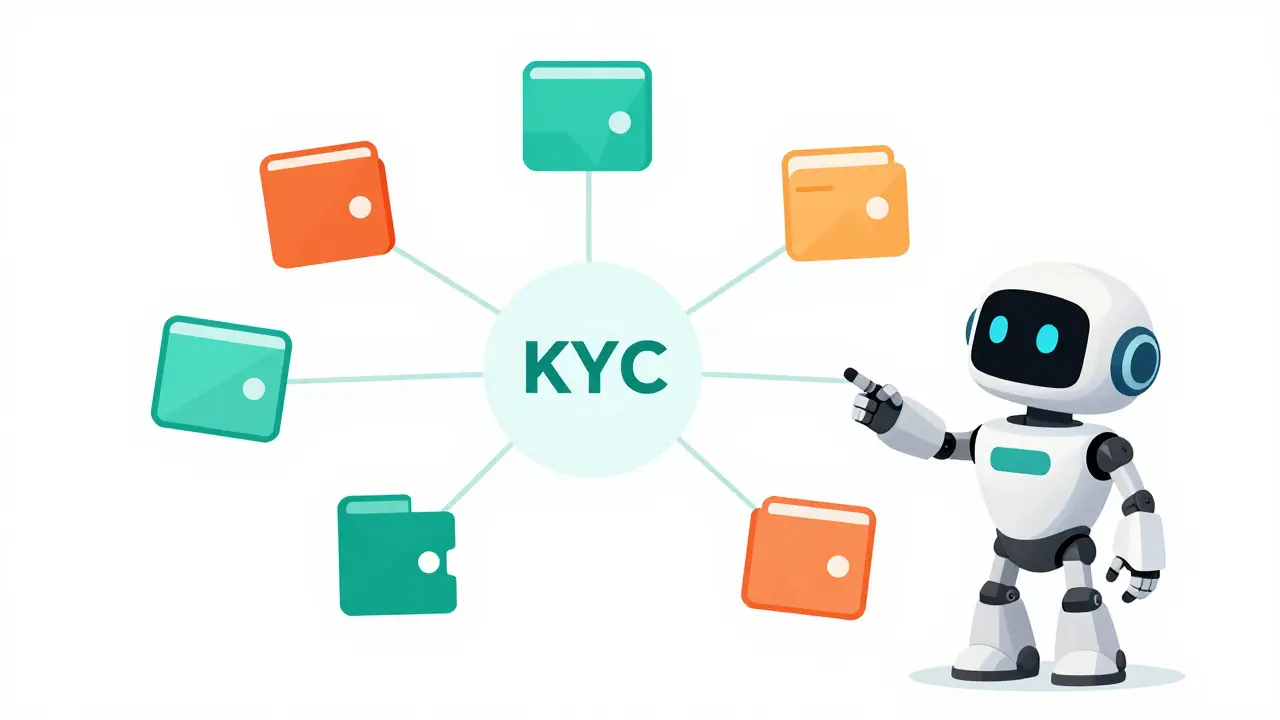
The most powerful tool in a tracer's kit is wallet clustering. This technique groups multiple wallet addresses together, assuming they belong to the same person or organization. How do they do this? By looking for common spend patterns. If Wallet A and Wallet B both send funds to Wallet C in the same transaction, it’s highly likely A and B are controlled by the same entity.
Once clusters are formed, the next step is attribution. This is where external data comes in. When a user deposits crypto into a centralized exchange like Coinbase or Binance, they undergo Know Your Customer (KYC) checks. The exchange links their verified identity to their deposit address. If investigators can trace illicit funds flowing into that deposit address, they can attribute the cluster-and the crime-to a real-world individual. As noted by HKA's 2024 analysis, this interaction with exchanges is one of the seven primary techniques used to unravel crypto crimes.
However, there’s a catch. Dr. Sarah Meiklejohn, a cryptography professor at University College London, cautioned in 2024 that definitive identity linkage still requires non-blockchain evidence. You can cluster addresses with high confidence, but proving who owns them usually needs a subpoena or a data breach from a third party.
The Cross-Chain Challenge
Tracing funds within Bitcoin or Ethereum is one thing. Tracing them as they jump between networks is another beast entirely. Criminals know this. They bounce funds through multiple networks in succession-for example, moving from Ethereum to Binance Smart Chain (BSC) via a bridge, then to Tron, and finally to a privacy coin. Each hop forces investigators to pause, find the exit point on the new chain, and resume tracing.
Cross-chain tracing presents significant technical hurdles. A 2024 report by Cryptoisac.org highlights that sophisticated launderers exploit the complexity of bridges. To trace these movements, analysts must understand different bridge mechanics, such as lock-mint or swap models. Premium analytics platforms now offer automated cross-chain tracing features, but even then, accuracy drops. Heuristic methods see their accuracy fall from 89% to 63% when crossing chains. If the trail becomes too convoluted with simultaneous hops, experts recommend seeking specialized assistance, as manual tracing often hits a dead end.
| Methodology | Best Used For | Accuracy Rate (Est.) | Key Limitation |
|---|---|---|---|
| Heuristic-Based | Single-chain tracking, basic clustering | 89% (Single Chain) | Drops to 63% on cross-chain |
| Rule-Based | Identifying known patterns (e.g., peel chains) | 92% (Pattern Detection) | Requires constant rule updates |
| Graph Learning (AI) | Complex multi-hop tracing | 85% (Multi-hop) | High computational cost |
Tools of the Trade
If you want to get serious about on-chain analysis, you can't just use a free blockchain explorer like Etherscan or Blockstream Explorer. Those are great for quick lookups, but they lack the depth needed for forensic tracing. Professional implementation requires specific skills and expensive software.
According to Arkham's 2024 guide, analysts typically need 3-6 months of dedicated training to become proficient. The essential toolkit includes:
- Blockchain Explorers: For raw data access (Etherscan, Solscan).
- Professional Analytics Platforms: Tools like TRM Labs, Elliptic, and Nansen provide pre-clustered data and risk scores.
- Open Source Tools: Options like BlockSci allow for custom analysis but require coding knowledge.
Cost is a barrier to entry. Comprehensive forensics tools cost between $15,000 and $50,000 annually per seat as of early 2025. Cross-chain capabilities add another layer of expense, with premium automated solutions hovering around $27,500 a year. This pricing reflects the high stakes involved; banks and exchanges pay these premiums to avoid regulatory fines and reputational damage.
Privacy Coins and Obfuscation
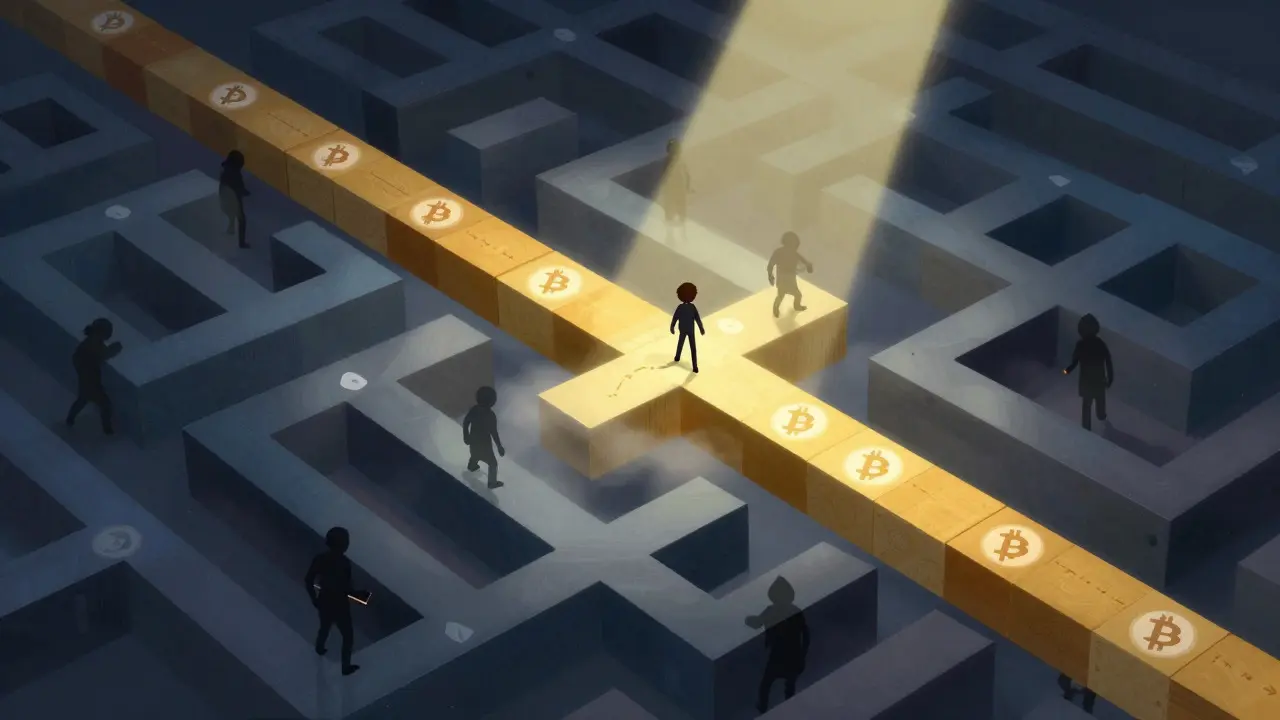
Not all crypto is created equal when it comes to traceability. Privacy coins like Monero and Zcash are designed specifically to hide transaction details. In 2024, these coins accounted for 7.2% of illicit transaction volume according to CipherTrace. Tracing funds once they enter a privacy pool is extremely difficult, often requiring off-chain intelligence rather than pure on-chain analysis.
Additionally, decentralized mixers have become a favorite tool for launderers, accounting for 18.3% of illicit volume in 2024. Mixers pool funds from many users and redistribute them, breaking the link between sender and receiver. While graph learning techniques are improving at detecting mixer usage, the "cat-and-mouse game" continues. As David Jevans, CEO of CipherTrace, notes, every advance in tracing technology is met with corresponding advances in obfuscation.
Regulatory Drivers and Future Outlook
The adoption of on-chain tracing isn't just driven by tech capability; it's mandated by regulation. The Financial Action Task Force (FATF) 'Travel Rule' requires virtual asset service providers to share originator and beneficiary information for transactions over $1,000. This regulation sparked massive growth in the blockchain analytics market, which ballooned from $200 million in 2019 to $1.87 billion in 2024.
By 2025, 87% of cryptocurrency exchanges were using blockchain analytics tools. Traditional finance is joining the fray too, with 63 of the top 100 global banks implementing monitoring solutions. Looking ahead, Gartner predicts that by 2027, 70% of enterprise blockchain analytics tools will incorporate generative AI for anomaly detection. This shift promises faster, more intuitive tracing, but it also raises privacy concerns. Advocates like the Electronic Frontier Foundation warn against using these powerful tools to surveil legitimate financial activity.
For now, on-chain tracing remains a vital component of financial integrity. Whether you're a regulator, an investor, or just a curious user, understanding these techniques helps demystify the blockchain and reveals the true nature of digital money: transparent, permanent, and increasingly accountable.
Can I trace my own crypto transactions easily?
Yes, for basic tracking. You can use free blockchain explorers like Etherscan for Ethereum or Blockstream for Bitcoin. Simply paste your wallet address to see incoming and outgoing transactions. However, identifying who sent or received funds from you will require professional tools or KYC-linked data.
Is on-chain tracing 100% accurate?
No. Accuracy varies by method and complexity. Heuristic methods are around 89% accurate on single chains but drop significantly for cross-chain movements. Definitive identity attribution often requires external legal evidence, not just blockchain data.
What is the difference between heuristic and rule-based tracing?
Heuristic tracing uses probabilistic algorithms to guess ownership based on spending patterns (e.g., common inputs). Rule-based tracing applies fixed criteria to flag specific suspicious behaviors, such as known money laundering patterns or interactions with blacklisted addresses.
How do privacy coins affect transaction tracing?
Privacy coins like Monero and Zcash obscure transaction details, making on-chain tracing nearly impossible without external data. They accounted for 7.2% of illicit transaction volume in 2024, serving as a final destination for laundered funds.
Why is cross-chain tracing so difficult?
Cross-chain tracing is difficult because each blockchain operates independently. Funds moved via bridges often appear as new minting events or burns on the receiving chain, breaking the direct transactional link. Analysts must manually correlate timestamps and amounts across different network protocols.