
Memecoin Survival Calculator
How long will your memecoin last?
Based on University of Chicago 2025 study data showing 94.7% of memecoins crash 90%+ within 18 months
Your Results
Most people think memecoins are just internet jokes dressed up as money. And honestly? They’re right. Dogecoin started as a joke. Shiba Inu was built to mock Dogecoin. Trump-themed memecoins popped up because someone thought a viral tweet could print cash. But here’s the real question: long-term viability of memecoins isn’t about whether they’re funny. It’s about whether they can survive when the laughs stop.
They’re Not Coins. They’re Cultural Products
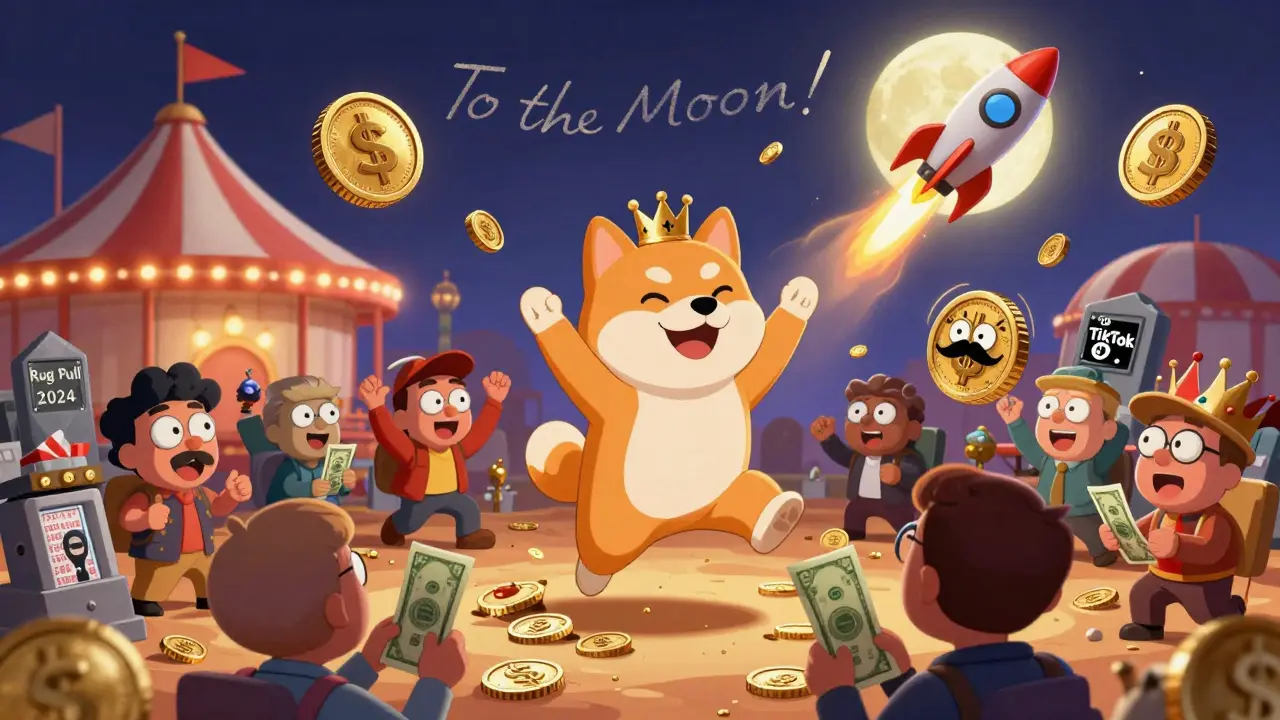
Bitcoin is digital gold. Ethereum is a global computer. Memecoins? They’re digital inside jokes with a price tag. Their value doesn’t come from smart contracts, decentralized apps, or energy-efficient consensus. It comes from Reddit threads, Elon Musk tweets, and TikTok trends. Dogecoin’s price didn’t jump because of a technical upgrade. It jumped because a billionaire said ‘Dogecoin to the moon’ on live TV. That’s not finance. That’s pop culture.
That’s why 94.7% of memecoins crash 90% or more within 18 months of launch. The University of Chicago’s 2025 study didn’t find a single memecoin with lasting value except Dogecoin and Shiba Inu. And even those two? They’re riding on community muscle, not code. Dogecoin has 2.3 million monthly active users. Most memecoins struggle to hit 5,000. When the hype dies, the users vanish. No one’s holding a memecoin because they need it. They’re holding it because they hope someone else will pay more for it tomorrow.
Infrastructure? Barely Exists
Most memecoins run on other people’s blockchains. About 68% of new ones in 2024-2025 were built on Solana because it’s cheap and fast. Dogecoin runs on its own chain, but it confirms transactions in a minute. Solana-based memecoins? They can settle in under half a second. But speed doesn’t matter if no one’s using it. The average memecoin sees fewer than 1,000 transactions a day. Bitcoin? 43 million. Ethereum? 1.2 million. Dogecoin? 350,000. Shiba Inu? 120,000. The rest? Ghost towns.
And forget about utility. Only one memecoin - MEME, from Memeland - gives you real features: staking, NFT purchases, voting rights. The rest? You can’t pay for coffee with them. Only 0.7% of crypto-accepting merchants take any memecoin besides Dogecoin. Even then, it’s mostly for novelty. Tesla accepts Dogecoin. Why? Because Musk likes it. Not because it’s practical. That’s not a business model. That’s a celebrity endorsement.
The Numbers Don’t Lie - Most Fail Fast
Let’s talk survival rates. Fidelity’s 2025 report looked at every memecoin launched in the last five years. Only 12% still trade with a market cap over $1 million. The median lifespan? Just 87 days. Chainalysis says 31% of failures were outright rug pulls - developers vanished with the money. CoinGecko found 64% of new memecoins drop over 90% in the first 30 days. That’s not volatility. That’s a trap.
And here’s the kicker: 87% of memecoin holders keep their coins for less than 90 days. Compare that to Bitcoin, where 58% hold longer than three months. People aren’t investing in memecoins. They’re gambling. The average purchase? $147. For Bitcoin? $1,850. You’re not buying into a future. You’re buying a lottery ticket with a blockchain logo.
Regulators Are Watching - And They’re Not Impressed
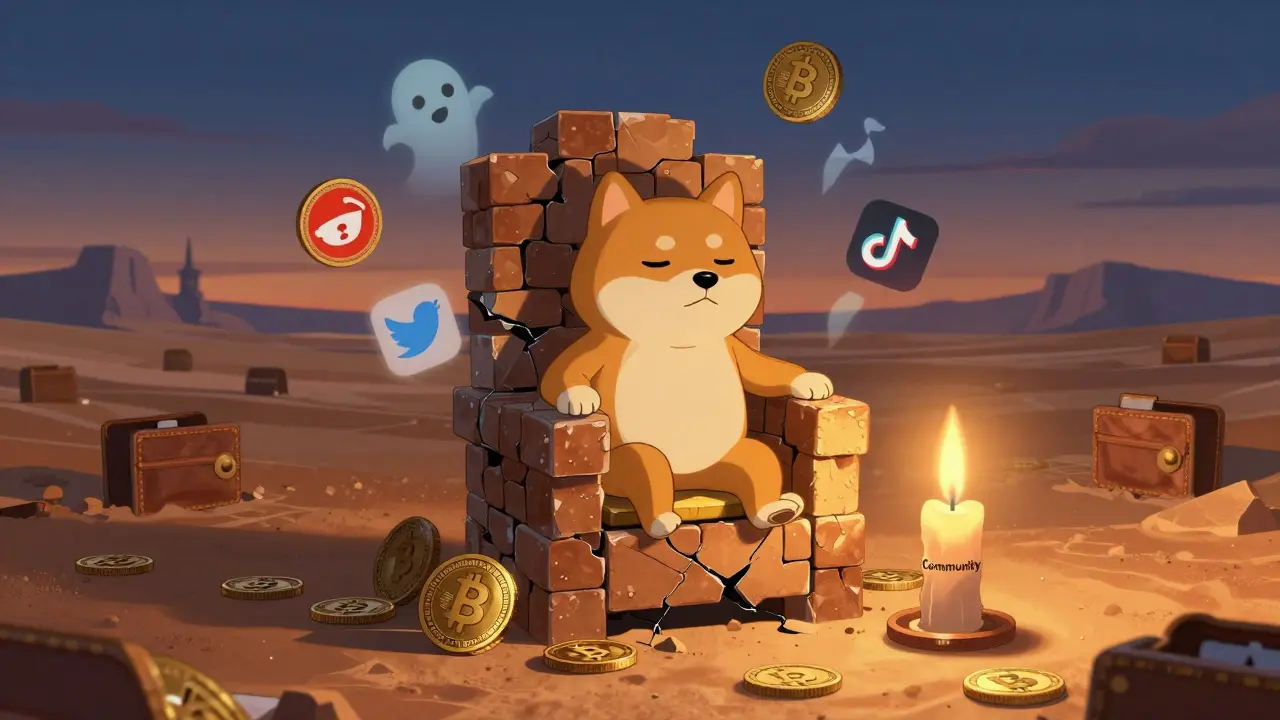
The SEC called memecoins ‘akin to collectibles’ in February 2025. That’s not a compliment. It means they’re not securities. No legal protections. No fiduciary duty. No accountability. If your memecoin crashes, you can’t sue. You can’t get your money back. The CFTC filed 17 enforcement actions against memecoin promoters in just nine months of 2025. That’s up from 3 in all of 2024. They’re cracking down on pump-and-dump schemes, fake influencers, and exit scams.
And the market share? It’s shrinking. Memecoins hit 4.1% of the total crypto market in 2021. Now? 2.3%. That’s $58.7 billion out of $2.55 trillion. Bitcoin alone is worth $980 billion. Ethereum? $410 billion. Memecoins are a rounding error. And they’re getting smaller.
So What’s Left? Dogecoin and Shiba Inu - Barely
Two memecoins are still standing. Dogecoin, with a $22.3 billion market cap. Shiba Inu, at $7.8 billion. Why? Because they built communities. Dogecoin has charity drives, tipping systems, and a decade of loyalty. Shiba Inu launched Shibarium, a Layer-2 network that’s processed 247 million transactions with fees under a penny. Neither is revolutionary. But they’re persistent.
They’re not going to replace Bitcoin. They won’t power DeFi. But they might survive as niche assets - like baseball cards or rare sneakers. People collect them. People trade them. People feel part of something. That’s not investing. That’s belonging. And for now, that’s enough.
Should You Buy One?
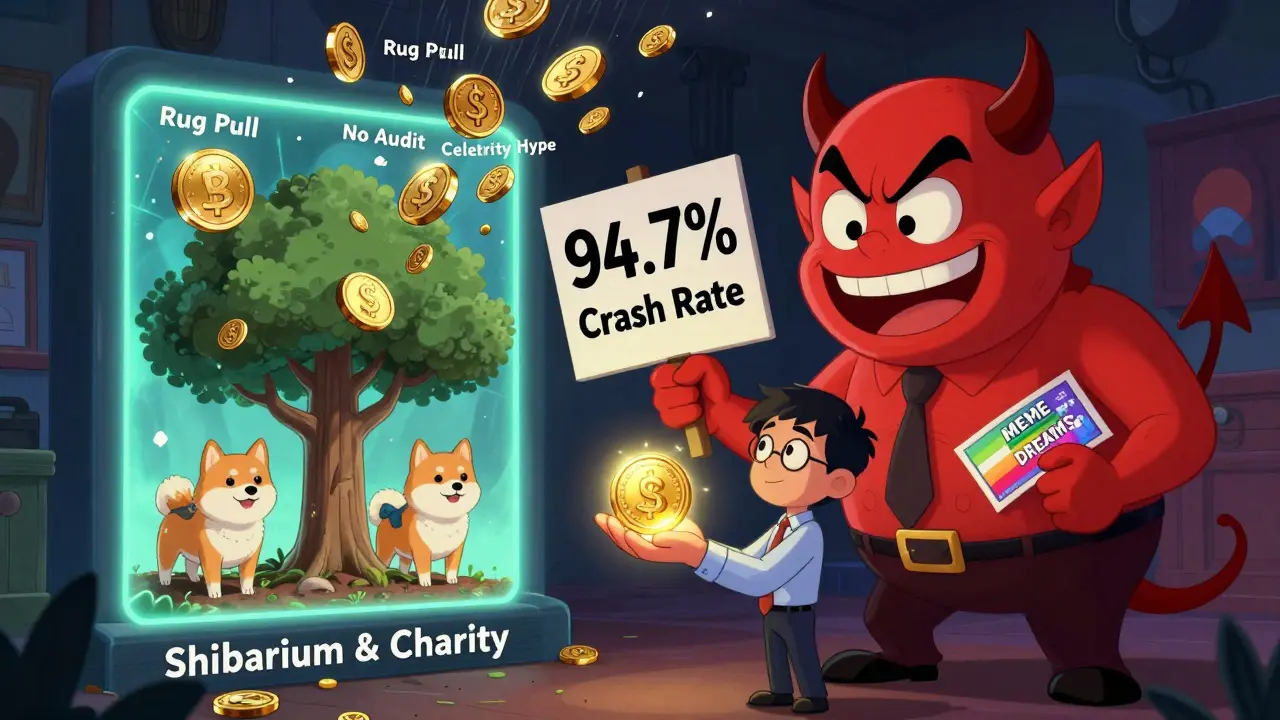
If you’re asking this, you’re probably already thinking about it. Here’s the truth: only buy a memecoin if you’re okay losing every dollar. Not ‘hoping to win big.’ Not ‘dipping in for fun.’ If you can’t afford to lose it, don’t touch it.
And if you do? Stick to Dogecoin or Shiba Inu. Avoid anything with a celebrity name, a 10-minute Twitter thread as its whitepaper, or a Telegram group that looks like a party. Check if it’s audited. Most aren’t. 73% of 2024 memecoins had zero security review. That’s like buying a car with no brakes and hoping the road is smooth.
And never invest more than you’d spend on a concert ticket or a weekend trip. That’s the only smart way to play this game. Because the only thing more unpredictable than a memecoin’s price? Its future.
What’s Next for Memecoins?
Experts agree: 95% of today’s memecoins will be worthless in five years. Bernstein Research says only the top 3-5 will survive - and even then, they’ll be a tiny slice of the market. Dogecoin’s upcoming protocol upgrade in Q3 2026 might help. Shiba Inu’s Shibarium could become a real platform. But neither is solving real-world problems. They’re just trying not to die.
The future of memecoins isn’t about technology. It’s about culture. If Dogecoin keeps trending on social media, if its community stays active, if it keeps getting mentioned by influencers - it might last. But if the jokes run out? So does the money.
That’s the cruel irony. Memecoins were never meant to last. But now, the only ones that might are the ones that accidentally became real.
Are memecoins a good investment?
No - not as an investment. Memecoins are speculative bets with no underlying value, no cash flow, and no utility for most. Only Dogecoin and Shiba Inu have shown any staying power, and even they’ve lost over 75% of their peak values. If you buy one, treat it like a lottery ticket, not a portfolio asset.
Why do people still buy memecoins if they crash so fast?
Because of FOMO and social proof. When a memecoin spikes, people see others making quick profits and jump in hoping to catch the next wave. Reddit, Twitter, and TikTok amplify the hype. Most buyers don’t research - 78% spend less than 30 minutes before buying. It’s not investing. It’s chasing dopamine.
Can memecoins ever become useful like Bitcoin or Ethereum?
Unlikely for most. Only a handful have added even basic utility - like Dogecoin being accepted by Tesla or Shiba Inu’s Shibarium network. But these are exceptions. Memecoins lack the technical foundation, developer teams, and long-term roadmaps needed to build real applications. Their purpose was always entertainment, not infrastructure.
Is Dogecoin the only memecoin with long-term potential?
Dogecoin is the only one with a decade-long track record, a massive active community, and real-world use cases like merchant acceptance. Shiba Inu is the closest second, thanks to Shibarium. But even these two are outliers. The rest are temporary trends with no path to sustainability.
What’s the biggest risk when buying a memecoin?
Rug pulls - where developers abandon the project and drain the liquidity. Chainalysis found 31% of failed memecoins were scams. Other risks include extreme volatility, zero security audits (73% of 2024 coins had none), and no customer support. You’re not buying a product. You’re gambling on a community that might vanish overnight.
How do I know if a memecoin is a scam?
Check three things: 1) Has it been audited by a known firm? (Most haven’t.) 2) Is the team anonymous? (Red flag.) 3) Is the whitepaper just a meme or a tweet? (That’s not a plan.) Also, avoid coins promoted heavily by influencers who don’t disclose paid partnerships. If it sounds too good to be true - and it’s based on a joke - it probably is.
Should I include memecoins in my crypto portfolio?
Only if you’re okay with losing it all. Morningstar surveyed 1,200 financial advisors in October 2025 - 92% said memecoins should make up less than 1% of any portfolio. Treat them as entertainment, not assets. Never risk money you can’t afford to lose. If you’re building wealth, stick to Bitcoin, Ethereum, or other established projects with real utility.
Final Thought
Memecoins aren’t going away. But they’re not growing either. They’re stuck in a loop: hype, crash, repeat. The ones that survive won’t change the world. They’ll just be the last ones standing in a graveyard of failed jokes. If you’re drawn to them - go ahead. But know what you’re really buying. Not a currency. A feeling. And feelings don’t pay bills.
Chevy Guy
December 15, 2025 AT 09:43They let a dog coin survive because it's funny but ban real crypto that actually does something? The system's rigged and you know it. They're scared of what happens when people stop trusting banks and start trusting memes.
Kelsey Stephens
December 16, 2025 AT 21:50I get why people are drawn to these. It's not about the money-it's about being part of something that feels alive. Even if it's chaotic. That sense of belonging? That’s rare these days.
Sue Bumgarner
December 17, 2025 AT 18:03America invented the internet so of course we invented meme coins. Every other country is still stuck in their old-school finance systems. We don't need regulation-we need more Doge.
Kayla Murphy
December 19, 2025 AT 11:05You don't have to believe in it to believe in the people behind it. The Dogecoin community didn't just chase a price-they built something real. That’s worth respecting.
Florence Maail
December 21, 2025 AT 07:32Of course the SEC calls them collectibles-that's what they want you to think. Meanwhile, the Fed prints trillions and no one calls that a joke. Wake up. This is all a distraction. The real wealth is being stolen while we argue about Shiba Inu.
Abby Daguindal
December 22, 2025 AT 10:24Anyone who buys memecoins without reading the whitepaper deserves to lose it. No one’s stopping you. But don’t come crying when your $150 turns into $3.
SeTSUnA Kevin
December 22, 2025 AT 14:01The linguistic and economic absurdity of assigning market capitalization to a cartoon dog is a perfect metaphor for late-stage capitalism.
Madhavi Shyam
December 22, 2025 AT 18:44Shibarium’s TPS is suboptimal compared to Solana’s native chain. The gas fee arbitrage is negligible and the liquidity pools are illiquid. You’re chasing alpha in a zero-sum game with no edge.
Mark Cook
December 23, 2025 AT 04:26Actually, I bought a memecoin last week and made 5000%. So yeah, they're all scams except mine. 😎
Bradley Cassidy
December 24, 2025 AT 09:00man i just think its wild that a dog with a goofy face has more heart than most wall street bros. i dont know if its smart but it feels right?? 🐶💛
Shruti Sinha
December 24, 2025 AT 09:35It’s fascinating how culture can create value where economics sees none. The community is the asset.
Sean Kerr
December 24, 2025 AT 11:39Heyyy, i just wanna say… if you're thinking about dipping in… just remember… it's okay to lose it all… but don't lose your chill 😊🙌
Rebecca Kotnik
December 25, 2025 AT 18:53One must consider the phenomenological implications of speculative asset formation in a post-truth digital economy. The memecoin, as a cultural artifact, represents not merely a financial instrument but a collective unconscious expression of disenchantment with institutional authority and a yearning for decentralized, emotionally resonant value systems. The persistence of Dogecoin, despite its lack of technical innovation, suggests a deeper sociological need for symbolic belonging that transcends traditional economic utility.
Elvis Lam
December 26, 2025 AT 18:1394.7% crash? That’s not a bug-it’s a feature. The system filters out the weak. Only the ones with real community muscle survive. That’s Darwinian finance. Stop crying about it and learn the rules.
Jonny Cena
December 28, 2025 AT 06:07It’s okay to be drawn to these. You’re not dumb for feeling it. Just don’t bet your rent on it. Keep it small. Keep it fun. And remember-you’re not alone in wondering if this makes any sense.
Dionne Wilkinson
December 29, 2025 AT 08:24Maybe the joke was never the coin. Maybe the joke was us-for believing we could turn laughter into legacy.
Emma Sherwood
December 30, 2025 AT 12:11In India, we have a saying: 'A joke that outlives its punchline becomes a tradition.' Dogecoin isn’t a currency. It’s a digital diwali. Fireworks that keep going even after the lights go out.