

Imagine you’ve got some crypto sitting idle. You hear about staking - earning rewards just by holding your coins. But then you hit a wall: do you lock it up for higher returns, or keep it flexible so you can move it anytime? There’s no one-size-fits-all answer. Your choice between locked staking and flexible staking depends on how you think about money, risk, and timing.
What Locked Staking Actually Means
Locked staking is like putting your crypto in a savings account with a fixed term. You agree to leave your tokens untouched for a set period - 15 days, 30 days, 90 days, even a year. During that time, you can’t sell, trade, or withdraw them. If you try, you lose all the rewards you’ve earned so far. No partial refunds. No exceptions.This isn’t just a rule - it’s a security feature. Blockchains like Ethereum, Solana, and Polygon rely on validators to confirm transactions. When you lock your tokens, you’re essentially saying, “I’m in this for the long haul.” The longer you lock, the more the network trusts you. That trust gets paid back in higher rewards.
On Binance, locked staking for popular coins like ATOM or DOT can offer between 10% and 30% annual returns. The 90-day option usually pays more than the 30-day one. Kraken’s bonded staking works the same way: lock longer, earn more. Crypto.com gives better rates for CRO locked over 180 days. These aren’t random numbers - they’re incentives designed to keep capital locked in the network, making it harder for bad actors to attack.
But here’s the catch: if Bitcoin crashes 40% in a week and you’ve got your ETH locked for 90 days, you’re stuck. You can’t sell to cut losses. You can’t move to a better opportunity. You’re locked in - literally.
Flexible Staking: Freedom With a Trade-Off
Flexible staking is the opposite. You stake your crypto, and you can unstake it anytime. No waiting. No penalties. No lost rewards. Your funds are always liquid. That’s why traders, day investors, and people who hate feeling trapped love it.Binance Flexible Savings lets you earn interest on over 50 coins with daily payouts. You can withdraw your entire balance in seconds. Kraken’s flexible staking works the same way. The catch? Rewards are lower. You might get 3% to 8% APY instead of 15% to 30%. Why? Because the network can’t rely on you staying. If everyone could leave at any moment, validators would be unstable. So the network pays less to compensate for that risk.
Flexible staking is perfect if you’re actively trading. Say you’re using a bot like Cryptohopper to buy low and sell high. You can stake your ETH during quiet periods, then pull it out the second you see a buying signal. No delays. No headaches. You’re not sacrificing control - you’re using your crypto smarter.
It’s also great if you’re unsure about the market. Maybe you bought SOL because you liked the project, but you’re not sure if it’ll hold up. Flexible staking lets you earn while you wait - without locking yourself into a bad bet.
Why Locked Staking Gives Better Rewards
You might wonder: why do locked staking rewards beat flexible ones so badly? It’s not just greed. It’s math.Blockchains need long-term validators to stay secure. If half the stakers could pull out tomorrow, the network becomes vulnerable. Attackers could buy up cheap tokens, stake them, and then dump them after manipulating the chain. That’s called a “nothing-at-stake” attack. Locked staking prevents it by making it expensive to exit.
Think of it like renting an apartment. If you sign a 12-month lease, the landlord gives you a better rate. If you pay month-to-month, they charge more because you could leave anytime. Same logic. Locked staking = long-term commitment = higher reward. Flexible = short-term = lower reward.
Platforms like Lido DAO are trying to fix this. They let you stake ETH and get back a token called stETH that’s worth exactly 1 ETH. You can trade stETH on DeFi platforms, use it as collateral, or even earn more yield in liquidity pools - all while your original ETH keeps staking. It’s like getting the rewards of locked staking without losing liquidity. But even Lido’s model isn’t perfect: stETH can trade at a discount during market stress, and you still rely on the underlying validator network.
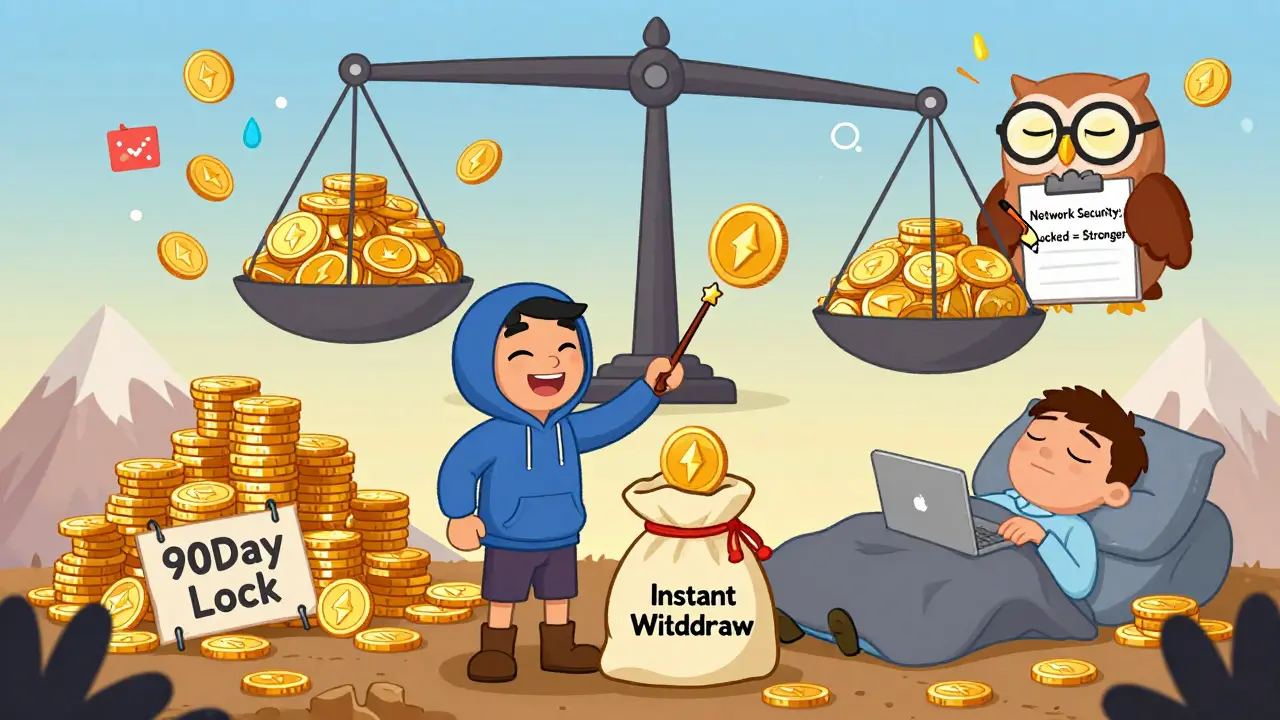
Who Should Use Which?
There’s no right or wrong. Only what fits your life.If you’re a long-term holder - you bought Bitcoin or Ethereum because you believe in it for the next 5 years - locked staking is your friend. You don’t need the cash. You’re not watching the price every hour. You want maximum yield, and you’re okay with not touching it. Locking 80% of your holdings for 90+ days makes sense.
If you’re an active trader - you monitor charts, use alerts, jump on news - flexible staking is essential. You need to move fast. You can’t wait 30 days to sell when a token pumps. Keep 20-30% in flexible staking so you can react instantly.
And if you’re new to crypto? Start with flexible. Test the waters. Learn how rewards work. See how your chosen coin behaves. Then, once you’re confident, move part of your portfolio to locked staking. Don’t lock everything on day one.
The Hybrid Approach: Split Your Staking
Most smart investors don’t pick one. They split.Here’s a real-world example: You have 10 ETH. You lock 6 ETH for 90 days at 18% APY. That’s about 1.08 ETH in rewards over three months. You keep 4 ETH in flexible staking at 6% APY. That’s 0.24 ETH in rewards over the same period. Total: 1.32 ETH earned. And you still have 4 ETH ready to trade if the market moves.
Platforms like Binance and Kraken make this easy. You can have both accounts open at once. You can even set up auto-renewal for locked staking so it rolls over without you lifting a finger.
Some users even rotate. Lock for 30 days. Cash out. Re-lock for 90. Repeat. It’s not passive, but it gives you control over timing - and sometimes better average returns.

Security: The Hidden Cost of Flexibility
Here’s something most beginners overlook: flexible staking weakens the network.When validators can leave anytime, the network becomes less stable. During a market crash, if 30% of stakers pull out at once, the blockchain has to reorganize. That slows down transactions. It can even cause temporary forks. Locked staking prevents this by creating a stable base of committed participants.
That’s why Ethereum’s transition to PoS relied heavily on locked staking. Validators had to deposit 32 ETH and lock it indefinitely. No flexibility. No shortcuts. That’s what made Ethereum 2.0 secure.
Flexible staking is great for users. But it’s not ideal for the blockchain’s long-term health. That’s why the best platforms - like Lido and Rocket Pool - are building bridges between the two. Liquid staking derivatives are the future, but they’re still new. Use them cautiously.
What’s Next for Staking?
The next 12 months will see big changes. More chains are moving to PoS. More platforms will offer dynamic staking: rewards that adjust based on network demand. Imagine staking at 15% today, but if 10,000 new users join, your rate drops to 12% to avoid inflation. Or if fewer people stake, your rate jumps to 20% to attract more.Also, expect more integration with DeFi. Soon, you might stake your SOL, get a liquid token, then use that token as collateral to borrow USDC - all in one step. No manual transfers. No waiting.
For now, the choice is simple: locked for yield, flexible for freedom. But the line between them is blurring. And if you’re not paying attention, you’ll miss the next wave.
Can I lose my crypto by staking?
No, you don’t lose your principal by staking. Your tokens stay in your wallet or the platform’s custody. You’re not risking your original balance. But if the platform gets hacked or goes bankrupt - like Celsius or FTX - you could lose access. Always use reputable exchanges with strong security and insurance. Never stake on unknown DeFi protocols without auditing them first.
Is flexible staking really instant?
Most platforms say “instant,” but there’s usually a short delay. On Binance, unstaking takes 1-2 hours. On Kraken, it’s often under 10 minutes. This delay happens because the blockchain needs to process your request. It’s not the platform holding you up - it’s the network. So plan ahead. Don’t try to unstake right before a big trade unless you’re ready to wait.
Do I pay taxes on staking rewards?
Yes, in most countries, including New Zealand, staking rewards are treated as income. You owe tax when you receive them, not when you sell. Keep detailed records of every reward you earn - date, amount, USD value at the time. Use tools like Koinly or CoinTracker to automate this. Ignoring taxes is a common mistake that leads to penalties.
What’s the minimum amount to stake?
It varies. Binance lets you start with as little as 0.1 ETH or 1 ADA. Kraken requires 0.001 BTC. Some chains like Solana need a full validator stake (32 SOL), but you can join pools with as little as 1 SOL. Always check the platform’s minimum before you start. Don’t assume it’s the same everywhere.
Can I stake on multiple platforms at once?
Yes, but be careful. You can’t stake the same token on two places at once. If you stake 5 SOL on Binance, you can’t also stake those same 5 SOL on Kraken. You’d need separate holdings. Many users split their portfolio: some on Binance, some on Kraken, some in Lido. Just make sure you’re not overextending yourself across too many platforms. More platforms = more passwords, more risks.
Raja Oleholeh
January 3, 2026 AT 08:44Alexandra Wright
January 3, 2026 AT 14:02christopher charles
January 4, 2026 AT 01:26Brooklyn Servin
January 4, 2026 AT 19:38Kenneth Mclaren
January 5, 2026 AT 10:35Jackson Storm
January 7, 2026 AT 07:40Amy Garrett
January 8, 2026 AT 17:34Jack and Christine Smith
January 9, 2026 AT 22:30Haritha Kusal
January 11, 2026 AT 09:35Alison Hall
January 12, 2026 AT 14:20Michelle Slayden
January 13, 2026 AT 21:17Rajappa Manohar
January 15, 2026 AT 18:12Abhisekh Chakraborty
January 17, 2026 AT 15:06dina amanda
January 17, 2026 AT 17:20Khaitlynn Ashworth
January 17, 2026 AT 18:59Mike Pontillo
January 19, 2026 AT 15:25NIKHIL CHHOKAR
January 21, 2026 AT 13:18Joydeep Malati Das
January 21, 2026 AT 22:46rachael deal
January 22, 2026 AT 03:10Ryan Husain
January 22, 2026 AT 08:33Prateek Chitransh
January 23, 2026 AT 18:44Vernon Hughes
January 24, 2026 AT 23:15