

South Korea doesn’t just regulate cryptocurrency-it controls it. If you’ve ever tried to trade crypto there, you know it’s not like opening a Binance account and going wild. Every step, from signing up to withdrawing profits, is locked down with layers of bureaucracy, bank partnerships, and government oversight. This isn’t about stopping crypto. It’s about making sure no one slips through the cracks. And for the average trader, that means security-but also serious limits.
Only Four Exchanges Are Legal
You can’t just pick any crypto exchange in South Korea. Since March 2021, the Financial Services Commission (FSC) has required every platform to get a license. And only four have made it: Upbit, Bithumb, Coinone, and Korbit. Together, they handle over 95% of all local trading volume. That’s it. No Binance, no Coinbase, no Kraken-unless they set up a local branch and jump through every bureaucratic hoop.
These exchanges don’t just register. They need to pass a strict Information Security Management System (ISMS) certification, which costs over 500 million KRW ($375,000) per year to maintain. They must also partner with a Korean bank-like KB Kookmin, Shinhan, or NH Nonghyup-to verify your identity. Without that bank link, you can’t trade. And if you try to use an unlicensed platform? It’s not just risky. It’s illegal. Over 200 unlicensed exchanges have been shut down since 2021.
Real-Name Verification Is Non-Negotiable
Since 2018, Korea has banned anonymous crypto trading. That means your exchange account must be tied to a bank account in your exact legal name. No aliases. No foreign accounts. No VPNs hiding your IP. When you sign up, you upload your national ID card, do a video call with customer service, and link your Korean bank account. The system checks that your name, ID number, and bank details all match perfectly.
This isn’t just KYC-it’s real-name verification with teeth. If your bank account is under your mom’s name, you can’t trade. If you’re a foreigner without a Korean bank account, you’re locked out. Even if you’re a Korean citizen living abroad, you still need a local bank account to trade legally. The system was built to prevent money laundering, and it works. There have been zero major hacks on these four licensed exchanges since the rules took effect. Compare that to global exchanges that lost billions in the same period.
What You Can and Can’t Buy
Security comes at a cost: choice. While global exchanges like Binance list over 600 cryptocurrencies, Korean platforms typically offer only 200 to 300. Many new or smaller tokens-especially DeFi coins, memecoins, or tokens from startups-are simply not available. Why? Because exchanges must vet every coin for compliance, and the process is slow and expensive.
Traders complain about this. On Reddit and Naver Cafes, you’ll see posts like: “I found a coin doing 10x on Binance, but I can’t even find it on Upbit.” The trade-off? You can’t lose your funds to a rug pull or a hacked exchange. Your assets are held in cold storage-70% or more of all crypto is kept offline. Plus, every exchange carries at least 1 billion KRW ($750,000) in cyber insurance. If something goes wrong, you’re covered.

How You Fund Your Account
You can’t buy crypto with a credit card in Korea. No PayPal. No international wire transfers. The only way to deposit money is through a domestic bank transfer from your verified account. And yes, your bank knows exactly what you’re doing. Banks monitor transfers to crypto exchanges and flag suspicious activity.
That means if you’re trying to send money from overseas, you’re out of luck. Even if you’re a Korean expat trying to fund your account from Japan or the U.S., you need a Korean bank account. This restriction keeps money flowing through the formal financial system and makes it harder for criminals to move funds anonymously. But it also makes it harder for foreigners to participate.
20% Tax on Profits-Starting in 2025
Profit from crypto trading? You owe taxes. Starting January 1, 2025, any profit over 2.5 million KRW ($1,800) in a year is taxed at 20%. That’s not a small number. For many retail traders, this means they’ll need to track every trade, calculate gains and losses, and file a tax return. The government has been preparing for this since 2022, and exchanges are now required to provide annual profit reports to users.
There’s no tax on holding crypto. Only on selling. So if you bought Bitcoin in 2023 and sold it in 2025 for a 5 million KRW profit, you pay 20% on the 2.5 million KRW above the threshold. That’s 500,000 KRW ($360). It’s not as high as some countries, but it’s a big shift for a market that used to be mostly tax-free.
Why This System Works-And Why It’s Controversial
Most Korean traders are happy. A 2024 survey of 1,200 users found 87% satisfied with security levels on licensed exchanges. That’s far above the global average of 62%. People trust the system. They don’t fear losing their money to fraud or hacking. And with institutions like Samsung Securities and KB Securities now offering crypto custody services, the market is gaining legitimacy.
But critics say it’s too heavy-handed. The Korea Fintech Industry Association argues that the high cost of compliance kills innovation. New exchanges can’t afford the ISMS certification or bank partnerships. That means Upbit and Bithumb have a near-monopoly. Some traders and developers are leaving for Singapore or Hong Kong, where rules are looser and altcoins are easier to list.
Dr. Park Jun-ho from Seoul National University calls Korea’s model the “gold standard” for balancing safety and access. But international consultant Alex Kim warns: “If you make it too hard to start a business, innovation moves elsewhere.”
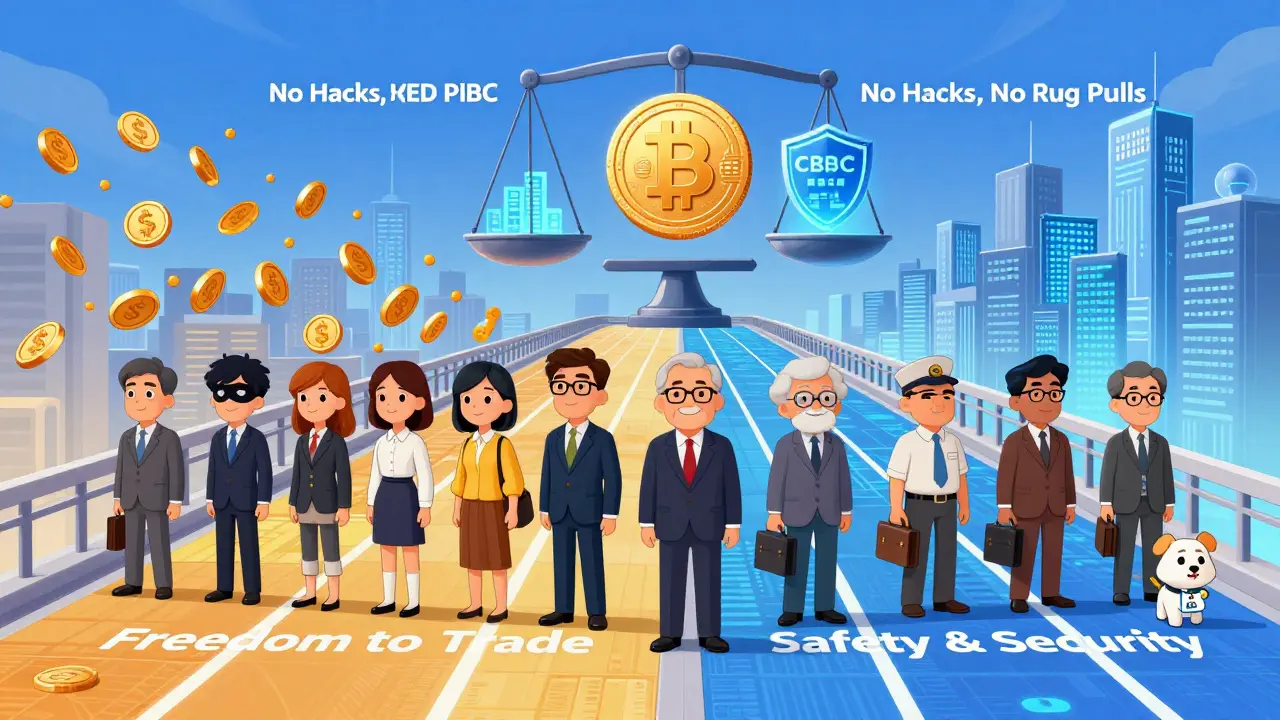
What’s Next? Stablecoins, CBDCs, and More Rules
Regulators aren’t slowing down. In September 2024, the FSC announced new rules for stablecoins. USDT and USDC must now prove they’re fully backed by cash or equivalents-and submit monthly audits. No more “we’re 95% backed” excuses. This is a direct response to the Terra collapse and other stablecoin failures.
And in early 2025, South Korea will launch its own Central Bank Digital Currency (CBDC) pilot. It’s not meant to replace crypto-but to give the government a digital tool for payments, subsidies, and tax collection. Some analysts think this could reduce demand for private cryptocurrencies over time.
One thing’s clear: Korea’s crypto market is not going to become more open. It’s going to become more controlled. More transparent. More secure. But also more restricted.
How to Trade Legally in Korea in 2026
If you’re a resident and want to trade crypto legally:
- Get a Korean bank account in your name.
- Download one of the four licensed apps: Upbit, Bithumb, Coinone, or Korbit.
- Complete Level 3 verification: upload ID, link bank account, do video call.
- Deposit KRW via bank transfer only.
- Trade only listed coins (200-300 options).
- Track your profits. If you make over 2.5 million KRW in a year, prepare to pay 20% tax.
Don’t try to use foreign exchanges. Your bank will block transfers. Your funds could disappear. And you’ll have no legal recourse.
Is It Worth It?
For most Korean traders, yes. The system gives you safety you won’t find anywhere else. You don’t have to worry about your exchange vanishing overnight. You don’t have to guess if your coins are real. You don’t have to fear a hack wiping out your life savings.
But if you want access to every new coin, low fees, or international trading pairs-you’re out of luck. Korea isn’t for the crypto maximalist. It’s for the cautious investor who values security over freedom.
The market is growing anyway. Over 4.6 million people traded crypto in 2024. That number will hit 6.2 million by year-end. People are still buying. Still trading. Still making money. But they’re doing it on Korea’s terms.
Can foreigners trade crypto in South Korea?
Only if they have a Korean bank account and a valid Korean ID. Without a local bank account linked to your real name, you cannot legally trade on any Korean exchange. Foreigners living in Korea on long-term visas may qualify if they open a bank account under their legal name. Tourists and short-term visitors cannot trade legally.
Are Bitcoin and Ethereum available on Korean exchanges?
Yes. Bitcoin and Ethereum are the most heavily traded pairs on all four licensed exchanges. The Korean Won (KRW) is the third most-traded fiat currency for Bitcoin globally, after USD and EUR. You can buy, sell, and hold BTC and ETH just like on any other exchange-but only through Upbit, Bithumb, Coinone, or Korbit.
Can I use a VPN to access foreign exchanges from Korea?
Technically yes, but it’s risky and against bank policies. Korean banks actively block transfers to foreign crypto exchanges. Even if you use a VPN, your bank may freeze your account for suspicious activity. You also lose legal protection-if something goes wrong, you have no recourse under Korean law. Most experienced traders avoid this entirely.
Why can’t I buy crypto with a credit card in Korea?
Credit card purchases are banned to prevent fraud, money laundering, and speculative debt. The government wants all crypto transactions to flow through verified bank accounts, where funds can be traced and monitored. This reduces impulsive buying and ensures only people with verified income can trade. Bank transfers are slower but safer and more accountable.
What happens if I don’t pay crypto taxes in Korea?
The National Tax Service has direct access to exchange profit reports starting in 2025. If you earn over 2.5 million KRW in profits and don’t report, you’ll face penalties of up to 40% of the unpaid tax, plus interest. In severe cases, the FSC can freeze your bank accounts. Many traders now use accounting software or hire tax specialists to stay compliant.
Is crypto trading banned in South Korea?
No, it’s not banned. It’s heavily regulated. Trading is legal only through licensed exchanges that follow strict rules on identity, security, and taxation. The government encourages responsible participation but shuts down anything that doesn’t comply. This makes Korea one of the safest places in the world to trade crypto-just not the most flexible.
Kip Metcalf
January 10, 2026 AT 21:19Natalie Kershaw
January 12, 2026 AT 10:51Jon Martín
January 13, 2026 AT 14:45Mujibur Rahman
January 13, 2026 AT 22:32Danyelle Ostrye
January 15, 2026 AT 19:56Jennah Grant
January 17, 2026 AT 02:27Dennis Mbuthia
January 17, 2026 AT 22:19Dave Lite
January 19, 2026 AT 20:22Tracey Grammer-Porter
January 20, 2026 AT 23:30sathish kumar
January 22, 2026 AT 00:15jim carry
January 23, 2026 AT 22:12Denise Paiva
January 25, 2026 AT 20:40Meenakshi Singh
January 26, 2026 AT 10:43Krista Hoefle
January 26, 2026 AT 11:42Jessie X
January 26, 2026 AT 20:05Frank Heili
January 27, 2026 AT 20:37Jacob Clark
January 28, 2026 AT 23:58Becky Chenier
January 30, 2026 AT 11:28Staci Armezzani
January 31, 2026 AT 21:30Don Grissett
February 2, 2026 AT 04:14Katrina Recto
February 3, 2026 AT 05:17