

Imagine you own a house in one city, but you want to use it as collateral for a loan in another city where the banks don't recognize your deed. You can’t just move the house. That is exactly the problem Wrapped Bitcoin (WBTC) solves. It acts as a digital bridge, allowing you to take your Bitcoin and use it on the Ethereum network without selling it. This unlocks a world of decentralized finance opportunities that native Bitcoin simply cannot offer.
Bitcoin is secure and stores value well, but it isn’t very flexible. You can’t easily lend it out or trade it against other assets on complex platforms. Ethereum, on the other hand, is built for smart contracts and financial apps. WBTC connects these two worlds. By wrapping your Bitcoin into an ERC-20 token, you get a version of Bitcoin that behaves like any other asset on Ethereum. You keep ownership of the underlying BTC, but you gain access to Ethereum’s ecosystem.
The Core Mechanism: How Wrapping Actually Happens
To understand how WBTC works, you need to look at the three main players involved: the user, the merchant, and the custodian. This isn’t a fully automated, trustless process like some other crypto transactions. It relies on a specific infrastructure designed to keep things secure.
Here is the step-by-step flow when you decide to wrap your Bitcoin:
- You choose a Merchant: You go to an approved platform (like Dharma or AirSwap). These merchants act as the interface between you and the system. They handle your identity verification.
- KYC Verification: Because real Bitcoin is being held by someone else, regulations require proof of identity. You complete Know Your Customer (KYC) checks. This usually takes about 15 minutes.
- Deposit Bitcoin: You send your actual Bitcoin to a wallet controlled by the custodian, which is currently BitGo.
- Minting WBTC: Once BitGo confirms they have received your BTC, they signal the Ethereum smart contract to mint new WBTC tokens. These tokens are sent directly to your Ethereum wallet address.
The ratio is strictly 1:1. If you deposit 1 BTC, you receive 1 WBTC. The total supply of WBTC changes dynamically based on how much Bitcoin is locked in reserve. As of early 2024, there were over 167,000 WBTC tokens in circulation, backed by an equivalent amount of Bitcoin held in cold storage.
The Role of Custody and Security
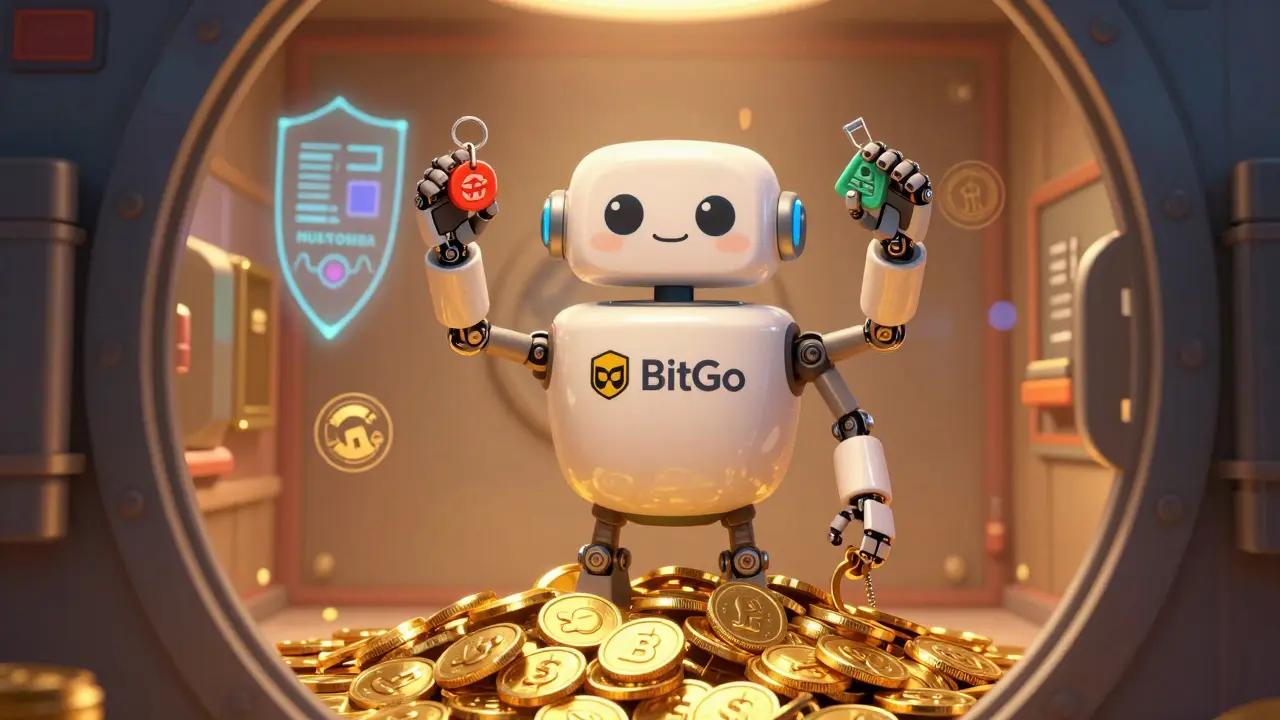
This is the part that often raises eyebrows among crypto purists. Who holds your Bitcoin? The answer is BitGo. BitGo serves as the sole custodian for the WBTC system. They hold the private keys to the wallets where your wrapped Bitcoin lives.
Does this mean BitGo can steal your money? Not really. The system uses multi-signature technology. Specifically, it requires a 3-of-5 signature scheme. This means five different entities must agree to move funds, and at least three of them must sign off. These entities include BitGo itself, plus representatives from the WBTC DAO and other consortium members. No single party can unilaterally drain the reserves.
Additionally, the system undergoes regular Proof of Reserves audits. These are public reports that verify the amount of Bitcoin held matches the amount of WBTC issued. You can check these audits on-chain. While no system is immune to risk-BitGo has faced temporary API outages in the past-the multi-sig structure adds a significant layer of protection compared to holding funds in a standard exchange wallet.
Why Use WBTC Instead of Native Bitcoin?
If you already own Bitcoin, why bother converting it to WBTC? The primary reason is utility. Native Bitcoin sits in a vault; it doesn’t generate yield or interact with other protocols. WBTC, however, is an ERC-20 token, which makes it compatible with thousands of applications on Ethereum.
- Lending and Borrowing: You can deposit WBTC into protocols like Aave or Compound to earn interest. In Q1 2024, WBTC users were earning around 4.2% APY, whereas holding native Bitcoin yields 0%.
- Liquidity Provision: You can pair WBTC with ETH or stablecoins on decentralized exchanges like Uniswap to earn trading fees. This helps maintain market liquidity while you profit from volatility.
- Collateral: Need cash but don’t want to sell your Bitcoin? You can use WBTC as collateral to borrow stablecoins like USDC or DAI instantly.
Essentially, WBTC turns your static store of value into a productive asset. It bridges the gap between Bitcoin’s security and Ethereum’s programmability.
Unwrapping: Getting Your Bitcoin Back
When you’re done using WBTC in DeFi, you can reverse the process. This is called "unwrapping." Here is how it works:
- Burn WBTC: You send your WBTC tokens back to the merchant or protocol initiating the unwrap request. The smart contract destroys (burns) these tokens, removing them from circulation.
- Release BTC: Once the burn is confirmed on the Ethereum blockchain, BitGo releases the corresponding amount of native Bitcoin from their cold storage.
- Receive Funds: The Bitcoin is sent to your designated Bitcoin wallet address. This typically takes 30 to 60 minutes to complete.
There is no fee for the unwrapping itself, though you will pay standard Bitcoin network transaction fees for the final transfer to your wallet. The key takeaway is that you always get your original Bitcoin back, not a copy or a derivative.
WBTC vs. Other Wrapped Bitcoin Solutions
WBTC isn’t the only way to bring Bitcoin to Ethereum. There are alternatives like renBTC, tBTC, and sBTC. So why does WBTC dominate with over 67% market share?
| Feature | WBTC | renBTC | tBTC |
|---|---|---|---|
| Custody Model | Centralized (BitGo) | Decentralized (RenVM) | Decentralized (Threshold Network) |
| Market Share | ~67% | ~14% | ~5% |
| Total Value Locked | $1.2 Billion+ | Lower | $93 Million |
| Speed | Fast (15-30 mins) | Variable | Slow (6-12 hours) |
| Primary Risk | Custodial Counterparty | Smart Contract Exploits | Liquidity & Complexity |
WBTC wins on liquidity and integration. Most major DeFi protocols support WBTC first because it has been around since 2019 and has a proven track record. renBTC offers more decentralization but suffered a $1.4 million exploit in 2022, highlighting the risks of complex decentralized code. tBTC is highly secure and decentralized but suffers from low liquidity and slow minting times. For most users, WBTC strikes the best balance between ease of use, speed, and widespread acceptance.

Risks and Considerations
No financial tool is risk-free. When using WBTC, you are accepting certain trade-offs for convenience.
Custodial Risk: Even with multi-sig protections, relying on BitGo introduces a central point of failure. If BitGo were to be hacked, go bankrupt, or face regulatory seizure, your WBTC could be at risk. While unlikely due to the consortium structure, it is non-zero.
Regulatory Uncertainty: In February 2024, the SEC classified WBTC as a "security-adjacent instrument" due to its custodial nature. This could lead to stricter compliance requirements or restrictions in certain jurisdictions. Always check local laws before engaging.
Gas Fees: Since WBTC operates on Ethereum, you pay Ethereum gas fees for every interaction. During periods of high network congestion, these fees can spike, making small transactions uneconomical. However, with the expansion to Layer 2 solutions like Polygon and Arbitrum, costs are decreasing.
The Future of WBTC
The WBTC ecosystem is evolving. In March 2024, the WBTC DAO approved expansion to EVM-compatible chains like Polygon, Arbitrum, and Optimism. This allows users to benefit from lower fees and faster transactions while still holding WBTC. Furthermore, future upgrades aim to reduce reliance on BitGo through Multi-Party Computation (MPC) technology, moving closer to a fully decentralized model.
For now, WBTC remains the gold standard for bridging Bitcoin into DeFi. It offers a practical solution for those who want to keep their Bitcoin exposure while participating in the broader crypto economy. Just remember to do your own research, verify merchants, and understand the custodial risks before diving in.
Is WBTC safe to use?
WBTC is considered relatively safe due to its multi-signature custody model managed by BitGo and regular Proof of Reserves audits. However, it carries custodial risk because a third party holds your underlying Bitcoin. It is safer than many decentralized alternatives that have suffered exploits, but less secure than holding native Bitcoin in your own hardware wallet.
What happens if I lose my WBTC private key?
If you lose access to your Ethereum wallet containing WBTC, you cannot recover the tokens yourself. Unlike traditional banking, there is no customer service to reset your password. You would need to recover your seed phrase or private key. If that is impossible, the WBTC is lost forever, even though the underlying Bitcoin is still held in reserve.
Can I convert WBTC back to Bitcoin instantly?
Not instantly. The unwrapping process involves burning the WBTC on Ethereum and then releasing Bitcoin from BitGo’s cold storage. This typically takes 30 to 60 minutes. Additionally, the Bitcoin transfer itself requires blockchain confirmations, which can add another 10-60 minutes depending on network congestion.
Do I pay taxes when wrapping Bitcoin?
In many jurisdictions, including the US, swapping Bitcoin for WBTC is considered a taxable event because you are disposing of one cryptocurrency to acquire another. You may owe capital gains tax on any appreciation of the Bitcoin since you bought it. Always consult a tax professional for advice specific to your situation.
Who controls the WBTC protocol?
The WBTC protocol is governed by a Decentralized Autonomous Organization (DAO). The DAO manages system parameters, approves new merchants, and oversees upgrades. BitGo acts as the custodian, but they cannot act alone; major decisions require consensus from the consortium members represented in the DAO.