
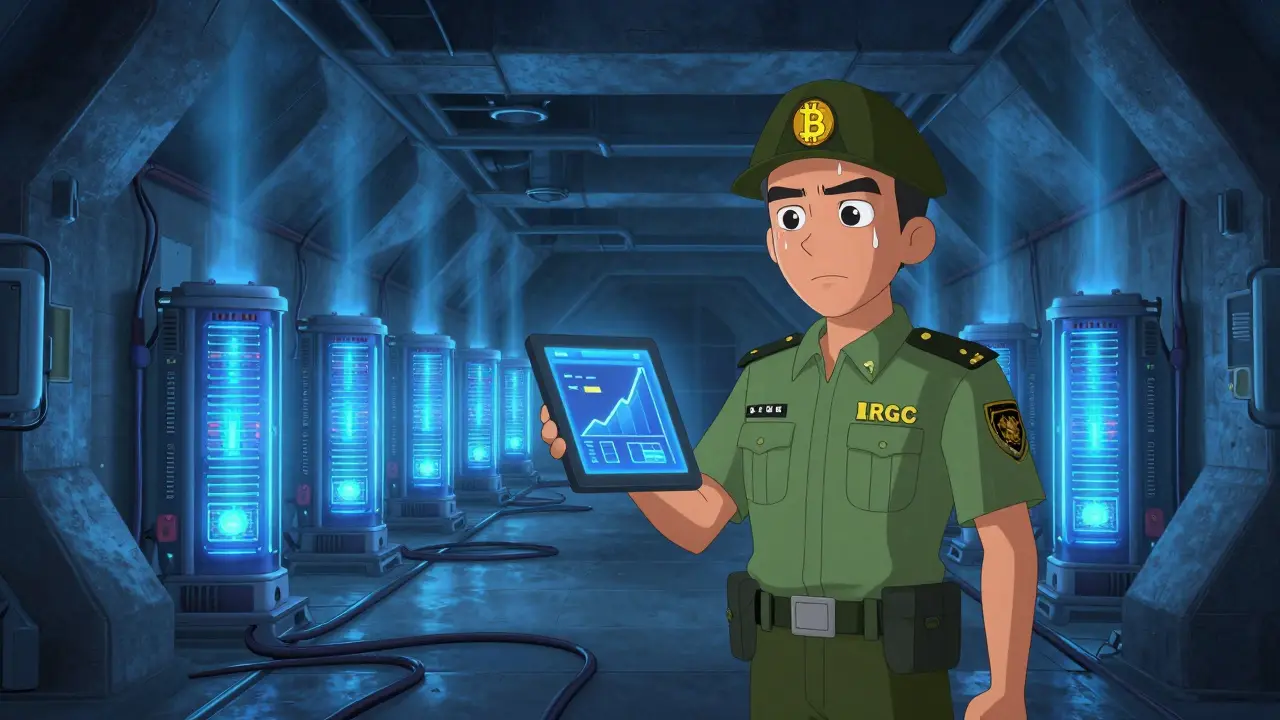
You might think that international sanctions isolate a country from the global financial system. In Iran, they have done the opposite. They have forced the creation of a massive, shadow economy built on electricity and code. Since 2018, the Iranian government has not just tolerated cryptocurrency mining; it has weaponized it. The result is a unique hybrid model where state security forces run industrial-scale Bitcoin farms to generate hard currency, often at the direct expense of civilian power grids.
This isn't about small-time hobbyists in their basements. We are talking about megawatts of computing power hidden in military bases and sports stadiums. By June 2026, this system has evolved into a complex web of subsidies, surveillance, and survival strategies. Here is how state-controlled crypto mining works in Iran, who really profits from it, and why it keeps breaking the national grid.
The Rise of the "Crypto Cartel"
To understand today's landscape, you have to look back at 2018. Under President Hassan Rouhani, Iran officially legalized cryptocurrency mining. The stated goal was regulation. The real goal was evasion. With access to SWIFT and international banking cut off, Tehran needed a way to earn foreign currency without touching traditional banks. Bitcoin became that vehicle.
But the private sector didn't lead this charge. The Islamic Revolutionary Guard Corps (IRGC) is a powerful military and political organization in Iran that controls significant portions of the national economy stepped in. Along with entities linked to Supreme Leader Ali Khamenei, these groups formed what investigators call a "crypto cartel." They partnered with Chinese technology firms to build massive mining operations. These aren't transparent businesses. They operate in special economic zones or on military bases, shielded from public scrutiny and legal oversight.
The advantage for these state actors is simple: energy. In most countries, electricity costs make up 30-50% of a miner's expenses. In Iran, subsidized rates drop that cost to near zero. Some reports cite tariffs as low as 0.004 cents per kWh for certain state-linked operations. That is roughly 1/50th of the global commercial average. This subsidy creates enormous profit margins, allowing the IRGC to mine Bitcoin efficiently even when global hash rates rise and competition intensifies elsewhere.
Hidden Infrastructure: From Stadiums to Tunnels
If you walk past the Shahid Ghorbani Sports Complex in Ahvaz, you see a cycling track and athletic facilities. You don't see the tunnels beneath it. For over two years, a large-scale Bitcoin mining operation ran undetected in the service rooms and underground passages of this stadium. It was only discovered after local residents complained about persistent power outages.
This concealment is a hallmark of Iran's state-controlled mining. Unlike China, which banned mining in 2021, or Kazakhstan, which opened its borders to miners fleeing China, Iran hides its infrastructure. Why? Because the public hates it. When the heat hits 45°C (113°F) in summer, factories shut down, hospitals struggle, and homes go dark. Meanwhile, the ASIC miners-specialized computers designed solely for cryptographic hashing-keep running.
By early 2023, Iran's total mining capacity was estimated to exceed 1,000 megawatts. At its peak in 2022, Iran accounted for roughly 4.5% of the global Bitcoin hash rate, making it the third-largest mining nation. But this output comes from a fragile grid. The Ministry of Energy frequently cuts power to residential areas during peak demand. Yet, investigations show that IRGC-affiliated mines often continue operating uninterrupted, protected by their political connections.
| Feature | State-Controlled Iran | Private Sector (Global Avg.) |
|---|---|---|
| Electricity Cost | ~$0.00004/kWh (Subsidized) | $0.05 - $0.10/kWh |
| Regulatory Oversight | Minimal for state actors | Strict environmental/tax laws |
| Primary Goal | Sanctions evasion & hard currency | Profit maximization |
| Grid Impact | Causes blackouts & rationing | Often uses renewable/excess energy |

The Regulatory Tightrope: Licenses and Taxes
While the IRGC operates in the shadows, the rest of the industry faces a moving target. Technically, mining is still legal if you follow the rules. As of 2025, the Ministry of Industry, Mine and Trade requires licenses. The process takes 6-8 weeks and mandates the use of government-approved hardware. There is a catch: these approved devices are often older models, reducing efficiency by 15-20% compared to the latest international ASICs.
Then there is the tax man. In August 2025, Iran enacted the "Law on Taxation of Speculation and Profiteering." This law treated cryptocurrency like gold or real estate, imposing capital gains taxes on trading profits. Before this, the sector was largely untaxed. The Central Bank of Iran (CBI) had long complained that billions of dollars in transactions were flowing through exchanges like Nobitex without contributing to the treasury.
But enforcement is selective. Private miners face strict audits, API surveillance, and sudden power cuts. State-linked operators? They rarely pay the full tariff or report their earnings. This double standard fuels public anger. On social media, hashtags like #IranEnergyCrisis trended in May 2024, with citizens posting videos of empty streets during blackouts while knowing nearby mines were humming along.
Sanctions Evasion and the Stablecoin Shift
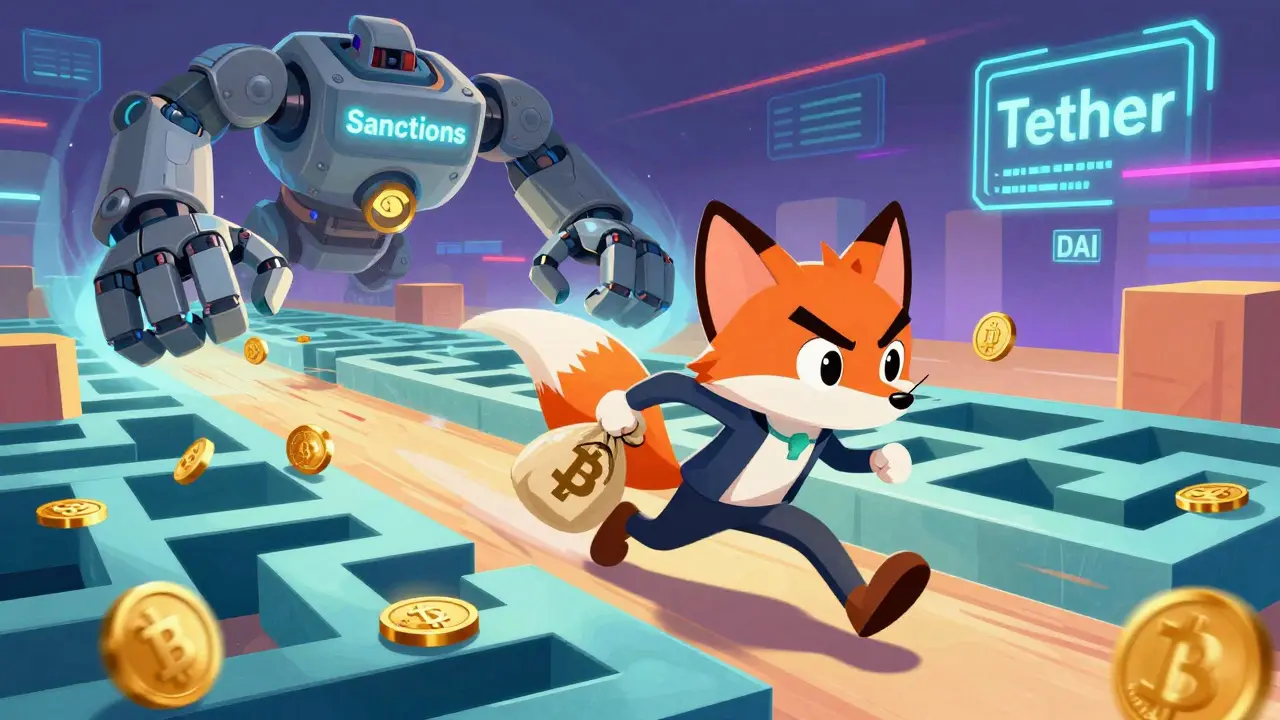
Why does Iran care so much about Bitcoin? It’s not just speculation. It’s survival. The mined Bitcoin is converted into stablecoins, primarily USDT (Tether), which act as a digital dollar. This allows Iranian entities to bypass US sanctions and pay for imports or move money abroad without using traditional banks.
However, the walls are closing in. On July 2, 2025, Tether executed its largest-ever freeze of Iranian-linked funds. They blocked 42 addresses connected to Nobitex and IRGC wallets. This wasn't a minor glitch; it disrupted established transaction patterns overnight. TRM Labs, a blockchain intelligence firm, noted that this forced rapid adaptation. Within weeks, the government urged users to switch from USDT to DAI, a decentralized stablecoin running on the Polygon network, to avoid future freezes.
This shift highlights the fragility of the system. Iran relies on centralized issuers like Tether for liquidity, but those issuers comply with US sanctions. So, Tehran pushes toward decentralized alternatives, even though they are less liquid and harder to use for large-scale trade. It’s a constant game of cat and mouse between Iranian regulators and Western financial intelligence agencies.
The Human Cost: Blackouts and Public Outrage
Behind the geopolitical strategy lies a daily struggle for ordinary Iranians. The energy crisis is not abstract. In June 2024, Reddit discussions in the r/Iran community featured hundreds of comments detailing factory shutdowns and spoiled food due to power rationing. One user reported a 14-hour blackout in Tehran’s District 3 during a heatwave. Hospitals switched to generators, straining already limited fuel supplies.
The irony is stark. The government claims to be protecting national sovereignty through crypto mining. But the people experience it as theft of basic services. The IRGC’s mining operations are described by critics as "plundering national electricity for profit." When the Central Bank ordered the closure of rial payment gateways for crypto exchanges in December 2024, it was partly an attempt to curb capital flight. But it also reflected internal panic: the state couldn't control the flow of money anymore.
In January 2025, the CBI partially reversed this ban, but only with a twist. Exchanges had to integrate government APIs that provided "full user data." This turned legal crypto trading into a surveillance tool. Every transaction was monitored. Privacy died, but access returned-for now.
Future Outlook: A Fragile Balance
As we move through 2026, the model shows signs of strain. International pressure is mounting. Tether’s freezes are becoming more frequent. Domestic unrest over energy shortages grows louder. And yet, the state cannot quit. Crypto mining remains one of the few reliable sources of hard currency outside oil exports, which are themselves heavily sanctioned.
Experts predict further consolidation. The IRGC will likely absorb more private operators, offering them protection in exchange for a share of profits. Regulations will tighten, focusing on taxation and surveillance rather than banning mining outright. We may see more moves toward decentralized stablecoins and privacy-focused cryptocurrencies to evade tracking.
For the average Iranian citizen, the outlook is bleak. Unless the government reforms its energy subsidies or finds alternative revenue streams, the grid will remain unstable. The crypto boom won’t fix the power plants. It just drains them faster.
Is cryptocurrency mining legal in Iran?
Yes, but with strict conditions. Legal mining requires a license from the Ministry of Industry, Mine and Trade, adherence to specific electricity tariffs, and use of government-approved hardware. However, enforcement is inconsistent, and state-affiliated entities often operate outside these rules.
Who controls the major crypto mining operations in Iran?
The Islamic Revolutionary Guard Corps (IRGC) and organizations linked to Supreme Leader Ali Khamenei dominate the sector. They operate large-scale farms in military zones and special economic areas, benefiting from subsidized energy and political protection.
How does crypto mining affect Iran's power grid?
Mining consumes vast amounts of electricity, contributing to frequent blackouts and power rationing for civilians and industries. During peak summer months, residential areas often lose power while state-linked mines continue operating, causing public outrage.
What happened with the Tether freeze in July 2025?
Tether froze 42 Iranian-linked addresses, including those connected to the largest domestic exchange, Nobitex, and IRGC-affiliated wallets. This was the largest such action against Iran, forcing users to shift to decentralized stablecoins like DAI to maintain access to funds.
Does Iran tax cryptocurrency profits?
Yes. As of August 2025, the "Law on Taxation of Speculation and Profiteering" imposes capital gains taxes on crypto trading, treating digital assets similarly to gold, real estate, and forex. This aims to capture revenue from the previously untaxed sector.
Why did Iran start promoting crypto mining?
Initially, it was a strategy to circumvent U.S. sanctions. By mining Bitcoin and converting it to stablecoins, Iran could generate hard currency and facilitate international transactions without relying on the restricted traditional banking system.