

Every year, more than 46,000 people in the U.S. lose money to crypto phishing scams. In 2023, the average loss jumped to $550 per person - and that’s just what got reported. These aren’t random mistakes. They’re targeted attacks that trick people into giving away their private keys, login details, or sending crypto to fake wallets. The scary part? Most of these attacks could have been stopped with simple education.
What Exactly Is Crypto Phishing?
Crypto phishing isn’t just spam emails. It’s a full-on deception campaign designed to exploit trust. Scammers create fake websites that look exactly like Coinbase, MetaMask, or Binance. They send texts claiming your wallet is locked and you need to click a link to unlock it. They pose as tech support on Twitter or Discord, asking for your recovery phrase to "fix" your account. Some even create fake job offers that require you to buy crypto as part of your onboarding. These aren’t old-school scams. Modern crypto phishing uses multiple channels at once - email spoofing, social media impersonation, and SMS phishing (smishing). Chainalysis found that 68% of attacks in 2023 combined at least two of these methods. The goal? Get you to act fast before you think. And it works. Because most people don’t know what to look for.Why Education Is the First Line of Defense
Security software can block some phishing sites. Multi-factor authentication (MFA) can stop account takeovers. But none of it matters if you’re the one clicking the link. Cloudflare’s research shows that 78% of successful crypto phishing attacks could have been prevented if the victim had known how to check a URL or spot a fake email. That’s not a coincidence. It’s a pattern. People who understand how phishing works are far less likely to fall for it. The FTC says the biggest red flags are:- Someone asking you to pay upfront in crypto for a job
- A message that says your wallet is frozen and you need to act now
- An offer that promises guaranteed returns or free crypto
- A request for your 12-word recovery phrase
The Five Key Things You Need to Learn
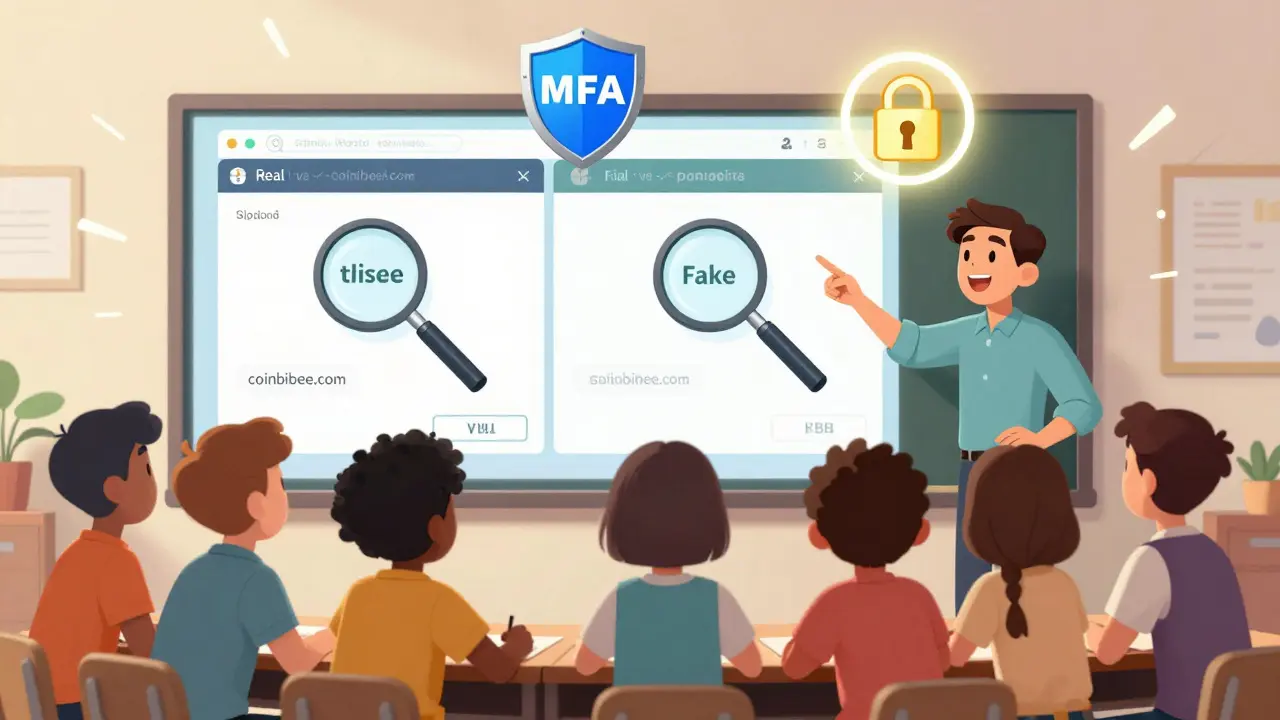
You don’t need a cybersecurity degree to protect yourself. Here’s what actually works:- Check the URL before you click - Fake websites often use slight misspellings: coinbasee.com, metamask-wallet.com, or binance-security.net. Real sites never use extra letters or odd domains.
- Never share your recovery phrase - No legitimate service will ever ask for it. Not even your wallet provider. Not even your "tech support." If they do, it’s a scam.
- Enable MFA on everything - Use an authenticator app like Authy or Google Authenticator, not SMS. SMS can be intercepted. MFA with a code from an app blocks 99.9% of automated attacks, according to Microsoft.
- Watch for poor grammar and urgency - Scammers write fast. They use all caps, exclamation points, and phrases like "ACT NOW!" or "YOUR ACCOUNT WILL BE CLOSED." Legit companies don’t talk like that.
- Verify communication channels - If someone DMs you on Twitter saying they’re from Coinbase, check their profile. Do they have a verified checkmark? Is their account new? Has anyone else reported them? Fake accounts often have no posts or just copied images.
How Organizations Are Fighting Back
It’s not just individuals. Companies are waking up. Fidelity’s "Stop Cryptocurrency Scams" campaign lists eight common scams and shows real screenshots of fake websites. Digital Defenders Group offers free webinars that have reached over 127,000 people since 2022. Users who complete their training report a 78% improvement in spotting scams. Even bigger players are changing their approach. Coinbase started using AI-powered phishing simulations in 2023. Employees are randomly sent fake phishing emails - not to punish them, but to train them. After six months, their detection rate jumped 71%. That’s not luck. That’s education in action. Fortune 500 companies are now required to include crypto phishing training in their annual cybersecurity programs. According to Guardian Digital’s 2023 survey, 65% of large enterprises have added crypto-specific modules. Why? Because the cost of a breach is too high. IBM’s 2023 report found that organizations with trained staff saw a 5:1 return on their education investment.What’s Changing in 2026
The threat isn’t slowing down. In fact, it’s getting smarter. The FTC updated its phishing guide in January 2024 with new examples based on 2023 data. California’s DFPI launched its "Crypto: Handle with Caution" campaign in 2022 - and it’s reached over 2.3 million people. Now, the Department of Homeland Security’s CISA is rolling out a nationwide crypto security awareness initiative in October 2024. Universities are catching up too. The Blockchain Education Network plans to launch a standardized crypto security curriculum in Q3 2024. This isn’t about coding. It’s about survival. Students will learn how to spot phishing before they ever touch a wallet. Gartner predicts that by 2026, 80% of companies with crypto holdings will make phishing education mandatory. That’s up from just 35% in 2023. The reason? People who know what to look for don’t get scammed. And businesses that train their teams save money, reputation, and trust.
What You Can Do Today
You don’t need to wait for your company to act. Start now:- Go to ftc.gov and read their guide on crypto scams. It’s free and updated monthly.
- Turn on MFA on your crypto exchange and wallet accounts - use an app, not SMS.
- Bookmark your wallet’s real website. Never search for it - type it manually.
- Ask yourself before clicking: "Would a real company ask me to do this?" If the answer feels off, it probably is.
- Share what you learn. Tell your family, your friends, your crypto group. One person learning can protect ten.
Why Tech Alone Won’t Save You
Some experts argue that relying on user education creates a false sense of security. They say advanced phishing tools now bypass human detection entirely. And yes, some attacks are designed to fool even experts. But here’s the truth: no tool is perfect. Firewalls fail. Antivirus misses zero-days. MFA can be bypassed if you give away your password. The only constant defense is awareness. Education doesn’t make you invincible. But it makes you harder to trick. And in crypto, that’s everything.Final Thought: You’re the Last Line of Defense
No blockchain protocol can protect you from yourself. No wallet app can stop you from typing your seed phrase into a fake site. No AI filter can replace your judgment when you’re under pressure. The next time you get a message saying your crypto is at risk - pause. Check the URL. Ask yourself why they’re asking. Look for the red flags. Then, if it still feels wrong - delete it. Block it. Report it. Because in crypto, knowledge isn’t power. It’s protection.What is crypto phishing?
Crypto phishing is when scammers trick people into giving away private keys, login details, or crypto funds by pretending to be a trusted service like Coinbase, MetaMask, or a tech support team. They use fake websites, spoofed emails, fake social media accounts, and urgent messages to create panic and get you to act without thinking.
Can antivirus software stop crypto phishing?
Antivirus software can block some malicious files or known phishing sites, but it won’t catch everything. Many crypto phishing sites use legitimate domains or new URLs that haven’t been flagged yet. The most effective protection is learning how to recognize scams yourself - not just relying on software.
Should I ever share my recovery phrase?
Never. Not under any circumstances. Your recovery phrase gives full access to your wallet. No legitimate company, support agent, or government agency will ever ask for it. If someone does, it’s a scam. Treat it like your house key - if you give it away, anyone can walk in.
What’s the difference between MFA and two-factor authentication?
They’re the same thing. MFA stands for multi-factor authentication, and two-factor authentication (2FA) is a type of MFA that uses two methods - like a password and a code from an app. For crypto, always use an authenticator app (like Authy or Google Authenticator), not SMS. SMS codes can be hijacked through SIM swapping.
How do I know if a website is real?
Always type the URL directly into your browser. Don’t click links from emails, texts, or social media. Check the domain carefully - real sites use exact names like coinbase.com or metamask.io. Fake ones add extra letters, use different domains (.net, .org instead of .com), or misspell words. Look for the padlock icon and HTTPS, but remember - even fake sites can have HTTPS.
Are crypto scams getting worse?
Yes. In 2023, over 46,000 people in the U.S. reported crypto fraud - a 37% increase from 2022. The average loss rose from $400 to $550. Attacks are now using multiple channels at once: email, social media, and SMS. Scammers are also using AI to generate more convincing messages and fake websites. Education is the only defense that’s keeping pace.
Can I get my money back if I get phished?
Almost never. Cryptocurrency transactions are irreversible. Once you send crypto to a scammer’s wallet, it’s gone. There’s no FDIC insurance, no chargeback option, and no customer service team that can reverse it. That’s why prevention is the only real solution.
What should I do if I think I’ve been phished?
Stop all activity immediately. Don’t log in again. Don’t click any more links. If you gave away your recovery phrase, move your funds to a new wallet right away - but only if you haven’t already sent anything. Report the scam to the FTC at reportfraud.ftc.gov and to the platform you were impersonated on (e.g., Twitter, Discord). Share what happened to warn others.
Callan Burdett
January 19, 2026 AT 08:32Bro this is the most practical thing I’ve read all year. I showed my grandma this and she just blocked three fake Coinbase DMs today. No joke. She’s 72 and now she checks URLs like a hacker. Education isn’t fancy tech-it’s just teaching people to pause. And that’s powerful.
Andre Suico
January 20, 2026 AT 02:58The data presented here is compelling and aligns with multiple peer-reviewed studies on behavioral security vulnerabilities. The 78% prevention rate attributed to basic URL literacy is consistent with findings from the Journal of Cybersecurity Education (2023). However, one must acknowledge that education alone cannot counter social engineering attacks that exploit cognitive biases like authority bias or urgency bias. A layered defense remains essential.
Stephen Gaskell
January 22, 2026 AT 02:49Stop wasting time with education. Just ban crypto. Problem solved.
Hannah Campbell
January 23, 2026 AT 14:21Oh wow another ‘education will save us’ essay. Let me guess next you’ll say wearing a helmet stops all car crashes? People are dumb. No amount of bullet points fixes that. Just let the market eat the fools and move on.
Anthony Ventresque
January 25, 2026 AT 07:22What’s wild is how many people still think MFA via SMS is safe. I’ve seen so many Reddit threads where folks say ‘I have 2FA’ and mean SMS. That’s like locking your door but leaving the key under the mat. The real win here is pushing authenticator apps hard. Maybe even make it mandatory on exchanges.
Christina Shrader
January 25, 2026 AT 16:32I work in community outreach and we’ve started running ‘Phishing Scam Simulations’ at senior centers. One woman told me she almost sent $3,000 because a ‘Coinbase rep’ texted her about a ‘security update.’ After the workshop, she now forwards every weird message to her grandson. That’s the ripple effect. We’re not just teaching-we’re building networks of vigilance.
Pramod Sharma
January 25, 2026 AT 22:11Knowledge is protection but protection without wisdom is just information. The real enemy isn’t the scammer-it’s the belief that you’re immune. The moment you think ‘I’m too smart for this’ is the moment you become the target.
Josh V
January 26, 2026 AT 05:35Check the URL. Never share your seed. Use an app not SMS. These are the three rules. If you follow them you’re already ahead of 90% of people. Stop overcomplicating it.
Michael Jones
January 27, 2026 AT 03:29One thing missing from this discussion: the role of language. Many phishing messages are written in near-perfect English but contain subtle grammatical errors or unnatural phrasing. Non-native speakers are often more likely to spot these because they’re already hyper-aware of linguistic cues. Maybe we should integrate linguistic analysis into training modules-not just technical checks.
myrna stovel
January 27, 2026 AT 12:30I teach this to my book club every month. We take one scam example, break it down, and role-play how to respond. Last week we had a guy who got hit with a fake job offer asking for ETH as a ‘training fee.’ He didn’t send it-he showed us instead. That’s the kind of culture we need: not fear, but shared awareness.
Ashlea Zirk
January 28, 2026 AT 23:08While the educational framework presented is comprehensive, it is imperative to recognize that the psychological architecture of phishing exploits the limbic system’s response to threat and reward. Cognitive behavioral interventions, when paired with procedural training, have demonstrated a 42% increase in long-term retention of security protocols in controlled studies (Journal of Applied Behavioral Science, 2024). Merely listing rules is insufficient without reinforcing neural pathways through repetition and emotional anchoring.
Chidimma Okafor
January 30, 2026 AT 12:39In Nigeria, we call this ‘419’-but now it’s got NFTs and blockchain jargon. The tactics haven’t changed, just the packaging. What’s brilliant here is how the post ties education to cultural context. We need this in schools here-not just as tech training, but as life literacy. One young man told me he saved his mother from a fake ‘Nigerian IRS crypto audit’ because he remembered the ‘never share your phrase’ rule. That’s impact.
Nishakar Rath
January 31, 2026 AT 06:46Education my ass everyone knows this shit its just greed and laziness that makes people get scammed you think reading a list makes you smart its just another way to feel good about being dumb
Chris O'Carroll
January 31, 2026 AT 08:16They say education is the answer but then they give you a 10-point checklist like it’s a IKEA manual. Meanwhile, the scammers are using AI to generate voice calls that sound like your cousin. No one’s talking about deepfakes. This feels like bringing a spoon to a gunfight.
Dustin Secrest
January 31, 2026 AT 10:37There’s a quiet irony here: the very tools meant to protect us-blockchain, decentralization, transparency-are the same ones that make these scams possible. We built a system where trust is replaced by code… but then we still trust the humans writing the code. Maybe the real lesson isn’t how to spot a fake site-but how to accept that no system is foolproof, and humility is the only true security protocol.