
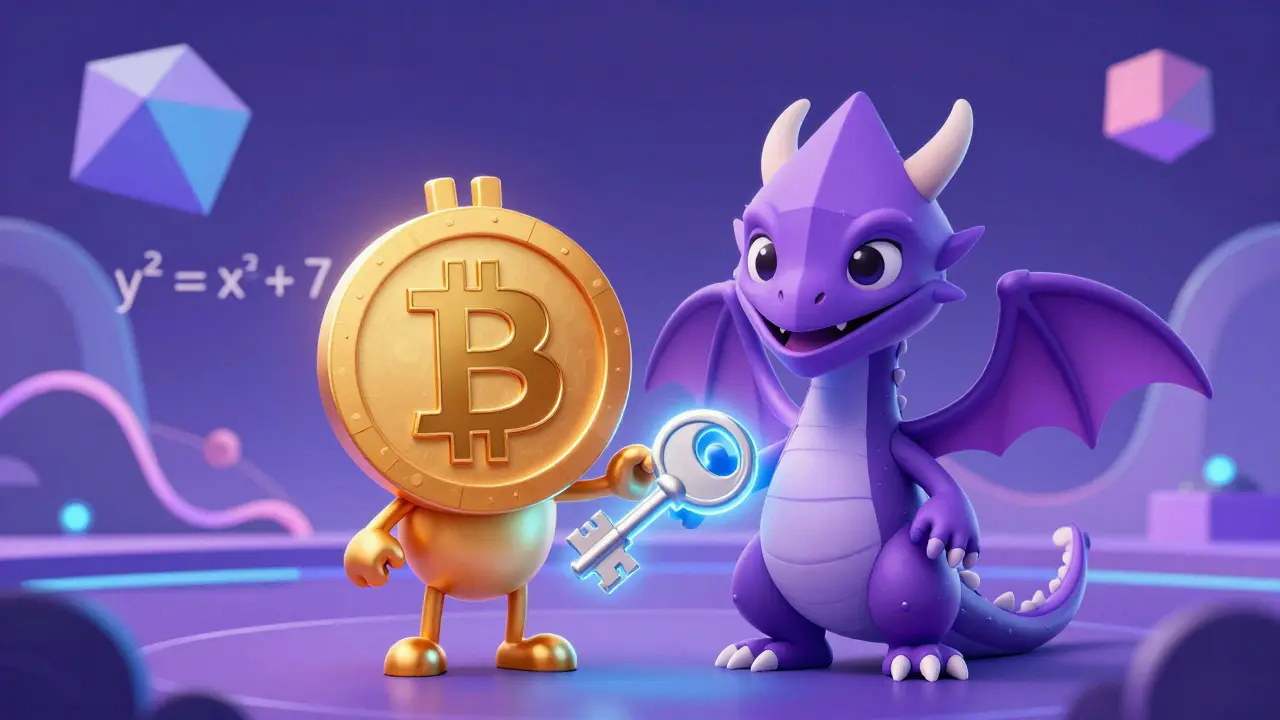
Every time you send a Bitcoin or interact with an Ethereum smart contract, you are relying on a specific piece of mathematics to prove that the transaction is yours. This mathematical proof is called ECDSA, which stands for Elliptic Curve Digital Signature Algorithm. It is the invisible lock and key that keeps your funds safe from hackers who might try to steal them by forging a signature.
You don't need to be a mathematician to understand why this matters. You just need to know that without ECDSA, blockchains like Bitcoin and Ethereum would collapse because anyone could spend anyone else's money. But here is the catch: while both networks use the same core algorithm, they implement it differently. These differences affect speed, security, and how developers build applications on top of them.
The Core Engine: What Is ECDSA?
At its heart, ECDSA is a way to create a digital signature that verifies your identity without revealing your private key. Think of it like signing a physical document with a unique pen stroke. Everyone can see the signature, but no one can forge it because they don't have your hand or your muscle memory.
In the digital world, your "muscle memory" is your private key-a random 256-bit number. Your "signature" is a complex calculation based on that number and the data you want to sign (like a transaction). The beauty of ECDSA is efficiency. Older algorithms like RSA required massive keys (3072 bits) to provide the same level of security as a tiny 256-bit ECDSA key. For decentralized networks where storage and processing power are limited, this size difference is huge.
Both Bitcoin and Ethereum chose the same elliptic curve for this process: secp256k1. This curve is defined by the equation y² = x³ + 7 over a finite field. It was selected for its balance of speed and security. When you generate a wallet address, you are essentially deriving a public point on this curve from your private key. The math makes it easy to go from private to public, but practically impossible to reverse.
Bitcoin vs. Ethereum: Same Math, Different Hashes
If you look under the hood of Bitcoin and Ethereum, you will see they share the same cryptographic foundation but diverge in how they prepare the data before signing it. This distinction is crucial for developers and security experts.
| Feature | Bitcoin | Ethereum |
|---|---|---|
| Hash Function | SHA-256 (Double) | Keccak-256 |
| Curve Used | secp256k1 | secp256k1 |
| Data Encoding | Serialized Transaction | RLP Encoded |
| Primary Use Case | Value Transfer | Smart Contracts & State Changes |
| Malleability Fix | SegWit (2017) | EIP-155 (2016) |
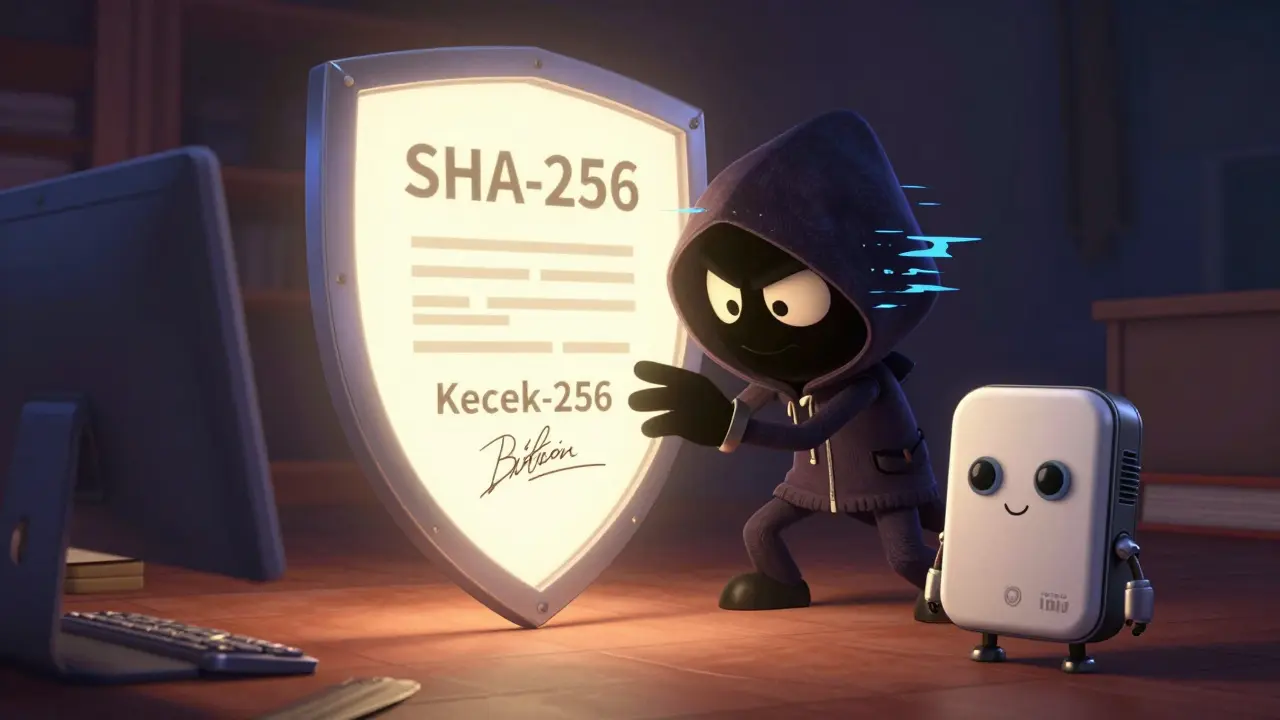
Bitcoin uses SHA-256, a hash function standardized by NIST in 2002. It hashes the transaction data twice (double SHA-256) before applying the ECDSA signature. This double hashing provides an extra layer of protection against collision attacks, though none have been found yet. Bitcoin’s approach is conservative and battle-tested. It has processed millions of transactions since 2009 without a single cryptographic break of the underlying signature scheme.
Ethereum, launched in 2015, chose Keccak-256. This is the algorithm that later became the SHA-3 standard. Keccak uses a "sponge construction," which is theoretically more resistant to certain types of length-extension attacks than SHA-256’s Merkle-Damgård structure. Benchmarks suggest Keccak-256 is about 15% faster than SHA-256 on modern processors. For a network like Ethereum, which executes complex smart contracts and requires high throughput, this speed advantage matters.
The Danger of Randomness: Nonces and Security
Here is where things get scary. ECDSA relies heavily on a random number called a "nonce" (number used once) during the signing process. If this nonce is not truly random, or worse, if it is reused, your private key can be mathematically derived by anyone watching the network.
This isn't just theoretical. In 2010, Sony engineers reused nonces when signing software updates for the PlayStation 3, allowing hackers to extract their private keys and jailbreak the console. In the crypto world, similar mistakes have cost users millions. In 2011, several early Bitcoin wallets suffered from poor random number generation, leading to stolen funds. More recently, in 2023, researchers from Kudelski Security demonstrated a "Polynonce" attack that recovered private keys from 127 Bitcoin addresses by exploiting patterns in nonce generation across consecutive transactions.
To mitigate this, modern implementations use RFC 6979, a standard that generates the nonce deterministically from the private key and the message hash. This means you don't need a perfect hardware random number generator; the math ensures the nonce is unique and unpredictable as long as your private key is secret. Both Bitcoin and Ethereum clients now rely on this deterministic approach, significantly reducing the risk of human error or faulty hardware RNGs.
Signature Malleability and Protocol Upgrades
Another headache for blockchain developers is signature malleability. In simple terms, this means that for a given transaction, there can be multiple valid signatures. An attacker could modify the signature slightly, changing the transaction ID without changing the actual content. This caused major issues for Bitcoin in 2014, disrupting payment processors that relied on transaction IDs to confirm payments.
Bitcoin solved this with Segregated Witness (SegWit), activated in August 2017. By moving the signature data out of the main transaction body, Bitcoin eliminated most malleability vectors. Ethereum addressed a similar issue earlier, in November 2016, with EIP-155. This upgrade added the chain ID to the signature process, ensuring that a signature valid on Ethereum Mainnet cannot be replayed on a testnet or a fork. This is a critical feature for preventing accidental fund loss across different network environments.

The Quantum Threat Horizon
While ECDSA is secure against classical computers, it is vulnerable to quantum computing. Shor’s algorithm, running on a sufficiently powerful quantum computer, could derive a private key from a public key in hours rather than billions of years. Estimates vary, but experts believe we are at least 15 to 20 years away from quantum computers capable of breaking 256-bit ECDSA keys.
This timeline gives the industry breathing room, but not infinite time. NIST has already begun standardizing post-quantum cryptographic algorithms, selecting CRYSTALS-Dilithium as a primary candidate. Both Bitcoin and Ethereum communities are actively researching migration paths. However, transitioning a decentralized network to a new cryptographic standard is incredibly difficult. It requires consensus among thousands of nodes and users. Until then, ECDSA remains the king of blockchain security.
Practical Tips for Users and Developers
For everyday users, the lesson is simple: use reputable wallets. Hardware wallets like Ledger and Trezor use dedicated secure elements to generate nonces and store private keys, isolating them from potential malware on your computer. They also implement constant-time operations to prevent side-channel attacks, where attackers might guess your key by measuring power consumption or timing.
For developers working with Ethereum’s Web3.js or Python libraries, pay close attention to signature formats. Ethereum’s signature format includes a recovery byte (v) that allows the recipient to verify the signer’s address. Misinterpreting this byte, especially during hard forks or network transitions, can lead to validation failures. Always test your signature logic on testnets like Sepolia or Goerli before deploying to Mainnet.
Understanding ECDSA doesn’t require you to solve elliptic curves by hand. But knowing how it works helps you appreciate why backups matter, why randomness is critical, and why the slow, deliberate upgrades of Bitcoin and Ethereum are necessary for long-term security.
What happens if I reuse a nonce in ECDSA?
If you reuse a nonce (the random number k) with the same private key, an attacker can calculate your private key using basic algebra. This is why deterministic nonce generation (RFC 6979) is critical in modern wallets.
Why does Ethereum use Keccak-256 instead of SHA-256?
Ethereum chose Keccak-256 for its superior performance and sponge construction, which offers better resistance to length-extension attacks compared to SHA-256's Merkle-Damgård structure. It is also approximately 15% faster on modern hardware.
Is ECDSA vulnerable to quantum computers?
Yes, ECDSA is vulnerable to Shor’s algorithm on a large-scale quantum computer. However, current estimates suggest such technology is 15-20 years away, giving blockchain networks time to transition to post-quantum algorithms like CRYSTALS-Dilithium.
What is the secp256k1 curve?
secp256k1 is a specific elliptic curve defined by the equation y² = x³ + 7. It is used by both Bitcoin and Ethereum for generating key pairs and signatures due to its efficient arithmetic properties and strong security record.
How does Bitcoin prevent signature malleability?
Bitcoin mitigated signature malleability through the Segregated Witness (SegWit) upgrade in 2017. By separating signature data from the transaction input, SegWit ensures that modifying the signature does not change the transaction ID.