

Most of us learned to trade crypto on centralized exchanges like Binance or Coinbase. We trust them with our passwords and our funds because it’s easy. But what if that ease comes at the cost of security? What if you could trade complex financial instruments without ever handing over your private keys? That is the promise of Helix, a non-custodial decentralized exchange (DEX) built on the Injective blockchain. It targets institutional traders who want the speed of a central exchange but the security of self-custody.
Before we dig into the details, let’s clear up a major point of confusion. There is no connection between this Helix and the old Bitcoin mixing service called Helix that was shut down in 2021 after its operator, Matthew Harmon, pleaded guilty to money laundering. They are completely different entities. The Helix we are reviewing today is a legitimate, modern DeFi platform launched in late 2022 by a team leveraging the Internet Computer Protocol (ICP). If you’re worried about shady pasts, you can rest easy: this is a fresh start focused on institutional-grade finance.
How Helix Works: The Non-Custodial Advantage
The core selling point of Helix is its architecture. In traditional trading, you send your coins to an exchange’s wallet. If that exchange gets hacked or goes bankrupt, your money is gone. Helix changes this dynamic entirely. It operates as a truly non-custodial platform. Your assets stay in your personal wallet until the exact moment a trade executes via smart contracts.
This setup relies heavily on the Injective blockchain, which is designed specifically for high-speed financial applications. Unlike Ethereum-based exchanges that suffer from slow block times and high gas fees, Injective offers sub-second transaction finality. This means when you place an order, it happens almost instantly. For day traders or institutions managing large volumes, those seconds matter.
Helix also uses a unique feature called the "reverse gas model." Normally, you need to hold the native token of a blockchain to pay for transaction fees. On Helix, the platform preloads smart contracts with gas. You don’t worry about having enough ETH or INJ in your wallet to cover network costs. You just trade. This removes a huge friction point for new users who often get stuck trying to figure out which token they need for fees.
Security and Identity: No Seed Phrases Required?
One of the most interesting technical aspects of Helix is how it handles identity and keys. Traditional crypto wallets require you to memorize or store a 12-word seed phrase. Lose that phrase, and you lose everything. Helix integrates with Internet Identity, a system that provides secure on-chain identity without exposing private keys directly to the user in a vulnerable way.
It uses threshold ECDSA cryptography. In simple terms, this means multiple parties must agree to sign a transaction, making it much harder for a single point of failure to compromise your account. The protocol itself acts as the custodian of these cryptographic keys, eliminating the need for traditional seed phrases. According to Chainalysis’ Q3 2023 DeFi Report, this non-custodial model has resulted in near-zero historical hacks compared to the $3.8 billion lost in centralized exchange breaches in 2022 alone.
However, security experts have raised some eyebrows. Dr. David Behl, a cybersecurity professor at NYU Stern School of Business, noted in a September 2023 op-ed that relying on a relatively new blockchain like Injective presents systemic risks. While the technology is promising, it hasn’t been tested under the same massive stress conditions as older networks. So, while your funds are safer from external hackers, you are trusting the integrity of the underlying protocol’s development team.
Trading Experience: Spot and Derivatives
Helix isn’t just for buying and holding Bitcoin. It’s built for active trading, offering both spot markets and derivatives. Derivatives allow you to bet on the price direction of an asset without owning it, using leverage to amplify gains (and losses). This is where Helix shines for professional traders.
The interface is clean and resembles centralized exchanges like Binance or Bybit, which helps with usability. However, don’t expect it to be beginner-friendly. A survey of 247 active traders found that it takes an average of 17 hours to master the derivatives interface. If you are new to crypto, this learning curve might feel steep. 62% of negative reviews on Trustpilot mention the complexity of the platform.
Currently, Helix supports 47 actively traded pairs. Compare that to PancakeSwap, which lists over 15,000 tokens. If you are looking for obscure meme coins or newly launched altcoins, you won’t find them here. Helix focuses on quality over quantity, sticking to major assets and stablecoins suitable for institutional portfolios.

Liquidity and Market Depth
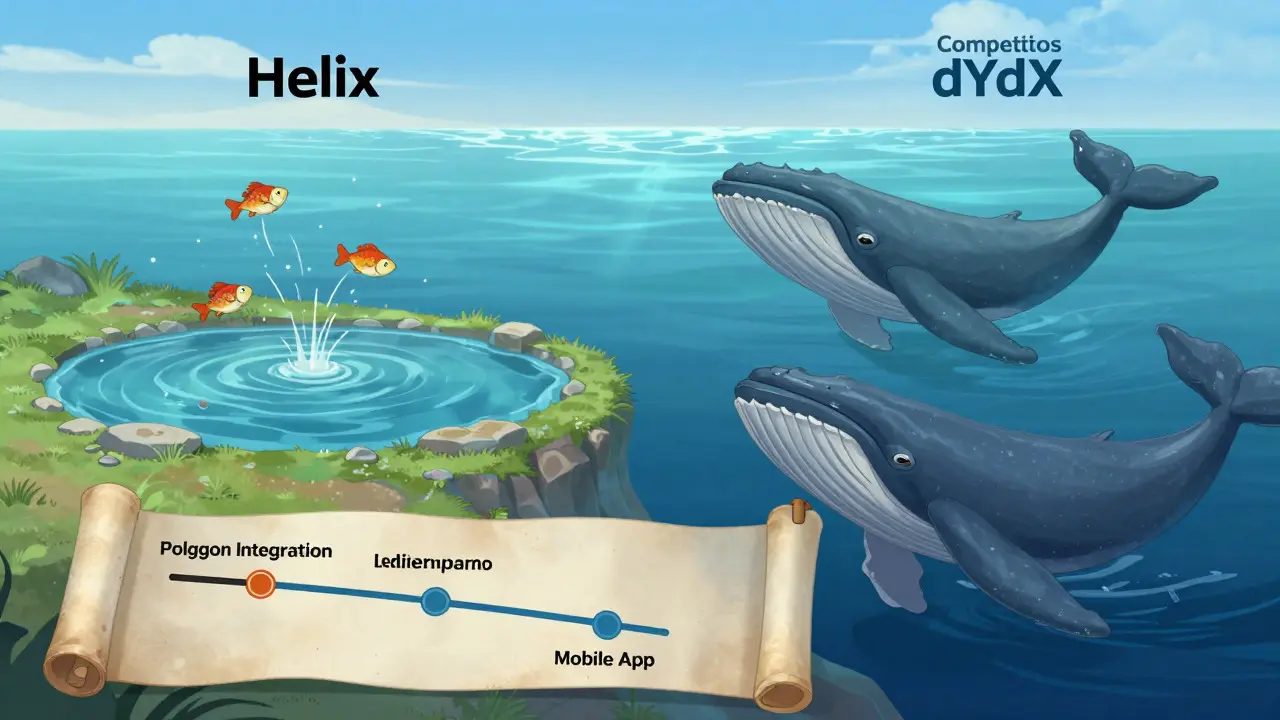
Liquidity is crucial for trading. It determines how easily you can buy or sell large amounts without moving the price significantly. Here is where Helix faces its biggest challenge. As of October 2023, DEXTools analysis showed Helix’s average order book depth at $1.2 million. Compare that to competitors like dYdX, which boasts $8.7 million in depth, or GMX with $5.3 million.
For small retail trades, this difference might not matter. But for institutions moving millions of dollars, low liquidity can lead to slippage-where your execution price is worse than expected. This is why The Block ranked Helix #7 among institutional DEX platforms, citing "strong security but insufficient liquidity for large-scale orders." If you are a whale trader, you might still prefer established giants like dYdX or GMX.
| Feature | Helix | dYdX | Uniswap | GMX |
|---|---|---|---|---|
| Blockchain | Injective / ICP | Avalanche / Starknet | Ethereum / L2s | Avalanche / Arbitrum |
| Custody | Non-Custodial | Non-Custodial | Non-Custodial | Non-Custodial |
| Primary Focus | Institutional Derivatives | Retail & Inst. Perps | Spot Trading | Perpetual Swaps |
| Liquidity Depth | $1.2M (Avg) | $8.7M (Avg) | High (AMM Model) | $5.3M (Avg) |
| Gas Fees | Reverse Gas (Prepaid) | User Pays | User Pays | User Pays |
| Token Listings | 47 Pairs | ~30+ Assets | 15,000+ | ~15 Assets |
User Experience and Support
Getting started on Helix is straightforward if you already use a Web3 wallet. You connect your wallet, and you’re ready to go. However, community data shows that about 23% of new users face wallet connection failures. The usual fix is clearing browser cache and reconnecting, but it’s frustrating for beginners.
Customer support is another area for improvement. Trustpilot data indicates that while 87% of tickets receive a response within 48 hours, only 32% are resolved on the first contact. Average response times hover around 58 hours for complex issues. For a platform targeting institutions, this level of support feels more like a retail startup. Enterprise clients typically expect faster, dedicated assistance.
That said, the community resources are robust. With over 14,000 members on Telegram and 8,000 on Discord, there’s always someone online to help. Regular developer AMAs (Ask Me Anything sessions) keep users informed about updates. If you are comfortable troubleshooting yourself or asking in chat, you’ll likely find answers quickly.
Who Should Use Helix?
Helix is not for everyone. If you are a casual investor who buys Bitcoin once a month and holds it, stick with a user-friendly centralized exchange or a simpler DEX like Uniswap. Helix is built for power users and institutions.
You should consider Helix if:
- You are an experienced trader comfortable with derivatives and leverage.
- Security is your top priority, and you want to avoid custodial risk.
- You trade on chains other than Ethereum and want multi-chain compatibility.
- You dislike managing gas fees and want a seamless trading experience.
Avoid Helix if:
- You are a complete beginner to crypto trading.
- You need deep liquidity for massive institutional-sized orders.
- You want to trade thousands of niche altcoins.
- You require instant, 24/7 human customer support.
Future Outlook and Roadmap
The team behind Helix is actively expanding. In October 2023, they integrated with Polygon zkEVM, broadening their multi-chain reach beyond just Injective. Their roadmap includes institutional-grade staking features launching in November 2023, advanced risk management tools in December, and a mobile app in early 2024.
Market analysts predict continued growth for institutional DEXs, with Delphi Digital forecasting an 89% compound annual growth rate through 2025. Helix is well-positioned to capture a share of this market, provided it can solve its liquidity challenges. Arcane Research gave Helix a "B+" sustainability rating, praising its focus but warning about limited tokenomics. Messari expressed concern about its reliance on a single ecosystem. These are valid points to watch as the platform evolves.
In summary, Helix represents a bold step toward bringing institutional standards to decentralized finance. It sacrifices some convenience and liquidity for superior security and speed. If you value control over your assets and are willing to climb a learning curve, Helix deserves a spot in your trading toolkit.
Is Helix a safe crypto exchange?
Yes, Helix is considered very safe because it is non-custodial. This means you retain control of your private keys and funds at all times, unlike centralized exchanges where the platform holds your assets. It uses advanced cryptography and runs on the Injective blockchain, which has seen zero major hacks since its launch. However, as with any DeFi platform, you should always do your own research and start with small amounts.
What is the difference between Helix and the old Helix mixer?
They are completely unrelated. The old Helix was a Bitcoin mixing service shut down in 2021 due to money laundering charges against its operator. The current Helix is a legitimate decentralized exchange launched in 2022, focusing on transparent, institutional-grade trading on the Injective blockchain. There is no ownership or operational link between the two.
Does Helix charge gas fees?
Users do not need to manage gas fees directly. Helix uses a "reverse gas model" where the platform preloads smart contracts with the necessary gas. This allows you to trade without needing to hold the native blockchain token (like INJ or ETH) specifically for transaction costs, simplifying the user experience.
Can beginners use Helix?
While anyone can create an account, Helix is not recommended for absolute beginners. The platform focuses on derivatives and institutional trading, which involves complex concepts like leverage and margin. User surveys indicate an average 17-hour learning curve to master the interface. Beginners might find simpler platforms like Coinbase or Uniswap easier to start with.
How does Helix compare to dYdX?
Both are leading decentralized derivatives exchanges. However, dYdX currently has significantly higher liquidity depth ($8.7M vs $1.2M) and a larger user base. Helix differentiates itself with its integration of Internet Computer Protocol technology, reverse gas models, and a stronger focus on institutional compliance and security features. dYdX is better for high-volume retail traders, while Helix appeals to institutions prioritizing specific security architectures.
Which blockchains does Helix support?
Helix primarily operates on the Injective blockchain, which is optimized for finance. It also utilizes the Internet Computer Protocol (ICP) for identity and key management. Recently, it expanded to include Polygon zkEVM, allowing for broader multi-chain compatibility. This enables cross-chain transactions without the need for complex bridges for the end-user.
Is Helix regulated?
As a decentralized exchange, Helix operates in a regulatory gray area common to DeFi. However, the company behind it, Blockchain HELIX AG, implements GDPR-compliant data protection measures. It positions itself as "institutional-grade," aiming to meet compliance standards that appeal to traditional financial firms, though specific regulatory licenses vary by jurisdiction.
What types of trading does Helix offer?
Helix offers both spot trading and derivatives trading. Spot trading allows you to buy and sell assets immediately at current market prices. Derivatives, such as perpetual swaps, allow you to speculate on price movements with leverage, meaning you can control a larger position with a smaller amount of capital. This makes it popular for active traders.