

Crypto Compliance Cost Estimator
Estimate Your Compliance Investment
Based on 2025 regulatory requirements from SEC, MiCA, and global frameworks
Your Compliance Investment Estimate
Ignoring compliance could cost 40% more in penalties by 2027. The article notes that over 40 small firms were fined in 2024 for non-compliance.
By 2025, crypto compliance isn’t optional anymore-it’s the difference between staying open and shutting down. What used to be a gray area with vague warnings from regulators is now a tightly woven legal grid. If you’re running a business that touches digital assets, you need to understand how the rules changed in the last 18 months-and how to adapt before it’s too late.
Regulation Finally Got Real
The U.S. didn’t wait around. In March 2025, Congress passed three major bills in one week: the GENIUS Act, the CLARITY Act, and the Anti-CBDC Act. For the first time, there’s a clear line between what’s a security and what’s a commodity. The SEC now handles tokens that act like stocks. The CFTC takes the ones that behave like futures. No more back-and-forth. No more “it depends.” The SEC’s Crypto Task Force, launched in January 2025, shifted from chasing bad actors to building rules that let good businesses operate. They released their first formal guidance in April 2025: real-time monitoring of transactions across Bitcoin, Ethereum, Solana, and Layer 2 networks. That’s not a suggestion. It’s a requirement. Meanwhile, the EU’s MiCA regulation went fully live on June 30, 2025. It forces stablecoins to hold 100% reserves. It demands full disclosure of 20+ risk factors. It applies to every member state, uniformly. If you’re serving European customers, you’re under MiCA now-no exceptions.Compliance Isn’t Just Paperwork Anymore
You can’t just file forms and call it done. Modern crypto compliance means tracking every dollar moving across chains. Criminals aren’t using one blockchain anymore. They jump from Ethereum to Solana, then through a cross-chain bridge to Monero, then into a mixer. The $225 million in USDT frozen by Tether in early 2025? That was traced across five different blockchains. That’s why tools like Chainalysis Reactor 5.2 and Elliptic’s AI systems are now standard. These platforms scan billions of transactions daily, flagging patterns that match known laundering behavior. The accuracy? Up to 92.7% on public chains. But here’s the catch: privacy coins like Monero and Zcash still slip through. Detection rates drop to under 40%. That’s a blind spot every firm must account for. And it’s not just about tracking money. You need to know what your own employees are doing. StarCompliance’s 2025 survey found that 55% of financial firms can’t track their staff’s personal crypto trades. That’s a massive risk. Insider trading, conflict of interest, even money laundering-those can start from inside your own company.Global Rules, Local Headaches
There’s no single global rulebook. The U.S. has its dual-regulator system. The EU has MiCA. The UK requires suspicious transactions over £1,000 to be reported within 24 hours. Dubai has a four-tier licensing system based on risk. And Singapore? They’re still figuring it out. If you’re operating internationally, you’re juggling at least three different compliance frameworks. A transaction that’s clean in the U.S. might be flagged in the EU. A wallet address that’s approved in Dubai could be blacklisted in Switzerland. Coinbase CEO Brian Armstrong called this complexity “both a challenge and opportunity.” The opportunity? Build systems that work everywhere. The challenge? It costs money. According to Ocorian’s analysis of 75 firms, initial setup for full compliance runs between $1.2 million and $2.8 million. That’s not startup money. That’s enterprise-level investment.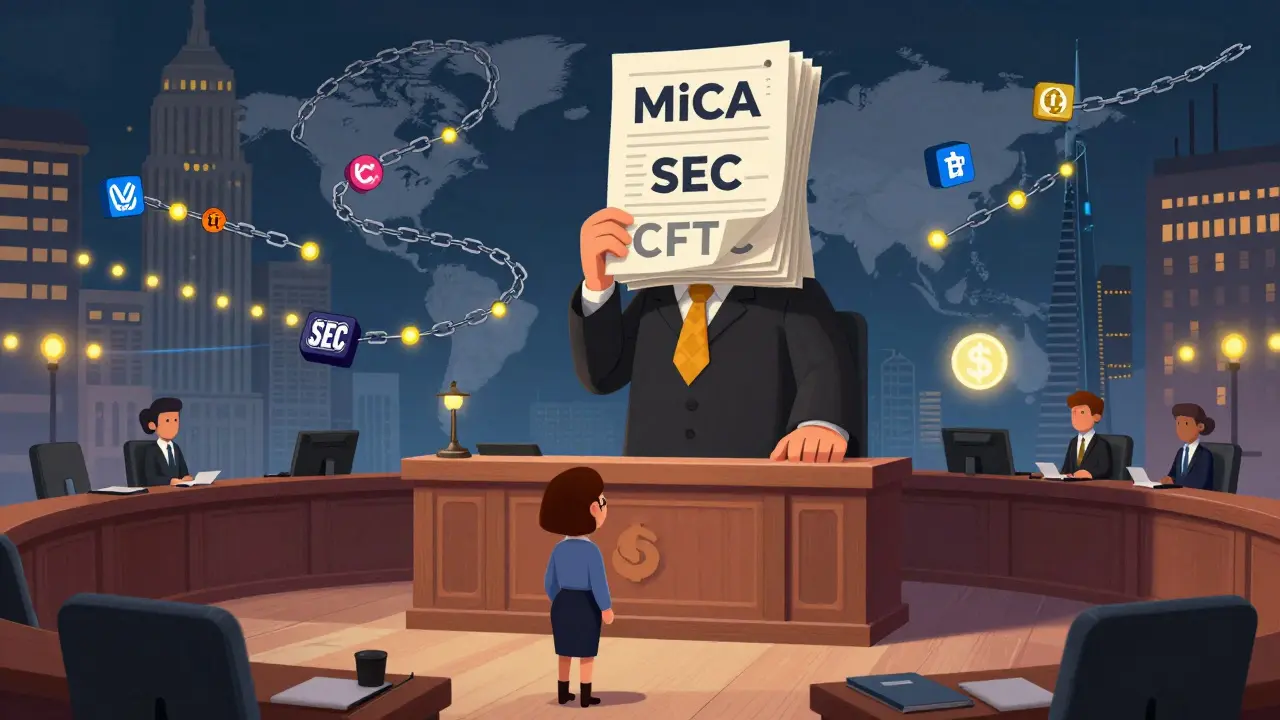
Technology Is Changing the Game
Compliance tech has moved beyond basic transaction monitoring. Today’s tools use behavioral AI. They learn what normal looks like for each user or wallet. If someone suddenly sends $500,000 to a mixer they’ve never used before? The system flags it. Not because it’s on a blacklist-but because it’s out of character. JPMorgan Chase cut false positives by 63% in Q1 2025 using this approach. That means fewer wasted hours for compliance teams and faster customer onboarding. But here’s what most companies miss: you need skilled people to run these tools. Burning Glass Technologies analyzed 8,400 crypto compliance job postings in Q2 2025. The top three required skills? Blockchain forensics (47%), smart contract auditing (32%), and integrating regulatory tech (29%). You can’t hire a compliance officer who learned this in a 2020 webinar. The bar is higher now. Training takes 120 to 160 hours. Certification programs like Global Digital Finance’s 2025 framework are the new baseline. And vendors? 87% now offer 24/7 blockchain monitoring support-up from 63% in 2024. You can’t afford to go it alone anymore.Who’s Winning and Who’s Losing
The firms that treat compliance as a cost center are falling behind. The ones that see it as a competitive edge are growing. Think about payroll. ADP’s 2025 workforce study found 78% of Gen Z employees want to get paid in crypto. In gaming and streaming, that number jumps to over 90%. If you’re not offering crypto payroll, you’re losing talent. But if you offer it without compliance? You’re exposing yourself to regulatory risk. The market for crypto compliance tools hit $4.7 billion in Q2 2025. Growth? 38.2% year-over-year. Sixty-two percent of traditional banks now have dedicated crypto compliance budgets. That’s new. That’s significant. Meanwhile, firms that ignored the shift are getting hit. The Bank for International Settlements estimates companies with reactive compliance will pay 40% more in penalties by 2027. Those with proactive systems? They’ll cut operational risk by 22-35%.
What You Need to Do Now
If you’re reading this, you’re probably already behind. But it’s not too late. Here’s what to do:- Map your exposure. Which blockchains do you touch? Which jurisdictions do you serve? List every one.
- Assess your tools. Are you using AI-powered behavioral analytics? Or just basic blacklists? Upgrade if needed.
- Train your team. Get at least two people certified in blockchain forensics and regulatory tech. No shortcuts.
- Track internal activity. Implement a policy for employee crypto trading. Require disclosures. Monitor transactions.
- Build for global. Even if you’re U.S.-only now, assume you’ll expand. Design systems that can adapt to MiCA, VARA, or FCA rules.
Compliance Is Now a Growth Engine
The old idea-that compliance slows innovation-is dead. In 2025, the opposite is true. Firms with strong compliance frameworks are getting faster access to banks, better terms from exchanges, and more trust from customers. Investors now ask: “What’s your compliance stack?” before they write a check. KYC-Chain put it best: “Compliance is no longer just about avoiding fines. It’s about protecting your business and unlocking growth.” The future isn’t about avoiding regulation. It’s about leading it. The firms that do will thrive. The ones that don’t? They’ll become case studies.Is crypto compliance mandatory for small businesses?
Yes-if you’re handling crypto transactions, even for a single customer. The SEC and EU regulators don’t exempt small firms. If you’re accepting payments in Bitcoin, offering staking, or running a DeFi wallet service, you’re subject to the same rules as Coinbase or Binance. The difference is scale: small businesses may have simpler systems, but they still need KYC, transaction monitoring, and reporting.
What happens if I ignore crypto compliance?
You risk fines, asset freezes, or being shut down. The SEC doesn’t just go after big names anymore. In 2024, over 40 small crypto firms were fined for failing to report suspicious activity. In 2025, the penalties increased by 60%. Banks are also cutting off services to non-compliant businesses. If your payment processor freezes your account because of crypto activity, you could lose access to payroll, rent, and vendor payments overnight.
Can I use free blockchain explorers for compliance?
No. Free tools like Etherscan or Blockchain.com only show public transaction data. They don’t flag risk patterns, link addresses to real identities, or monitor cross-chain movements. Compliance requires AI-powered platforms that connect on-chain behavior to known illicit actors. Free tools won’t protect you from regulatory action-they’ll give you a false sense of security.
How do MiCA and U.S. rules differ?
MiCA is prescriptive: it tells you exactly what to do-like holding 100% reserves for stablecoins. The U.S. is more outcome-based: it says, “Don’t violate securities laws,” and lets regulators decide what counts as a security case by case. MiCA applies uniformly across Europe. U.S. rules vary by agency (SEC vs. CFTC) and sometimes by state. If you operate in both, you’ll need two sets of controls.
Do I need to monitor NFTs for compliance?
Yes-if they’re traded as investments or represent ownership rights. The SEC has already treated some NFTs as securities. If you’re running an NFT marketplace, you need to verify buyers and sellers, monitor for wash trading, and report suspicious activity. Even if you think your NFTs are “just art,” regulators may see them as financial instruments. Assume they’re regulated unless proven otherwise.
Is crypto payroll compliant?
It can be-but only if you handle it right. You need to track the value of crypto payments at the time of issuance, report them as income, withhold taxes, and ensure the payroll provider is licensed for crypto. Companies like BitPay and Coinbase Pay offer compliant payroll solutions. Doing it yourself without proper tracking is a compliance risk.
Heath OBrien
December 11, 2025 AT 11:09Compliance? Nah. Just use Monero and call it a day. 🤷♂️
Patricia Whitaker
December 13, 2025 AT 05:09Oh please. Another ‘compliance is growth’ sales pitch. You think some $2M tool is gonna save you when your CEO’s still trading ETH from his personal wallet? 😒
Sarah Luttrell
December 13, 2025 AT 12:35So let me get this straight - the U.S. finally gets its act together, and now we’re supposed to bow to MiCA’s overregulated EU nanny state? 🇺🇸💪
Vidhi Kotak
December 14, 2025 AT 23:47Actually, for small teams, starting with a basic KYC + Chainalysis Lite + employee policy is enough. No need to burn $2M right away. Just be consistent. 🙏
Kim Throne
December 15, 2025 AT 17:09It's worth noting that the 92.7% detection accuracy cited applies only to public chains with transparent address histories. Privacy coins remain a systemic blind spot, and no current solution fully resolves this without compromising decentralization. This is a structural, not technical, challenge.
Kathryn Flanagan
December 16, 2025 AT 23:50Look, I’ve been in this space since 2017, and I’ve seen every wave come and go - the ICO boom, the DeFi summer, the NFT craze - and every single time, the same thing happens: people think they can skip the boring stuff like KYC and AML, and then boom, the regulators come knocking, and suddenly your bank account is frozen, your employees are unpaid, and your whole business is a footnote in a Bloomberg article. It’s not complicated. Do the work. Train your people. Use the tools. Don’t be the person who says ‘I didn’t know’ - because now, you can’t say that anymore. It’s 2025. The rules are out there. Read them. Follow them. Or get out.
Steven Ellis
December 17, 2025 AT 01:54The real win here isn’t avoiding fines - it’s trust. When your customers know you’re not just compliant, but transparent and proactive, they stick around. When your investors ask about your compliance stack and you can show them your AI models, your employee monitoring logs, your MiCA-ready architecture - that’s when you stop being seen as a risky startup and start being seen as a real financial institution. That’s the quiet revolution happening right now.
Toni Marucco
December 18, 2025 AT 15:28There’s a quiet irony here: the very technologies that made crypto disruptive - pseudonymity, decentralization, cross-chain interoperability - are now the same ones forcing us to build the most sophisticated compliance infrastructure in financial history. We didn’t ask for this. But we’re building it anyway. And maybe, just maybe, that’s how we earn legitimacy - not by begging for permission, but by solving problems regulators didn’t even know they had.
Alex Warren
December 19, 2025 AT 00:10Free explorers don’t track behavioral anomalies. They don’t correlate wallet clusters across chains. They don’t flag a user who suddenly sends 90% of their balance to a mixer after 3 years of zero activity. That’s not oversight - that’s fantasy.
Taylor Fallon
December 19, 2025 AT 12:28It’s funny how we all act like compliance is this burden… but honestly? It’s the only thing keeping crypto from becoming a total free-for-all. I’ve seen friends lose everything because they thought ‘it’s just crypto’ - no paperwork, no rules. But now? The rules are here, and they’re clear. And honestly? It’s kind of beautiful. We’re growing up. We’re becoming real. And that’s worth the headache. 💙
Kathleen Sudborough
December 20, 2025 AT 11:59One thing everyone’s missing: compliance isn’t just about money. It’s about dignity. When you do it right, you protect your employees from being dragged into criminal investigations. You protect your customers from scams. You protect your own sleep at night. That’s not a cost center - that’s your moral foundation. And yeah, it’s expensive. But what’s the price of shame?
Jeremy Eugene
December 22, 2025 AT 09:21Respect the framework. Build for scale. Don’t treat compliance as a checkbox. Treat it as your business’s immune system.
Joey Cacace
December 22, 2025 AT 09:33Thank you for this comprehensive, well-researched breakdown. The integration of behavioral AI and cross-chain monitoring represents a paradigm shift in regulatory technology. I have shared this with our legal and risk teams, and we are initiating a gap analysis against the outlined benchmarks. Your clarity is deeply appreciated.
Taylor Farano
December 23, 2025 AT 05:11Oh wow, $2.8 million to play by the rules? Guess I’ll just move to Venezuela and mine Dogecoin in my garage. 🤭