

Remember when everyone thought Ethereum sharding was coming in 2022? The hype was real. Developers promised a network split into 64 separate chains that would process 100,000 transactions per second. It sounded like the ultimate fix for high gas fees and slow confirmations. But if you’ve been watching the roadmap closely, you might have noticed something strange: those specific shard chains never launched. Instead, we got The Merge, then EIP-4844, and now a whole new focus on Layer 2 solutions.
The truth is, the original plan for Ethereum sharding implementation changed drastically. What started as a complex system of independent blockchains evolved into a simpler, more powerful data availability layer known as Danksharding. Understanding this shift isn't just about technical trivia; it’s crucial for anyone trying to figure out where Ethereum is heading in 2026 and beyond. If you’re waiting for the old-style shards, you’ll be waiting forever. But if you want to understand how Ethereum actually scales today, you need to look at what replaced them.
The Original Vision: 64 Independent Chains
To understand why the plan changed, we first need to look at what the original Ethereum 2.0 roadmap proposed. The idea was straightforward but technically heavy. The network would be divided into exactly 64 shard chains. Each shard would act like its own mini-Ethereum mainnet, holding its own state, processing its own transactions, and running its own smart contracts.
In this model, validators wouldn’t track everything. They would only track one or two shards at a time. This horizontal scaling approach meant that adding more shards would linearly increase the network’s capacity. The goal was to boost throughput from roughly 15-30 transactions per second (TPS) on the original Proof-of-Work chain to over 100,000 TPS across all shards combined.
The security model relied heavily on the Beacon Chain. The Beacon Chain acted as the central coordinator, managing validator assignments and ensuring consensus. Validators were pseudorandomly assigned to shards every epoch (about 6.4 minutes). This constant reshuffling was designed to prevent attackers from targeting a single shard. The theory stated that an attacker would have a one-in-a-trillion chance of controlling two-thirds of the validators in any given shard. It was a mathematically sound design, but it came with massive complexity costs.
Why the Original Plan Was Abandoned
If the original sharding plan was so good, why did the Ethereum community pivot away from it? The answer lies in execution difficulty and changing priorities. Building 64 fully functional, independent chains that could communicate securely with each other was incredibly hard. Cross-shard communication-the ability for a contract on Shard A to talk to a contract on Shard B-introduced significant security risks and development headaches.
Additionally, the rise of Layer 2 (L2) rollups changed the landscape. Projects like Optimism and Arbitrum were already proving that they could scale Ethereum by processing transactions off-chain and posting compressed data back to the mainnet. By 2023, it became clear that L2s were the immediate future, not shard chains. The core developers realized that building infrastructure to support L2s was more valuable than building standalone shard chains that might compete with them.
This strategic shift allowed the team to prioritize The Merge, which transitioned Ethereum from Proof-of-Work to Proof-of-Stake. Completing The Merge required immense effort, and delaying it further to build complex sharding architecture didn’t make sense. The community decided to simplify the roadmap: secure the base layer first, then optimize it for data availability.
Danksharding: The New Reality
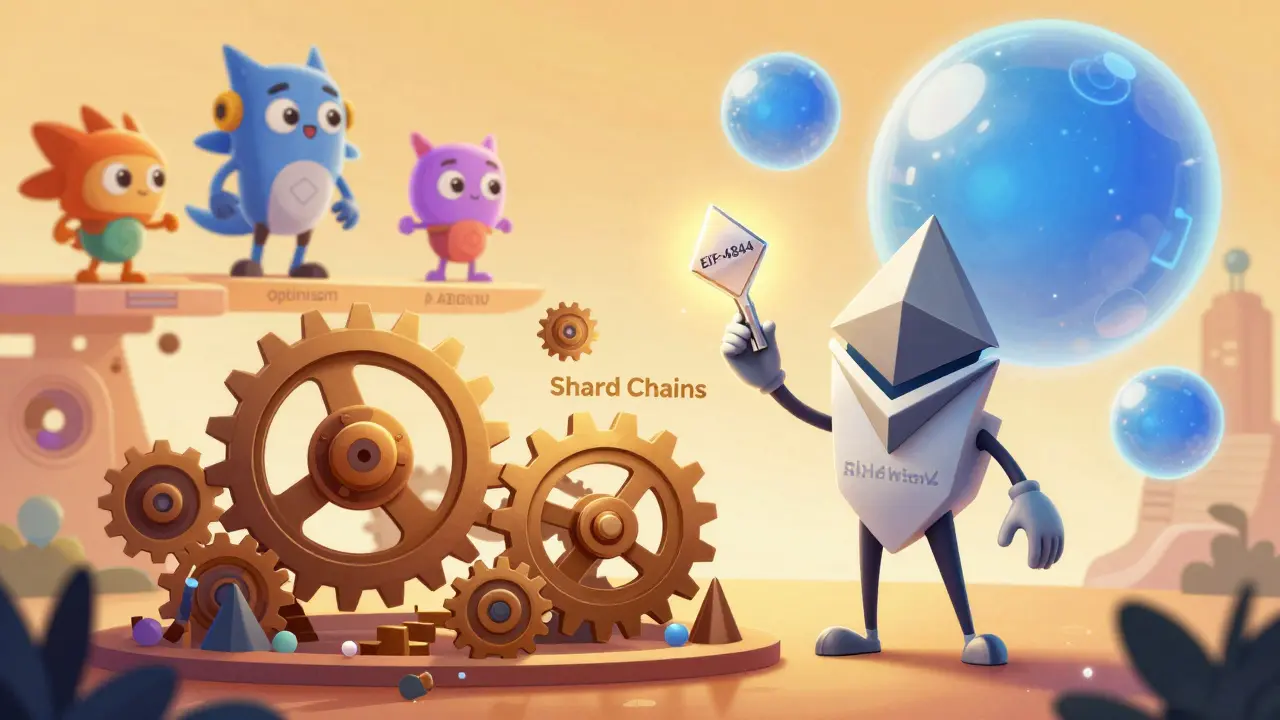
So, what replaced the old sharding plan? Enter Danksharding. Named after its creators Protolabs’ Dankad and Sharding, this concept reimagined what sharding meant for Ethereum. Instead of creating 64 separate chains that process transactions, Danksharding focuses purely on data availability.
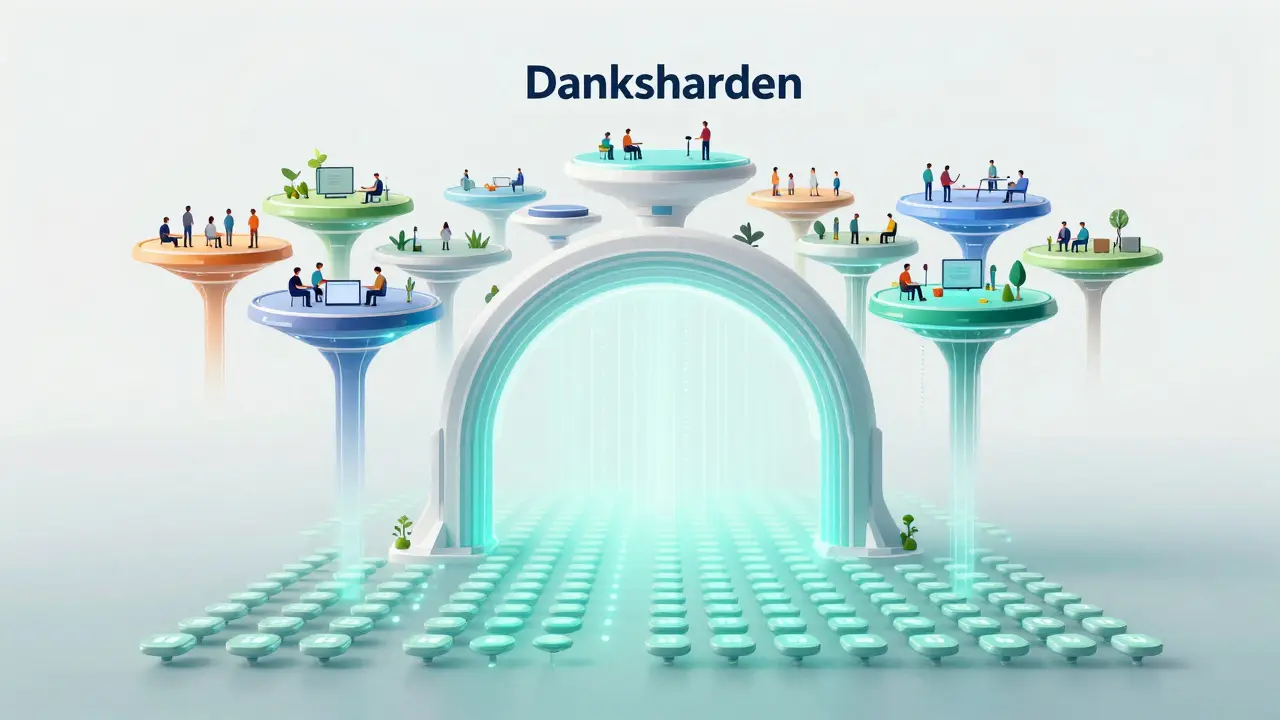
In the Danksharding model, the Ethereum beacon chain continues to coordinate consensus, but the "shards" are no longer full blockchains. They are simply data blobs. These blobs carry the transaction data from Layer 2 networks. The validators don’t execute these transactions; they only verify that the data exists and is available. This separation of duties-execution on L2s, data availability on Ethereum-is the key innovation.
The first major step toward Danksharding was EIP-4844, also known as Proto-Danksharding, which went live in March 2024. EIP-4844 introduced "blobs," a new type of transaction that carries large amounts of data cheaply. Before EIP-4844, L2s had to store their data in standard calldata, which was expensive. With blobs, the cost dropped significantly because the data is temporary-it gets pruned after about 18 days, reducing the long-term storage burden on nodes.
Full Danksharding will eventually expand this capability. While EIP-4844 supports one blob per block, full Danksharding aims to support up to 64 blobs simultaneously. This doesn’t mean 64 chains; it means 64 slots for data. This structure allows Layer 2 networks to post vastly more data to Ethereum without clogging the main execution layer. It turns Ethereum into a settlement layer and data archive, while L2s handle the actual user activity.
How Danksharding Compares to Other Blockchains
It’s worth noting that not all blockchains approach sharding the same way. For example, NEAR Protocol implemented a sharding solution called Nightshade. NEAR’s approach is different because its shards are not entirely independent. Every validator tracks all shards, and every block contains information about transactions from all shards. This simplifies cross-shard communication but places a higher burden on individual nodes.
Ethereum’s path with Danksharding is distinct because it avoids executing cross-shard logic on the base layer. By pushing execution to L2s, Ethereum sidesteps the complexity of cross-shard messaging entirely. The base layer only needs to ensure that the data posted by L2s is valid and available. This makes Ethereum’s architecture more modular and resilient.
| Feature | Original Ethereum Sharding | Danksharding (Current) | NEAR Nightshade |
|---|---|---|---|
| Shard Function | Execution & Storage | Data Availability Only | Execution & State |
| Cross-Shard Communication | Complex, built-in | Handled by L2s | Simplified via shared blocks |
| Validator Load | Track subset of shards | Verify data blobs | Track all shards |
| Status | Cancelled | In Progress (Proto-Danksharding Live) | Live |
Impact on Users and Developers
For the average user, the shift from traditional sharding to Danksharding means lower fees and faster experiences, but perhaps not in the way originally advertised. You won’t see yourself choosing between "Shard 1" and "Shard 2" when sending a transaction. Instead, you’ll continue using your favorite Layer 2 network, whether it’s Arbitrum, Base, or Optimism.
The benefit comes from the backend. Because L2s can post data to Ethereum much more cheaply thanks to EIP-4844 and upcoming Danksharding upgrades, their transaction fees drop. In early 2024, we saw L2 fees fall by 90% or more after Proto-Danksharding activation. As full Danksharding rolls out, this trend should continue. The bottleneck shifts from data storage to computation, which is easier to optimize.
For developers, the implications are profound. Building on Ethereum no longer means fighting for limited block space on the mainnet. It means building scalable applications on L2s that inherit Ethereum’s security. The modularity of the stack allows developers to specialize. Some teams focus on building better L2 execution environments, while others work on improving data compression techniques. This division of labor accelerates innovation.
Challenges and Future Roadmap
Despite the progress, challenges remain. Full Danksharding requires significant changes to node software. Nodes must be able to handle and verify multiple data blobs efficiently. There is also the issue of data persistence. Since blobs are ephemeral (deleted after ~18 days), relying solely on them for historical data is risky. Solutions like archival nodes and decentralized storage partnerships are being explored to ensure long-term data integrity.
Furthermore, the coordination between Ethereum’s core developers and the various L2 teams is critical. The Ethereum Foundation sets the rules for data availability, but L2 projects decide how to use it. Misalignment here could lead to inefficiencies. However, the current trajectory suggests strong collaboration, with many L2 leaders actively participating in Ethereum Improvement Proposal (EIP) discussions.
Looking ahead, the next steps involve refining the blob market mechanism and potentially increasing the number of supported blobs beyond the initial limits. The goal remains consistent: make Ethereum the most secure, scalable, and accessible global computer. Danksharding is the bridge to that future, replacing the dream of 64 chains with the reality of one highly efficient data layer supporting thousands of applications.
Is Ethereum sharding still happening?
Yes, but in a different form. The original plan for 64 independent shard chains has been abandoned. Instead, Ethereum is implementing Danksharding, which focuses on data availability rather than execution. This allows Layer 2 networks to scale more efficiently by posting data to Ethereum at a lower cost.
What is the difference between sharding and Danksharding?
Traditional sharding splits the blockchain into separate chains that process transactions independently. Danksharding does not create separate execution chains. Instead, it divides the network’s capacity to store data into "blobs." These blobs allow Layer 2 networks to post transaction data cheaply, while the actual transaction processing happens off-chain.
When will full Danksharding be released?
While exact dates are subject to change based on testing and developer consensus, the Ethereum roadmap targets full Danksharding implementation in the mid-to-late 2020s. Proto-Danksharding (EIP-4844) is already live, serving as a stepping stone. Full implementation will likely follow after further upgrades to node efficiency and data handling protocols.
How does Danksharding affect gas fees?
Danksharding primarily reduces fees for Layer 2 networks. By providing a cheaper way to post data to Ethereum, L2s can pass these savings on to users. Mainnet Ethereum fees may not drop significantly because the base layer is focused on security and settlement, not high-volume user transactions. However, the overall ecosystem becomes more affordable.
Do I need to upgrade my node for Danksharding?
Yes, node operators will need to update their software to support the new data blob formats. As Danksharding progresses, requirements for node storage and bandwidth may increase slightly due to the volume of data blobs. However, the design aims to keep these requirements manageable for consumer-grade hardware.