
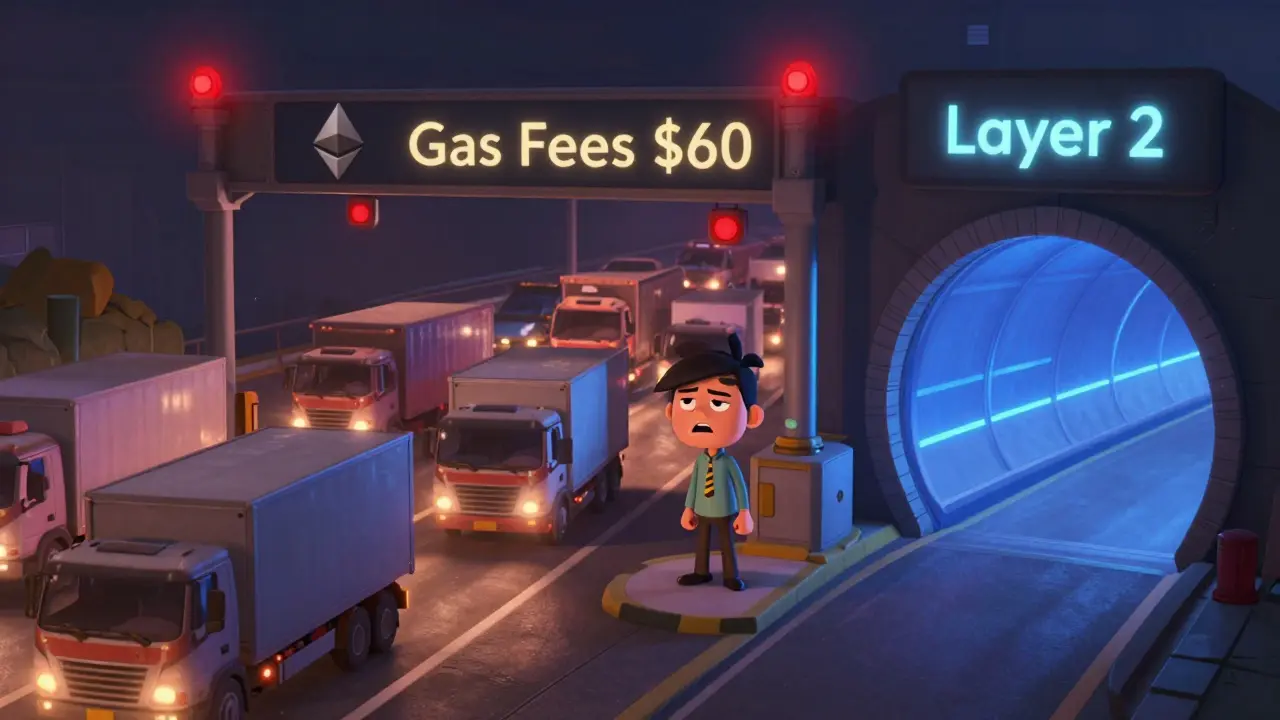
Remember the summer of 2021? You tried to swap a token on Ethereum, paid $60 in gas fees, and waited ten minutes for it to confirm. It felt less like using technology and more like paying a toll to enter a traffic jam. That pain point is exactly why Ethereum Layer 2 networks exist. They are not just an upgrade; they are the only way Ethereum can handle billions of users without becoming unusable.
Fast forward to mid-2026, and the landscape has shifted dramatically. Layer 2 solutions now process over 85% of all Ethereum ecosystem transactions. The average fee isn't dollars anymore-it's fractions of a cent. But with this speed comes complexity. If you are trying to navigate DeFi, mint NFTs, or build dApps today, understanding how these networks work is no longer optional. It’s essential.
The Core Problem: Why Ethereum Needs Help
To understand Layer 2, you first have to respect what Layer 1 (the mainnet) does. Ethereum’s primary job is security and decentralization. It is a global computer where thousands of nodes verify every single transaction. This makes it incredibly secure but painfully slow. The network caps out at about 15 to 30 transactions per second (TPS). Compare that to Visa, which handles thousands per second, and you see the bottleneck.
Vitalik Buterin, Ethereum’s co-founder, recognized this early. In 2018, he proposed scaling solutions because he knew Ethereum couldn’t scale horizontally by just adding more power to each node. Instead, the solution was vertical: move the heavy lifting off the main chain while keeping the security on it. This is the definition of Layer 2.
Layer 2 networks process transactions off-chain. They bundle thousands of individual transactions into a single batch and post that summary back to Ethereum mainnet. This means Ethereum still secures the data, but it doesn’t have to process every single step. The result? Fees drop from $3.75 to $0.003, and speed jumps from 15 TPS to over 4,000 TPS.
How Layer 2 Works: Two Main Architectures
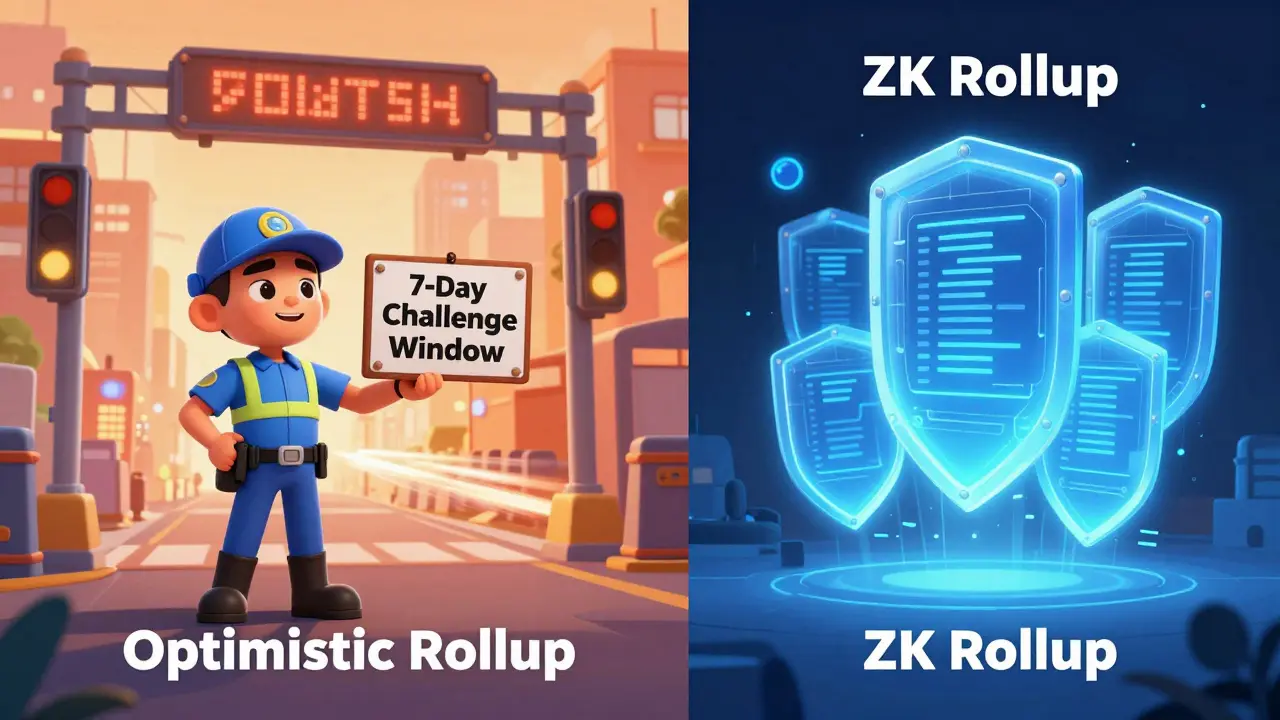
Not all Layer 2 networks are built the same. By mid-2026, two distinct technical approaches dominate the market: Optimistic Rollups and Zero-Knowledge (ZK) Rollups. Understanding the difference between them helps you choose where to deploy your funds or build your app.
- Optimistic Rollups: These networks assume transactions are valid by default. They post data to Ethereum immediately. However, there is a catch: a seven-day "challenge window." During this week, anyone can dispute a transaction if they believe it’s fraudulent. If no one challenges it, the funds are finalized. This approach is cheaper to develop and currently hosts the most value. Major players include Arbitrum One, Optimism, and Coinbase’s Base.
- ZK Rollups: These use complex cryptography to prove transactions are valid before they even hit the network. There is no challenge window. Finality happens in minutes, not days. This is technically superior but harder to build. Leaders here are zkSync Era and Starknet.
A third category, Plasma chains and State Channels, largely faded from mainstream relevance after 2020 due to usability issues, leaving rollups as the clear winners.
Comparing the Giants: Arbitrum, Optimism, Base, and zkSync
If you are new to Layer 2, the sheer number of networks can be overwhelming. As of late 2025 and into 2026, four ecosystems stand out based on Total Value Locked (TVL), user activity, and developer support.
| Network | Type | Avg. Fee (USD) | Key Strength | Best For |
|---|---|---|---|---|
| Arbitrum One | Optimistic | $0.008 | Highest TVL ($18.3B), mature DeFi ecosystem | Traders seeking deep liquidity |
| Optimism | Optimistic | $0.009 | OP Stack modularity, strong governance | Developers building interoperable apps |
| Base | Optimistic | $0.005 | Coinback integration, massive user growth | Retail users entering from Coinbase |
| zkSync Era | ZK Rollup | $0.0015 | Lowest costs, instant finality | Micro-transactions and high-frequency trading |
| Starknet | ZK Rollup | $0.002 | High compute power (Cairo VM) | Gaming and complex applications |
Arbitrum remains the king of total value locked, holding over $18 billion in assets. It feels like "Ethereum but faster" because it supports almost all existing smart contracts without changes. Base, powered by Coinbase, has exploded in popularity because it offers a seamless bridge for millions of retail users who already hold accounts there. Meanwhile, zkSync and Starknet are pushing the boundaries of what’s possible computationally, making them ideal for gaming and real-world asset tokenization.
The Hidden Risks: Centralization and Bridges
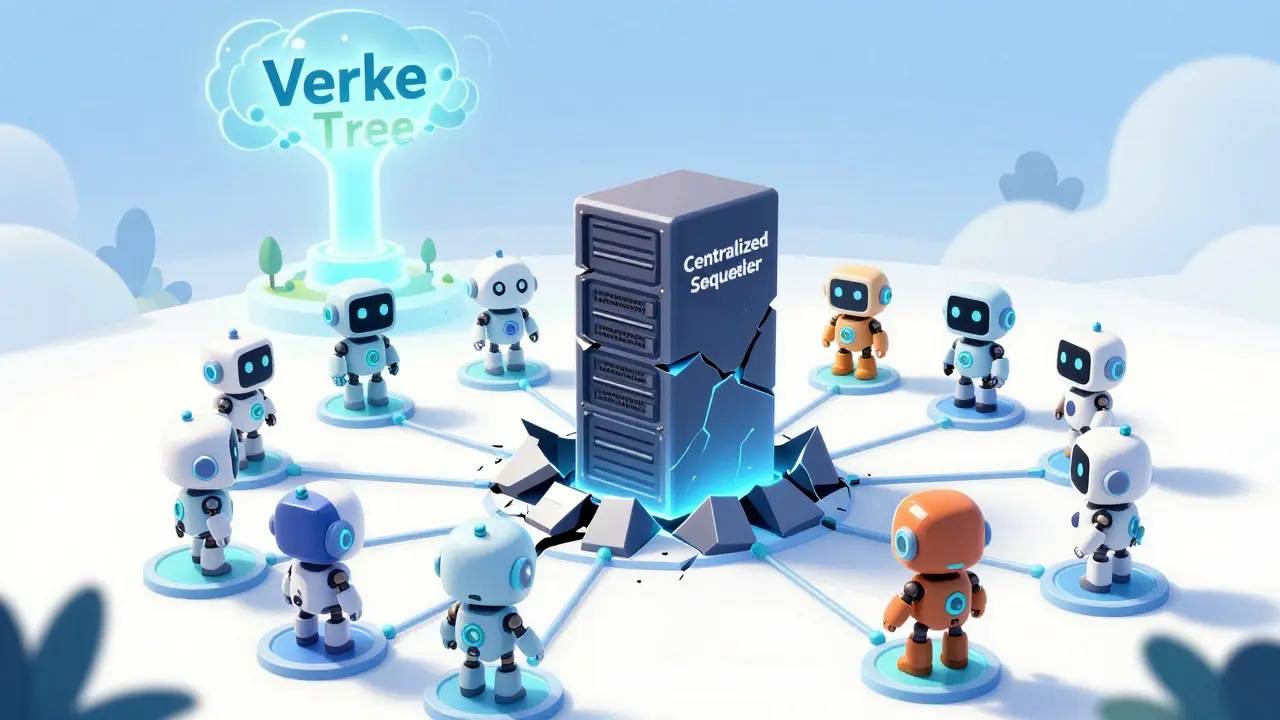
While Layer 2 solves the cost and speed problem, it introduces new risks. The biggest issue right now is sequencer centralization. A sequencer is the entity that orders transactions before posting them to Ethereum. Currently, most major Layer 2s rely on a single centralized sequencer operated by their founding teams.
This creates a single point of failure. In April 2025, Coinbase’s Base network went down for 44 minutes when its sequencer failed, locking up access for 1.2 million users. While brief, this incident highlighted a critical vulnerability: if the operator goes offline or acts maliciously, the network stops. Vitalik Buterin has openly warned about this "timebomb," noting that nearly 90% of Layer 2 networks remain vulnerable to single points of failure.
Then there are bridges. Moving money from Ethereum mainnet to Layer 2 requires a bridge. These bridges have been the target of some of the largest hacks in crypto history. In 2025 alone, Layer 2-specific exploits resulted in over $280 million in losses. The Synapse Protocol bridge hack on Arbitrum stole $22 million by exploiting cross-chain messaging flaws. Always remember: bridging adds trust assumptions. Use reputable aggregators like LI.FI or Socket, and always double-check contract addresses. Phishing attacks often trick users into sending funds to fake tokens that share names with legitimate ones across different networks.
For Developers: Building on Layer 2 in 2026
If you are a developer, the barrier to entry has lowered, but the learning curve remains steep. Solidity knowledge is still king, but you need more than that. Arbitrum uses the Nitro stack, which involves WebAssembly (WASM). Starknet uses Cairo, a completely different programming language designed for provability. zkSync uses Zinc.
The good news is standardization. The implementation of EIP-7686 in April 2025 standardized cross-L2 communication protocols, reducing bridging failures by 63%. Tools like Chainlink CCIP now allow developers to send messages between layers securely. However, debugging remains tricky. Gas estimation on zkSync can vary by 40% between testnet and mainnet, causing unexpected reverts. Start with Arbitrum or Base if you want maximum compatibility with existing Ethereum tools. Move to ZK chains only if your application requires instant finality or massive computational throughput.
The Future: Decentralization and Verkle Trees
The industry is moving toward decentralizing sequencers. Arbitrum announced a plan to reach 50 validator nodes by early 2026. Optimism’s OP Stack v2.1 will introduce distributed sequencers later this year. This shift is crucial for maintaining Ethereum’s ethos of censorship resistance.
Looking ahead to late 2026, Ethereum’s upcoming "Verkle Tree" upgrade promises to reduce mainnet storage costs by 95%. This could change the economics of Layer 2 again, potentially allowing for even cheaper data availability. But for now, Layer 2 is not a temporary fix. As Vitalik stated in June 2025, it is the permanent architecture for Ethereum’s mass adoption. Whether you are a trader, a gamer, or a builder, your future on Ethereum is Layer 2.
Is Layer 2 safer than Ethereum mainnet?
Layer 2 inherits Ethereum's security for final settlement, meaning your funds are ultimately secured by Ethereum. However, Layer 2 introduces new risks related to the sequencer operator and the bridge contracts used to deposit funds. While the core protocol is secure, centralization risks in sequencers and historical vulnerabilities in bridges mean you must vet the specific network and bridge you are using.
What is the difference between Arbitrum and Optimism?
Both are Optimistic Rollups, so they function similarly regarding fraud proofs and 7-day withdrawal windows. Arbitrum generally has higher Total Value Locked (TVL) and a more mature DeFi ecosystem, making it popular for traders. Optimism focuses heavily on modularity through its OP Stack, allowing other chains to launch easily, and has a strong focus on community governance and public goods funding.
Why are ZK Rollups considered better than Optimistic Rollups?
ZK Rollups provide cryptographic proof of validity instantly, eliminating the 7-day challenge window required by Optimistic Rollups. This results in faster finality (minutes vs. weeks) and potentially lower data costs. However, ZK technology is more complex to implement and currently supports fewer types of smart contracts compared to the near-perfect EVM compatibility of Optimistic Rollups.
How do I move my ETH from Mainnet to Layer 2?
You use a bridge. Most Layer 2 networks have official bridges on their websites. Alternatively, you can use decentralized aggregators like LI.FI or Socket, which find the cheapest and fastest route. Never click links from social media; always navigate directly to the official site. Be aware that bridging takes time-optimistic rollups may require waiting for the transaction to be posted to Ethereum before you can withdraw back.
Will Layer 2 replace Ethereum mainnet?
No. Ethereum mainnet will remain the base layer for security, consensus, and high-value settlement. Layer 2 networks are execution layers that handle daily transactions. Think of Ethereum as the federal court system (secure, slow, final) and Layer 2 as local courts (fast, cheap, handling volume). They work together, not against each other.