

Imagine holding an asset that your government wants to control every move of. That is the reality for Iranians navigating the world of digital assets today. The legal status of cryptocurrencies in Iran is not a simple yes or no. It is a complex mix of strict state oversight, specific licensing requirements, and heavy penalties for those who operate outside the system. While you can technically buy, sell, and mine digital coins, you do so under the watchful eye of the Central Bank of Iran (CBI), which holds direct access to your transaction data.
This guide breaks down exactly what is allowed, what is banned, and how the recent regulatory shifts in 2025 have changed the game for both everyday users and professional miners. Whether you are looking to hedge against inflation or set up a mining farm, understanding these rules is critical to avoid legal trouble.
Key Takeaways
- Cryptocurrency is legal but heavily regulated: Trading and mining are permitted only through CBI-approved channels with full data transparency.
- Mining requires a license: Unlicensed mining is illegal; operators must pay export-level electricity rates and sell output to the state via NIMA.
- New taxes apply: A capital gains tax on crypto trading was introduced in August 2025, aligning it with other speculative assets like gold.
- Stablecoin shifts: Due to external pressures, many users migrated from USDT to DAI on the Polygon network in mid-2025.
- Enforcement is active: The government has seized over 250,000 unauthorized devices and dismantled hundreds of illegal farms.
The Regulatory Framework: Who Controls What?
The Central Bank of Iran is the sole authority governing the "ramzpol" (digital currency) market. Following a directive by President Masoud Pezeshkian in January 2025, the CBI gained unrestricted access to all statistics, records, and data related to crypto activities. This means there is no privacy shield for your transactions if they occur within the official ecosystem.
The framework aims to balance economic benefits with security concerns. The government worries about money laundering, power grid strain, and sanctions evasion. To manage this, they issued Executive Order 2025-01, which mandates that all market participants-individuals, businesses, and legal entities-must secure licenses from the CBI. If you want to hold or exchange digital assets legally, you need to go through designated accounts approved by the central bank. Brokers must conduct rial transactions transparently, ensuring the state can track the flow of funds.
Mining in Iran: Legal Requirements vs. Reality
Mining became officially legal in 2019, but the conditions are tough. You cannot just plug in a machine and start hashing. Miners must obtain a license from the Ministry of Industry, Mine and Trade. Once licensed, you face two major hurdles: hardware restrictions and electricity costs.
You are required to use only government-approved hardware. More importantly, you do not get subsidized domestic electricity rates. Instead, your bills are pegged to export prices, which are significantly higher. This is designed to prevent miners from draining the national power grid at the expense of regular households.
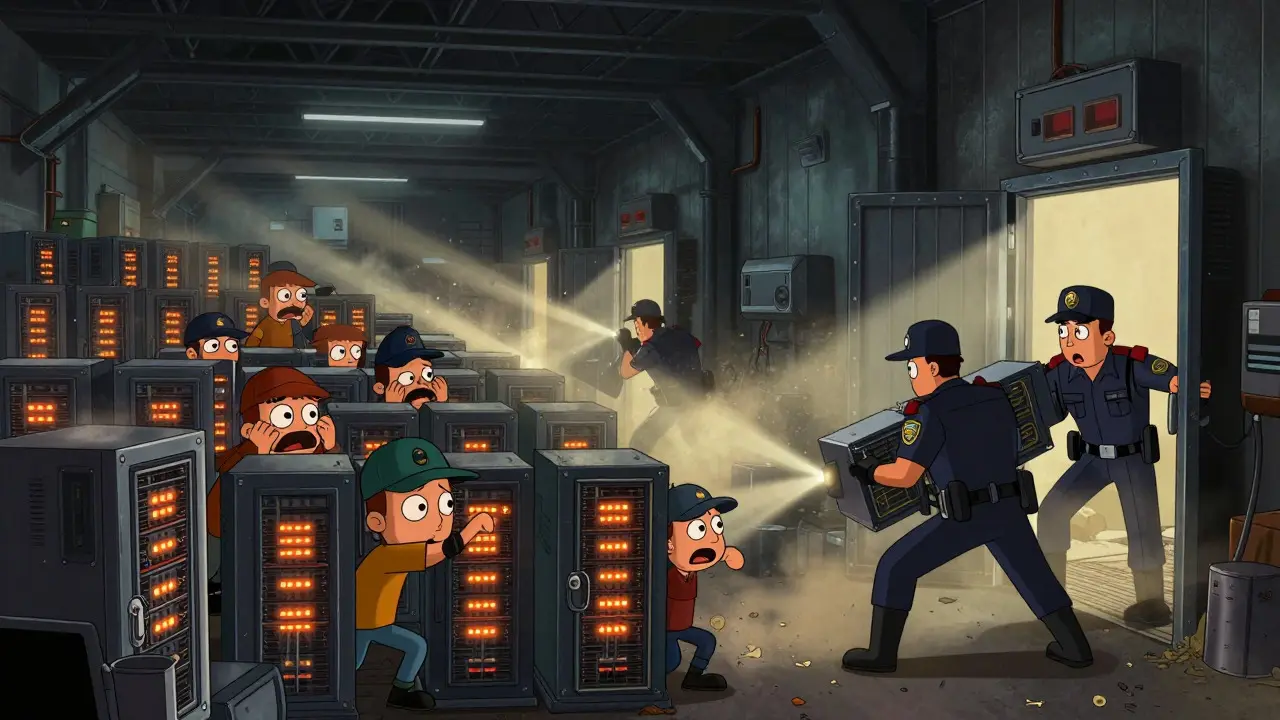
Here is the catch: despite legalization, experts estimate that around 95% of mining activity in Iran still operates illegally. In August 2025, the Ministry of Energy launched a program encouraging citizens to report illegal operations. So far, authorities have dismantled approximately 100 unauthorized farms and seized more than 250,000 devices. If you are considering mining, the risk of seizure is high unless you are fully compliant with the CBI and Ministry of Energy rules.
| Feature | Legal Mining | Illegal Mining |
|---|---|---|
| Licensing | Required from Ministry of Industry | None (Risk of seizure) |
| Electricity Rate | Export price (High) | Subsidized domestic rate (Low) |
| Sales Channel | Must sell to CBI via NIMA | Free market/OTC |
| Hardware | Government-approved only | Any available hardware |
| Risk Level | Low (Compliance focus) | High (Seizure/Fines) |
Taxation and Financial Compliance
In August 2025, Iran enacted the Law on Taxation of Speculation and Profiteering. This was a landmark moment because it imposed a capital gains tax on cryptocurrency trading for the first time. Crypto is now treated similarly to gold, real estate, and forex markets. The implementation began in Q3 2025, meaning traders need to keep accurate records of their profits to stay compliant.
This tax change signals Tehran's intent to formally integrate digital assets into the broader tax framework. It also adds another layer of complexity for users. You are not just dealing with market volatility; you are dealing with a tax authority that expects you to report gains. For ordinary Iranians using crypto as a hedge against inflation, this increases the cost of holding long-term positions.
Market Dynamics and the Stablecoin Shift
Despite strict rules, the Iranian crypto market remains active. In 2022, local exchanges processed nearly $3 billion in transactions, with Nobitex handling 87% of the volume. By 2025, Nobitex maintained its dominance, though overall volumes declined by 11% year-over-year, reaching approximately USD 3.7 billion between January and July 2025.
A significant event occurred in July 2025 when Tether froze addresses with Iranian exposure. This forced a rapid migration of users from USDT to DAI via the Polygon network. Exchanges, influencers, and government-aligned channels urged users to swap their holdings to preserve liquidity. This shift demonstrated the ecosystem's adaptability but also highlighted the vulnerability of relying on foreign-issued stablecoins under sanctions pressure.
For most everyday Iranians, crypto serves as a vital tool against financial instability. Illicit transactions account for only 0.9% of total activity on Iranian exchanges, according to TRM Labs. The majority of usage is driven by the need to protect savings from hyperinflation rather than illicit trade.

Practical Steps for Users and Businesses
If you are operating within Iran, here is how to navigate the current landscape:
- Verify Your License: Ensure any exchange or broker you use is CBI-approved. Check if they have a direct payment gateway within the regulatory framework.
- Track Your Taxes: Keep detailed records of every trade. With the new capital gains tax, unreported profits could lead to penalties.
- Monitor Stablecoin Options: Given the USDT freeze, diversify into other stablecoins like DAI on supported networks like Polygon to mitigate counterparty risk.
- Stay Updated on Mining Rules: If you are a miner, confirm your hardware is approved and your electricity contract reflects the correct export-tier rates.
- Watch for Enforcement: Be aware of local enforcement actions. Reporting hotlines for illegal mining are active, and neighbors may report unlicensed setups.
Frequently Asked Questions
Is it legal to hold Bitcoin in Iran?
Yes, holding Bitcoin is legal, but you should ideally do so through CBI-approved channels to ensure compliance. The Central Bank has direct access to data on registered participants, so unofficial holding methods carry higher regulatory risk.
What happens if I mine without a license?
You risk having your equipment seized and facing fines. The government has already seized over 250,000 unauthorized devices. Additionally, you may be liable for back-taxes on electricity usage if caught using subsidized rates.
Which exchange is the largest in Iran?
Nobitex is the dominant player, handling the vast majority of domestic trading volume. It processes transactions in Rial and offers various crypto pairs, serving as the primary hub for retail investors.
Do I need to pay tax on my crypto profits?
Yes. Since August 2025, a capital gains tax applies to cryptocurrency trading. It is treated similarly to other speculative assets like gold and real estate. Accurate record-keeping is essential for compliance.
Can I use USDT freely in Iran?
Usage has become more complex since Tether froze some Iranian-linked addresses in July 2025. Many users have shifted to DAI on the Polygon network to maintain liquidity. Always check the current status of stablecoin support on your chosen exchange.
Kelsey Anne
August 17, 2026 AT 08:47Finally some transparency. The CBI is doing the right thing by cracking down on unlicensed miners who drain the grid.
Carmene Jackson
August 18, 2026 AT 05:15It just feels so heavy knowing they can see every single move you make, doesn't it? Like there's no escape from their gaze. It makes me feel like I'm living in a fishbowl myself sometimes.
Jennifer Ulmer
August 18, 2026 AT 22:35I think the key here is that they are trying to balance things out. If everyone mines illegally, the power goes out for hospitals and schools. So maybe the strict rules are necessary for the greater good of the grid stability.
Jade Brown
August 19, 2026 AT 13:50Let’s not kid ourselves about this 'transparency' nonsense. It’s a classic state capture play. By pegging electricity rates to export prices, they aren’t protecting the grid; they’re engineering a margin squeeze to force small operators into bankruptcy or compliance with state-owned entities. The 'legal' mining sector is essentially a subsidized monopoly for those with political connections, while the rest are priced out by artificial cost structures designed to kill competition. It’s textbook rent-seeking behavior disguised as regulatory hygiene.
Stephanie Millar
August 20, 2026 AT 21:16From a British perspective, we often assume regulation means protection! But here, it seems to mean control. The shift from USDT to DAI on Polygon is fascinating though, shows how resilient these communities are when the floor drops out from under them. It’s a bit chaotic, but very human!
Nikki keller
August 22, 2026 AT 06:20It is interesting to observe how the legal framework shifts based on external pressure rather than internal logic. The migration to DAI wasn't just a preference change; it was a survival mechanism against sanctions risk. This highlights that for many users, crypto is less about investment and more about preserving purchasing power in a volatile currency environment.
miranda gamboa
August 24, 2026 AT 02:36So basically, if you want to mine, you need the license AND the high bill AND the approved hardware? That sounds like a recipe for disaster for any independent miner. How does anyone stay profitable with those constraints? It feels like the door is closed unless you're part of the inner circle.
Kiran Jayaram
August 24, 2026 AT 05:38typical western bias calling this 'control' when its actually just basic market discipline. look at india, we have our own issues with crypto taxes but at least we dont let random guys run illegal farms in their backyards stealing subsidized power. iran is just cleaning up its act before the global markets catch up. stop crying about your privacy, its called accountability
Uday N M
August 24, 2026 AT 20:20The narrative of 'sanctions evasion' is overblown. Most usage is for inflation hedging. The government knows this. They are regulating to tax, not to ban. The seizure of 250k devices is a show of force to ensure compliance with the new tax regime, not a war on crypto.
Melissa G
August 26, 2026 AT 04:29One must consider the cultural context of financial instability. When a local currency loses value rapidly, the desire to hold hard assets becomes a primal instinct rather than a speculative choice. The regulations, while strict, acknowledge this reality by allowing trading through official channels, albeit with reduced privacy. It is a compromise between state security and individual economic survival.
Patrick Pat
August 27, 2026 AT 00:00So let me get this straight. You pay export-level electricity rates, which are higher than what foreign companies pay, to mine coins that you then have to sell to the state via NIMA. And the reward for all this compliance is... a capital gains tax? Brilliant strategy. Truly the height of economic innovation.
Claudio Perrone
August 28, 2026 AT 19:36its basically the end of the road for retail miners. i dont see how this works unless you have deep pockets. the whole thing feels rigged from the start. why even bother going legal if the margins are crushed by the state?
Aaron Morrissey
August 30, 2026 AT 14:16It is, without a doubt, a masterclass in bureaucratic suffocation. To require one to sell output exclusively to the state at a dictated rate, while simultaneously imposing punitive energy tariffs, is to create an environment where only the most politically connected can survive. It is not regulation; it is nationalization by attrition. The 'license' is merely a leash, ensuring that the private sector serves the public purse, or rather, the state's coffers, without the inconvenience of true market freedom.
Sarah Campbell
August 30, 2026 AT 16:38This is exactly what happens when governments don't understand tech! 🙄 They think they can just slap a license on everything and call it a day. Meanwhile, the real innovation is happening off-chain or on altcoins like DAI because USDT froze people out. 😡 Total chaos.
Sonia Gomez Gomez
August 31, 2026 AT 07:47You really should be more careful with your words, dear. ~ It's not 'chaos', it's order. The government is just trying to keep the lights on for the rest of us. If you don't like the rules, maybe you shouldn't be mining in the first place. Just sayin'. ~
SHIV SHANKAR KANTA
September 1, 2026 AT 07:49the tragedy of modern finance is that we trade liberty for security and receive neither. the state demands your data, your profits, and your silence in return for the privilege of existing within its borders. it is a philosophical dead end. we are all prisoners of our own greed and the state's hunger
Daniel Brown
September 2, 2026 AT 14:17Let's look at the numbers again. Nobitex handled 87% of volume. That is a massive concentration of risk. If the CBI decides to pull the plug on Nobitex, half the Iranian crypto market disappears overnight. The 'diversification' to DAI is smart, but the reliance on a single domestic exchange hub is a ticking time bomb waiting to go off.
Marco Maldonado
September 3, 2026 AT 16:50Nobitex is the only game in town so what do you expect? Everyone uses it because it works. Yes its risky but the alternative is using shady OTC desks or holding USD cash that loses value daily. Its the lesser of two evils. Stop complaining and buy your DAI already lol
Darren Moon
September 5, 2026 AT 04:22One might argue that the concentration of market share in a single entity is not a bug, but a feature of a heavily regulated ecosystem. In such environments, the 'dominant player' often acts as a de facto regulator, enforcing norms that the state prefers to leave implicit. The decline in overall volume suggests a maturing, if somewhat stagnant, market where speculative fervor has been tempered by the cold reality of fiscal policy. It is a sobering reminder that liquidity is a fickle mistress, especially when her suitor holds the pen that writes the law.