

Crypto mining in Georgia is legal - and it’s getting easier
Georgia doesn’t just allow crypto mining. It’s actively inviting it. As of 2025, the country is one of the top 10 mining hubs in the world, accounting for about 5% of global hash power. That’s up from less than 1% in 2019. Why? Because Georgia made mining simple, cheap, and legal - without the red tape that chokes operations elsewhere.
Who can mine? Individuals and businesses both benefit
If you’re an individual miner running a few rigs in your garage, Georgia treats you like a hobbyist. No taxes on mining profits. No registration. No paperwork. You keep every bitcoin or ether you mine. That’s rare. Most countries tax crypto as income or capital gains. Georgia doesn’t. For personal miners, it’s the closest thing to a free pass.
For businesses, it’s different - but still straightforward. You don’t need a special mining license. You don’t need to apply to the National Bank of Georgia just to run servers. But if your business handles crypto transactions, exchanges, wallets, or acts as a service provider for others, then you fall under the VASP (Virtual Asset Service Provider) rules. That’s the only real licensing requirement.
The two paths to legal operation: VASP vs. Tbilisi Free Zone
Georgia gives you two options to operate legally as a business. The first is the mainland VASP license, issued by the National Bank of Georgia. It’s mandatory if you’re offering crypto services like trading, custody, or staking. It requires AML/KYC compliance, employee training, security audits, and ongoing reporting. The cost? Around $5,000-$10,000 to set up, plus annual renewal fees.
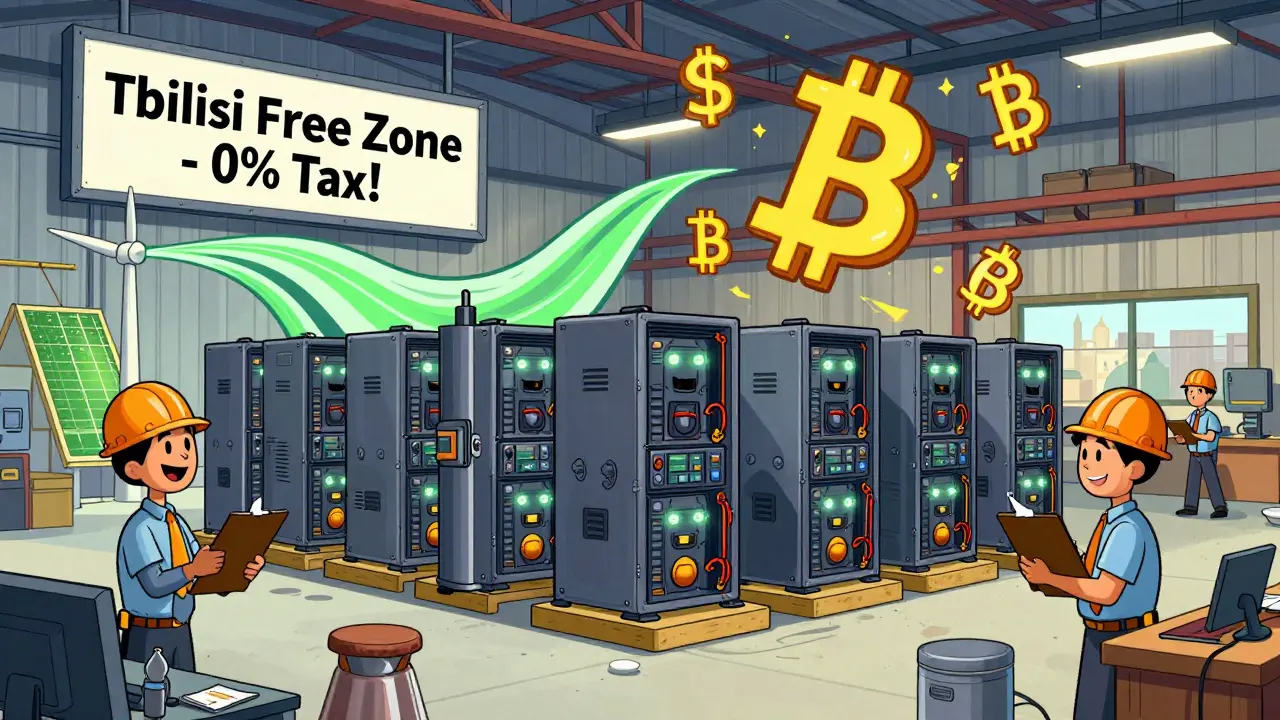
The second option is the Tbilisi Free Zone (FIZ) crypto license. This is for companies that want to operate offshore-style within Georgia. FIZ licenses offer zero corporate tax, no VAT, and no currency controls. You still need to register your company in the free zone, but you avoid most of the heavy compliance burden of the mainland VASP system. Many mining farms choose FIZ because they’re focused on hardware and electricity - not trading or wallet services.
Here’s how they compare:
| Feature | Mainland VASP License | Tbilisi Free Zone (FIZ) License |
|---|---|---|
| Required for mining? | No | No |
| Required if you trade or custody crypto? | Yes | Yes |
| Corporate tax | 15% | 0% |
| AML/KYC compliance | Strict, mandatory | Mandatory, but lighter |
| Annual renewal cost | $1,500-$3,000 | $500-$1,000 |
| Best for | Exchanges, wallet providers | Miners, hardware operators |
Energy is the real advantage - not just taxes
Georgia’s electricity isn’t just cheap. It’s abundant and clean. Over 90% of the country’s power comes from hydropower. That means low emissions and stable pricing. Crypto mining uses a lot of electricity, but in Georgia, it only accounts for about 2% of total national consumption. That’s low compared to Kazakhstan (10%) or the U.S. (over 3%).
Why does that matter? Because cooling costs kill profits. Georgia’s mountainous regions - like Svaneti and Kazbegi - are naturally cool. Miners set up in old Soviet-era buildings or repurposed factories and don’t need expensive air conditioning. One operator in Kutaisi reported cutting cooling costs by 60% just by choosing a high-altitude location.
Plus, the government doesn’t cap energy use for miners. No blackout threats. No rationing. That’s not true in China, Russia, or even Texas. Georgia lets you plug in and run.
Compliance isn’t optional - but it’s manageable
The National Bank of Georgia, through its Financial Monitoring Service, is serious about stopping money laundering. Every business with a VASP license must:
- Verify customer identities (KYC)
- Report suspicious transactions
- Train staff on AML/CFT rules
- Keep records for five years
These rules came into full effect in 2023 and were strengthened in 2024 after IMF recommendations. The system isn’t perfect, but it’s transparent. If you’re a legitimate miner, you won’t be burdened. If you’re trying to hide dirty money, you’ll get caught.
One company in Tbilisi got flagged in 2024 because they were moving large sums between anonymous wallets without customer data. The FMS froze their account. They had to prove their customers were real. After 8 weeks of documentation, they got back online. The lesson? Don’t skip KYC - even if you think you’re just a miner.
Where are miners setting up shop?
Location matters. Small-scale miners (under 500 kW) tend to cluster in the mountains: Bakuriani, Mestia, and Sighnaghi. These areas have cheap or even free power for locals, and the cold air keeps rigs cool.
Larger operations (over 1 MW) go to industrial zones: Tbilisi, Kutaisi, and Batumi. These cities have grid stability, fiber-optic internet, and access to skilled labor. Kutaisi, in particular, has become a mining hotspot because of its low land costs and government incentives for tech startups.
Some miners even rent space in data centers that already host servers for banks and telecoms. It’s cheaper than building your own facility, and you get backup power and security built in.
What’s next? The 2026 deadline changes everything
By 2026, Georgia will fully implement its VASP framework. That means:
- All crypto service providers must be registered
- On-chain transaction monitoring will be mandatory
- Offshore structures will face stricter scrutiny
Right now, the FIZ license is a loophole. But the National Bank is watching. They’re not shutting it down - they’re tightening it. If you’re thinking of starting a mining business, do it now. The window for easy setup is closing.
Also, energy usage reporting is coming. The government is already testing a system that tracks how much power each mining facility uses. It won’t cap you - but it will make you accountable. Transparency is the new norm.

Why Georgia beats the competition
Compare Georgia to other mining countries:
- China: Banned mining in 2021. Done.
- Kazakhstan: High taxes, power cuts, political risk.
- United States: Patchy state laws, high electricity, environmental pushback.
- Russia: Unclear legality, sanctions risk, unreliable grid.
Georgia has none of those problems. It’s stable, legal, cheap, and clear. No one’s trying to ban you. No one’s raising your taxes. You just plug in and mine.
What you need to do to start
If you’re an individual:
- Buy your mining rig.
- Find a place with cheap electricity (mountain village or rural area).
- Plug it in. Keep your receipts. You owe zero tax.
If you’re a business:
- Decide: Are you just mining? Or are you trading, staking, or offering wallets?
- If only mining → Register a company in Georgia (cost: $500-$1,000).
- If offering services → Apply for a VASP license or FIZ license.
- Set up KYC/AML systems.
- Open a local bank account (most banks now accept crypto businesses if they’re compliant).
- Start mining.
It takes 4-6 weeks to get a FIZ license. VASP can take 8-12 weeks. But once you’re in, you’re in for good.
Bottom line: Georgia is the easiest place to mine crypto right now
No country offers this combo: zero tax for individuals, low-cost energy, clear rules, and no political risk. If you’re serious about mining, Georgia isn’t just an option - it’s the smartest one.
Don’t wait for the rules to get harder. The window is open. Move now.
Is crypto mining legal in Georgia in 2025?
Yes, crypto mining is fully legal in Georgia in 2025. Both individuals and businesses can mine without a ban. The government actively encourages it as part of its strategy to become a regional blockchain hub.
Do I need a license to mine crypto in Georgia?
No, individual miners don’t need a license. Businesses don’t need a mining-specific license either. But if your business provides crypto services - like exchanges, wallets, or staking - you must register as a VASP or get a Tbilisi Free Zone license.
Is crypto mining taxed in Georgia?
No, individuals pay zero tax on mining profits. For businesses, corporate tax is 15% on the mainland, but 0% if you operate through the Tbilisi Free Zone. Mining income is treated as personal property, not income, so no capital gains or income tax applies to individuals.
What’s the difference between VASP and FIZ licenses?
The VASP license is for businesses offering crypto services under Georgia’s main regulatory system. It requires strict AML/KYC and costs more. The FIZ license is for offshore-style operations in the Tbilisi Free Zone - zero corporate tax, lighter compliance, and lower fees. FIZ is better for pure mining; VASP is needed for trading or custody.
Can I mine crypto at home in Georgia?
Yes, and it’s one of the best places in the world to do it. No registration, no taxes, and low electricity costs - especially in mountain regions. Many people mine as a side hustle with just 2-5 rigs.
What happens if I don’t comply with AML rules?
The Financial Monitoring Service can freeze your accounts, shut down your operation, and report you to international agencies. If you’re a business, non-compliance can lead to license revocation and fines. Don’t skip KYC or transaction reporting - even if you think you’re just a miner.
Is Georgia’s crypto mining boom sustainable?
Yes. With 90% renewable energy, stable government policy, and growing infrastructure, Georgia is built to last. The 2026 VASP deadline will clean up the market, but it won’t kill it. Legitimate miners will thrive. The country is betting big on blockchain - and it’s winning.
Krista Hewes
December 7, 2025 AT 23:12ronald dayrit
December 9, 2025 AT 10:28Doreen Ochodo
December 10, 2025 AT 19:06Yzak victor
December 12, 2025 AT 14:06Holly Cute
December 13, 2025 AT 07:21Josh Rivera
December 14, 2025 AT 08:34Neal Schechter
December 15, 2025 AT 20:50Madison Agado
December 16, 2025 AT 03:01Tisha Berg
December 16, 2025 AT 12:44Billye Nipper
December 17, 2025 AT 05:36Roseline Stephen
December 18, 2025 AT 18:25Jon Visotzky
December 19, 2025 AT 17:39Isha Kaur
December 19, 2025 AT 21:50Glenn Jones
December 20, 2025 AT 14:04Joe West
December 20, 2025 AT 14:53