
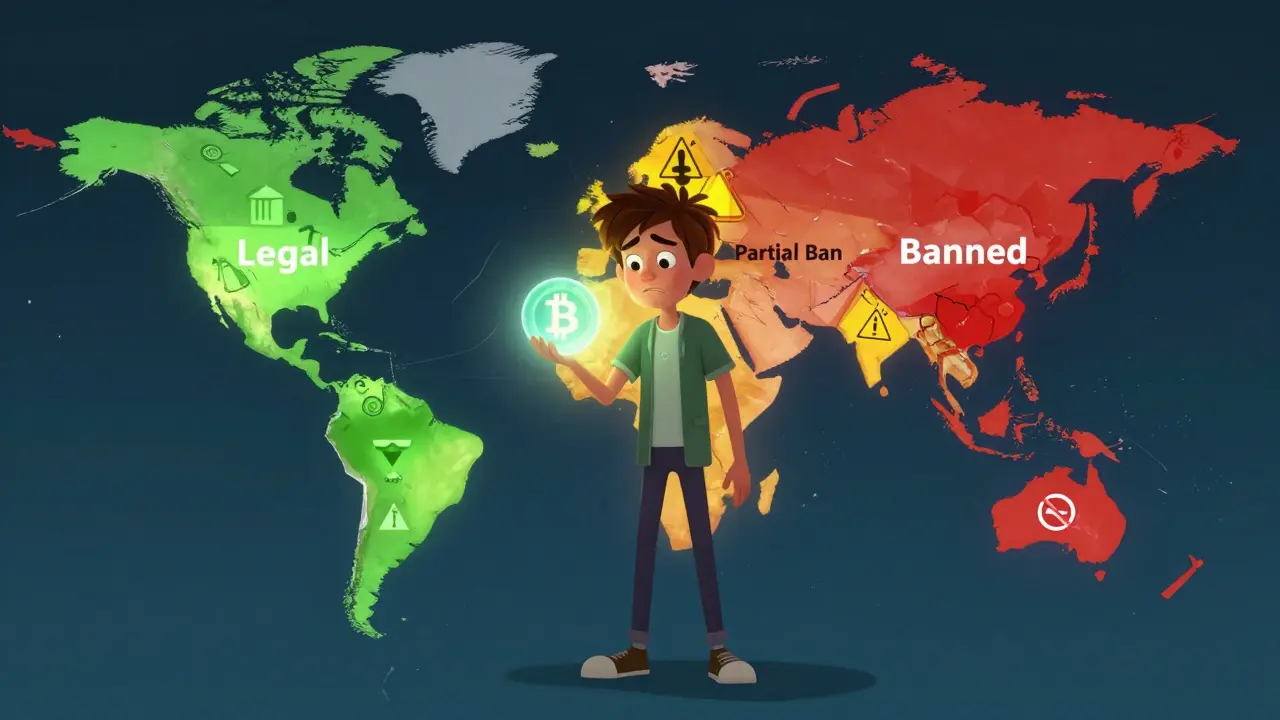
You might think that buying Bitcoin or holding Ethereum is a harmless personal choice. But if you live in certain parts of the world, that simple act can land you in serious legal trouble. The global landscape for cryptocurrency is a decentralized digital currency that operates independently of a central bank is fractured. While some nations embrace it, others have drawn a hard line, imposing criminal penalties on anyone who buys, sells, or even holds these assets.
The reality is that enforcement varies wildly. In some countries, the law is clear but ignored by locals using peer-to-peer apps. In others, the penalties are severe and actively enforced. Understanding where you stand isn't just about avoiding fines; it’s about protecting your freedom and financial security. Let’s look at what happens when you cross the line in jurisdictions with strict crypto bans.
The Global Split: Legal, Partial, and Banned
To understand the risk, you first need to know where you fit. The Atlantic Council’s Cryptocurrency Regulation Tracker (2025) analyzed 75 countries and found a stark divide. Forty-five nations fully legalize crypto. Twenty have partial bans, often restricting banks from dealing with it while allowing individuals to hold it. Then there are the ten countries with general bans, where the activity is outright prohibited.
The primary goal of these bans is usually national security and financial stability. Governments want to prevent money laundering, terrorist financing, and capital flight. For example, the TRM Labs 2025 Crypto Crime Report highlights how sanctions target entities supporting illicit economies through virtual currencies. When a country bans crypto, they are trying to close the door on anonymous transactions that bypass state control.
| Status | Number of Countries | Typical Enforcement Focus |
|---|---|---|
| Fully Legal | 45 | Tax compliance, consumer protection |
| Partially Banned | 20 | Banks and financial institutions restricted |
| Generally Banned | 10 | Individual usage, trading, and mining |
Strict Bans: Algeria, Morocco, and Egypt
In North Africa, the stance is uncompromising. Algeria prohibits the purchase, sale, use, and holding of virtual currency under Article 117 of its official journal from December 28, 2017. The law states that any breach is punishable according to existing laws. However, the specific penalty amounts are rarely quantified in public records, leaving users in a gray area of potential severity.
Morocco takes a similar approach. The Office des Changes declared in November 2017 that transactions via virtual currencies infringe on exchange regulations. Bank Al-Maghrib Governor Abdellatif Jouahri clarified that Bitcoin is not currency but a risky financial asset. Violations here can lead to significant fines and legal action under foreign exchange laws.
Egypt maintains an outright prohibition on individuals, banks, and financial institutions dealing in cryptocurrencies. While the documentation doesn't always specify exact jail terms for every minor transaction, the intent is clear: participation is illegal. Users in these regions often rely on circumvention methods, but the legal risk remains high.

China: The Business vs. Individual Distinction
China represents one of the strictest regulatory environments globally. Since 2021, the country has implemented comprehensive bans on exchanges, trading, and crypto mining. The enforcement mechanism here is interesting because it primarily targets business operations rather than individual holders.
If you run a crypto business in China, you face severe criminal consequences. However, for the average person holding Bitcoin, the penalties are less documented. Chainalysis estimated $28.7 billion in peer-to-peer cryptocurrency transactions originated from China in 2024 despite official prohibitions. This suggests that while the state cracks down on infrastructure, individual possession is often tolerated unless linked to fraud or large-scale capital flight.
Sanctions as the New Penalty
A growing trend in 2025 is the use of sanctions instead of blanket criminalization. The U.S. Department of the Treasury's Office of Foreign Assets Control (OFAC) increasingly targets specific illicit actors. For instance, OFAC issued 13 sanctions designations including 86 cryptocurrency addresses targeting Russia-related entities in 2024.
This approach hits harder than a simple ban. If your wallet address gets sanctioned, you lose access to the global financial system. Banks will freeze your accounts, and exchanges will block your funds. Cases like Elena Chirkinyan and Khadzi-Murat Dalgatovich Magomedov show that involvement in money laundering through crypto leads to international designation and severe asset forfeiture.
Similarly, Mustafa Ayash, founder of GazaNow, was sanctioned for raising funds for Hamas. These cases demonstrate that terrorist financing triggers the most aggressive enforcement actions worldwide. It’s not just about breaking a local ban; it’s about violating international anti-money laundering (AML) standards.

Enforcement Gaps and User Reality
Here is the uncomfortable truth: bans are often ineffective. Dr. Sarah Bloom Raskin, former Deputy Secretary of the U.S. Treasury, noted in January 2025 that criminalization creates significant enforcement challenges when adoption rates remain high. The Atlantic Council’s data supports this, showing no significant correlation between regulatory restrictiveness and actual usage levels.
Users in banned countries find ways around restrictions. On Reddit’s r/CryptoCurrency, a March 2025 thread revealed experiences from Algeria, Morocco, and Egypt. One user reported successful use of LocalBitcoins for 18 months without incident in Morocco. Another noted frequent payment processor blocks but no personal legal consequences in Egypt.
However, this luck is not guaranteed. A CoinDesk survey in May 2025 found that 12% of respondents in banned jurisdictions did report personal legal consequences. Trustpilot reviews of platforms like KuCoin, which is prohibited in Canada, show common themes of account freezes when KYC verification fails. The risk is real, even if many fly under the radar.
The Shift Toward Targeted Regulation
The global narrative is shifting. Blanket criminalization is giving way to targeted enforcement. The U.S. Department of Justice’s April 2025 memorandum, "Ending Regulation by Prosecution," re-scoped digital asset enforcement to prioritize misappropriation of client assets, sanctions evasion, fraud, and unlicensed money transmission.
This means regulators care less about you simply holding Bitcoin and more about whether you are using it to commit crimes. South Korea’s Virtual Asset Users Protection Act (2023) exemplifies this nuance, focusing on record-keeping and transparency rather than criminalizing users. The European Union’s MiCA framework, implemented in 2024, also avoids criminal penalties for usage while establishing strict licensing requirements for service providers.
Even in the U.S., the GENIUS Act signed into law in July 2025 regulates stablecoins as payment instruments rather than securities. This signals a move toward functional regulation. The future looks like sophisticated enforcement mechanisms targeting bad actors, rather than sweeping bans that fail to stop everyday users.
Is it a crime to hold crypto in a banned country?
It depends on the jurisdiction. In countries like Algeria and Egypt, holding crypto is technically illegal under current laws. However, enforcement often focuses on commercial activities or large transactions rather than small personal holdings. Always consult local legal counsel, as laws can change rapidly.
What are the typical penalties for crypto violations?
Penalties vary widely. They can range from heavy fines and confiscation of assets to imprisonment, especially if the activity involves money laundering, tax evasion, or terrorist financing. Sanctions designations can also freeze your assets globally, making them inaccessible.
How do people use crypto in banned countries?
Many users turn to peer-to-peer (P2P) platforms like LocalBitcoins or decentralized finance (DeFi) protocols that do not require identity verification. However, this carries significant risk, including scams, frozen accounts, and potential legal repercussions if authorities trace the transactions.
Is China still banning crypto?
Yes, China maintains a comprehensive ban on crypto exchanges, trading, and mining since 2021. While individual possession is not always prosecuted, any business activity related to crypto is strictly enforced with severe penalties.
What is the difference between a ban and a sanction?
A ban is a domestic law prohibiting crypto activity within a country. A sanction is an international measure, often led by bodies like OFAC, that targets specific individuals or entities involved in illicit activities. Sanctions can freeze assets globally and cut off access to the financial system, regardless of local laws.