
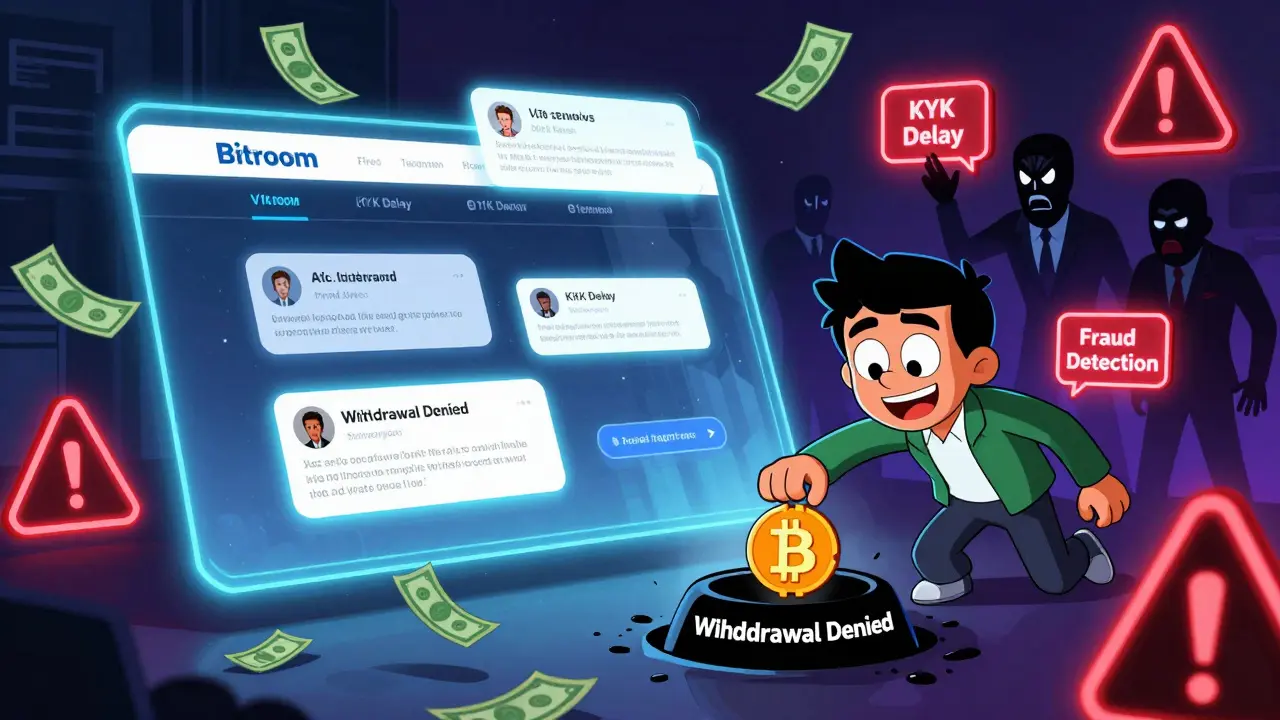
There’s no such thing as a legitimate crypto exchange called Bitroom. Not in any official database. Not on any regulated exchange list. Not even in the records of the California DFPI, Kraken, Binance.US, or Gemini. If you’ve seen a website, app, or social media ad pushing Bitroom as a place to trade Bitcoin or altcoins, you’re looking at a scam.
What Bitroom Actually Is
Bitroom doesn’t exist as a real business. It’s a fake platform built to look like a crypto exchange. The website probably has sleek graphics, fake testimonials, and a live chat that answers too fast. It might even show your balance going up - until you try to withdraw. Then the excuses start: ‘Maintenance,’ ‘KYC delay,’ ‘fraud detection.’
This isn’t new. Scammers have been doing this for years. They pick names that sound like real exchanges - Bitroom, BitBull, BitFusion, CryptoHive - anything that tricks you into thinking it’s part of the same family as Binance or Kraken. They copy the UI, steal logos, and even hire actors to pretend to be customer support. Their goal? Get you to deposit money. Then vanish.
How the Bitroom Scam Works
Here’s how it plays out in real life:
- You see an ad on Instagram or TikTok: ‘Earn 5% daily with Bitroom - guaranteed returns!’
- You click the link. The site looks professional. It even has a ‘Live Trading’ feed showing prices.
- You sign up with your email and phone. No ID needed - that’s a red flag.
- You deposit $500 in BTC or USDT. The platform credits your account instantly.
- You try to withdraw $100. The system says ‘minimum withdrawal is $500’ or ‘your account needs verification.’
- You deposit another $1,000 to ‘unlock’ your funds. Now you’re stuck.
- The site goes dark. The chat goes silent. The phone number doesn’t work.
This is called a ‘pig butchering’ scam. The name comes from how scammers ‘fatten up’ their victims with small wins before slaughtering them. One victim in California lost $179,000 to a platform just like this. He thought he was trading. He was just feeding money into a black hole.
Why Legit Exchanges Don’t Look Like Bitroom
Real crypto exchanges have public records. They’re registered with financial regulators. They publish security audits. They have physical offices. They answer to governments.
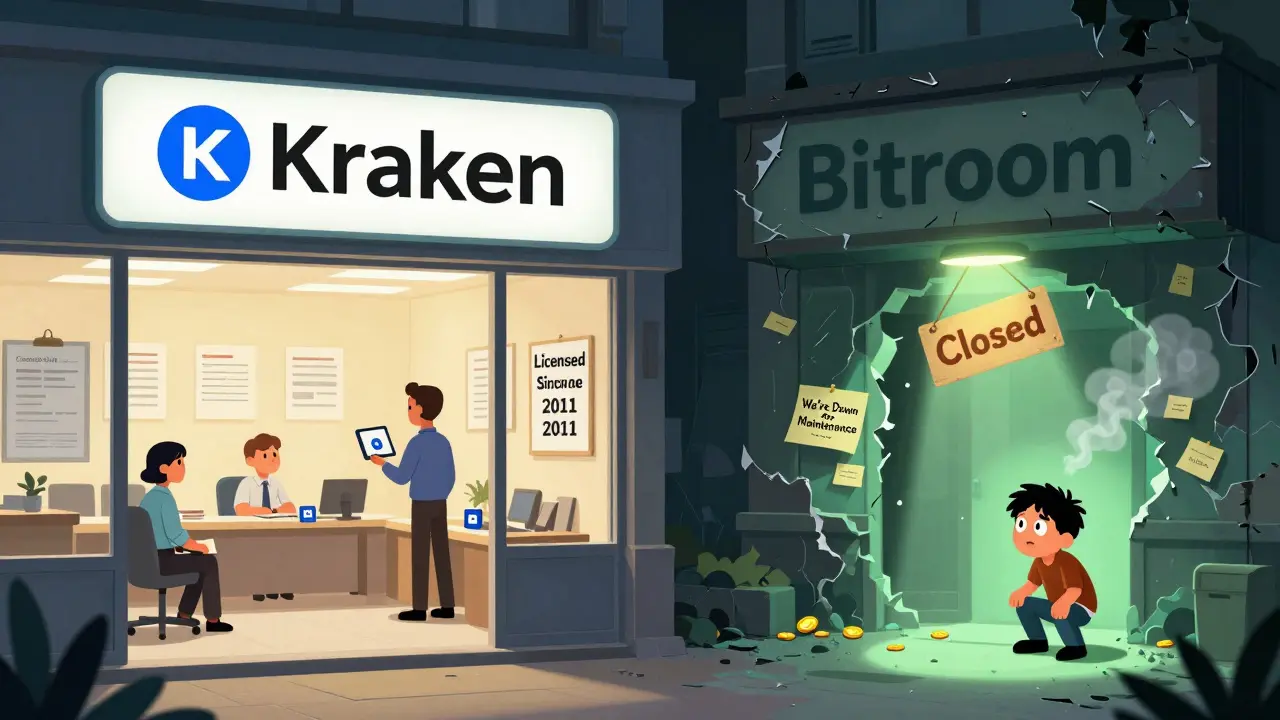
Take Kraken. It’s licensed in the U.S., EU, and Canada. It’s been around since 2011. It’s been hacked once - and they paid back every customer. That’s accountability.
BitMEX? Operated under strict compliance until it was fined $100 million by the U.S. Treasury. Even when they messed up, they were held responsible.
Bitroom? No registration. No license. No address. No history. No legal team. No audit reports. Nothing.

Red Flags That Bitroom Is a Scam
- No mention on CoinMarketCap, CoinGecko, or CryptoCompare
- No regulatory body (FinCEN, FCA, ASIC, etc.) lists it
- Website domain registered less than 6 months ago
- Only accepts crypto deposits - no bank transfers or fiat on-ramps
- Customer support replies in broken English or uses stock chatbot phrases
- Promises of guaranteed returns or ‘risk-free trading’
- Pressure to deposit quickly: ‘Limited time offer!’
If you see even one of these, walk away. If you see three or more, it’s a 100% scam.
What to Do If You’ve Already Lost Money to Bitroom
If you deposited funds into Bitroom, don’t panic - but don’t wait either.
Step 1: Stop sending more money. No matter what they say, don’t fund another deposit to ‘unlock’ your balance. That’s the classic trap.
Step 2: Report it. File a report with your local financial crime unit. In the U.S., go to IC3.gov. In the UK, use Action Fraud. In Australia, report to ACSC. In New Zealand, contact the NZ Police Financial Crime Unit.
Step 3: Share your story. The California DFPI Crypto Scam Tracker has logged over 1,200 fake exchange cases since 2022. Your report helps others avoid the same fate.
Step 4: Don’t hire a ‘recovery service.’ These are just scams inside scams. They’ll take your money too, promising to ‘trace’ your funds. They can’t. The money is gone - moved through mixers, converted to Monero, and vanished.
Where to Trade Crypto Safely in 2025
If you want to trade crypto, use platforms that have been around, been tested, and been held accountable:
- Kraken - Best for U.S. and EU users, strong security, low fees
- Binance.US - Wide selection of coins, regulated in the U.S.
- Coinbase - Simple for beginners, insured custodial wallets
- Bitstamp - One of the oldest, trusted by institutions since 2011
- Bybit - Popular for derivatives, strong track record since 2020
All of these have public company info, clear fee schedules, and verified support channels. You can call them. You can email them. You can visit their offices if you need to.
Bitroom? You can’t. And that’s the difference between a business and a trap.
How to Spot Fake Exchanges Before You Deposit
Before you sign up for any exchange, check these three things:
- Search the name + ‘scam’ - If you see even one report, walk away.
- Check CoinMarketCap or CoinGecko - Legit exchanges are listed there. If it’s not, it’s not real.
- Look up the domain registration - Go to whois.domaintools.com. If it was registered last month, that’s a huge red flag.
Also, never trust a platform that asks you to download a custom app. Legit exchanges work in your browser. They don’t push you to install unknown software.
Final Warning
There’s no ‘hidden gem’ here. No ‘new platform’ with better rates. Bitroom is a ghost. A digital trap. A money hole. People lose everything to these scams - not because they’re stupid, but because the scammers are incredibly good at pretending to be real.
If you’re new to crypto, start with Coinbase or Kraken. Learn the basics. Understand how wallets work. Know how to spot a fake. The market is risky enough without adding fraud to the mix.
Bitroom isn’t a crypto exchange. It’s a crime scene. Don’t walk in.
Is Bitroom a real crypto exchange?
No, Bitroom is not a real crypto exchange. It does not appear on any official registry, regulatory database, or trusted crypto platform like CoinMarketCap or CoinGecko. All evidence points to it being a fraudulent platform designed to steal user funds.
Why can’t I find Bitroom on any crypto review sites?
Legitimate exchanges are listed on major review and tracking sites because they’re regulated, audited, and have a public track record. Bitroom is not listed because it has no legal presence, no security audits, and no history. Its absence is a warning sign, not a coincidence.
Can I get my money back if I deposited into Bitroom?
Recovering funds from a scam like Bitroom is extremely rare. Once the money leaves your wallet and enters the scammer’s system, it’s quickly moved through multiple wallets and converted into untraceable coins like Monero. Reporting the scam to authorities can help prevent others from being targeted, but recovery is unlikely.
Are there any legitimate exchanges with names similar to Bitroom?
Yes, there are legitimate exchanges with ‘Bit’ in their name - like Bitstamp, BitMEX, and Bitfinex. But none are called Bitroom. Scammers often use names that sound similar to real exchanges to trick users. Always double-check the exact spelling and official website domain.
How do I know if a crypto exchange is safe?
Check if the exchange is regulated by a financial authority like the SEC, FCA, or ASIC. Look for public security audits, two-factor authentication, cold storage for funds, and a clear company address. Avoid platforms that promise high returns, don’t require ID, or push you to download apps. If it feels too good to be true, it is.
Sammy Tam
December 16, 2025 AT 07:39Man, I saw a Bitroom ad on TikTok last month-looked slick as hell, like a Apple product for crypto. Thought I was getting in early. Lost $800 before I realized the ‘live trading’ feed was just looping the same 30-second clip. Worst part? I told three friends about it before I figured it out. Don’t be me.
Elvis Lam
December 17, 2025 AT 20:25Exactly. If it’s not on CoinGecko or has no FINCEN registration, it’s a ghost. I’ve audited 47 fake exchanges in the last two years. They all follow the same playbook: fake UI, no KYC, then vanish after the second deposit. The ‘minimum withdrawal’ trap? Classic pig butchering. Always check the domain age. If it’s younger than your last Netflix binge, run.
Sue Bumgarner
December 19, 2025 AT 09:19Oh please, you guys are overreacting. The government doesn’t want you to trade freely. Bitroom might be unregulated but that doesn’t mean it’s fake. They’re just avoiding the bureaucratic red tape that kills innovation. Kraken’s boring. Bitroom’s got guts. Also, why is everyone so scared of crypto? It’s money. Money doesn’t need permission.
Jonny Cena
December 20, 2025 AT 20:27Hey, if you’re new to this, don’t beat yourself up. I lost my first $300 to a fake exchange called BitVortex. The key is learning, not blaming. Start small. Use Coinbase. Enable 2FA. Never trust a ‘guaranteed return.’ Crypto’s volatile enough without adding scammers. You’re not dumb-you’re just early in the journey.
Dionne Wilkinson
December 21, 2025 AT 23:59I think about how people get pulled in. Not because they’re greedy, but because they’re lonely. The chatbots reply fast. The fake traders look real. It’s not just money-it’s connection. We want to believe there’s a place where things work, where you can grow. Bitroom doesn’t offer trading. It offers hope. And hope is the most dangerous currency.
Chevy Guy
December 22, 2025 AT 03:17Who says Bitroom isn’t real? Ever hear of Operation Chameleon? The government shuts down any platform that lets normal people make money without them taking a cut. The ‘no registration’ thing? That’s proof it’s working. They’re hiding from the IRS, not stealing. I’ve got a friend who made 200% in 3 weeks. He just got ‘locked out’ because he withdrew too fast. Classic.
Terrance Alan
December 22, 2025 AT 04:15You people are pathetic. You lose money because you’re lazy. You don’t do your research. You click ads like toddlers. You think crypto is a game. It’s not. It’s war. And you’re the enemy of your own wallet. If you don’t know how to check a domain or read a whitepaper, stay out. Don’t whine. Don’t post. Just disappear. You’re a liability to the ecosystem.
George Cheetham
December 22, 2025 AT 14:00There’s a deeper truth here. We live in a world where trust has been commodified. Scammers don’t just steal money-they steal faith. The real tragedy isn’t the $179k lost. It’s that someone believed in something that didn’t exist. Maybe the answer isn’t more regulation. Maybe it’s more honesty. In ourselves. In the tools we use. In the stories we tell.
Rebecca Kotnik
December 22, 2025 AT 21:38As someone who spent 18 months working in financial compliance at a Tier-1 bank, I can confirm with absolute certainty that Bitroom exhibits every hallmark of a Class-A synthetic financial entity. No legal entity registration, no AML/KYC infrastructure, no audit trail, no physical address, no corporate officers listed with any state or federal registry. The domain was registered via a privacy shield service in the Seychelles six months ago. The SSL certificate was issued by a non-CA entity. The ‘customer support’ chatbot uses NLP models trained on scam transcripts from 2021. This is not a borderline case-it is textbook fraud, meticulously engineered to exploit cognitive biases around FOMO, authority bias, and the illusion of control. The fact that this is still a recurring pattern speaks to systemic failures in digital literacy education, not individual negligence.
Amy Copeland
December 24, 2025 AT 16:19Oh sweetie, you really think Kraken is safe? They’re just the fancy face of Wall Street’s crypto casino. The real scam is that you think any exchange is ‘legit.’ They all report to the Fed. They all freeze accounts. They all take your data. Bitroom at least lets you keep your privacy. You’re not mad they stole your money-you’re mad they didn’t let you feel like a king for a week.
Samantha West
December 26, 2025 AT 02:43Let me ask you something: if Bitroom is a scam, then why do so many people swear they made money? Why do YouTube videos show ‘real withdrawals’? Why do the testimonials have real names and faces? Are all those people lying? Or are you just part of the mainstream narrative that refuses to acknowledge decentralized alternatives? The system doesn’t want you to win without their permission. That’s the real crime.
Kayla Murphy
December 26, 2025 AT 05:05Just wanted to say-your post saved me. I was about to deposit $1,200. I Googled ‘Bitroom scam’ and found your thread. I cried. Not because I lost money-but because I almost gave it away. Thank you for writing this. You’re doing real work.
Greg Knapp
December 27, 2025 AT 16:22I lost $50k to Bitroom. Then I got a DM from someone saying ‘I can recover your funds for 15% fee.’ I sent them $7k. Now I’m out $57k. And they’re still replying ‘processing’ with a GIF of a rocket. I’m not even mad anymore. Just numb. This isn’t crypto. This is a horror movie where everyone’s the victim.
Sally Valdez
December 28, 2025 AT 06:59America’s biggest export isn’t oil or tech-it’s gullible people who think the internet is fair. Bitroom’s not a scam. It’s a revolution. The government’s scared because regular folks are finally getting rich without a degree or a trust fund. You call it fraud. I call it freedom. Go cry to your Kraken account while I’m stacking sats on the real underground.