
You've probably seen the buzz around "v3" upgrades across the DeFi world, but here is the cold truth: Beamswap is a decentralized exchange (DEX) built on the Moonbeam network that uses an automated market maker (AMM) protocol. Despite what some community rumors suggest, Beamswap doesn't actually run on a V3 architecture. It sticks to the UniswapV2 style, which means it lacks the "concentrated liquidity" that the big players use to squeeze more efficiency out of every dollar. If you are looking for a high-speed, low-cost way to trade within the Polkadot ecosystem, it's a strong contender, but you need to know where it wins and where it fails before you bridge your funds.
The Fast Facts: Beamswap at a Glance
Before we get into the weeds, let's look at the baseline. Beamswap is the dominant player on Moonbeam, holding nearly 60% of the network's DEX market share. It's designed for people who want the ease of Ethereum-style wallets (like MetaMask) but are tired of paying $20 in gas for a simple swap.
| Feature | Details/Value | Comparison (vs Uniswap V3) |
|---|---|---|
| Average Gas Fee | $0.0008 - $0.002 GLMR | ~92% Lower |
| Transaction Finality | 12-15 Seconds | 4.3x Faster Settlement |
| Standard Swap Fee | 0.3% | Competitive |
| Daily Volume (Avg) | $1.2M - $3.8M | Significantly Lower |
| Liquidity Model | Constant Product (x*y=k) | Less Efficient (No Concentrated Liquidity) |
How it Actually Works: The Tech Stack
Beamswap isn't just a website; it's a layer of smart contracts written in Solidity that live on the Moonbeam Network. Because Moonbeam is a Polkadot parachain that is EVM-compatible, you don't need to learn a new language or use a weird proprietary wallet. If you can use MetaMask, you can use Beamswap.
The heart of the platform is the GLINT token. This isn't just a speculative asset; it's a utility tool. If you stake GLINT, you get a 0.05% discount on fees when you provide liquidity. For a casual swapper, this is a rounding error. For a professional liquidity provider (LP), it's a necessary edge in a tight market.
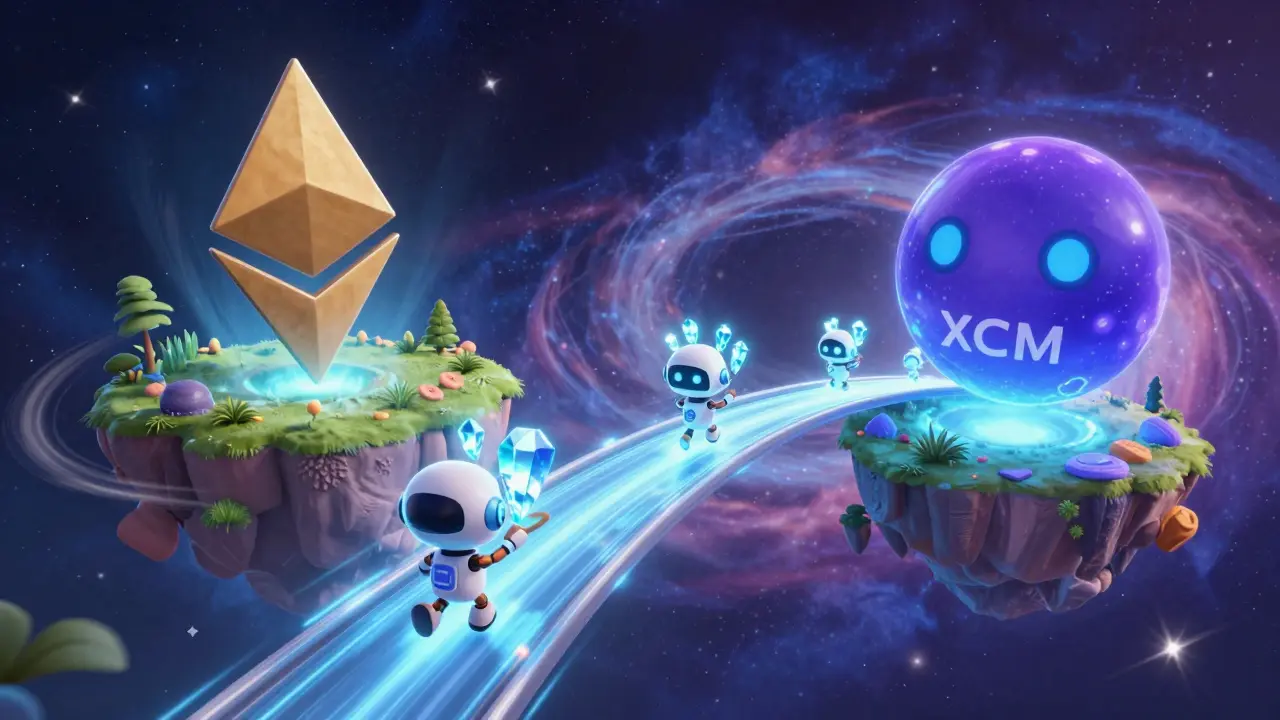
One of the coolest things about the recent version 2.0 update is the integration with XCM (Cross-Consensus Messaging). In plain English: you can swap assets between Ethereum and Polkadot without having to jump through the hoops of a third-party bridge portal. This has caused cross-chain volume to spike by over 200% because it removes the "fear factor" of bridging funds manually.
The Good, The Bad, and The Slippage
Let's be real: no DEX is perfect. Beamswap is fantastic for stablecoin pairs. If you're swapping USDC for another stable asset under $50,000, the slippage is almost invisible (sub-0.1%). But the moment you move into volatile assets or large trades, the cracks show.
Because Beamswap lacks concentrated liquidity, its capital efficiency is about 37% lower than a V3 system. What does that mean for you? If you try to trade $10,000 of a volatile token, you might see a 2.3% slippage. Compare that to 0.8% on a more mature platform, and you're losing money just by clicking "Swap." We saw this happen during the March 2025 Bitcoin volatility event, where about 12.7% of trades over $5,000 simply failed to execute.
On the security side, they've done their homework. The contracts have been audited by CertiK, OpenZeppelin, and Quantstamp. All critical bugs were patched before launch. However, since the platform is permissionless and doesn't charge listing fees, you'll find a lot of junk. Between 2023 and 2024, over 230 scam tokens were listed and later nuked. Always double-check your contract addresses.
Step-by-Step: Getting Your First Swap Done
If you're new to the Moonbeam ecosystem, don't let the "parachain" jargon scare you. Here is the most direct path to making a trade:
- Set up your wallet: Use MetaMask or Polkadot.js. If using MetaMask, you'll need to add the Moonbeam Network (Chain ID 1284).
- Fund your account: You need GLMR (the native Moonbeam token) to pay for gas. Without a tiny bit of GLMR, your transaction will just sit there and fail.
- Bridge assets: Use the Moonbeam Portal to move your funds from Ethereum or Polkadot into the Moonbeam ecosystem.
- Connect: Head to the Beamswap interface and link your wallet.
- Approve: Before you swap, you have to "Approve" the token. This is a separate transaction that tells the smart contract it's okay to move your funds.
- Swap: Enter the amount, check the "Price Impact," and confirm.
- Verify: Use the blockchain explorer to make sure your assets landed where they should.
Pro Tip: If you get a "Price impact too high" warning, don't just ignore it. Adjust your slippage tolerance to between 0.8% and 1.2%. If it's still too high, you're trying to trade too much for a pool that doesn't have enough liquidity. Break your trade into three smaller chunks to get a better average price.
Liquidity Provision: Is it a Good Deal?
Providing liquidity is basically like becoming a mini-bank. You put your tokens into a pool, and in return, you earn a slice of the 0.3% swap fee. 90% of that fee goes to the LPs, and 10% goes to the treasury.
Is it profitable? It depends on the pair. During the late 2024 stability period, some users reported APYs of over 22% in the GLMR-USDC pool. But here's the catch: Impermanent Loss. If one token in your pair moons while the other stays flat, you might have been better off just holding the tokens. Some users on Trustpilot complained about losses exceeding 35% during high volatility. This is the inherent risk of the UniswapV2 model that Beamswap uses.

Future Outlook: The 'Orbit Update' and Beyond
The team knows they are lagging behind the "V3" world. They've announced the "Orbit Update" for late 2025/2026, which aims to introduce a hybrid AMM-CLOB (Central Limit Order Book) architecture. If they pull this off, they'll finally have native limit orders, which would be a massive win for traders who are tired of just "swapping at market price."
They've also started tackling the "sandwich attack" problem. By implementing the SUAVE framework from Flashbots, they've managed to cut MEV (Maximal Extractable Value) attacks by 74%. This means fewer bots front-running your trades and stealing your profit.
Final Verdict: Who is Beamswap For?
Beamswap is for the Moonbeam loyalist. If you are already deep in the Polkadot ecosystem and need a fast, cheap way to move between GLMR, USDC, and other parachain assets, it's your best bet. The XCM integration makes it a breeze compared to the old days of manual bridging.
However, if you are a "whale" moving six figures per trade, the slippage will eat you alive. You'd be better off using a platform with concentrated liquidity or a centralized exchange for those specific moves. It's a solid, reliable tool for the average user, but it's not yet the "Uniswap Killer" it wants to be.
Is Beamswap v3 actually out?
No. Despite the search terms and community rumors, Beamswap currently operates on a version based on the UniswapV2 protocol. It does not have the concentrated liquidity features found in Uniswap V3, although the 'Orbit Update' is planned to address these technical gaps.
What token do I need for gas fees?
You must hold GLMR (Moonbeam) tokens to pay for gas. Every swap, approval, or liquidity addition requires a small amount of GLMR. If your wallet is empty of GLMR, your transactions will fail regardless of how many other tokens you have.
Is it safe to provide liquidity on Beamswap?
From a technical standpoint, yes-the smart contracts have been audited by CertiK, OpenZeppelin, and Quantstamp. However, the financial risk is high due to impermanent loss, which can significantly reduce your gains if the tokens in the pool change in value relative to each other.
Why are my transactions failing during high volatility?
This is usually due to high slippage or a lack of liquidity depth. When prices move rapidly, the "expected price" changes before the transaction is finalized. Try increasing your slippage tolerance to 1.2% or breaking your trade into smaller amounts.
How does GLINT help me?
GLINT is the native utility token. Staking it allows you to get a 0.05% discount on swap fees when providing liquidity. It also gives you governance rights to vote on future protocol upgrades.
Findlay Duncan Lyon
April 24, 2026 AT 22:20XCM integration is a total game changer for the ecosystem.
Mike Word
April 25, 2026 AT 16:26The lack of concentrated liquidity is definitely the biggest bottleneck here. It's interesting that they're sticking to V2 while the rest of the industry moved on years ago. It makes the slippage on larger trades almost predatory if you aren't paying attention to the price impact screen.
Kathleen Bergin
April 26, 2026 AT 00:45Just use the portal it's easy.
Keith Garcia
April 26, 2026 AT 19:12Imagine actually thinking a 0.05% discount is a
Keith Garcia
April 27, 2026 AT 18:45Imagine actually thinking a 0.05% discount is a meaningful incentive for any serious liquidity provider. 🙄 The sheer audacity of calling GLINT a "utility tool" when it's essentially a glorified coupon for a discount that wouldn't cover a cup of coffee is simply quaint. One must possess a truly pedestrian understanding of capital efficiency to be swayed by such paltry crumbs. The architecture is archaic, the incentives are laughable, and the overall user experience is merely a pale imitation of superior protocols. I find the optimistic outlook on the "Orbit Update" to be nothing more than corporate cope to keep the bagholders from fleeing to a chain that actually understands the 2026 market dynamics. 💅✨
Miranda Jamieson
April 28, 2026 AT 04:35If you're losing 35% to impermanent loss, you're an idiot. Basic DeFi 101 is knowing when to exit a pool before the volatility wipes you out. Stop complaining about the protocol and start learning how to actually manage your risk.
Jason M
April 30, 2026 AT 04:04LISTEN UP EVERYONE! 🚀 If you're feeling overwhelmed by the slippage, remember that breaking your trades into smaller chunks is a TOTAL LIFE SAVER! I've seen people lose a fortune by just clicking swap without thinking, but you can absolutely beat the system if you just take a breath and split those orders! You've got this! Let's all grow together in this crazy Moonbeam world! 🌟
Larry Yang
May 1, 2026 AT 21:38The anlysis here is basically fine but the slipage data is probly slightly off from what I saw in my own tests. Honestly it's just another mid-tier dex that'll be forgotton once a real V3 clone launches on the chain. Not even worth the gas to move my funds there tbh.
Greg Reynolds
May 3, 2026 AT 19:34Actually, the claim that Beamswap is the dominant player is a narrow interpretation of the data. Market share in TVL doesn't equate to actual utility or user retention. Most of that liquidity is likely just mercenary capital chasing short-term GLINT rewards, which is a fundamentally unstable foundation for any DEX to build upon.
Sarah Fisher
May 3, 2026 AT 22:00It's interesting to think about the trade-off between simplicity and efficiency. While V3 is technically superior, the ease of use for a casual user in a V2 model has a certain philosophical appeal. It lowers the barrier to entry, even if it costs a bit more in slippage for the larger trades.
Paige Raulerson
May 4, 2026 AT 16:51The UI is so dated it's almost offensive. I don't care if the backend is audited, the frontend feels like it was designed by someone who's never seen a modern app. It's just lazy design all around.
praveen subbiah
May 5, 2026 AT 01:52The Moonbeam network is absolutely incredible and Beamswap is the crowning jewel of our digital finance future! 🇮🇳 I am so proud to see this technology expanding and giving us the freedom to trade without those greedy middle-men! It is truly a revolution in the making!
Guy Bianco
May 5, 2026 AT 09:24Please ensure that all new users remember to keep a reserve of GLMR in their wallets. It is a common mistake to bridge all funds and find oneself unable to execute a transaction due to lack of gas. ☺
Ali Tate
May 6, 2026 AT 23:45who cares about concentrated liqudity when the fees are basically zero man. the v3 hype is just a bunch of nerds fighting over fractions of a penny. just bridge your stuff and swap. its not that deep
Alex Wan
May 7, 2026 AT 03:54I must strongly concur with the notion that the XCM integration is a monumental achievement!! 🎆 It is truly a marvelous time to be involved in the Polkadot ecosystem, and I am absolutely thrilled to assist anyone who might be struggling with their first bridge! Just let me know how I can help you navigate this wonderful journey!! 🌈
Sarah Ingrams
May 8, 2026 AT 16:44glad they have audits cause i dont trust anything without them