
You’ve probably heard that Bitcoin is the king of crypto. But if you’re looking for real growth potential, or just want to explore the wilder side of digital assets, you need an altcoin exchanger. These platforms are your gateway to thousands of cryptocurrencies beyond Bitcoin-think Ethereum, Solana, Cardano, and hundreds of smaller projects.
But here’s the catch: not all exchanges are created equal. Some charge hidden fees that eat your profits. Others have terrible security. And some simply don’t list the coins you actually want to buy. With over 20,000 altcoins out there and a combined market cap exceeding $1.2 trillion as of late 2025, picking the right platform is critical.
In this review, I’ll break down the top contenders for 2026. We’ll look at who offers the deepest selection, who has the lowest fees, and who keeps your money safest. Whether you’re a beginner buying your first ADA or a pro trading DeFi tokens on Kraken, this guide will help you decide where to park your funds.
What Makes an Altcoin Exchanger Different?
A standard crypto exchange might focus heavily on Bitcoin and major pairs like BTC/USD. An altcoin-focused platform, however, prioritizes diversity. They list emerging blockchain projects, decentralized finance (DeFi) tokens, and niche assets that big banks ignore.
The main value proposition here is liquidity and discovery. You need a place where you can actually sell that obscure token without losing half its value to slippage. According to data from CoinGecko in October 2025, the altcoin market now dominates trading volume, representing 68% of total activity across major exchanges. This shift means specialized platforms are more important than ever.
When evaluating these platforms, you should look at three things:
- Asset Selection: How many coins do they support? More isn’t always better, but you need enough variety to find what you want.
- Fee Structure: Are they charging high spreads, hidden withdrawal fees, or excessive trading commissions?
- Security & Compliance: Do they hold funds in cold storage? Are they regulated by bodies like the NYDFS or EU’s MiCA framework?
Top Altcoin Exchanges Reviewed for 2026
Based on extensive research, user feedback from Reddit and Trustpilot, and technical audits from firms like Koinly and Brave New Coin, here are the standout platforms for trading altcoins today.
Kraken: The King of Altcoin Variety
If you want access to the widest range of cryptocurrencies, Kraken is a cryptocurrency exchange founded in 2011 known for its extensive altcoin selection and institutional-grade security is hard to beat. Founded by Jesse Powell, Kraken currently supports over 350 cryptocurrencies. That’s significantly more than most competitors.
Why does this matter? Because serious traders often need to swap between emerging DeFi tokens quickly. On Kraken, you can withdraw SOL and swap it for a new AI-blockchain token without leaving the platform. User u/AltcoinHunter87 on Reddit noted in October 2025 that Kraken’s selection is "unmatched for serious altcoin traders."
Key Attributes:
- Supported Assets: 350+ cryptocurrencies
- Fees: Maker-taker model ranging from 0% to 0.4%. Average trading fee is around 0.16%, which is much lower than industry averages.
- Security: SOC 2 Type 2 certified. 95% of assets are stored in offline, air-gapped cold storage.
- Best For: Traders who prioritize coin selection and low fees over a flashy interface.
The downside? The professional trading view has a learning curve. Expect to spend 3-5 hours familiarizing yourself with the charts and order types before you feel comfortable. But once you do, you have powerful tools at your disposal.
Coinbase: The Beginner-Friendly Giant
Coinbase is the largest U.S.-based cryptocurrency exchange, launched in 2012, known for its ease of use and regulatory compliance remains the go-to for newcomers. If you’ve never bought crypto before, Coinbase’s interface is incredibly intuitive. You can complete your first altcoin purchase in under 15 minutes using their Instant Buy feature.
However, convenience comes at a cost. Coinbase supports 235 cryptocurrencies, which is decent, but their fees are notoriously high. Standard trades can cost up to 3.99% depending on your payment method. One user on Reddit complained about paying $15 in fees on a $100 ADA purchase. Ouch.
Key Attributes:
- Supported Assets: 235 cryptocurrencies
- Fees: 0% to 3.99%. Advanced Trade features offer lower maker-taker fees, but the basic app is expensive.
- Security: 95% cold storage, PGP encryption, and two-factor authentication (2FA).
- Best For: Beginners in the U.S. who want simplicity and don’t mind higher fees.
Note that Coinbase has eliminated phone support, relying on email and chat with response times of 24-48 hours during peak periods. If you need immediate help, this could be frustrating.
Binance: The Global Leader for Volume
For global traders outside the U.S., Binance is the world's largest cryptocurrency exchange by trading volume, offering a vast array of tokens and advanced trading features is still the heavyweight champion. Binance.com supports over 700 cryptocurrencies. That’s an unparalleled catalog.
Binance offers advanced features like futures, margin trading, and decentralized trading via BNB Chain. Their fee structure is highly competitive, ranging from 0% to 0.6%, with discounts if you hold their native BNB token.
Key Attributes:
- Supported Assets: 700+ on Binance.com; 158 on Binance US
- Fees: 0% to 0.6% with volume-based discounts
- Security: Multi-layered security, including SAFU insurance fund
- Best For: Experienced traders seeking maximum variety and low fees globally.
Be aware that Binance US operates separately due to regulatory pressures. Its altcoin selection dropped from 200+ to 158 following SEC enforcement actions in Q3 2025. If you’re in the U.S., you won’t get the full Binance experience.
Crypto.com: Mobile-First Rewards
Crypto.com is a mobile-first cryptocurrency exchange and ecosystem known for its rewards program and user-friendly app stands out for its lifestyle integration. Launched in 2016, it supports 313 cryptocurrencies. Fees range from 0% to 2.99%, depending on whether you hold CRO tokens.
The biggest draw here is the rewards program. Users earn 1-4% cash back in over 50 cryptocurrency options when using their Visa card. One Trustpilot reviewer earned over $50 in XRP rewards from regular purchases in 2025. It’s a great way to dip your toes into altcoins while spending daily.
Key Attributes:
- Supported Assets: 313 cryptocurrencies
- Fees: 0% to 2.99%
- Security: Deposit screening, transaction monitoring, multi-factor auth
- Best For: Mobile users and those who want to earn crypto rewards on everyday spending.

Comparison Table: Which Exchange Fits Your Needs?
| Exchange | Altcoin Count | Trading Fees | Security Rating | Best For |
|---|---|---|---|---|
| Kraken | 350+ | 0% - 0.4% | SOC 2 Type 2 | Deep altcoin selection & low fees |
| Coinbase | 235 | 0% - 3.99% | NYDFS Regulated | Beginners & U.S. residents |
| Binance (Global) | 700+ | 0% - 0.6% | SAFU Fund | Global traders & high volume |
| Crypto.com | 313 | 0% - 2.99% | Multi-layered | Mobile users & rewards |
| Gemini | 73 | 0.5% - 3.49% | SOC 2 Type 2 | Security-conscious investors |
Hidden Costs and Pitfalls to Avoid
It’s not just about the trading fee. When you’re moving altcoins, network congestion can kill your profits. Tokenmetrics reported in October 2025 that altcoin traders experience 15-25% higher effective fees during Ethereum network congestion periods. Always check the gas fees before sending large amounts.
Also, beware of "zero-fee" traps. Robinhood offers free crypto trading, but they only support 25 cryptocurrencies and eliminate crypto-to-crypto trading. As one iOS user noted, "I had to use three different exchanges to access all my altcoins since Robinhood only offers 25." For serious altcoin enthusiasts, this limitation makes Robinhood unsuitable.
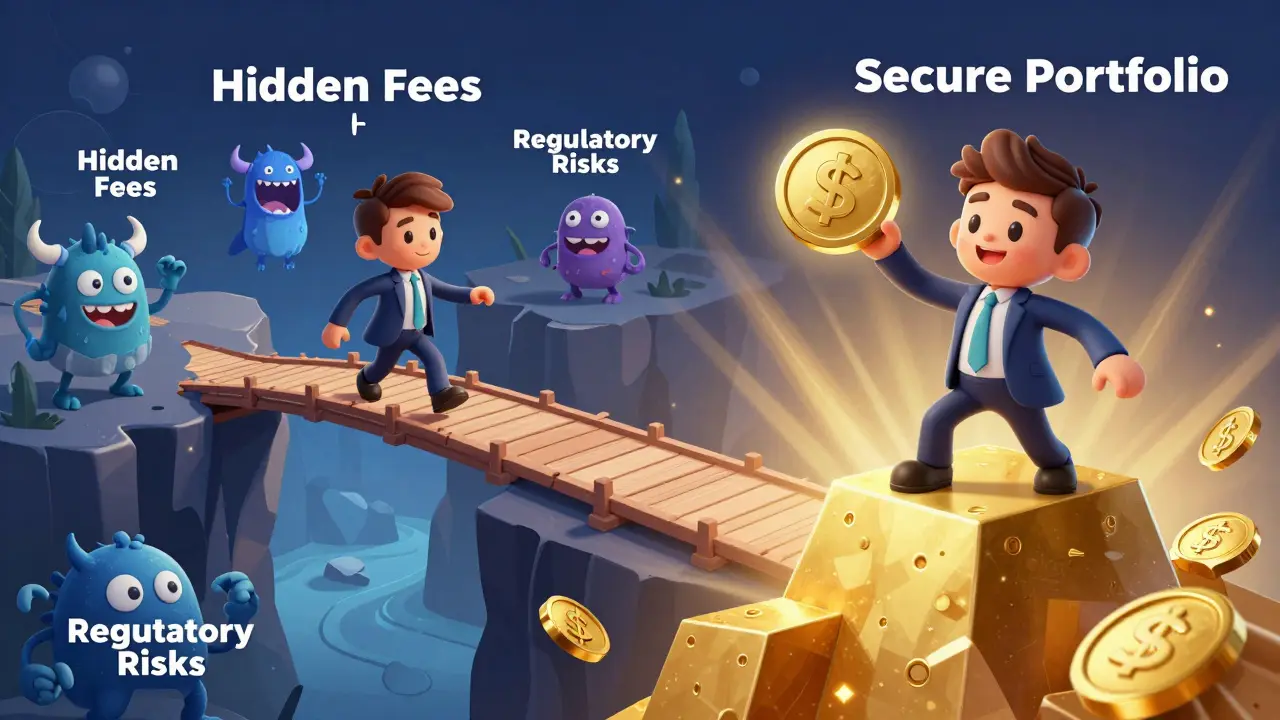
Another pitfall is regulatory risk. The SEC filed enforcement actions against three major exchanges in Q3 2025 for listing unregistered securities. This caused Binance US to reduce its coin list. Always check if an exchange is compliant with local regulations, such as the EU’s MiCA regulation implemented in June 2025.
How to Choose Your Altcoin Exchanger
Your choice depends on your experience level and goals.
- If you’re a beginner: Start with Coinbase. The interface is simple, and you can learn the basics without getting overwhelmed. Just be mindful of the fees.
- If you’re a serious trader: Go with Kraken or Binance. You need the deep liquidity and wide selection to execute complex strategies. Kraken’s 0.16% average fee saves you thousands compared to Coinbase’s 0.5%+ standard fee.
- If you want passive income: Look at Crypto.com. Their staking services for 35 altcoins offer yields between 3.5% and 12.7% annually. Plus, the cash-back rewards are a nice bonus.
- If security is your #1 concern: Gemini or Kraken. Both are SOC 2 Type 2 certified and maintain rigorous cold storage protocols. Gemini’s limited selection (73 coins) is a trade-off for peace of mind.
Many experienced users adopt a hybrid strategy. A popular approach mentioned in 78% of top-voted Reddit comments is: "Use Kraken for deep altcoin selection, Coinbase for easy fiat on-ramp, and Crypto.com for mobile trading and rewards." This diversifies your risk and leverages the strengths of each platform.
Future Outlook: What’s Next for Altcoin Trading?
The landscape is shifting fast. Gartner predicts in November 2025 that 30% of current exchange platforms will merge or cease operations by Q2 2026 due to regulatory pressures. Consolidation is coming.
Platforms that survive will be those with strong compliance, deep liquidity, and integrated DeFi features. Kraken, for instance, announced a "Launchpad" program to integrate 50 new altcoins per month, targeting emerging AI and DeFi projects. Coinbase launched "Advanced Trade" to compete on fees. Crypto.com is expanding its chain integration to blend centralized and decentralized trading.
As an investor, keep an eye on these trends. The exchanges that offer seamless integration between traditional trading and DeFi yield farming will likely gain 15-20% market share by end of 2026.
Which exchange has the most altcoins?
Binance (global) leads with over 700 supported cryptocurrencies. Among U.S.-accessible platforms, Kraken offers the most with 350+ altcoins, making it the best choice for traders seeking variety within regulatory boundaries.
Are altcoin exchanges safe?
Major exchanges like Kraken, Coinbase, and Gemini implement robust security measures, including cold storage for 95% of assets, SOC 2 Type 2 certification, and multi-factor authentication. However, no platform is immune to risk. Always use strong passwords and enable 2FA. Consider withdrawing large holdings to a private hardware wallet for long-term storage.
What are the lowest fees for trading altcoins?
Kraken and Binance offer the lowest trading fees, typically ranging from 0% to 0.4% for makers and up to 0.6% for takers. Coinbase’s standard fees can reach 3.99%, though their Advanced Trade platform offers lower rates for high-volume users. Always check the specific fee schedule for your region and trading volume.
Can I trade altcoins on Robinhood?
Yes, but with significant limitations. Robinhood supports only 25 cryptocurrencies and does not allow crypto-to-crypto trading. You must convert to USD first. This makes it unsuitable for serious altcoin traders who need access to a wider range of tokens and direct swapping capabilities.
Is Kraken available in the United States?
Yes, Kraken is fully available in the U.S. and is known for its strict regulatory compliance. Unlike Binance, which operates a separate U.S. entity with fewer coins, Kraken offers its full suite of services and altcoin selection to American traders, making it a top choice for domestic users.
How do I avoid high network fees when transferring altcoins?
Network fees fluctuate based on blockchain congestion. To minimize costs, transfer altcoins during off-peak hours (typically weekends or late nights UTC). Also, consider using Layer-2 solutions or networks with lower base fees, like Solana or Polygon, when possible. Always check the current gas price estimates before initiating a transfer.
Logan Edmison
July 6, 2026 AT 04:51look i dont know bout all this fancy tech stuff but kraken seems like a solid pick for most peeps. the fees are low and they have lots of coins. just make sure u dont lose ur password cuz then ur screwed lol.
Tuan Nguyen
July 7, 2026 AT 10:15The average retail investor lacks the sophistication to navigate the nuanced liquidity pools of these platforms, rendering their choice of exchange irrelevant in the grand scheme of market manipulation. You are merely picking which cage is slightly less rusted while the architects of the system siphon value through spread arbitrage and hidden slippage metrics that you do not even understand. It is pathetic to see such enthusiasm for centralized intermediaries when the entire premise of decentralized finance was to eliminate exactly these types of gatekeepers. Your 'research' is superficial at best, ignoring the macroeconomic headwinds and regulatory crackdowns that will inevitably render these platforms obsolete or heavily restricted within the next fiscal quarter.
Hazel Fruitman
July 7, 2026 AT 15:42i think its really important that we talk about the ethics of where our money goes. some of these exchanges are involved in shady deals and it makes me feel sick to support them. we should only use platforms that are transparent and fair to everyone. also typos happen so dont judge me for that.
Autumn Story
July 7, 2026 AT 22:20I am so happy to see this guide!! It is really helpful for people who are just starting out! I personally love Coinbase because it is so easy to use! Even though the fees are high, it is worth it for the peace of mind! Please be safe out there!!!
Mark Tuason
July 8, 2026 AT 09:55This is a very well-structured overview of the current landscape. I appreciate the detailed breakdown of fee structures, as transparency is paramount in financial decision-making. For those interested in long-term holding, the security protocols mentioned for Kraken and Gemini seem particularly robust. It might be beneficial to consider a diversified approach across multiple platforms to mitigate single-point-of-failure risks.
Ella Collinson
July 9, 2026 AT 09:31Your analysis of the maker-taker fee models is fundamentally flawed because you fail to account for the microstructural inefficiencies inherent in order book depth during high-volatility regimes. The concept of 'low fees' is a marketing construct designed to obscure the true cost of capital allocation when factoring in slippage on illiquid altcoin pairs. Furthermore, your reliance on static data points from Q3 2025 ignores the dynamic nature of liquidity provision in decentralized versus centralized hybrid environments. You need to run a proper backtest against historical volatility indices before making such sweeping generalizations about platform superiority.
Andrew Schneider
July 9, 2026 AT 10:40Oh wow, another article telling us how to give our money to corporations 🙄 I mean, sure, if you want to play by their rules. But let's be real, the whole crypto thing is just a giant ponzi scheme dressed up in blockchain jargon. Binance? More like Binance-deception 😂 Kraken? Just a snake waiting to bite you. I'm sticking to my mattress under the floorboards. At least the interest rate is guaranteed (it's zero, but hey, no hacks!) 💸🔥
Eric Braddock
July 11, 2026 AT 08:39Don't trust any of this. They are watching you. Every transaction is tracked. The SEC isn't regulating them; they ARE the regulators working with the banks to crush the little guy. The 'security' features are just backdoors for the FBI. Wake up sheeple. The deep state wants your digital currency gone. Use cash. Only cash. Or gold. Buried in the backyard. That's the only freedom left.
Nick G
July 11, 2026 AT 09:15In my experience living between cultures, I have observed that the adoption of cryptocurrency varies significantly depending on local economic stability and trust in traditional banking institutions. While the United States focuses heavily on regulatory compliance and security certifications like SOC 2, other regions may prioritize accessibility and lower entry barriers. It is fascinating to see how different communities interpret the value of decentralization. Perhaps we can learn from each other's approaches to balancing innovation with consumer protection, fostering a more inclusive global financial ecosystem that respects diverse perspectives on monetary sovereignty.
Nick Wengel
July 13, 2026 AT 07:52Good info here. I use binance mostly because it has everything. Simple enough.
Alicia Hull
July 14, 2026 AT 16:11You missed the point entirely. The question is not which exchange has the most coins, but which one provides the most secure environment for institutional-grade trading without compromising on regulatory oversight. Your focus on quantity over quality is disingenuous. I demand answers regarding the specific audit firms used for Kraken's cold storage verification. Until then, this review is insufficient for serious investors.
Johan Otto
July 14, 2026 AT 21:25Boring. All same stuff. Fees fees fees. Where is the fun? 😒
Anuj Kashyap
July 16, 2026 AT 06:01One must contemplate the philosophical implications of trusting algorithms with one's wealth. Is it truly freedom if we are bound by the terms of service of a private entity? 🤔 Yet, here we are, dancing to the tune of the market. Interesting times indeed. 😂
Michelle Walker
July 17, 2026 AT 21:23This is garbage. Everyone knows Robinhood is trash but you didn't even mention the UI lag. And Kraken? Please. Their customer support is non-existent. Stop giving bad advice.
Shay Thomson
July 17, 2026 AT 21:52My heart sinks when I see people arguing about fees instead of community! Let us come together in harmony! Crypto is about connection! 🌈✨
DJ Maleko
July 19, 2026 AT 11:10Why are you guys still using centralized exchanges? Are you stupid? Move to DeFi now. Uniswap, PancakeSwap. No KYC. No rules. Just pure freedom. Also, send me some ETH to my wallet please, I need gas fees to trade. 🙏💸
Erika Pozzetto
July 20, 2026 AT 10:15It is imperative to consider the long-term sustainability of these platforms in light of evolving regulatory frameworks such as MiCA in Europe and various US state-level regulations. The integration of traditional financial services with cryptocurrency ecosystems presents both opportunities and challenges that require careful navigation by investors who seek to preserve capital while participating in emerging markets.
Russ Fincham
July 21, 2026 AT 20:52Look, I've been trading since 2013. Kraken is fine. Binance is fine. Don't overthink it. Just buy and hold. The rest is noise.
Linda Hilliard
July 23, 2026 AT 05:45Typical amateur analysis. You clearly don't understand the nuances of order flow toxicity or the impact of market maker incentives on spread widening during volatile periods. Real traders use API connections and algorithmic strategies, not these basic web interfaces. If you're reading this and thinking about buying ADA on Coinbase, you're already behind. Do better. :)